
Fasting Rules
 Meat
Abstain
 Fish
Abstain
 Dairy
Abstain
 Oil
Allowed
 Wine
Allowed
Saints & Commemorations
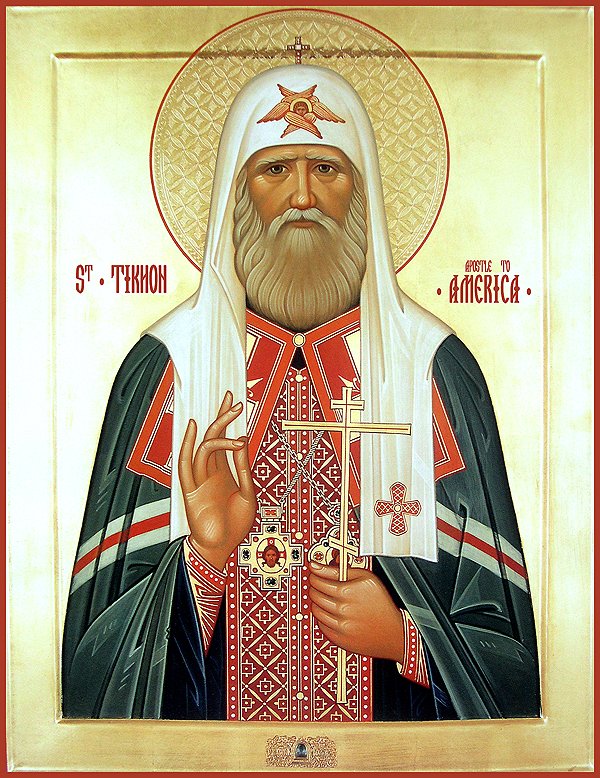
Repose St. Tikhon, Patriarch of Moscow, Enlightener N. America
Saint Tikhon, Patriarch of Moscow and Enlightener to America was born as Vasily Ivanovich Belavin on January 19, 1865 into the family of Ioann Belavin, a rural priest of the Toropetz district of the Pskov diocese. His childhood and adolescence were spent in the village in direct contact with peasants and their labor.
Saint Tikhon, Patriarch of Moscow and Enlightener to America was born as Vasily Ivanovich Belavin on January 19, 1865 into the family of Ioann Belavin, a rural priest of the Toropetz district of the Pskov diocese. His childhood and adolescence were spent in the village in direct contact with peasants and their labor. From his early years he displayed a particular religious disposition, love for the Church as well as rare meekness and humility.
When Vasily was still a boy, his father had a revelation about each of his children. One night, when he and his three sons slept in the hayloft, he suddenly woke up and roused them. He had seen his dead mother in a dream, who foretold to him his imminent death, and the fate of his three sons. She said that one would be unfortunate throughout his entire life, another would die young, while the third, Vasily, would be a great man. The prophecy of the dead woman proved to be entirely accurate in regard to all three brothers.
From 1878 to 1883, Vasily studied at the Pskov Theological Seminary. The modest seminarian was tender and affectionate by nature. He was fair-haired and tall of stature. His fellow students liked and respected him for his piety, brilliant progress in studies, and constant readiness to help comrades, who often turned to him for explanations of lessons, especially for help in drawing up and correcting numerous compositions. Vasily was called “bishop” and “patriarch” by his classmates.
In 1888, at the age of 23, Vasily Belavin graduated from the Saint Petersburg Theological Academy as a layman, and returned to the Pskov Seminary as an instructor of Moral and Dogmatic Theology. The whole seminary and the town of Pskov became very fond of him. He led an austere and chaste life, and in 1891, when he turned 26, he took monastic vows. Nearly the whole town gathered for the ceremony. He embarked on this new way of life consciously and deliberately, desiring to dedicate himself entirely to the service of the Church. The meek and humble young man was given the name Tikhon in honor of Saint Tikhon of Zadonsk.
He was transferred from the Pskov Seminary to the Kholm Theological Seminary in 1892, and was raised to the rank of archimandrite. Archimandrite Tikhon was consecrated Bishop of Lublin on October 19, 1897, and returned to Kholm for a year as Vicar Bishop of the Kholm Diocese. Bishop Tikhon zealously devoted his energy to the establishment of the new vicariate. His attractive moral make-up won the general affection, of not only the Russian population, but also of the Lithuanians and Poles. On September 14, 1898, Bishop Tikhon was made Bishop of the Aleutians and Alaska. As head of the Orthodox Church in America, Bishop Tikhon was a zealous laborer in the Lord’s vineyard.
He did much to promote the spread of Orthodoxy, and to improve his vast diocese. He reorganized the diocesan structure, and changed its name from “Diocese of the Aleutians and Alaska” to “Diocese of the Aleutians and North America” in 1900. Both clergy and laity loved their archpastor, and held him in such esteem that the Americans made Archbishop Tikhon an honorary citizen of the United States.
On May 22, 1901, he blessed the cornerstone for Saint Nicholas Cathedral in New York, and was also involved in establishing other churches. On November 9, 1902, he consecrated the church of Saint Nicholas in Brooklyn for the Syrian Orthodox immigrants. Two weeks later, he consecrated Saint Nicholas Cathedral in NY.
In 1905, the American Mission was made an Archdiocese, and Saint Tikhon was elevated to the rank of Archbishop. He had two vicar bishops: Bishop Innocent (Pustynsky) in Alaska, and Saint Raphael (Hawaweeny) in Brooklyn to assist him in administering his large, ethnically diverse diocese. In June of 1905, Saint Tikhon gave his blessing for the establishment of Saint Tikhon’s Monastery.
In 1907, he returned to Russia, and was appointed to Yaroslavl, where he quickly won the affection of his flock. They came to love him as a friendly, communicative, and wise archpastor. He spoke simply to his subordinates, never resorting to a peremptory or overbearing tone. When he had to reprimand someone, he did so in a good-natured, sometimes joking manner, which encouraged the person to correct his mistakes.
When Saint Tikhon was transferred to Lithuania on December 22, 1913, the people of Yaroslavl voted him an honorary citizen of their town. After his transfer to Vilnius, he did much in terms of material support for various charitable institutions. There too, his generous soul and love of people clearly manifested themselves. World War I broke out when His Eminence was in Vilnius. He spared no effort to help the poor residents of the Vilnius region who were left without a roof over their heads or means of subsistence as a result of the war with the Germans, and who flocked to their archpastor in droves.
After the February Revolution and formation of a new Synod, Saint Tikhon became one of its members. On June 21, 1917, the Moscow Diocesan Congress of clergy and laity elected him as their ruling bishop. He was a zealous and educated archpastor, widely known even outside his country.
On August 15, 1917, a local council was opened in Moscow, and Archbishop Tikhon was raised to the dignity of Metropolitan, and then elected as chairman of the council. The council had as its aim to restore the life of Russian Orthodox Church on strictly canonical principles, and its primary concern was the restoration of the Patriarchate. All council members would select three candidates, and then a lot would reveal the will of God. The council members chose three candidates: Archbishop Anthony of Kharkov, the wisest, Archbishop Arseny of Novgorod, the strictest, and Metropolitan Tikhon of Moscow, the kindest of the Russian hierarchs.
On November 5, following the Divine Liturgy and a Molieben in the Cathedral of Christ the Savior, a monk removed one of the three ballots from the ballot box, which stood before the Vladimir Icon of the Mother of God. Metropolitan Vladimir of Kiev announced Metropolitan Tikhon as the newly elected Patriarch. Saint Tikhon did not change after becoming the primate of the Russian Orthodox Church. In accepting the will of the council, Patriarch Tikhon referred to the scroll that the Prophet Ezekiel had to eat, on which was written, “Lamentations, mourning, and woe.” He foresaw that his ministry would be filled with affliction and tears, but through all his suffering, he remained the same accessible, unassuming, and kindly person.
All who met Saint Tikhon were surprised by his accessibility, simplicity and modesty. His gentle disposition did not prevent him from showing firmness in Church matters, however, particularly when he had to defend the Church from her enemies. He bore a very heavy cross. He had to administer and direct the Church amidst wholesale church disorganization, without auxiliary administrative bodies, in conditions of internal schisms and upheavals by various adherents of the Living Church, renovationists, and autocephalists.
The situation was complicated by external circumstances: the change of the political system, by the accession to power of the godless regime, by hunger, and civil war. This was a time when Church property was being confiscated, when clergy were subjected to court trials and persecutions, and Christ’s Church endured repression. News of this came to the Patriarch from all ends of Russia. His exceptionally high moral and religious authority helped him to unite the scattered and enfeebled flock. At a crucial time for the church, his unblemished name was a bright beacon pointing the way to the truth of Orthodoxy. In his messages, he called on people to fulfill the commandments of Christ, and to attain spiritual rebirth through repentance. His irreproachable life was an example to all.
In order to save thousands of lives and to improve the general position of the church, the Patriarch took measures to prevent clergy from making purely political statements. On September 25, 1919, when the civil war was at its height, he issued a message to the clergy urging them to stay away from political struggle.
The summer of 1921 brought a severe famine to the Volga region. In August, Patriarch Tikhon issued a message to the Russian people and to the people of the world, calling them to help famine victims. He gave his blessing for voluntary donations of church valuables, which were not directly used in liturgical services. However, on February 23, 1922, the All-Russian Central Executive Committee published a decree making all valuables subject to confiscation.
According to the 73rd Apostolic Canon, such actions were regarded as sacrilege, and the Patriarch could not approve such total confiscation, especially since many doubted that the valuables would be used to combat famine. This forcible confiscation aroused popular indignation everywhere. Nearly two thousand trials were staged all over Russia, and more than ten thousand believers were shot. The Patriarch’s message was viewed as sabotage, for which he was imprisoned from April 1922 until June 1923.
His Holiness, Patriarch Tikhon did much on behalf of the Russian Orthodox Church during the crucial time of the so-called Renovationist schism. He showed himself to be a faithful servant and custodian of the undistorted precepts of the true Orthodox Church. He was the living embodiment of Orthodoxy, which was unconsciously recognized even by enemies of the church, who called its members “Tikhonites.”
When Renovationist priests and hierarchs repented and returned to the church, they were met with tenderness and love by Saint Tikhon. This, however, did not represent any deviation from his strictly Orthodox policy. “I ask you to believe me that I will not come to agreement or make concessions which could lead to the loss of the purity and strength of Orthodoxy,” the Patriarch said in 1924.
Being a good pastor, who devoted himself entirely to the church’s cause, he called upon the clergy to do the same: “Devote all your energy to preaching the word of God and the truth of Christ, especially today, when unbelief and atheism are audaciously attacking the Church of Christ. May the God of peace and love be with all of you!”
It was extremely painful and hard for the Patriarch’s loving, responsive heart to endure all the Church’s misfortunes. Upheavals in and outside the church, the Renovationist schism, his primatial labors, his concern for the organization and tranquility of Church life, sleepless nights and heavy thoughts, his confinement that lasted more than a year, the spiteful and wicked baiting of his enemies, and the unrelenting criticism sometimes even from the Orthodox, combined to undermine his strength and health.
In 1924, Patriarch Tikhon began to feel unwell. He checked into a hospital, but would leave it on Sundays and Feast Days in order to conduct services. On Sunday, April 5, 1925, he served his last Liturgy, and died two days later. On March 25/April 7, 1925 the Patriarch received Metropolitan Peter and had a long talk with him. In the evening, the Patriarch slept a little, then he woke up and asked what time it was. When he was told it was 11:45 P.M., he made the Sign of the Cross twice and said, “Glory to Thee, O Lord, glory to Thee.” He did not have time to cross himself a third time.
Almost a million people came to say farewell to the Patriarch. The large cathedral of the Donskoy Monastery in Moscow could not contain the crowd, which overflowed the monastery property into the square and adjacent streets. Saint Tikhon, the eleventh Patriarch of Moscow, was primate of the Russian Church for seven and a half years.
It would be difficult to imagine the Russian Orthodox Church without Patriarch Tikhon during those years. He did so much for the Church and for the strengthening of the Faith itself during those difficult years of trial. Perhaps his own words best sum up his life: “May God teach every one of us to strive for His truth, and for the good of the Holy Church, rather than something for our own sake.”
Saint Tikhon is also commemorated on September 26 / October 9 (the day of his glorification); October 5/18 (Synaxis of Moscow Saints); November 5/18 (his election to the Patriarchal throne); January 25 / February 7 (Synaxis of the New Martyrs and Confessors of Russia, if it is a Sunday, if not, then on the nearest Sunday to January 27; February 9/22 (the Discovery of his relics).
Troparion - Tone 1
Let us praise Tikhon, the patriarch of all Russia, / and enlightener of North America / an ardent follower of the Apostolic traditions, / and good pastor of the Church of Christ. / Who was elected by divine providence, / and laid down his life for his sheep. / Let us sing to him with faith and hope, / and ask for his hierarchical intercessions: / Keep the church in Russia in tranquility, / and the church in North America in peace. / Gather her scattered children into one flock, / bring to repentance those who have renounced the True Faith, / preserve our lands from civil strife, / and entreat God’s peace for all people!
Kontakion - Tone 3
Today the assembly of New Martyrs / stands together with us in the Church / and together we raise a festive song / celebrating the uncovering of the relics of our Hierarch Father Tikhon / who defeated the enemy and preserved the Faith / While protecting the flock entrusted to him. / For he ever prays for us all / that we may never be deprived of the Love of God.
Holy Martyr Calliopius, with his mother Theoclea (304)
Calliopius was the only son of a senator from Pamphylia and his wife Theoclea, who had long prayed to God for a child. The devout Theoclea reared her son in purity of life and love for God from infancy. When persecution of Christians broke out under Maximian, Theoclea put Calliopius aboard a ship bound for Pompeiopolis to save him from the persecutors.
Calliopius was the only son of a senator from Pamphylia and his wife Theoclea, who had long prayed to God for a child. The devout Theoclea reared her son in purity of life and love for God from infancy. When persecution of Christians broke out under Maximian, Theoclea put Calliopius aboard a ship bound for Pompeiopolis to save him from the persecutors. But Calliopius, as soon as he disembarked, encountered a pagan festival, where he was arrested when he refused to make sacrifice to the idols. Brought before the governor Maximus, he freely confessed that he was a Christian. For this he was cruelly tortured and thrown into prison. His mother, hearing of his torments, sold her goods and hurried to comfort him and encourage him in his martyrdom.
Calliopius was sentenced to death by crucifixion, as it happened on Holy Thursday; but the holy Theoclea bribed the officials to postpone the execution by one day, so that her son might imitate the Lord’s Crucifixion on the day that He endured it; she also prevailed upon the torturers to crucify Calliopius upside-down (like St Peter) in humility toward the Lord. When her son’s lifeless body was taken down from the cross, Theoclea cast herself upon it and died.
St Justin (Popovic) of Chelije in Serbia (1979) (March 25 OC)
He was born on the Feast of the Annunciation 1894, in Vranje, South Serbia, to a family whose seven previous generations had been headed by priests (Popovich means ‘family or son of a priest’ in Serbian). He began reading the scriptures at a young age, and as an adult carried a New Testament with him, reading three chapters every day. He
He was born on the Feast of the Annunciation 1894, in Vranje, South Serbia, to a family whose seven previous generations had been headed by priests (Popovich means ‘family or son of a priest’ in Serbian). He began reading the scriptures at a young age, and as an adult carried a New Testament with him, reading three chapters every day. He studied at the Seminary of St Sava in Belgrade while St Nikolai Velimirovic (March 18) was on the faculty. In 1914, Blagoje (as he was called before his tonsure) completed the nine-year seminary program. He desired to become a monk, but postponed entry into the monastic ranks due to the outbreak of war and the poor health of his parents. He spent the war caring for his parents and serving as a student nurse.
In 1915 he was tonsured a monk under the name Justin, after St Justin the Philosopher. Shortly thereafter he traveled to Petrograd to study at the seminary; there he acquired a deep, first-hand knowledge of the Russian ascetical tradition and a lifelong love of Russian spirituality, especially that of the common people. He then attended Oxford University from 1916 to 1919, writing a doctoral dissertation which was rejected. After a brief return to Belgrade, he entered the Greek Orthodox School of Theology in Athens. As in Russia, he used his time there not merely to study but to drink in the Orthodox spirituality of the Greek people. He was ordained to the diaconate while in Greece, then to the priesthood after returning to Belgrade in 1922. He wept ‘as a newborn babe’ throughout his ordination service. One of his first labors as a priest was to translate the Divine Liturgy into modern Serbian. During this period he came to know Metropolitan Anthony Khrapovitsky (later first hierarch of the Russian Orthodox Church abroad) and St John Maximovich, both of whom were living in Serbia as exiles from the Russian Revolution.
Father Justin’s preaching, writing and spiritual counsel became known throughout his country. In 1931 he was sent to Czechoslovakia to help in reorganizing the Church there (then under the jurisdiction of the Serbian Church), which was greatly tried and weakened by Uniatism. Realizing the people’s crying need a clear exposition of the Faith in their own language, he began in 1932 his three-volume Dogmas of the Orthodox Church. The first volume was so well-received that Fr Justin was made Professor of Dogmatics at the Seminary of St Sava, where he remained, completing the Dogmas and several other books, until the end of World War II. The new atheistic Communist regime then banned him from the university system, and Fr Justin lived from that time on in various Serbian monasteries.
In 1948 he entered Chelije Monastery, where he remained until his repose in 1979. He became Archimandrite and spiritual head of the Monastery. It was during this period that he emerged as a great light of Orthodoxy: pious believers from all parts of Yugoslavia, from Greece, and from all over the world traveled to Chelije to hear the holy Justin’s preaching and seek his counsel.
Saint Justin reposed in peace in 1979 at the age of 85, on the Feast of the Annunciation — the date of his birth. Since his repose, many miracles have been witnessed at his grave: healings, flashes of unearthly light from his tomb, and conversions of unbelievers by his prayers. His many writings are increasingly recognized as a fount of pure Orthodox teaching in the midst of our dark time.
Note: St Justin is commemorated on the anniversary of his repose, so his commemoration only coincides with the Feast of the Annunciation on the Old Calendar.
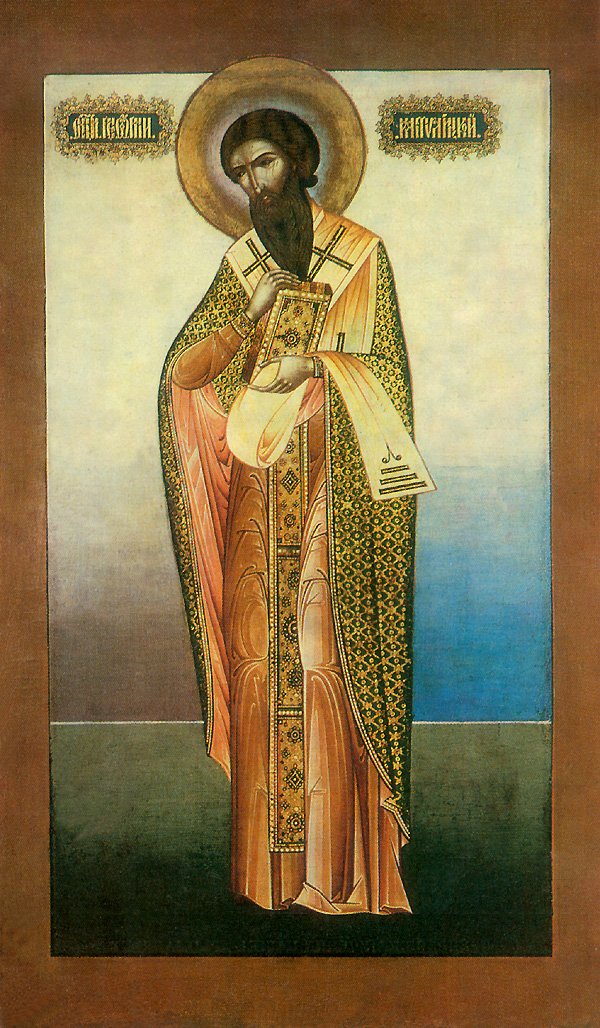
St George the Confessor, bishop of Mitylene (ca. 820)
Saint George, Metropolitan of Mytilene, from his youth led a monastic life, and was especially accomplished in the virtue of humility. In the reign of Leo the Isaurian (716-741) the saint underwent persecution from the iconoclasts and became a Confessor.
During the reign of the emperor Constantine Porphyrogenitos (780-797) Saint George was elevated to the archbishopal cathedra of the city of Mytilene on the island of Lesbos.
Saint George, Metropolitan of Mytilene, from his youth led a monastic life, and was especially accomplished in the virtue of humility. In the reign of Leo the Isaurian (716-741) the saint underwent persecution from the iconoclasts and became a Confessor.
During the reign of the emperor Constantine Porphyrogenitos (780-797) Saint George was elevated to the archbishopal cathedra of the city of Mytilene on the island of Lesbos. His life was radiant with prudence and purity and resembled the life of angels. He possessed a gift of wonderworking, cast out unclean spirits and healed incurable diseases. The saint distinguished himself by his compassion, and he helped all the needy. In 815, during the reign of the iconoclast Leo the Armenian (813-820), the holy archpastor was banished and sent to Cherson, where he died after the year 820.
At the hour of his death a bright star shone in the heavens over the city of Mytilene.
Troparion - Tone 3
Like a meadow planted by God / you were fruitful with the grace of the Spirit, / O holy Archpastor of the Mysteries. / You cultivated the souls of the faithful / refreshing them with living water. / O righteous Father George, / pray Christ our God to grant us great mercy!
Kontakion - Tone 4
You shone on the world like the sun, O holy and righteous George, / inspired initiate of the holy Faith, / enlightening your disciples!
St Nilus (Nil Sorsky), abbot of Sora (1508)
St Nilus established the monastic skete (a community of monks living separately like hermits, but sharing some common life) in Russia. He took one side of a religious controversy that troubled the Russian Church’s life for many years. St Nilus and his disciples claimed that prayer and ascetic struggle are the whole purpose of monastic life, and opposed monastic ownership of property, or involvement in works such as almshouses, hospitals, and orphanages. J
St Nilus established the monastic skete (a community of monks living separately like hermits, but sharing some common life) in Russia. He took one side of a religious controversy that troubled the Russian Church’s life for many years. St Nilus and his disciples claimed that prayer and ascetic struggle are the whole purpose of monastic life, and opposed monastic ownership of property, or involvement in works such as almshouses, hospitals, and orphanages. Joseph, abbot of Volokalamsk, took up the argument on the other side, insisting that the Church and its monks should be involved in good works (and have the means to do those works) as well as in prayer. The two groups became known as the “Possessors” (Joseph’s side) and the “Non-Possessors” (Nilus’ side). Each group had reason to be troubled by the other’s extremes: Monasteries owned huge amounts of land, kept serfs, and were subject to corruption by involvement in finance; at the same time, the Church formed most of the ‘welfare’ system of Russia, and the Non-possessors did not suggest how the poor were to be tended, or orphans cared for, without the monasteries’ charity. Many of the Non-possessors tended toward a non-Russian and almost un-Orthodox puritanism, condemning beautiful churches and icons as diversions from true spirituality.
The Possessors (not surprisingly) were favored by the Tsarist government, and eventually won out. The artificial division of the Church into mystical and practical ‘parties,’ and the victory of one of the parties, led to a period of stagnation in the Russian church that was only corrected two hundred years later, when a great renewal of religious life, characterized by such holy Fathers as St Paisios Velichkovsky and St Seraphim of Sarov, restored the fullness and balance of Orthodox life to the Russian church.
An indication of the fullness of Orthodoxy: the Church has glorified not only St Nilus but his opponent St Joseph of Volokalamsk, who is commemorated on Sept. 9.
Saint Savvas the New of Kalymnos (1948) (March 25 OC)
He was born in Thrace to a poor family. Early in life he desired to become a monk and, failing to get his parents’ consent, left secretly for Mt Athos. After several years there, he traveled to Palestine, where he entered the Monastery of St George the Chozebite. In 1903 he was ordained to the priesthood. F
He was born in Thrace to a poor family. Early in life he desired to become a monk and, failing to get his parents’ consent, left secretly for Mt Athos. After several years there, he traveled to Palestine, where he entered the Monastery of St George the Chozebite. In 1903 he was ordained to the priesthood. From 1907–1916 he lived in severe asceticism as a hermit on the banks of the Jordan. After living in several monasteries in Greece, he served with St Nektarios of Aegina for the last year of the Saint’s life (he reposed in 1920). After six more years on Aegina, Fr Savvas moved to the island of Kalymnos, where he spent the remainder of his life. He lived in quietness and asceticism, acquiring a reputation throughout the island as a confessor and spiritual father. He slept only a few hours each night, and gave away any money that came to him the same day, since he believed that it was wrong for a monk to have money in his cell after nightfall.
Saint Savvas reposed on the Old Calendar feast of the Annunciation in 1948. Innumerable miracles and healings have been wrought through his intercession. A striking example occurred in 1957: A group of young islanders were talking about the Saint, and one of them, who doubted his sanctity, said ‘If this lamp breaks I’ll believe.’ At that moment the lamp shattered spontaneously.
The following account is from Mother Nectaria McLees’ Evlogeite! A pilgrim’s guide to Greece: ‘His last words of counsel to his nuns were, “…love… is the bond of perfection,” and to the abbess he said, “Love, love, love (Agapa, agapa, agapa).” Then he clapped his hands six times, saying “The Lord, the Lord, the Lord…”
‘In 1957 his relics were uncovered in the presence of Metropolitan Isidoros of Kalymnos, who described them as “the bones being perfectly joined, and the vestments intact.” When the sepulchre was opened a divine and otherworldly fragrance covered the area, even to the outskirts of town far below. In 1961, an iconographer of the Skete of Kapsokalyvia on Mount Athos painted an icon of St. Savvas at Abbess Philothei’s request. The icon arrived by ferry, and as it was being transferred from the post office to the customs house where the nuns would pick it up, the convent bell began ringing by itself and continued until the icon was brought to the monastery.’
Scripture Readings
☩Epistle
Hebrews 7:26-8:2
26
For such an high priest became us, who is holy, harmless, undefiled, separate from sinners, and made higher than the heavens;
27
Who needeth not daily, as those high priests, to offer up sacrifice, first for his own sins, and then for the people’s: for this he did once, when he offered up himself.
28
For the law maketh men high priests which have infirmity; but the word of the oath, which was since the law, maketh the Son, who is consecrated for evermore.
1
Now of the things which we have spoken this is the sum: We have such an high priest, who is set on the right hand of the throne of the Majesty in the heavens;
2
A minister of the sanctuary, and of the true tabernacle, which the Lord pitched, and not man.
☩Gospel
John 10:9-16
9
I am the door: by me if any man enter in, he shall be saved, and shall go in and out, and find pasture.
10
The thief cometh not, but for to steal, and to kill, and to destroy: I am come that they might have life, and that they might have it more abundantly.
11
I am the good shepherd: the good shepherd giveth his life for the sheep.
12
But he that is an hireling, and not the shepherd, whose own the sheep are not, seeth the wolf coming, and leaveth the sheep, and fleeth: and the wolf catcheth them, and scattereth the sheep.
13
The hireling fleeth, because he is an hireling, and careth not for the sheep.
14
I am the good shepherd, and know my sheep, and am known of mine.
15
As the Father knoweth me, even so know I the Father: and I lay down my life for the sheep.
16
And other sheep I have, which are not of this fold: them also I must bring, and they shall hear my voice; and there shall be one fold, and one shepherd.
Notes
["Presanctified Liturgy"]
Liturgical data sourced from OCA.org and orthocal.info