
Today

Fasting Rules

Meat not allowed Meat Abstain
Fish not allowed Fish Abstain
Dairy not allowed Dairy Abstain
Oil not allowed Oil Abstain
Wine not allowed Wine Abstain

☦ Saints & Commemorations

Apostles of the Seventy Herodion, Agabus, Asyncritus, Rufuf, Phlegon, Hermes
All of these are numbered among the Seventy, and all are mentioned in the Epistles of St Paul. Herodion was a kinsmen of St Paul: ‘Salute Herodion my kinsman’ (Romans 16:11). After many sufferings for the Gospel, he worked with the Apostle Peter in Rome, and was beheaded with him. Agabus was granted a spirit of prophecy: two of his prophecies are important in the Acts of the Apostles (Acts 11:28, 21:11). Ruf All of these are numbered among the Seventy, and all are mentioned in the Epistles of St Paul. Herodion was a kinsmen of St Paul: ‘Salute Herodion my kinsman’ (Romans 16:11). After many sufferings for the Gospel, he worked with the Apostle Peter in Rome, and was beheaded with him. Agabus was granted a spirit of prophecy: two of his prophecies are important in the Acts of the Apostles (Acts 11:28, 21:11). Rufus was Bishop of Thebes. ‘Salute Rufus, chosen in the Lord’ (Romans 16:13). Asyncritus (Romans 16:14) was Bishop of Hyrcania in Asia. Phlegon, (Romans 16:14) was Bishop of Marathon in Thrace. Hermas (Romans 16:14) was a bishop in Dalmatia.
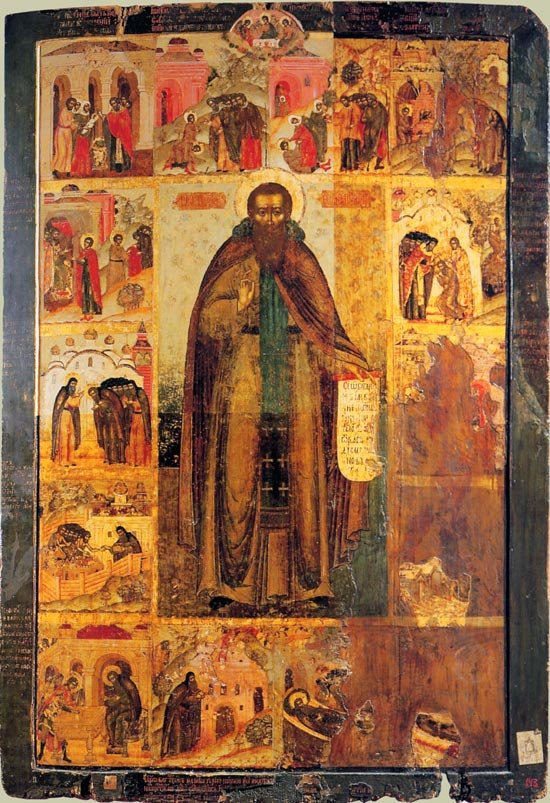
Rufus the Obedient of the Kiev Caves

Rufus the Obedient of the Kiev Caves

Saint Rufus the Obedient, Hermit of the Caves, lived at the Kiev Caves monastery during the fourteenth century. He was distinguished for his obedience and glorified as a lover of labor and fasting. He was buried in the Far Caves. He is celebrated a second time on August 28, the Synaxis of the Fathers of the Far Caves.

Troparion - Tone 8

By a flood of tears you made the desert fertile, / and your longing for God brought forth fruits in abundance. / By the radiance of miracles you illumined the whole universe! / O our holy father Rufus, pray to Christ our God to save our souls!
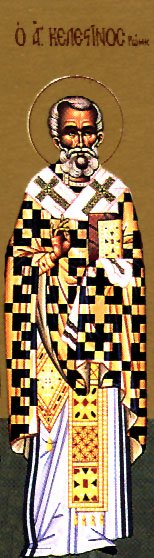
Saint Celestine, Pope of Rome (432)

Saint Celestine, Pope of Rome (432)

Saint Celestine, Pope of Rome (422-432), a zealous champion of Orthodoxy, lived during the reign of the holy Emperor Theodosius the Younger (408-450). He received an excellent education, and he knew philosophy well, but most of all he studied the Holy Scripture and pondered over theological questions. Saint Celestine, Pope of Rome (422-432), a zealous champion of Orthodoxy, lived during the reign of the holy Emperor Theodosius the Younger (408-450). He received an excellent education, and he knew philosophy well, but most of all he studied the Holy Scripture and pondered over theological questions. The virtuous life of the saint and his authority as a theologian won him the general esteem and love of the clergy and people. After the death of Saint Boniface (418-422), Saint Celestine was chosen to be the Bishop of Rome. During this time, the heresy of Nestorius emerged. At a local Council in Rome in 430, Saint Celestine denounced this heresy and condemned Nestorius as a heretic. After the Council, Saint Celestine wrote a letter to Saint Cyril, Archbishop of Alexandria (January 18), stating that if Nestorius did not renounce his false teachings after ten days, then he should be deposed and excommunicated. Saint Celestine also sent a series of letters to the churches in Constantinople and Antioch, in which he unmasked and denounced the Nestorian heresy. For two years after the Council, Saint Celestine proclaimed the true teaching about Christ the God-Man, and he died in peace on April 6, 432.

Troparion - Tone 4

In truth you were revealed to your flock as a rule of faith, / an image of humility and a teacher of abstinence; / your humility exalted you; / your poverty enriched you. / Hierarch Father Celestine, / entreat Christ our God / that our souls may be saved.

Scripture Readings

View scripture readings for this date on OCA.org.

View readings on OCA.org

Liturgical data sourced from OCA.org and orthocal.info