
Fasting Rules
 Meat
Allowed
 Fish
Allowed
 Dairy
Allowed
 Oil
Allowed
 Wine
Allowed
Saints & Commemorations
The Life-Giving Spring of the Most-holy Theotokos
St Alexis Toth of Wilkes-Barre, Pennsylvania (1909) (April 24 OC)
This light of Orthodoxy in North America was born in Austro-Hungary in 1854, to poor Carpatho-Russian parents. His father was a priest in the Eastern-rite Roman Catholic church and, following in his father’s footsteps, he was ordained in 1878. In 1889 he was appointed to serve as pastor to a Uniate parish in Minneapolis, Minnesota. P
This light of Orthodoxy in North America was born in Austro-Hungary in 1854, to poor Carpatho-Russian parents. His father was a priest in the Eastern-rite Roman Catholic church and, following in his father’s footsteps, he was ordained in 1878. In 1889 he was appointed to serve as pastor to a Uniate parish in Minneapolis, Minnesota. Prompted partly by the strong hostility of the American Roman Catholic hierarchy at that time to Eastern-rite practices, he convened a meeting of about ten Eastern-rite priests in Wilkes-Barre Pennsylvania, where the divinely-led decision was made to seek to return to the Orthodox faith. Fr Alexis contacted Bishop Vladimir of the Russian church in San Francisco, who, in 1891, received Fr Alexis and 361 of his parishioners back into the faith of their ancestors.
From that time forward, Fr Alexis worked tirelessly, at great personal sacrifice, to proclaim the truths of the Orthodox faith, especially to those still attached to its mimic, Byzantine Catholicism. For long periods of time he received little or no salary and (despite claims that he had embraced Orthodoxy to enrich himself) worked in a bakery to support himself. Through his work, thousands of Christians in North America were led into the fullness of the Orthodox Faith during his lifetime.
St Alexis reposed in 1909. He was officially glorified in 1994. His holy relics can be venerated at St Tikhon’s Monastery in South Canaan, Pennsylvania.
St Alexis Toth, Confessor and Defender of Orthodoxy in America
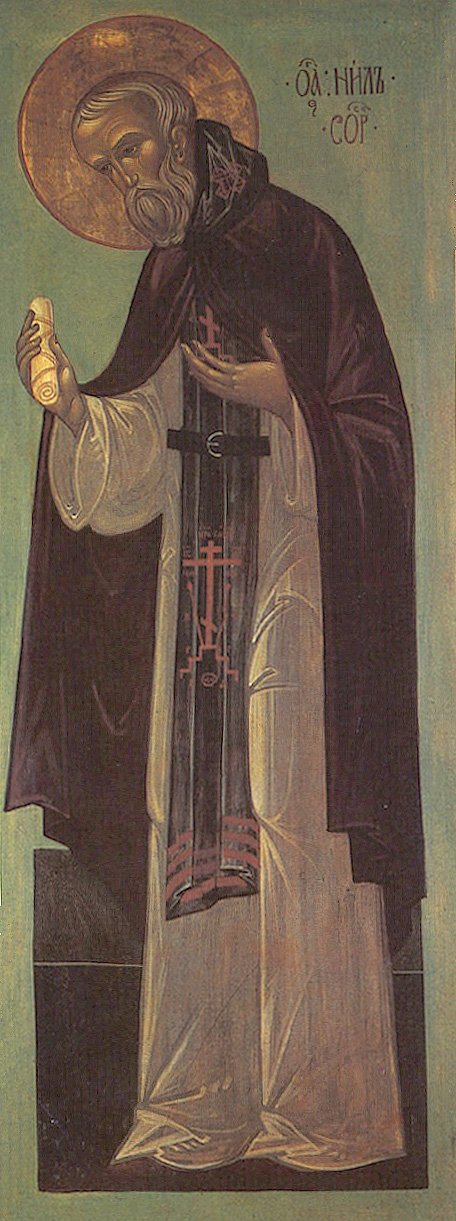
Repose of St. Nilus, abbot of Sora
Saint Nilus of Sora, a great ascetic of the Russian Church, was descended from the Maikov nobility. He accepted monasticism at the monastery of Saint Cyril of White Lake (June 9). Here he made use of the counsels of the pious Elder Paisius Yaroslavov, who was afterwards igumen of the Trinity-Sergiev Lavra.
Saint Nilus of Sora, a great ascetic of the Russian Church, was descended from the Maikov nobility. He accepted monasticism at the monastery of Saint Cyril of White Lake (June 9). Here he made use of the counsels of the pious Elder Paisius Yaroslavov, who was afterwards igumen of the Trinity-Sergiev Lavra.
Saint Nilus journeyed much through the East, studying the monastic life in Palestine and on Mt. Athos. Returning to Rus, he withdrew to the River Sora in the Vologda lands, and built a cell and a chapel, where there soon grew up a monastery with a new (for that time in Rus) skete Rule adopted by Saint Nilus from Mt. Athos. Following the command of Saint Nilus, the monks had to sustain themselves by the work of their own hands, to accept charity only in extreme need, and to shun the love of things and splendor even in church. Women were not permitted in the skete, monks was not allowed to leave the skete under any pretext, and the possession of lands or estates was forbidden.
The monks lived in the forest around the small church in honor of the Meeting of the Lord, in separate cells of one or two but not more than three men. They gathered together in church for divine services. Moreover, readings from the holy Fathers were prescribed at the All-Night Vigil, which actually lasted the whole night. On other days, each one prayed and worked in his own cell.
The saint struggled constantly with his own thoughts and passions. Then peace would be born in his soul, clarity in his mind, contrition and love in his heart. In his written works, “A Tradition for my Disciple, Wishing to Live in the Wilderness,” and the “Rule,” Saint Nilus describes the steps of this salvific mental activity in detail. The first step is renunciation of the world, particularly, from every worldly distraction. The second is unceasing prayer, accompanied by the remembrance of death.
The saint was distinguished for his non-possessiveness and love for work. He dug a pond and a well, whose water had healing power. For his sanctity of life the Elder Nilus was deeply venerated by the Russian hierarchs of his time. He participated in the Councils of 1490 and 1503. Disdaining the honors and glories of this world, he told his disciples before his death either to throw his body to be eaten by beasts and birds, or to bury it without honor at the place of his struggles.
The saint died in his seventy-sixth year of life, on May 7, 1508. His relics, buried in the monastery he founded, were glorified by many miracles. The Russian Church has numbered him among the saints.
[In English, fragments of his “Tradition” and “Rule” may be found in G. Fedotov’s TREASURY OF RUSSIAN SPIRITUALITY.]
Troparion - Tone 4
You forsook the world, concealing yourself like David,1 / and you considered all worldly things to be as filth, / and after settling in a quiet place, / you were filled with spiritual joy, our Father Nilus, / and desired to serve the One God, flourishing like a palm tree,2 / and as a prolific vine, you increased the number of monks in the wilderness. / Therefore, we cry out with gratitude: / “Glory to Him Who strengthened you in the contest of desert living. / Glory to Him Who chose you as a special founder of the Rules for solitary monks. / Glory to your intercessions for us with the Savior.”1 1 Kings 23:14, Septuagint.
2 Psalm 91:13, Septuagint.
Kontakion
You forsook the world, concealing yourself like David,1 / and you considered all worldly things to be as filth, / and after settling in a quiet place, / you were filled with spiritual joy, our Father Nilus, / and desired to serve the One God, flourishing like a palm tree,2 / and as a prolific vine, you increased the number of monks in the wilderness. / Therefore, we cry out with gratitude: / “Glory to Him Who strengthened you in the contest of desert living. / Glory to Him Who chose you as a special founder of the Rules for solitary monks. / Glory to your intercessions for us with the Savior.”
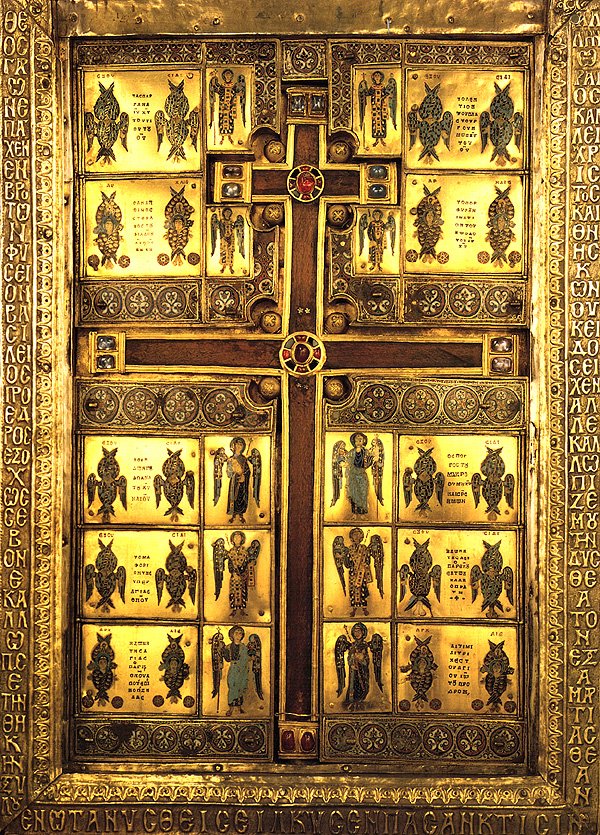
Commemoration of the Apparition of the Sign of the Precious Cross over Jerusalem in 351 AD
The Precious Cross appeared in the sky over Jerusalem on the morning of May 7, 351 during the reign of the emperor Constantius, the son of Saint Constantine (May 21).
At that time the heresy of Arianism, which taught that Christ was merely a creature and not God, was causing great turmoil and division throughout the Empire.
The Precious Cross appeared in the sky over Jerusalem on the morning of May 7, 351 during the reign of the emperor Constantius, the son of Saint Constantine (May 21).
At that time the heresy of Arianism, which taught that Christ was merely a creature and not God, was causing great turmoil and division throughout the Empire. Even after the First Ecumenical Council at Nicea in 325, many people were drawn to this false teaching, and the Orthodox found themselves in the minority in many places.
Constantius, the ruler of the eastern part of the Empire, was a fervent supporter of Arianism. His brothers Constantine II and Constans, who were pious Orthodox Christians, ruled in the west. They were both killed in separate battles around 350, leaving Constantius as sole ruler. Also in 350, Saint Cyril (March 18) became Patriarch of Jerusalem and began his zealous struggle against Arianism.
In May of 351 a luminous Cross appeared over Jerusalem, stretching from Golgotha to the Mount of Olives, a distance of about five and a half miles. The Cross was wide as it was long, and shone more brightly than the sun. Many people left their homes and workplaces to gather in the church and glorify Christ. The historian Sozomen says that this wondrous sign led to the conversion of multitudes of pagans and Jews to Christianity.
A letter from Saint Cyril to the emperor describing this phenomenon, and admonishing him to become Orthodox, has been preserved. The apparition of the Cross remained over the city for a whole week.
The vision of the Cross over Jerusalem strengthened the Orthodox faithful and contributed to the return of many Arians to the Church. It is also a reminder of the awesome Second Coming of Christ, when “the sign of the Son of man shall appear in heaven” (Matthew 24:30).
Troparion - Tone 8
Now the image of Your Cross has shone brighter than the sun, / spreading from the Holy Mountain1 to the Place of the Skull,2 / and in it O Savior, You revealed Your power, thereby strengthening us. / Keep us always in peace, through the intercessions of the Theotokos, O Christ God, and save us.1 The Mount of Olives.
2 Golgotha.
Kontakion - Tone 8
Now the image of Your Cross has shone brighter than the sun, / spreading from the Holy Mountain1 to the Place of the Skull,2 / and in it O Savior, You revealed Your power, thereby strengthening us. / Keep us always in peace, through the intercessions of the Theotokos, O Christ God, and save us.
Our Holy Fathers of Georgia (6th c.)
“In the sixth century, two hundred years after St Nina had preached the Gospel in Georgia, the most holy Mother of God appeared to John, an ascetic of Antioch, and commanded him to choose twelve of his disciples and go to Georgia, to strengthen the Orthodox faith there. John did so. Reaching Georgia, these twelve missionaries were formally welcomed by the prince of that country and the Catholicos, Eulalius, and immediately began their work with great zeal. T
“In the sixth century, two hundred years after St Nina had preached the Gospel in Georgia, the most holy Mother of God appeared to John, an ascetic of Antioch, and commanded him to choose twelve of his disciples and go to Georgia, to strengthen the Orthodox faith there. John did so. Reaching Georgia, these twelve missionaries were formally welcomed by the prince of that country and the Catholicos, Eulalius, and immediately began their work with great zeal. The people gathered around them in hordes, and they strengthened them in the Faith with great wisdom and many miracles. The chief of these Christ-loving missionaries was St John of Zedan, and the names of the others were: Abidus, Antony, David, Zeno, Thaddeus, Jesse, Isderius, Joseph, Michael, Pyrrus, Stephen and Shio. With apostolic zeal, they all strengthened the Christian faith in Georgia, founded many monasteries and left many disciples to follow them. Thus they became worthy of glory in heaven and power on earth.” (Prologue)
Martyr Acacius the Centurion at Byzantium (303)
The Holy Martyr Acacius, who lived mostly in the third century, was born at Cappadocia and was a centurion of the Martesian regiment under the military officer Firmus. When the persecution against Christians began on orders from the emperor Maximian Galerius (305-311), Firmus interrogated his soldiers one after the other about their faith.
The Holy Martyr Acacius, who lived mostly in the third century, was born at Cappadocia and was a centurion of the Martesian regiment under the military officer Firmus. When the persecution against Christians began on orders from the emperor Maximian Galerius (305-311), Firmus interrogated his soldiers one after the other about their faith. Saint Acacius firmly and openly confessed himself a Christian. Seeing the steadfastness of Saint Acacius, Firmus sent him to his superior officer, who was named Vivianus. Vivianus gave the saint over to fierce torture.
After the tortures they put him in heavy chains and locked him up in prison. A while later they led the martyr and other prisoners to Byzantium, to the prefect. The soldiers marched quickly, showing the prisoners no mercy. Saint Acacius weakened along the way from his wounds, from his chains, and from hunger and thirst. When finally they halted for the night, Saint Acacius offered thanks to God, for permitting him to suffer for His holy Name. As he prayed the saint heard a voice from the heavens, “Courage, Acacius, and be strong!” This voice was heard also by the other prisoners, and many of them believed in Christ and asked the saint to instruct them in the Christian Faith.
At Byzantium they placed the holy martyr in jail, while the other prisoners were held under less severe conditions. At night the other prisoners saw how radiant youths appeared to Saint Acacius and attended to him, washing his wounds and bringing him food. After seven days, Vivianus again summoned Saint Acacius before him and was struck by his fresh appearance. Supposing that the prison guard was bribed to give the prisoner both respite and food, he summoned the guard to question him. Since he did not believe his answers, Vivianus had the guard severely beaten. Saint Acacius himself then answered Vivianus, “My power and strength are given me by the Lord Jesus Christ, Who has healed my wounds.” Vivianus gave orders to beat the martyr about the face and to smash his teeth for his words.
Determined to intensify and prolong the torture of Saint Acacius, Vivianus sent him to the prefect Flaccinus with a letter. When he read the letter, Flaccinus became annoyed that Vivianus had tortured a centurion for so long and so cruelly, and he gave orders to behead the martyr without further delay.
At the place of execution Saint Acacius lifted up his eyes to the heavens, giving thanks to God for being granted a martyr’s death for His sake. Then he bowed his head beneath the sword. This occurred in the year 303.
Under Constantine the Great the relics of the holy martyr Acacius rested at Constantinople in a church built in his honor, and later they were transferred to Calabria, to the city of Scillatio. The holy martyr Acacius particularly helps those who struggle against temptations of the flesh, as attested by Saint Epiphanius, a disciple of Saint Andrew the Fool-for-Christ.
Troparion - Tone 3
Your holy martyr Acacius, O Lord, / through his sufferings has received an incorruptible crown from You, our God. / For having Your strength, he laid low his adversaries, / and shattered the powerless boldness of demons. / Through his intercessions, save our souls!
Kontakion - Tone 2
You appeared as a bright star announcing Christ with your radiance, / which is repulsive to this world, O Martyr Acacius; / extinguishing the allure of false gods, / you enlighten the faithful, / always interceding for us all.
St Lydia of Philippi (1st c.)
She is mentioned in chapter 16 of the Acts of the Apostles. A seller of purple cloth and a believer in God, she was baptized along with her household by St Paul, who stayed at her house during his missionary travels. She is the first recorded convert to Christianity in Europe.
Scripture Readings
☩Epistle
Acts 3:1-8
1
Now Peter and John went up together into the temple at the hour of prayer, being the ninth hour.
2
And a certain man lame from his mother’s womb was carried, whom they laid daily at the gate of the temple which is called Beautiful, to ask alms of them that entered into the temple;
3
Who seeing Peter and John about to go into the temple asked an alms.
4
And Peter, fastening his eyes upon him with John, said, Look on us.
5
And he gave heed unto them, expecting to receive something of them.
6
Then Peter said, Silver and gold have I none; but such as I have give I thee: In the name of Jesus Christ of Nazareth rise up and walk.
7
And he took him by the right hand, and lifted him up: and immediately his feet and ankle bones received strength.
8
And he leaping up stood, and walked, and entered with them into the temple, walking, and leaping, and praising God.
☩Gospel
John 2:12-22
12
After this he went down to Capernaum, he, and his mother, and his brethren, and his disciples: and they continued there not many days.
13
And the Jews’ passover was at hand, and Jesus went up to Jerusalem,
14
And found in the temple those that sold oxen and sheep and doves, and the changers of money sitting:
15
And when he had made a scourge of small cords, he drove them all out of the temple, and the sheep, and the oxen; and poured out the changers’ money, and overthrew the tables;
16
And said unto them that sold doves, Take these things hence; make not my Father’s house an house of merchandise.
17
And his disciples remembered that it was written, The zeal of thine house hath eaten me up.
18
Then answered the Jews and said unto him, What sign shewest thou unto us, seeing that thou doest these things?
19
Jesus answered and said unto them, Destroy this temple, and in three days I will raise it up.
20
Then said the Jews, Forty and six years was this temple in building, and wilt thou rear it up in three days?
21
But he spake of the temple of his body.
22
When therefore he was risen from the dead, his disciples remembered that he had said this unto them; and they believed the scripture, and the word which Jesus had said.
Liturgical data sourced from OCA.org and orthocal.info