
Fasting Rules
 Meat
Allowed
 Fish
Allowed
 Dairy
Allowed
 Oil
Allowed
 Wine
Allowed
Saints & Commemorations
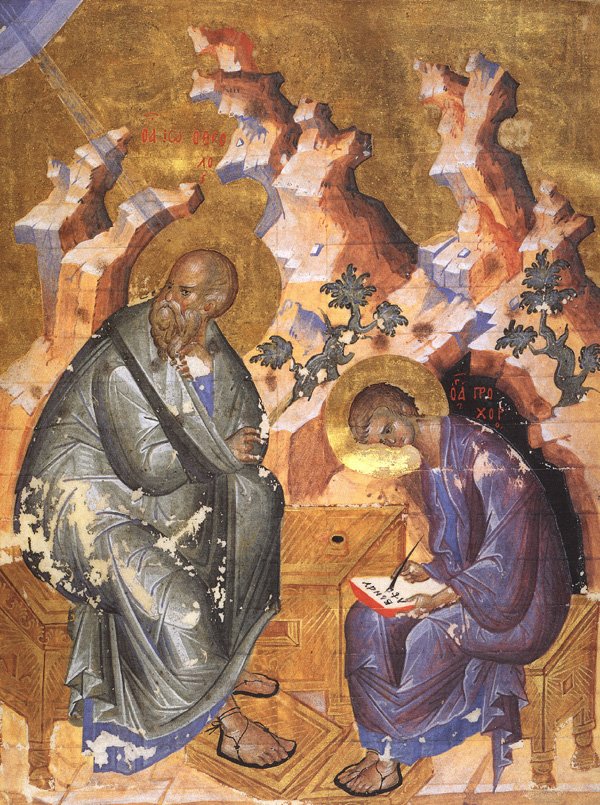
Holy Apostle John the Theologian
When Saint John was more than one hundred years old, he told seven of his disciples to take spades and follow him to a certain place outside the city of Ephesus, and then he told everyone to sit down while he went off to pray by himself for a while. When he returned, he told his disciples to dig a grave as long as he was tall, in the form of a cross.
When Saint John was more than one hundred years old, he told seven of his disciples to take spades and follow him to a certain place outside the city of Ephesus, and then he told everyone to sit down while he went off to pray by himself for a while. When he returned, he told his disciples to dig a grave as long as he was tall, in the form of a cross. After giving them instructions and kissing them, he climbed into the grave and said: "Take some earth, my mother earth, and cover me."
They covered him with earth up to his knees, and he said: "Now take some more earth and cover me up to my neck."
As soon as he they had done this, Saint John spoke again: "Bring a linen cloth and place it on my face, then kiss me again for the last time, because you shall not see me anymore in this life."
After the Apostle dismissed them, they buried him and wept bitterly. Later, they returned and opened the grave, but the Saint's body was not there. They wept and returned to the city.
Every year, on May 8, a red dust appears on his grave, which heals the sick, through the prayers of the Holy Apostle John. People call this dust "manna from the earth."
Saint Augustine knew about this dust, and Saint Gregory of Tours also wrote about it. Some sources call this Feast "rodismos" (ροδισμός) i.e. Day of the Roses. Some think that this manna is called ροδής (a pink ointment, or a rose-colored dust). Others say that by this name they celebrate the roses of spring, just as we decorate the church with greenery and flowers on Pentecost.
Saint John’s principal Feast Day is September 26, but today the Church commemorates Saint John because of the annual pilgrimage to his grave.
There is a special title to be used when commemorating Saint John at the Dismissal: “The holy, glorious Apostle and Evangelist, Virgin, Beloved friend of Christ, John the Theologian.” 1
1 John M. Fountoulis, Apanteseis Eis Leitourgikas Aporias (Thessalonike, 1973) pages 12 - 17.
Troparion - Tone 2
O beloved Apostle of Christ our God, / come quickly to deliver your helpless people. / He on whose breast you leaned, will accept you as intercessor. / Entreat Him, O Theologian, to disperse the clouds of darkness, / granting us peace and great mercy!
Kontakion - Tone 2
Who shall declare your greatness, / O virgin disciple, / for you pour forth wonders and are a source of healings, / and pray for our souls as theologian and friend of Christ.
Our Righteous Father Arsenios the Great (449)
He is one of the original and most honored Desert Fathers. Born of a noble family, he was a deacon and a courtier in Constantinople. One day he heard a voice saying “Arsenios, flee from men, and thou shalt be saved.” He left the capital in secret and sailed to Alexandria, then journeyed to Skete in the Egyptian desert, where he became a monk. For
He is one of the original and most honored Desert Fathers. Born of a noble family, he was a deacon and a courtier in Constantinople. One day he heard a voice saying “Arsenios, flee from men, and thou shalt be saved.” He left the capital in secret and sailed to Alexandria, then journeyed to Skete in the Egyptian desert, where he became a monk. For years he was the disciple of St John the Dwarf. Even though he had already abandoned the world so dramatically, after some time in the desert he again heard a voice saying, “Arsenios, flee, be silent, pray always, for these are the causes of sinning not.” He then separated himself from his brother monks and lived as a hermit, practicing silence. It was told of him that, on Saturday evenings, he would stand, turn his back to the setting sun, raise his hands in prayer, and pray without sitting down until the sun shone on his face the following morning. A monk who came to visit him looked into his cell and saw Arsenios at prayer, his entire body glowing like a flame. He reposed in peace at the age of ninety-five.
St Emilia (375), mother of Sts Macrina, Basil the Great and Gregory of Nyssa, Peter of Sebaste, and Theosevia
Her main commemoration is on May 8.
Scripture Readings
☩Epistle
Acts 3:11-16
11
And as the lame man which was healed held Peter and John, all the people ran together unto them in the porch that is called Solomon’s, greatly wondering.
12
And when Peter saw it, he answered unto the people, Ye men of Israel, why marvel ye at this? or why look ye so earnestly on us, as though by our own power or holiness we had made this man to walk?
13
The God of Abraham, and of Isaac, and of Jacob, the God of our fathers, hath glorified his Son Jesus; whom ye delivered up, and denied him in the presence of Pilate, when he was determined to let him go.
14
But ye denied the Holy One and the Just, and desired a murderer to be granted unto you;
15
And killed the Prince of life, whom God hath raised from the dead; whereof we are witnesses.
16
And his name through faith in his name hath made this man strong, whom ye see and know: yea, the faith which is by him hath given him this perfect soundness in the presence of you all.
☩Gospel
John 3:22-33
22
After these things came Jesus and his disciples into the land of Judea; and there he tarried with them, and baptized.
23
And John also was baptizing in Ænon near to Salim, because there was much water there: and they came, and were baptized.
24
For John was not yet cast into prison.
25
Then there arose a question between some of John’s disciples and the Jews about purifying.
26
And they came unto John, and said unto him, Rabbi, he that was with thee beyond Jordan, to whom thou barest witness, behold, the same baptizeth, and all men come to him.
27
John answered and said, A man can receive nothing, except it be given him from heaven.
28
Ye yourselves bear me witness, that I said, I am not the Christ, but that I am sent before him.
29
He that hath the bride is the bridegroom: but the friend of the bridegroom, which standeth and heareth him, rejoiceth greatly because of the bridegroom’s voice: this my joy therefore is fulfilled.
30
He must increase, but I must decrease.
31
He that cometh from above is above all: he that is of the earth is earthly, and speaketh of the earth: he that cometh from heaven is above all.
32
And what he hath seen and heard, that he testifieth; and no man receiveth his testimony.
33
He that hath received his testimony hath set to his seal that God is true.
Liturgical data sourced from OCA.org and orthocal.info