
Fasting Rules
 Meat
Allowed
 Fish
Allowed
 Dairy
Allowed
 Oil
Allowed
 Wine
Allowed
Saints & Commemorations
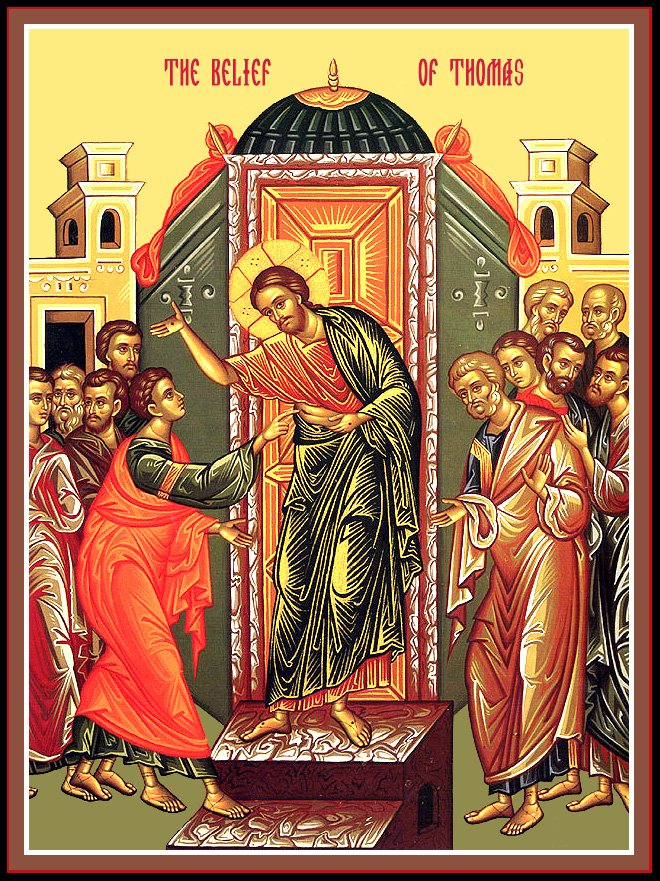
St Thomas Sunday
Some icons depicting this event are inscribed “The Doubting Thomas.” This is incorrect. In Greek, the inscription reads, “The Touching of Thomas.” The Slavonic inscription is, “The Belief of Thomas.” When Saint Thomas touched the Life-giving side of the Lord, he no longer had any doubts.
This day is also known as “Antipascha.” This does not mean “opposed to Pascha,” but “in place of Pascha.” Beginning with this first Sunday after Pascha, the Church dedicates every Sunday of the year to the Lord’s Resurrection. Sunday is called “Resurre
Some icons depicting this event are inscribed “The Doubting Thomas.” This is incorrect. In Greek, the inscription reads, “The Touching of Thomas.” The Slavonic inscription is, “The Belief of Thomas.” When Saint Thomas touched the Life-giving side of the Lord, he no longer had any doubts.
This day is also known as “Antipascha.” This does not mean “opposed to Pascha,” but “in place of Pascha.” Beginning with this first Sunday after Pascha, the Church dedicates every Sunday of the year to the Lord’s Resurrection. Sunday is called “Resurrection” in Russian, and “the Lord’s Day” in Greek.
Troparion - Tone 7
From the sealed tomb, You did shine forth O Life! / Through closed doors You did come to Your disciples, O Christ God! / Renew in us, through them, an upright spirit, / by the greatness of Your mercy, O Resurrection of all!
Kontakion - Tone 8
Thomas touched Your life-giving side with an eager hand, O Christ God, / when You did come to Your apostles through closed doors. / He cried out with all: You are my Lord and my God!
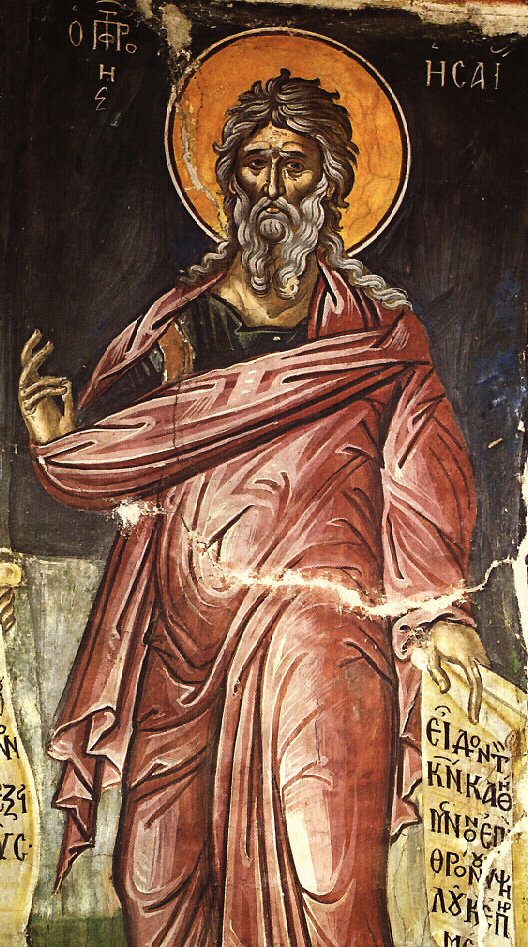
Prophet Isaiah
The Holy Prophet Isaiah lived 700 years before the birth of Christ, and was of royal lineage. Isaiah’s father Amos raised his son in the fear of God and in the law of the Lord. Having attained the age of maturity, the Prophet Isaiah entered into marriage with a pious prophetess (Is 8:3) and had a son Jashub (Is 8:18).
The Holy Prophet Isaiah lived 700 years before the birth of Christ, and was of royal lineage. Isaiah’s father Amos raised his son in the fear of God and in the law of the Lord. Having attained the age of maturity, the Prophet Isaiah entered into marriage with a pious prophetess (Is 8:3) and had a son Jashub (Is 8:18).
Saint Isaiah was called to prophetic service during the reign of Oziah [Uzziah], king of Judea, and he prophesied for 60 years during the reign of kings Joatham, Achaz [Ahaz], Hezekiah and Manasseh. The start of his service was marked by the following vision: he beheld the Lord God, sitting in a majestic heavenly temple upon a high throne. Six-winged Seraphim encircled Him. With two wings they covered their faces, and with two wings they covered their feet, and with two wings they flew about crying out one to another, “Holy, Holy, Holy Lord Sabaoth, heaven and earth are filled with His glory!” The pillars of the heavenly temple shook from their shouts, and in the temple arose the smoke of incense.
The prophet cried out in terror, “Oh, an accursed man am I, granted to behold the Lord Sabaoth, and having impure lips and living amidst an impure people!” Then was sent him one of the Seraphim, having in hand a red-hot coal, which he took with tongs from the altar of the Lord. He touched it to the mouth of the Prophet Isaiah and said, “Lo, this has touched thy lips, and will take away with thine iniquities, and will cleanse thy sins.” After this Isaiah heard the voice of the Lord, directed towards him, “Whom shall I send, and who will go to this people?” Isaiah answered, “Here am I, send me” (Is 6:1 ff). And the Lord sent him to the Jews to exhort them to turn from the ways of impiety and idol worship, and to offer repentance.
To those that repent and turn to the true God, the Lord promised mercy and forgiveness, but punishment and the judgment of God are appointed for the unrepentant. Then Isaiah asked the Lord, how long would the falling away of the Jewish nation from God continue. The Lord answered, “Until the cities be deserted, by reason of there being no people, and the land shall be made desolate. Just as when a tree be felled and from the stump come forth new shoots, so also from the destruction of the nation a holy remnant will remain, from which will emerge a new tribe.”
Isaiah left behind him a book of prophecy in which he denounces the Jews for their unfaithfulness to the God of their Fathers. He predicted the captivity of the Jews and their return from captivity during the time of the emperor Cyrus, the destruction and renewal of Jerusalem and of the Temple. Together with this he predicts the historical fate also of the other nations bordering the Jews. But what is most important of all for us, the Prophet Isaiah with particular clarity and detail prophesies about the coming of the Messiah, Christ the Savior. The prophet names the Messiah as God and Man, teacher of all the nations, founder of the Kingdom of peace and love.
The prophet foretells the birth of the Messiah from a Virgin, and with particular clarity he describes the Suffering of the Messiah for the sins of the world. He foresees His Resurrection and the universal spreading of His Church. By his clear foretelling of Christ the Savior, the Prophet Isaiah deserves to be called an Old Testament Evangelist. To him belong the words, “He beareth our sins and is smitten for us.... He was wounded for our sins and tortured for our transgressions. The chastisement of our world was upon Him, and by His wounds we were healed....” (Is 53:4-5. Vide Isaiah: 7:14, 11:1, 9:6, 53:4, 60:13, etc.).
The holy Prophet Isaiah had also a gift of wonderworking. And so, when during the time of a siege of Jerusalem by enemies the besieged had become exhausted with thirst, he by his prayer drew out from beneath Mount Sion a spring of water, which was called Siloam, i.e. “sent from God.” It was to this spring afterwards that the Savior sent the man blind from birth to wash, and He restored his sight. By the prayer of the Prophet Isaiah, the Lord prolonged the life of Hezekiah for 15 years.
The Prophet Isaiah died a martyr’s death. By order of the Jewish king Manasseh he was sawn through by a wood-saw. The prophet was buried not far from the Pool of Siloam. The relics of the holy Prophet Isaiah were afterwards transferred by the emperor Theodosius the Younger to Constantinople and installed in the church of Saint Laurence at Blachernae. At the present time part of the head of the Prophet Isaiah is preserved at Athos in the Hilandar monastery.
For the times and the events which occurred during the life of the Prophet Isaiah, see the 4th Book of Kings [alt. 2 Kings] (Ch 16, 17, 19, 20, 23, etc.), and likewise 2 Chr 26-32.
Troparion - Tone 4
With a great voice like that of a trumpet, / you proclaimed the coming of Christ to the world. / You were revealed as a swiftly-writing scribe of the things to come; / therefore, we acclaim you with hymns, / most illustrious prophet Isaiah.
Kontakion - Tone 2
Endowed with the gift of prophecy, / prophet-martyr Isaiah, herald of God, / you made clear to all the incarnation of Christ / by proclaiming with a great voice: / “Behold, the Virgin shall conceive in her womb.”
Trans. Rel. St Nicholas the Wonderworker
In 1087 the Saint’s relics were taken from Myra in Lycia (on the southern coast of present-day Turkey) to the town of Bari in Italy. This was done due to a Muslim attack on Lycia. At that time Bari was Orthodox and under the administration of the Patriarch of Constantinople. The Saint’s relics now lie in a Roman Catholic church in Bari; each year the
In 1087 the Saint’s relics were taken from Myra in Lycia (on the southern coast of present-day Turkey) to the town of Bari in Italy. This was done due to a Muslim attack on Lycia. At that time Bari was Orthodox and under the administration of the Patriarch of Constantinople. The Saint’s relics now lie in a Roman Catholic church in Bari; each year the casket containing the relics is opened by a Roman Catholic and Orthodox bishop together, and quantities of fragrant myrrh are removed, for the healing and encouragement of the faithful.
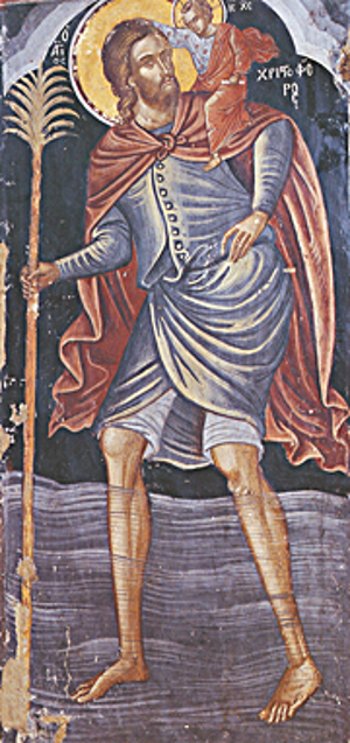
Holy Martyr Christopher (3rd c.)
The Holy Martyr Christopher lived during the third century and suffered about the year 250, during the reign of the emperor Decius (249-251). There are various accounts of his life and miracles, and he is widely venerated throughout the world. Saint Christopher is especially venerated in Italy, where people pray to him in times of contagious diseases.
The Holy Martyr Christopher lived during the third century and suffered about the year 250, during the reign of the emperor Decius (249-251). There are various accounts of his life and miracles, and he is widely venerated throughout the world. Saint Christopher is especially venerated in Italy, where people pray to him in times of contagious diseases.
There are various suggestions about his descent. Some historians believe that he was descended from the Canaanites, while others say from the “Cynoscephalai” [literally “dog-heads”] of Thessaly.
Saint Christopher was a man of great stature and unusual strength. According to tradition, Saint Christopher was very handsome, but wishing to avoid temptation for himself and others, he asked the Lord to give him an unattractive face, which was done. Before Baptism he was named Reprebus [Reprobate] because his disfigured appearance. Even before Baptism, Reprebus confessed his faith in Christ and denounced those who persecuted Christians. Consequently, a certain Bacchus gave him a beating, which he endured with humility.
Because of his renowned strength, 200 soldiers were assigned to bring him before the emperor Decius. Reprebus submitted without resistance. Several miracles occurred along the way; a dry stick blossomed in the saint’s hand, loaves of bread were multiplied through his prayers, and the travellers had no lack thereof. This is similar to the multiplication of loaves in the wilderness by the Savior. The soldiers surrounding Reprebus were astonished at these miracles. They came to believe in Christ and they were baptized along with Reprebus by Saint Babylus of Antioch (September 4).
Christopher once made a vow to serve the greatest king in the world, so he first offered to serve the local king. Seeing that the king feared the devil, Christopher thought he would leave the king to serve Satan. Learning that the devil feared Christ, Christopher went in search of Him. Saint Babylas of Antioch told him that he could best serve Christ by doing well the task for which he was best suited. Therefore, he became a ferryman, carrying people across a river on his shoulders. One stormy night, Christopher carried a Child Who insisted on being taken across at that very moment. With every step Christopher took, the Child seemed to become heavier. Halfway across the stream, Christopher felt that his strength would give out, and that he and the Child would be drowned in the river. As they reached the other side, the Child told him that he had just carried all the sins of the world on his shoulders. Then He ordered Christopher to plant his walking stick in the ground. As he did so, the stick grew into a giant tree. Then he recognized Christ, the King Whom he had vowed to serve.
Saint Christopher was brought before the emperor, who tried to make him renounce Christ, not by force but by cunning. He summoned two profligate women, Callinika and Aquilina, and commanded them to persuade Christopher to deny Christ, and to offer sacrifice to idols. Instead, the women were converted to Christ by Saint Christopher. When they returned to the emperor, they declared themselves to be Christians. Therefore, they were subjected to fierce beatings, and so they received the crown of martyrdom.
Decius also sentenced to execution the soldiers who had been sent after Saint Christopher, but who now believed in Christ. The emperor ordered that the martyr be thrown into a red-hot metal box. Saint Christopher, however, did not experience any suffering and he remained unharmed. After many fierce torments they finally beheaded the martyr with a sword. This occurred in the year 250 in Lycia. By his miracles the holy Martyr Christopher converted as many as 50,000 pagans to Christ, as Saint Ambrose of Milan testifies. The relics of Saint Christopher were later transferred to Toledo (Spain), and still later to the abbey of Saint Denis in France.
In Greece, many churches place the icon of Saint Christopher at the entrance so that people can see it as they enter and leave the building. There is a rhyming couplet in Greek which says, “When you see Christopher, you can walk in safety.” This reflects the belief that whoever gazes upon the icon of Saint Christopher will not meet with sudden or accidental death that day.
The name Christopher means “Christ-bearer.” This can refer to the saint carrying the Savior across the river, and it may also refer to Saint Christopher bearing Christ within himself (Galatians 2:20).
The skull of Saint Christopher is located in the Monastery of Karakalou on Mount Athos. Pieces of the Holy Relics of Saint Christopher are found in the Monasteries of Prousos in Evritania, Nativity of the Theotokos on Aegina, the Holy Unmercenary Physicians in Kastoria, and Kykkos on Cyprus.
Troparion - Tone 4
Adorned with garments woven from the blood of your martyrdom, / you stand before the Lord, the King of Heaven, O revered Christopher; / therefore, with the choirs of Angels and Martyrs, / you sing the Thrice-Holy Hymn with the sweetest melodies; / by your intercessions, save your servants.
Kontakion - Tone 4
You were terrifying both in might and countenance: / and willingly suffered temptation from your persecutors; / those men and women who sought to arouse the fire of lust in you, / but they followed you to martyrdom. / Therefore, you are our strong protector, O Great Martyr Christopher.
Scripture Readings
☩Epistle
Acts 5:12-20
12
And by the hands of the apostles were many signs and wonders wrought among the people; (and they were all with one accord in Solomon’s porch.
13
And of the rest durst no man join himself to them: but the people magnified them.
14
And believers were the more added to the Lord, multitudes both of men and women.)
15
Insomuch that they brought forth the sick into the streets, and laid them on beds and couches, that at the least the shadow of Peter passing by might overshadow some of them.
16
There came also a multitude out of the cities round about unto Jerusalem, bringing sick folks, and them which were vexed with unclean spirits: and they were healed every one.
17
Then the high priest rose up, and all they that were with him, (which is the sect of the Sadducees,) and were filled with indignation,
18
And laid their hands on the apostles, and put them in the common prison.
19
But the angel of the Lord by night opened the prison doors, and brought them forth, and said,
20
Go, stand and speak in the temple to the people all the words of this life.
☩Gospel
John 20:19-31
19
Then the same day at evening, being the first day of the week, when the doors were shut where the disciples were assembled for fear of the Jews, came Jesus and stood in the midst, and saith unto them, Peace be unto you.
20
And when he had so said, he shewed unto them his hands and his side. Then were the disciples glad, when they saw the Lord.
21
Then said Jesus to them again, Peace be unto you: as my Father hath sent me, even so send I you.
22
And when he had said this, he breathed on them, and saith unto them, Receive ye the Holy Ghost:
23
Whose soever sins ye remit, they are remitted unto them; and whose soever sins ye retain, they are retained.
24
But Thomas, one of the twelve, called Didymus, was not with them when Jesus came.
25
The other disciples therefore said unto him, We have seen the Lord. But he said unto them, Except I shall see in his hands the print of the nails, and put my finger into the print of the nails, and thrust my hand into his side, I will not believe.
26
And after eight days again his disciples were within, and Thomas with them: then came Jesus, the doors being shut, and stood in the midst, and said, Peace be unto you.
27
Then saith he to Thomas, Reach hither thy finger, and behold my hands; and reach hither thy hand, and thrust it into my side: and be not faithless, but believing.
28
And Thomas answered and said unto him, My Lord and my God.
29
Jesus saith unto him, Thomas, because thou hast seen me, thou hast believed: blessed are they that have not seen, and yet have believed.
30
And many other signs truly did Jesus in the presence of his disciples, which are not written in this book:
31
But these are written, that ye might believe that Jesus is the Christ, the Son of God; and that believing ye might have life through his name.
Liturgical data sourced from OCA.org and orthocal.info