
Fasting Rules
 Meat
Abstain
 Fish
Allowed
 Dairy
Abstain
 Oil
Allowed
 Wine
Allowed
Saints & Commemorations
Midfeast of Pentecost
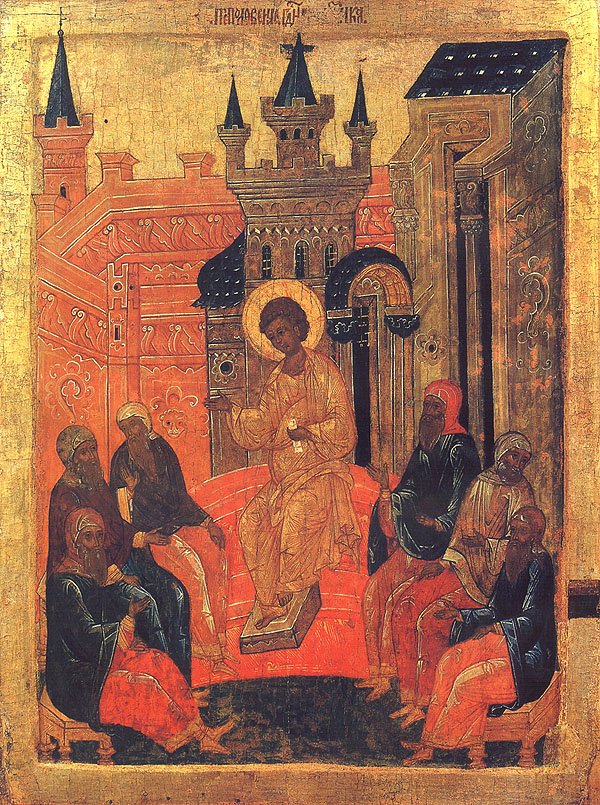
Today’s celebration is the midpoint of the fifty days between the Feasts of Pascha and Pentecost. Saint John tells us (John 7:14) that “in the midst of the feast Jesus went up into the Temple, and taught.” The Feast in question is the Feast of Tabernacles (celebrated in September), not Pentecost.
The
Today’s celebration is the midpoint of the fifty days between the Feasts of Pascha and Pentecost. Saint John tells us (John 7:14) that “in the midst of the feast Jesus went up into the Temple, and taught.” The Feast in question is the Feast of Tabernacles (celebrated in September), not Pentecost.
The Church has appointed John 7:14-30 to be read for the Midfeast, thereby linking Pascha and Pentecost. In Chapter 8 of Saint John’s Gospel, the Lord came to the Temple again and taught the people who came to Him. After leaving the Temple, he encounters the man born blind. We will hear about him on the Sunday of the Blind Man.
The Troparion of the Midfeast (“In the middle of the Feast, O Savior, fill my thirsting soul with the waters of godliness, as Thou didst cry to all: If anyone thirst, let him come to Me and drink [John 7:37]. O Christ God, Fountain of our life, glory to Thee!”) hints at the encounter of Christ and the Samaritan Woman in just a few days.
Today we perform the Lesser Blessing of Water, and the Blessing of Fields.
Troparion - Tone 8
In the middle of the Feast, O Savior, / fill my thirsting soul with the waters of godliness, as You did cry to all: / If anyone thirst let him come to me and drink! / O Christ God, Fountain of our life, glory to You!
Kontakion - Tone 4
Christ God, the Creator and Master of all / cried to all in the midst of the Feast of the law: / Come and draw the water of immortality! / We fall before You and faithfully cry: / Grant us Your bounties, for You are the Fountain of our life!
Apostles Carpus and Alphaeus of the Seventy
He was one of the Seventy and a companion of St Paul, who mentions him in 2 Timothy 4:13. He became a Bishop in Thrace (the Great Horologion says in Berea, the Prologue in Varna), where he suffered martyrdom. St Dionysius the Areopagite met and wrote about him, stating that Carpus never began the Liturgy without first receiving a heavenly vision.
He was one of the Seventy and a companion of St Paul, who mentions him in 2 Timothy 4:13. He became a Bishop in Thrace (the Great Horologion says in Berea, the Prologue in Varna), where he suffered martyrdom. St Dionysius the Areopagite met and wrote about him, stating that Carpus never began the Liturgy without first receiving a heavenly vision.
From the Prologue: “We must not desire the death of a sinner, but his repentance. Nothing so saddens the Lord who suffered on the Cross for sinners as when we pray to Him for the death of a sinner and his removal from our path. It once happened that the Apostle Carpus lost patience and began to pray God to send death upon two sinful men, the one pagan and the other an apostate from the Faith. The Lord appeared to him and said: ‘Behold, here I am; ready to be crucified again for the salvation of men.’ St Carpus related this event to St Dionysius the Areopagite, who wrote it down as a lesson for all in the Church that we must pray for the salvation of sinners and not for their destruction. For the Lord ‘is not willing that any should perish, but that all should come to repentance’ (II Peter 3:9).”
Great Martyr George the New at Sofia
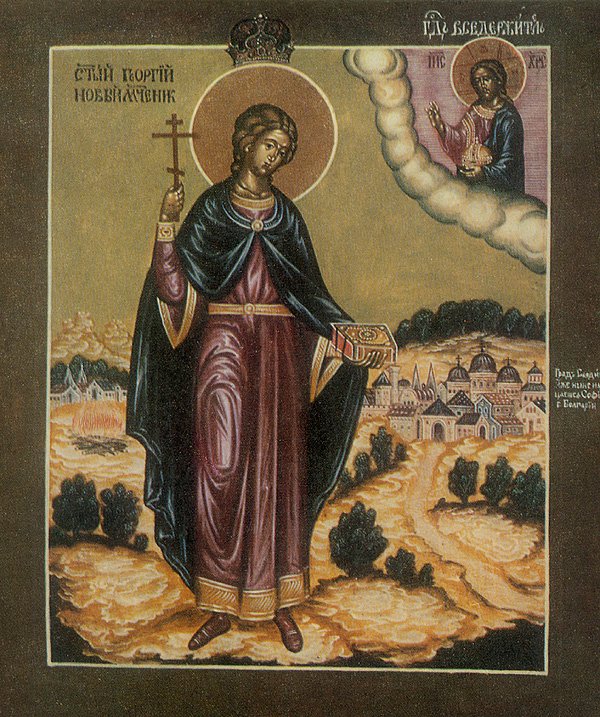
The Holy Martyr George the New was born into an illustrious Bulgarian family, living in the capital city of Bulgaria, Sredets (now the city of Sofia). Saint George’s childless parents, John and Mary, in their declining years entreated the Lord to send them a child. Their prayer was answered, and they baptized the infant with the name of the holy Great Martyr George (April 23).
The Holy Martyr George the New was born into an illustrious Bulgarian family, living in the capital city of Bulgaria, Sredets (now the city of Sofia). Saint George’s childless parents, John and Mary, in their declining years entreated the Lord to send them a child. Their prayer was answered, and they baptized the infant with the name of the holy Great Martyr George (April 23).
Young George received a fine upbringing, he attentively studied the Holy Scriptures, and he was pious and chaste. His parents died when George was twenty-five. At that time Bulgaria found itself under the rule of the Turks, who forcibly converted Christians to Islam.
Once, several Moslems tried to convert George. They put a fez on the saint’s head. This is a red circular hat which Moslems wear to enter their house of prayer. But George threw the fez on the ground. The Turks brought the martyr to their governor with beatings and abuse.
The governor was impressed with Saint George’s appearance and bearing, and he urged him to accept Islam, promising honors and wealth from Sultan Selim (1512-1520). The saint boldly and steadfastly confessed his faith in the Lord Jesus Christ, and reproached the errors of Islam. The governor in a rage gave orders to beat Saint George with rods, but the saint persevered in his confession of faith in Christ.
The governor ordered the tortures to be increased. The passion-bearer bore all his sufferings, calling on the Lord Jesus Christ for help. Then they led the martyr through the city to the beat of a drum and shouts: “Do not insult Mohammed nor abase the Moslem faith”.
Finally, a large fire was lit in the city, to burn Saint George. Weakened by his wounds, the saint fell to the ground. They threw him into the fire still alive, and they threw corpses of dogs on top of him so that Christians would not be able to find the relics of the martyr.
Suddenly, a heavy rain fell and extinguished the fire. With the onset of darkness, the place where the body of the martyr was thrown was illumined with a bright light. They gave permission to a certain Christian priest to take the venerable relics of the martyr for burial. Informed about the occurrence, Metropolitan Jeremiah and his clergy went to the place of execution. In the ashes of the fire they located the body of the holy Martyr George and carried it to the church of Saint George the Great Martyr in the city of Sredets.
On May 26, 1515 the holy relics of Saint George were removed from the grave, placed in a coffin, and then brought into the church, where they have remained ever since. The Church honors Saint George twice during the year: on February 11 , the day of his martyrdom, and on May 26, the uncovering of his holy relics.
Troparion - Tone 3
Your holy martyr George, O Lord, / through his sufferings has received an incorruptible crown from You, our God. / For having Your strength, he laid low his adversaries, / and shattered the powerless boldness of demons. / Through his intercessions, save our souls!
Kontakion - Tone 2
You appeared as a bright star announcing Christ with your radiance, / which is repulsive to this world, O Martyr George; / extinguishing the allure of false gods, / you enlighten the faithful, / always interceding for us all.
Saint Augustine of Canterbury, evangelizer of England (ca. 605)
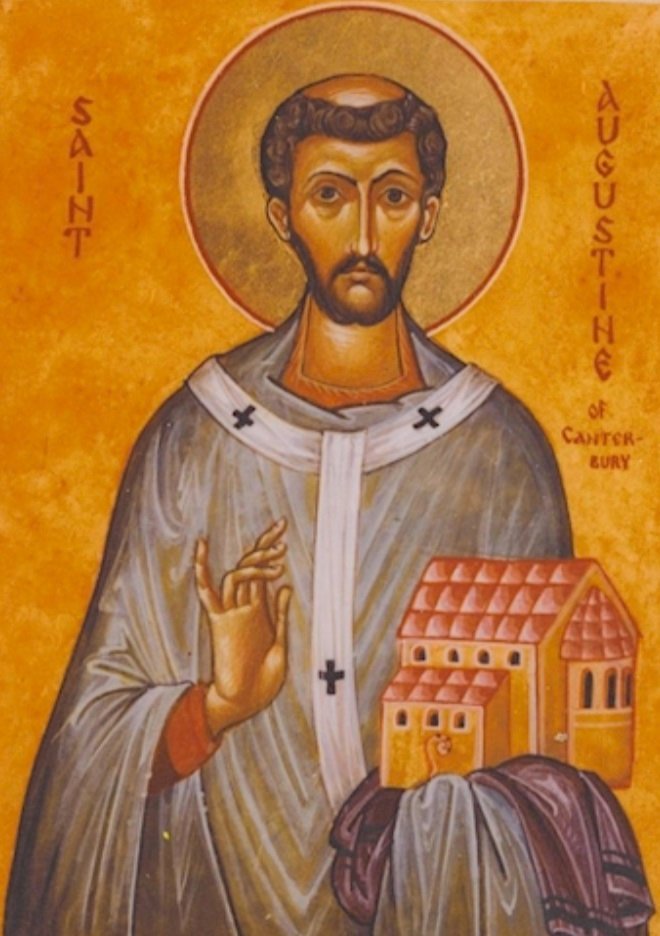
Saint Augustine was from Italy, and a disciple of Saint Felix, Bishop of Messana. Saint Gregory Dialogus (March 12) chose him to lead a mission of forty monks to evangelize the people of Britain. They arrived at Ebbsfleet (on the isle of Thanet) in Kent in 597.
King Ethelbert, whose Frankish wife Bertha was a Christian, welcomed them.
Saint Augustine was from Italy, and a disciple of Saint Felix, Bishop of Messana. Saint Gregory Dialogus (March 12) chose him to lead a mission of forty monks to evangelize the people of Britain. They arrived at Ebbsfleet (on the isle of Thanet) in Kent in 597.
King Ethelbert, whose Frankish wife Bertha was a Christian, welcomed them. They were allowed to base their mission at the ancient church of Saint Martin in Canterbury, which was restored for their use. This church had been built during the Roman occupation of Britain, and the queen often went there to pray. At first, the king was reluctant to give up his pagan beliefs, but he promised not to harm them, and to supply them with whatever they needed. He also promised that he would not prevent them from preaching Christianity. Saint Augustine later converted the king to Christianity, along with thousands of his subjects. The holy right-believing King Ethelbert is commemorated on February 25.
Bede says that Saint Augustine was consecrated as Archbishop of Britain by Archbishop Etherius of Arles (others say that it was his successor Saint Virgilius of Arles [March 5] who consecrated Saint Augustine). Returning to Britain, he threw himself into the work of evangelizing the country with renewed zeal. Saint Augustine built Christ Church, predecessor of the present cathedral at Canterbury, and consecrated it on June 9, 603 (according to the Anglo-Saxon Chronicle). He also founded the monastery of Saints Peter and Paul east of the city. Here Saint Augustine, the Archbishops of Canterbury, and the Kings of Kent were buried. The monastery, now in ruins, was later known as Saint Augustine’s Monastery.
The saint was instrumental in founding the dioceses of Rochester and London. In 604 he consecrated Saint Justus (November 10) and Saint Mellitus (April 24) as bishops for those Sees. Saint Augustine also helped the king draft the earliest Anglo-Saxon laws, and founded a school in Canterbury.
Saint Augustine was not completely successful in all his efforts, however. He was not able to achieve unity with the already existing Christian communities who followed Celtic practices. He met with some of their bishops to urge them to abandon their Celtic traditions and to accept the Roman practices. He invited them to cooperate with him in evangelizing the country, but they refused to give up their ancient traditions. Before meeting with Saint Augustine in 603, the Celtic bishops asked a holy hermit whether or not to accept Augustine as their leader. The hermit replied, “If he rises to greet you, then accept him. If he remains seated, then he is arrogant and unfit to be your leader, and you should reject him.” Unfortunately, Saint Augustine did not rise to greet them. Perhaps Saint Augustine was, to some degree, a bit tactless and too insistent on conformity to Roman customs. On the other hand, Celtic resentment against Roman authority also contributed to the stormy relationship.
Known in his lifetime as a wonderworker, Saint Augustine fell asleep in the Lord on May 26, 604. He was laid to rest at the entrance of the unfinished church of Saints Peter and Paul. When the church was dedicated in 613, his holy relics were placed inside. An epitaph was composed for his tomb. In part, it reads: “Here lies the Lord Augustine, first Archbishop of Canterbury, sent here by blessed Gregory, bishop of the city of Rome, who with the help of God, and aided by miracles, guided King Ethelbert and his people from the worship of idols to the Faith of Christ.”
Saint Bede (May 27) gives detailed information about Saint Augustine’s mission to Britain in his History of the English Church and People (Book I, 23-33. Book II, 1-3).
Troparion - Tone 8
In you the image was preserved with exactness, O Father, / for taking up your cross, you followed after Christ. / By so doing, you taught us to disregard the flesh, for it passes away, / but to care instead for the soul, since it is immortal. / Therefore, most venerable Father Augustine your spirit rejoices with the Angels.
Kontakion - Tone 2
Having divinely armed yourself with the purity of your soul, / and firmly grasping unceasing prayer as a spear, you pierced the armies of demons. / O our Father Augustine, pray unceasingly for us all.
Holy New Martyr Alexander of Thessalonica (1794)
He was born in Thessalonica and, though baptised a Christian, he accepted Islam as a young man, eventually becoming a Sufi (one of a mystical sect among the Muslims). But in time he began to repent, and concluded that martyrdom was the only way for him to cleanse himself from the stain of his denial of Christ.
He was born in Thessalonica and, though baptised a Christian, he accepted Islam as a young man, eventually becoming a Sufi (one of a mystical sect among the Muslims). But in time he began to repent, and concluded that martyrdom was the only way for him to cleanse himself from the stain of his denial of Christ. Having repented, he presented himself to the Turks dressed as a Christian. He was thrown into prison and tortured, but in response to every enticement, threat or torment, he would only say ‘I was born a Christian, and as a Christian I shall die.’ Finally he was sentenced to death, which Alexander joyfully accepted as a sign of God’s forgiveness. He was slain by the sword in Smyrna in 1794.
Scripture Readings
☩Epistle
Acts 14:6-18
6
They were ware of it, and fled unto Lystra and Derbe, cities of Lycaonia, and unto the region that lieth round about:
7
And there they preached the gospel.
8
And there sat a certain man at Lystra, impotent in his feet, being a cripple from his mother’s womb, who never had walked:
9
The same heard Paul speak: who stedfastly beholding him, and perceiving that he had faith to be healed,
10
Said with a loud voice, Stand upright on thy feet. And he leaped and walked.
11
And when the people saw what Paul had done, they lifted up their voices, saying in the speech of Lycaonia, The gods are come down to us in the likeness of men.
12
And they called Barnabas, Jupiter; and Paul, Mercurius, because he was the chief speaker.
13
Then the priest of Jupiter, which was before their city, brought oxen and garlands unto the gates, and would have done sacrifice with the people.
14
Which when the apostles, Barnabas and Paul, heard of, they rent their clothes, and ran in among the people, crying out,
15
And saying, Sirs, why do ye these things? We also are men of like passions with you, and preach unto you that ye should turn from these vanities unto the living God, which made heaven, and earth, and the sea, and all things that are therein:
16
Who in times past suffered all nations to walk in their own ways.
17
Nevertheless he left not himself without witness, in that he did good, and gave us rain from heaven, and fruitful seasons, filling our hearts with food and gladness.
18
And with these sayings scarce restrained they the people, that they had not done sacrifice unto them.
☩Gospel
John 7:14-30
14
Now about the midst of the feast Jesus went up into the temple, and taught.
15
And the Jews marvelled, saying, How knoweth this man letters, having never learned?
16
Jesus answered them, and said, My doctrine is not mine, but his that sent me.
17
If any man will do his will, he shall know of the doctrine, whether it be of God, or whether I speak of myself.
18
He that speaketh of himself seeketh his own glory: but he that seeketh his glory that sent him, the same is true, and no unrighteousness is in him.
19
Did not Moses give you the law, and yet none of you keepeth the law? Why go ye about to kill me?
20
The people answered and said, Thou hast a devil: who goeth about to kill thee?
21
Jesus answered and said unto them, I have done one work, and ye all marvel.
22
Moses therefore gave unto you circumcision; (not because it is of Moses, but of the fathers;) and ye on the sabbath day circumcise a man.
23
If a man on the sabbath day receive circumcision, that the law of Moses should not be broken; are ye angry at me, because I have made a man every whit whole on the sabbath day?
24
Judge not according to the appearance, but judge righteous judgment.
25
Then said some of them of Jerusalem, Is not this he, whom they seek to kill?
26
But, lo, he speaketh boldly, and they say nothing unto him. Do the rulers know indeed that this is the very Christ?
27
Howbeit we know this man whence he is: but when Christ cometh, no man knoweth whence he is.
28
Then cried Jesus in the temple as he taught, saying, Ye both know me, and ye know whence I am: and I am not come of myself, but he that sent me is true, whom ye know not.
29
But I know him: for I am from him, and he hath sent me.
30
Then they sought to take him: but no man laid hands on him, because his hour was not yet come.
Liturgical data sourced from OCA.org and orthocal.info