
Fasting Rules
 Meat
Allowed
 Fish
Allowed
 Dairy
Allowed
 Oil
Allowed
 Wine
Allowed
Saints & Commemorations
Hieromartyr Therapon
For boldly preaching Christ and bringing many to the Faith, he was seized and tortured by the pagans. After imprisoning and starving him, his persecutors bound him to four posts and flogged him until the flesh was stripped from his bones. But he remained alive, and the four dead posts to which he was tied sprouted into tall, green trees, from which many received healing.
For boldly preaching Christ and bringing many to the Faith, he was seized and tortured by the pagans. After imprisoning and starving him, his persecutors bound him to four posts and flogged him until the flesh was stripped from his bones. But he remained alive, and the four dead posts to which he was tied sprouted into tall, green trees, from which many received healing. At last St Therapon was slain by the sword, during the reign of the Emperor Valerian.
Trans. Rel. Ven. Nilus of Stolbensk
Hieromartyr Therapon, bishop of Sardis (259)
For boldly preaching Christ and bringing many to the Faith, he was seized and tortured by the pagans. After imprisoning and starving him, his persecutors bound him to four posts and flogged him until the flesh was stripped from his bones. But he remained alive, and the four dead posts to which he was tied sprouted into tall, green trees, from which many received healing.
For boldly preaching Christ and bringing many to the Faith, he was seized and tortured by the pagans. After imprisoning and starving him, his persecutors bound him to four posts and flogged him until the flesh was stripped from his bones. But he remained alive, and the four dead posts to which he was tied sprouted into tall, green trees, from which many received healing. At last St Therapon was slain by the sword, during the reign of the Emperor Valerian.
Holy Martyrs Theodora and Didymus (304)
The Holy Martyrs Theodora the Virgin and Didymus the Soldier suffered for Christ during the persecution against Christians under the emperor Diocletian (284-305), in the city of Alexandria in either the year 303 or 304.
The Virgin Martyr Theodora, standing trial before the prefect Eustratius of Alexandria, bravely confessed herself a Christian.
The Holy Martyrs Theodora the Virgin and Didymus the Soldier suffered for Christ during the persecution against Christians under the emperor Diocletian (284-305), in the city of Alexandria in either the year 303 or 304.
The Virgin Martyr Theodora, standing trial before the prefect Eustratius of Alexandria, bravely confessed herself a Christian. When the prefect asked why she had not married, the saint replied that she had dedicated herself to God, and had resolved to remain a virgin for the name of Christ.
Eustratius ordered the holy virgin to be taken to prison, giving her three days to make up her mind, and he threatened to have her taken to a brothel if she persisted in her disobedience. Brought again to trial three days later, Saint Theodora remained as resolute in her faith as before.
The saint was taken to the brothel, where dissolute youths began to argue which of them should be the first to have her. At this moment the Christian Didymus, dressed in soldier’s garb, entered the brothel without hindrance. He chased the frightened profligates out and saved the holy virgin, giving her his clothes so she could escape.
Upon learning what had happened, Eustratius interrogated Saint Didymus. Brought before the angry judge, Saint Didymus told how he had set the holy virgin free, and for this he was sentenced to death. Saint Theodora appeared at the place of execution, and said that she wanted to die with Saint Didymus. The prefect gave orders to execute both of them . The first to bend the neck beneath the sword was the holy martyr Theodora, and then the holy Martyr Didymus. The bodies of the martyrs were then burned.
Troparion - Tone 4
Your holy martyrs Theodora and Didymus, O Lord, / through their sufferings have received incorruptible crowns from You, our God. / For having Your strength, they laid low their adversaries, / and shattered the powerless boldness of demons. / Through their intercessions, save our souls!
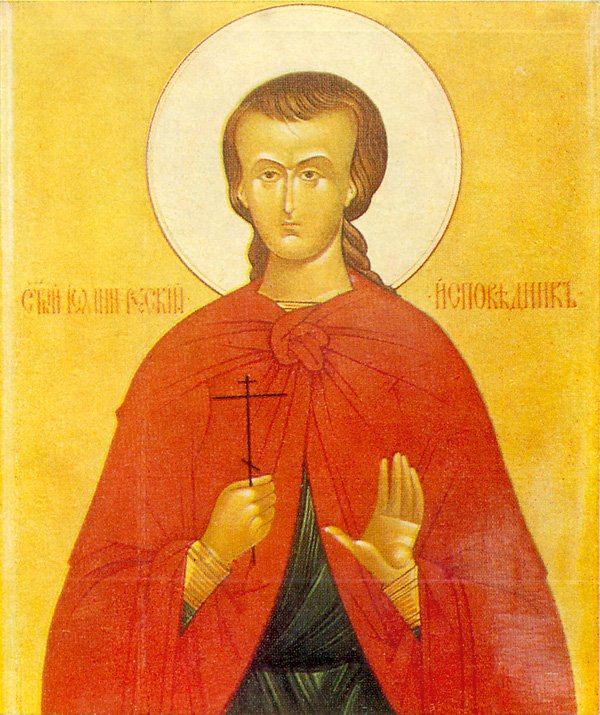
Holy New Confessor John the Russian (1730)
The Holy Confessor John the Russian was born in Little Russia around 1690, and was raised in piety and love for the Church of God. Upon attaining the age of maturity he was called to military service, and he served as a simple soldier in the army of Peter I and took part in the Russo-Turkish War. During the Prutsk Campaign of 1711 he and other soldiers were captured by the Tatars, who handed him over to the commander of the Turkish cavalry.
The Holy Confessor John the Russian was born in Little Russia around 1690, and was raised in piety and love for the Church of God. Upon attaining the age of maturity he was called to military service, and he served as a simple soldier in the army of Peter I and took part in the Russo-Turkish War. During the Prutsk Campaign of 1711 he and other soldiers were captured by the Tatars, who handed him over to the commander of the Turkish cavalry. He took his Russian captive home with him to Asia Minor, to the village of Prokopion.
The Turks tried to convert the Christian soldiers to the Moslem faith with threats and flattery, but those who resisted were beaten and tortured. Some, alas, denied Christ and became Moslems, hoping to improve their lot. Saint John was not swayed by the promise of earthly delights, and he bravely endured the humiliation and beatings.
His master tortured him often in the hope that his slave would accept Islam. Saint John resolutely resisted the will of his master saying, “You cannot turn me from my holy Faith by threats, nor with promises of riches and pleasures. I will obey your orders willingly, if you will leave me free to follow my religion. I would rather surrender my head to you than to change my faith. I was born a Christian, and I shall die a Christian.”
Saint John’s bold words and firm faith, as well as his humility and meekness, finally softened the fierce heart of his master. He left John in peace, and no longer tried to make him renounce Christianity. The saint lived in the stable and took care of his master’s animals, rejoicing because his bed was a manger such as the one in which the Savior was born.
From morning until late evening the saint served his Turkish master, fulfilling all his commands. He performed his duties in the winter cold and summer heat, half naked and barefoot. Other slaves frequently mocked him, seeing his zeal. Saint John never became angry with them, but on the contrary, he helped them when he could, and comforted them in their misfortune.
The saint’s kindness and gentle nature had its effect on the souls of both the master and the slaves. The Agha and his wife came to love him, and offered him a small room near the hayloft. Saint John did not accept it, preferring to remain in the stable with the animals. Here he slept on the hay, covered only by an old coat. So the stable became his hermitage, where he prayed and chanted Psalms.
Saint John brought a blessing to his master simply by living in his household. The cavalry officer became rich, and was soon one of the most powerful men in Prokopion. He knew very well why his home had been blessed, and he did not hesitate to tell others.
Sometimes Saint John left the stable at night and went to the church of the Great Martyr George, where he kept vigil in the narthex. On Saturdays and Feast days, he received the Holy Mysteries of Christ.
During this time Saint John continued to serve his master as before, and despite his own poverty, he always helped the needy and the sick, and shared his meager food with them.
One day, the officer left Prokopion and went to Mecca on pilgrimage. A few days later, his wife gave a banquet and invited her husband’s friends and relatives, asking them to pray for her husband’s safe return. Saint John served at the table, and he put down a dish of pilaf, his master’s favorite food. The hostess said, “How much pleasure your master would have if he could be here to eat this pilaf with us.” Saint John asked for a dish of pilaf, saying that he would send it to his master in Mecca. The guests laughed when they heard his words. The mistress, however, ordered the cook to give him a dish of pilaf, thinking he would eat it himself, or give it to some poor family.
Taking the dish, Saint John went into the stable and prayed that God would send it to his master. He had no doubt that God would send the pilaf to his master in a supernatual manner. The plate disappeared before his eyes, and he went into the house to tell his mistress that he had sent the pilaf to his master.
After some time, the master returned home with the copper plate which had held the pilaf. He told his household that on a certain day (the very day of the banquet), he returned from the mosque to the home where he was staying. Although the room was locked, he found a plate of steaming pilaf on the table. Unable to explain who had brought the food, or how anyone could enter the locked room, the officer examined the plate. To his amazement, he saw his own name engraved on the copper plate. In spite of his confusion, he ate the meal with great relish.
When the officer’s family heard this story, they marveled. His wife told him of how John had asked for a plate of pilaf to send to his master in Mecca, and how they all laughed when John came back and said that it had been sent. Now they saw that what the saint had said was true (Compare the story of Habakkuk, who miraculously brought a dish of pottage to Daniel in the lions’ den [Dan. 14:33-39], in the Septuagint).
Toward the end of his difficult life Saint John fell ill, and sensed the nearness of his end. He summoned the priest so that he could receive Holy Communion. The priest, fearing to go to the residence of the Turkish commander openly with the Holy Gifts, enclosed the life-giving Mysteries in an apple and brought them to Saint John.
Saint John glorified the Lord, received the Body and Blood of Christ, and then reposed. The holy Confessor John the Russian went to the Lord Whom he loved on May 27, 1730. When they reported to the master that his servant John had died, he summoned the priests and gave them the body of Saint John for Christian burial. Almost all the Christian inhabitants of Prokopion came to the funeral, and they accompanied the body of the saint to the Christian cemetery.
Three and a half years later the priest was miraculously informed in a dream that the relics of Saint John had remained incorrupt. Soon the relics of the saint were transferred to the church of the holy Great Martyr George and placed in a special reliquary. The new saint of God began to be glorified by countless miracles of grace, accounts of which spread to the remote cities and villages. Christian believers from various places came to Prokopion to venerate the holy relics of Saint John the Russian and they received healing through his prayers. The new saint came to be venerated not only by Orthodox Christians, but also by Armenians, and even Turks, who prayed to the Russian saint, “Servant of God, in your mercy, do not disdain us.”
In the year 1881 a portion of the relics of Saint John were transferred to the Russian monastery of the holy Great Martyr Panteleimon by the monks of Mount Athos, after they were miraculously saved by the saint during a dangerous journey.
Construction of a new church was begun in 1886, through the contributions of the monastery and the inhabitants of Prokopion. This was necessary because the church of the holy Great Martyr George, where the relics of Saint John were enshrined, had fallen into disrepair.
On August 15, 1898 the new church dedicated to Saint John the Russian was consecrated by the Metropolitan John of Caesarea, with the blessing of the Ecumenical Patriarch Constantine V.
In 1924, an exchange of the populations of Greece and Turkey took place. Many Moslems moved out of Greece, and many Christians moved out of Turkey. The inhabitants of Prokopion, when they moved to the island of Euboia, took with them part of the relics of Saint John the Russian.
For several decades the relics were in the church of Saints Constantine and Helen at New Prokopion on Euboia, and in 1951 they were transferred into a new church dedicated to Saint John the Russian. Thousands of pilgrims flocked here from all the corners of Greece, particularly on his Feast, May 27. Saint John the Russian is widely venerated on Mount Athos, particularly in the Russian monastery of Saint Panteleimon.
Saint John’s help is sought by travelers, and by those transporting things.
Troparion - Tone 4
He Who called you from earth into the heavenly abodes, / keeps your body1 incorrupt even after your death, O righteous John; / for you were taken as a prisoner into Asia / where you also won Christ as your friend. / Therefore, entreat Him that our souls may be saved.1 Literally “tabernacle.” In monastic literature the body of a Saint is sometimes called a tabernacle.
Kontakion - Tone 4
He Who called you from earth into the heavenly abodes, / keeps your body1 incorrupt even after your death, O righteous John; / for you were taken as a prisoner into Asia / where you also won Christ as your friend. / Therefore, entreat Him that our souls may be saved.
Saint David of Garesjei (6th c.)
“This David is one of the thirteen Georgian Fathers (May 7). He is thus named for the Garajeli desert near Tiflis, where he lived the ascetic life. In old age, David decided to visit the Holy Land with several of his disciples. He left the direction of the monastery to two elders, Lucian and Dodo, and set out on the way. W
“This David is one of the thirteen Georgian Fathers (May 7). He is thus named for the Garajeli desert near Tiflis, where he lived the ascetic life. In old age, David decided to visit the Holy Land with several of his disciples. He left the direction of the monastery to two elders, Lucian and Dodo, and set out on the way. When they came to a hill from which Jerusalem was visible, David burst into tears and said: ‘How can I dare to walk in the steps of God incarnate with these sinful feet?’, and he told his disciples to go and worship at the holy places, but he himself took up three stones and set off to return. But the Lord did not let such humility remain hidden from the world, and an angel appeared to Elias, the Patriarch of Jerusalem, and said to him: ‘Send at once for the elder who is even now returning to Syria; he has taken with him three stones, and is carrying with him all the Holy Land’s grace. One stone is a sufficient blessing for him; let him return the other two to Jerusalem. He is called Abba David of Garesjei.’ The Patriarch quickly sent men off to overtake the elder. They took two stones from him, and let him go on his way. The third stone lies on his grave to this day, and possesses miraculous healing power.” (Prologue)
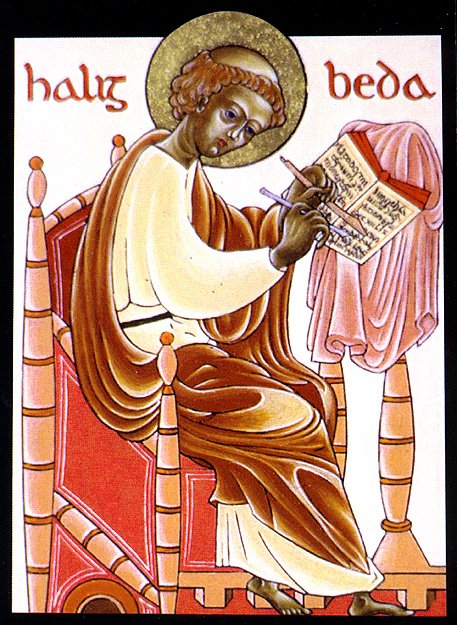
Venerable Bede (Baeda) (735)
Saint Bede was a church historian who recorded the history of Christianity in England up to his own time. He was probably born around 673 in Northumbria. We do not know exactly where he was born, but it is likely that it was somewhere near Jarrow.
When he was seven, Bede was sent to Saint Benedict Biscop (January 12) at the monastery of Saint Peter at Wearmouth to be educated and raised.
Saint Bede was a church historian who recorded the history of Christianity in England up to his own time. He was probably born around 673 in Northumbria. We do not know exactly where he was born, but it is likely that it was somewhere near Jarrow.
When he was seven, Bede was sent to Saint Benedict Biscop (January 12) at the monastery of Saint Peter at Wearmouth to be educated and raised. Then he was sent to the new monastery of Saint Paul founded at Jarrow in 682, where he remained until his death. There he was guided by the abbot Saint Ceolfrith (September 25), who succeeded Saint Benedict in 690, ruling both Wearmouth and Jarrow.
There is an incident in the anonymous Life of Ceolfrith which may refer to the young Bede. A plague swept through Ceolfrith’s monastery in 686, taking most of the monks who sang in the choir for the church services. Only the abbot and a young boy raised and educated by him remained. This young boy “is now a priest of the same monastery and commends the abbot’s admirable deeds both verbally and in writing to all who desire to learn them.”
Grieved by this catastrophe, Ceolfrith decided that they should sing the Psalms without antiphons, except at Matins and Vespers. After a week of this, he went back to chanting the antiphons in their proper place. With the help of the boy and the surviving monks, the services were performed with difficulty until other monks could be brought in and trained to sing.
Saint Bede was ordained as a deacon when he was nineteen, and to the holy priesthood at the age of thirty by Saint John of Beverley (May 7), the holy Bishop of Hexham (687), and later (705) of York. Bede had a great love for the church services, and believed that since the angels were present with the monks during the services, that he should also be there. “What if they do not find me among the brethren when they assemble? Will they not say, ‘Where is Bede?’
Bede began as a pupil of Saint Benedict Biscop, who had been a monk of the famous monastery at Lerins, and had founded monasteries himself. Saint Benedict had brought many books with him to England from Lerins and from other European monasteries. This library enabled Bede to write his own books, which include biblical commentary, ecclesiastical history, and hagiography.
Bede was not an objective historian. He is squarely on the Roman side in the debate with Celtic Christianity, for example. He was, however, fair and thorough. His books, derived from “ancient documents, from the traditions of our ancestors, and from my own personal knowledge” (Book V, 24) give us great insight into the religious and secular life of early Britain. To read Saint Bede is to enter a world shaped by spiritual traditions very similar to those cherished by Orthodox Christians. These saints engage in the same heroic asceticism shown by saints in the East, and their holiness fills us with love and admiration. Christians were expected to fast on Wednesdays and Fridays, and there was a forty day Nativity Fast (Book IV, 30).
Saint Bede became ill in 735. For about two weeks before Pascha, he was weak and had trouble breathing, but experienced little pain. He remained cheerful and gave daily lessons to his students, then spent the rest of the day singing Psalms and giving thanks to God. He would often quote the words of Saint Ambrose, “I have not lived in such a way that I am ashamed to live among you, and I do not fear to die, for God is gracious” (Paulinus, Life of Saint Ambrose, Ch. 45).
In addition to giving daily lessons and chanting the Psalms, Saint Bede was also working on an Anglo-Saxon translation of the Gospel of Saint John, and also a book of extracts from the writings of Saint Isidore of Seville (April 4). On the Tuesday before the Feast of the Lord’s Ascension, the saint’s breathing became more labored, and his feet began to swell. “Learn quickly,” he told those who were taking dictation from him, “for I do not know how long I can continue. The Lord may call me in a short while.”
After a sleepless night, Saint Bede continued his dictation on Wednesday morning. At the Third Hour, there was a procession with the relics of the saints in the monastery, and the brethren went to attend this service, leaving a monk named Wilbert with Bede. The monk reminded him that there remained one more chapter to be written in the book which he was dictating. Wilbert was reluctant to disturb the dying Bede, however. Saint Bede said, “It is no trouble. Take your pen and write quickly.”
At the Ninth Hour, Bede paused and told Wilbert that he had some items in his chest, such as pepper, incense, and linen. He asked the monk to bring the priests of the monastery so that he could distribute these items to them. When they arrived, he spoke to each of them in turn, requesting them to pray for him and to remember him in the services. Then he said, “The time of my departure is at hand, and my soul longs to see Christ my King in His beauty.”
That evening, Wilbert said to him, “Dear Master, there is one sentence left unfinished.”
Bede said, “Very well, write it down.”
Then the young monk said, “It is finished now.”
Saint Bede replied, “You have spoken truly, it is well finished.” Then he asked Wilbert to raise his head so that he could see the church where he used to pray. After chanting, “Glory to the Father, and to the Son, and to the Holy Spirit” to its ending, Saint Bede fell asleep in the Lord Whom he had loved.
Although Saint Bede reposed on May 25, the eve of the Ascension, he is commemorated on the 27th, since the Feast of Saint Augustine of Canterbury is appointed for the 26th. His body was first buried in the south porch of the monastery church, then later transferred to a place near the altar. Today his holy relics lie in Durham Cathedral, in the Galilee chapel. Saint Bede is the only Englishman mentioned by Dante in the DIVINE COMEDY (Paradiso).
Troparion - Tone 8
By a flood of tears you made the desert fertile, / and your longing for God brought forth fruits in abundance. / By the radiance of miracles you illumined the whole universe! / O our holy father Bede, pray to Christ our God to save our souls!
Scripture Readings
☩Epistle
Acts 10:34-43
34
Then Peter opened his mouth, and said, Of a truth I perceive that God is no respecter of persons:
35
But in every nation he that feareth him, and worketh righteousness, is accepted with him.
36
The word which God sent unto the children of Israel, preaching peace by Jesus Christ: (he is Lord of all:)
37
That word, I say, ye know, which was published throughout all Judea, and began from Galilee, after the baptism which John preached;
38
How God anointed Jesus of Nazareth with the Holy Ghost and with power: who went about doing good, and healing all that were oppressed of the devil; for God was with him.
39
And we are witnesses of all things which he did both in the land of the Jews, and in Jerusalem; whom they slew and hanged on a tree:
40
Him God raised up the third day, and shewed him openly;
41
Not to all the people, but unto witnesses chosen before of God, even to us, who did eat and drink with him after he rose from the dead.
42
And he commanded us to preach unto the people, and to testify that it is he which was ordained of God to be the Judge of quick and dead.
43
To him give all the prophets witness, that through his name whosoever believeth in him shall receive remission of sins.
☩Gospel
John 8:12-20
12
Then spake Jesus again unto them, saying, I am the light of the world: he that followeth me shall not walk in darkness, but shall have the light of life.
13
The Pharisees therefore said unto him, Thou bearest record of thyself; thy record is not true.
14
Jesus answered and said unto them, Though I bear record of myself, yet my record is true: for I know whence I came, and whither I go; but ye cannot tell whence I come, and whither I go.
15
Ye judge after the flesh; I judge no man.
16
And yet if I judge, my judgment is true: for I am not alone, but I and the Father that sent me.
17
It is also written in your law, that the testimony of two men is true.
18
I am one that bear witness of myself, and the Father that sent me beareth witness of me.
19
Then said they unto him, Where is thy Father? Jesus answered, Ye neither know me, nor my Father: if ye had known me, ye should have known my Father also.
20
These words spake Jesus in the treasury, as he taught in the temple: and no man laid hands on him; for his hour was not yet come.
Liturgical data sourced from OCA.org and orthocal.info