
Fasting Rules
 Meat
Allowed
 Fish
Allowed
 Dairy
Allowed
 Oil
Allowed
 Wine
Allowed
Saints & Commemorations
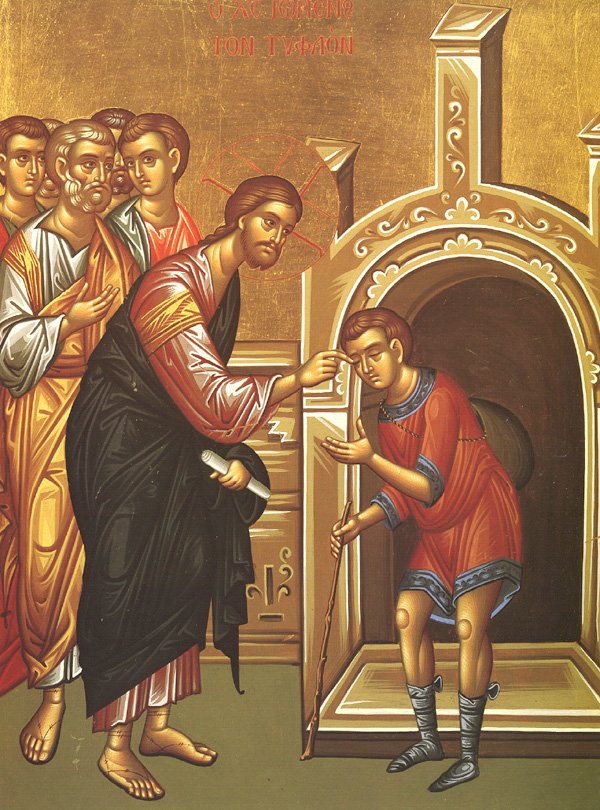
Blind Man
At the end of Chapter 8 in Gospel of Saint John, the Savior was disputing with the Pharisees in the Temple during the Feast of Tabernacles. He told them, "Your father Abraham was glad that he should see my day; and he saw it and rejoiced" (John 8:56). The Jews said that Jesus was not even fifty years old, so how could He claim to have seen Abraham?
At the end of Chapter 8 in Gospel of Saint John, the Savior was disputing with the Pharisees in the Temple during the Feast of Tabernacles. He told them, "Your father Abraham was glad that he should see my day; and he saw it and rejoiced" (John 8:56). The Jews said that Jesus was not even fifty years old, so how could He claim to have seen Abraham? The Lord replied, "Before Abraham was, I am." I am, of course, is the name that God revealed to Moses in the Burning Bush. When the Jews picked up stones to throw at Him, He hid Himself and went out of the Temple.
We read in SaInt John's Gospel (9:1-38): "As He passed by, he saw a man who was blind from birth." It might appear that Jesus was on His way to something or someone else, but in his Commentary on the Gospel of Saint John, the ever-memorable Archbishop Dmitri of Dallas, quotes from Homily LVI of Saint John Chrysostom: "that on going out of the Temple, He proceeded intentionally to the work, is clear from this: it was He who saw the blind man, and not the blind man who came to Him...."
Christ's disciples asked Him who had sinned, the blind man or his parents that he had been born blind. Jesus answered, "Neither this man nor his parents sinned, but that the works of God might be manifested in him" (John 9:3). It was thought that a person who had some affliction must have sinned (or his parents did) to deserve such punishment. In the Book of Exodus (20:5), God said that he would visit "the iniquity of the fathers upon the children unto the third and fourth generation." This, however, applied to the sin of idolatry, if the children emulated their parents' behavior.
The blind man was not born blind just so the miracle could be performed, but seeing the man in such a condition, the Lord decided to use him in a way that would manifest God's glory. He Who is the Light of the world healed the blind man and enlightened him. Giving sight to the blind was one of the signs which would identify the Messiah (Matthew 11:4-6).
The Lord made clay when He spat on the ground, and placed it in the man’s empty eye sockets and sent him to the pool of Siloam to wash. Most versions of the Gospels translate the word επεθηκεν as "anointed," but it can also mean "to spread on," or "to smear." Siloam means "sent," and in Saint John's Gospel Christ says about forty times that He Himself had been sent by the Father."
This manner of healing reminds us of the way God created man by fashioning him from the dust of the earth. In the Old Testament God created man from the dust of the earth, now Christ, the same God, fashions eyes from the clay and places them in the blind man’s empty sockets. Here are some quotes from the Pentecostarion:
At the Oikos of Matins: "He receives physical eyes as well as those of the soul."
In the Verses of the Synaxarion: O Bestower of light. Who are Light coming forth from Light; You gave eyes to the man who was blind from birth, O Word."
In the second exapostilarion: "Along the way, the Savior found a man who lacked both sight and eyes."
At Monday Vespers (stikheron of the Feast) we sing, "With his whole soul, and mind, and his tongue, the man who in times not long passed had been blind, confessed Him Who had fashioned eyes for him out of spittle and clay..."
Saint Theophylaktos says in his Commentary that "Jesus our Lord fashioned all the members of the blind man's body except for the eyes, which He omitted. By healing them now, he completes the divine act of creating and demonstrates that He is the Creator."
Jesus tests the faith of the blind man by sending him to the Pool of Siloam (which means “sent”). He respects the man’s freedom, but asks for his voluntary and free participation in the miracle. The blind man, with faith, obeys God’s command. He goes and washes in the pool, and he returns seeing.
The former blind man’s life was not made easier, however. He becomes the object of the Scribes' and Pharisees' evil and hatred, those who believed in God and in the observance of His Law. They themselves were blind, yet they were suspicious of the formerly blind man, imagining that he only pretended to be blind and now was able to see. "They willingly were made blind by the dark letter of the Law, in which Christ, the resplendent Sun shines." 1
They questioned the man who was blind, but when they see the miracle before their eyes, instead of believing, they shut the eyes of their souls. Then the man's parents were questioned. They were afraid to confirm the miracle that happened to their son who was born blind, because they did not want to be expelled from the synagogue. They tried to avoid trouble by concealing the truth. Therefore, they said, "He is of age, ask him!"
We who receive benefits from God every day are ashamed or afraid to confess God because of our lack of trust. We put our own interests above God, knowing that He will understand us! He will understand us, but He will also see our faith and what priorities we have in our lives. Christ will see what "gods" we have put in His place, but He will not cease to remind us that He is the light of the world.
The blind man was healed, not only in the eyes of his body but eventually in his soul as well. He recognizes Jesus as God, and does not hesitate to confess it before the religious rulers with courage that many of us would envy. Faith alone is not enough, we also need to confess our faith in order to become genuine children of God. When we confess Christ before men, He will confess us before His Father, as the Lord has promised us: "Everyone who shall confess me before men, I also shall confess him before my Father who is in Heaven; and whoever denies me before men I also will deny him before my Father who is in Heaven" (Matthew 10:32).
In addition to the Sunday of the Blind Man, today the Church also commemorates the Icon of the Mother of God "Of the Passion" ( see August 13 ) in remembrance of the miracles which occurred on this day.
In the Moscow church of the Unburnt Bush in the Khamovniki district, there is an Icon which was once in the Palace. The ancient writing is beautiful. The size of the Icon measures 1 arshin 12 vershkov long, and 1 arshin 7 vershkov wide. This Icon is commemorated twice: on September 4, the Feast Day of the Prophet Moses, and also on the Sixth Sunday After Pascha (the Sunday of the Blind Man), because according to Tradition, the Icon was transferred from the Kremlin to the newly-consecrated Khamovniki church on this day.
At Khamovniki is the Novodevichii Convent (founded in 1524) and the Zachatievsky convent (founded in 1584), the rebuilt cathedral of Christ the Savior, the church of Saint Nicholas the Wonderworker at Khamovniki and others. More than ten Orthodox churches in Khamovniki were destroyed during the Soviet era. Memorial chapels and memorial signs have now been placed on the site of some of the destroyed temples. Khamovniki is also the working residence of the Patriarch of Moscow and All Russia, and the Publishing Council of the Russian Orthodox Church.
1 Sunday of the Blind man, at Vespers, fourth stikheron on "Lord, I Call."
Troparion
I come to You, O Christ, / blind from birth in my spiritual eyes / and I call to You in repentance: / You are the most radiant light of those in darkness!
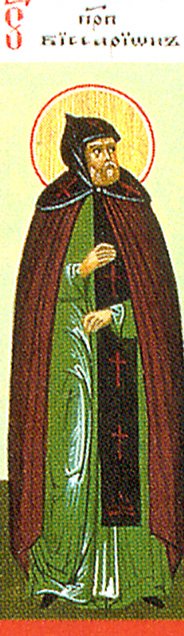
Ven. Bessarion the Wonderworker of Egypt
Saint Bessarion, Wonderworker of Egypt was an Egyptian. He was baptized while still in his youth, and he led a strict life, striving to preserve the grace given him during Baptism. Seeking to become more closely acquainted with the monastic life, he journeyed to the holy places. He was in Jerusalem, he visited Saint Gerasimus (March 4) in the Jordanian wilderness, he viewed other desert monasteries, and assimilated all the rules of monastic life.
Saint Bessarion, Wonderworker of Egypt was an Egyptian. He was baptized while still in his youth, and he led a strict life, striving to preserve the grace given him during Baptism. Seeking to become more closely acquainted with the monastic life, he journeyed to the holy places. He was in Jerusalem, he visited Saint Gerasimus (March 4) in the Jordanian wilderness, he viewed other desert monasteries, and assimilated all the rules of monastic life.
Upon his return, he received monastic tonsure and became a disciple of Saint Isidore of Pelusium (February 4). Saint Bessarion took a vow of silence, and partook of food only once a week. Sometimes he remained without food or drink for forty days. Once, the saint stood motionless for forty days and forty nights without food or sleep, immersed in prayer.
Saint Bessarion received from God the gift of wonderworking. When his disciple was very thirsty, he sweetened bitter water. By his prayer the Lord sent rain upon the earth, and he could cross a river as if on dry land. With a single word he cast out devils, but he did this privately to avoid glory.
His humility was so great that once, when a priest ordered someone from the skete to leave church for having fallen into sin, Bessarion also went with him saying, “I am a sinner, too.” Saint Bessarion slept only while standing or sitting. A large portion of his life was spent under the open sky in prayerful solitude. He peacefully departed to the Lord in his old age.
Troparion - Tone 4
O God of our Fathers, / always act with kindness towards us; / take not Your mercy from us, / but guide our lives in peace / through the prayers of the venerable Bessarion and Hilarion the New.
Kontakion - Tone 2
You imitated the powers on high, venerable Bessarion, / living by example the life of those who take flight. / Led by steadfast desire to the heavenly good things of Christ the King, / you put passing things from your mind and attained to Him. / Entreat Him without ceasing for the sake of us all!
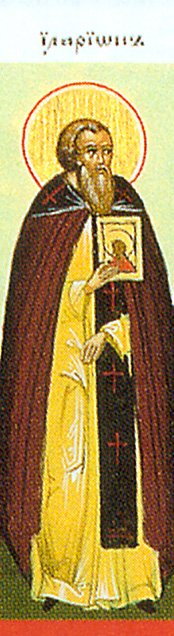
St Hilarion the New, abbot of the Dalmatian Monastery (845)
Saint Hilarion the New was born of pious parents, Peter and Theodosia, who raised him in the virtues and instructed him in Holy Scripture. At twelve years of age Saint Hilarion was tonsured as a monk at the Hesychius monastery near Constantinople, and from there he transferred to the Dalmatus monastery, where he received the Great Schema and became a disciple of Saint Gregory the Dekapolite (November 20).
Saint Hilarion the New was born of pious parents, Peter and Theodosia, who raised him in the virtues and instructed him in Holy Scripture. At twelve years of age Saint Hilarion was tonsured as a monk at the Hesychius monastery near Constantinople, and from there he transferred to the Dalmatus monastery, where he received the Great Schema and became a disciple of Saint Gregory the Dekapolite (November 20).
The monk deeply venerated his God-bearing patron Saint Hilarion the Great (October 21), and he strove to imitate his life, so he came to be called Hilarion the New. At the Dalmatus monastery, he was ordained presbyter. After the death of the igumen the brethren wanted to elect Saint Hilarion to this position, but learning of this, he secretly fled to Constantinople.
Then the monks of Dalmatus monastery sent a petition to Patriarch Nikēphóros, asking that Saint Hilarion be assigned as igumen. The Patriarch summoned the saint and persuaded him to give his assent. Saint Hilarion submitted out of holy obedience. For eight years he peacefully guided the monastery, but in the year 813 the iconoclast Leo the Armenian (813-820) occupied the imperial throne. The saint refused to dishonor the holy icons, and he boldly accused the emperor of heresy, for which he endured many torments. They locked him up in prison for awhile, and vexed him with hunger and thirst.
The impious Patriarch Theodotus, who replaced the exiled Patriarch Nikēphóros, caused the monk much suffering in demanding that he abandon Orthodoxy. The monks of the Dalmatus monastery went to the emperor and asked him to release the saint, promising to submit to the imperial will. After they returned to the monastery, however, Saint Hilarion and the monks continued to venerate the holy icons. The enraged emperor again threw the monk into prison. He gave the saint over to torture with all the means at his disposal, hoping to change his mind.
The wrath of God soon overtook the wicked emperor. He was cut down by his own soldiers in church at the very spot where he had once thrown down a holy icon. The new emperor Michael II (820-829) freed Saint Hilarion from his imprisonment, and the saint settled into a monastic cell. Upon the death of Saint Theodore the Studite (November 11), who also suffered for the holy icons, Saint Hilarion beheld holy angels taking the soul of Saint Theodore to Heaven.
Under the iconoclast emperor Theophilus (829-842), Saint Hilarion was again put under guard and beaten terribly, then they confined him on the island of Aphousia.
After the death of Theophilus, the holy empress Saint Theodora (842-855) gave orders to recall the confessors from exile. Saint Hilarion returned to the Dalmatus monastery, again agreeing to be igumen. He departed peacefully in the year 845.
Troparion - Tone 4
O God of our Fathers, / always act with kindness towards us; / take not Your mercy from us, / but guide our lives in peace / through the prayers of the venerable Bessarion and Hilarion the New.
Kontakion - Tone 2
You imitated the powers on high, venerable Hilarion, / living by example the life of those who take flight. / Led by steadfast desire to the heavenly good things of Christ the King, / you put passing things from your mind and attained to Him. / Entreat Him without ceasing for the sake of us all!
Our Holy Mothers the Martyrs Archelaïs, Thekla and Susanna (293)
The Holy Virgin Martyrs Archelais, Thekla and Susanna sought salvation in a small monastery near Rome. During the persecution by Diocletian (284-305), the holy virgins dressed themselves in men’s clothing, cut their hair and went to the Italian province of Campania. Settling in a remote area, they continued to pursue an ascetical life of fasting and prayer. T
The Holy Virgin Martyrs Archelais, Thekla and Susanna sought salvation in a small monastery near Rome. During the persecution by Diocletian (284-305), the holy virgins dressed themselves in men’s clothing, cut their hair and went to the Italian province of Campania. Settling in a remote area, they continued to pursue an ascetical life of fasting and prayer. They received the gift of healing from God, and treated the local inhabitants, converting many pagans to Christ.
When the governor of the district heard about them, he had them brought to Salerno. He threatened Saint Archelais with torture and death if she did not offer sacrifice to idols. With firm hope in the Lord, the saint refused to submit to the command, and she denounced the folly of worshipping soulless statues. Then the governor ordered the saint to be torn apart by hungry lions, but the beasts meekly lay at her feet. In a rage the governor ordered the lions to be killed, and locked the holy virgins in prison.
In the morning, having suspended Saint Archelais, the torturers began to rake her with iron utensils and pour hot tar on the wounds. The saint prayed even more loudly, and suddenly a light shone over her and a voice was heard, “Fear not, for I am with you.”
The saint was defended by the power of God. When they wanted to crush her with an immense stone, an angel pushed it to the other side, and it crushed the torturers instead. A judge ordered soldiers to behead the holy virgins, but the soldiers did not dare to put their hands upon the saints. Then Saints Archelais, Thekla and Susanna said to the soldiers, “If you do not fulfill the command, you shall have no respect from us.” The holy martyrs were beheaded in 293.
In the nineteenth century, Saint Susanna appeared to a disciple of Elder Boniface saying, “We must pray to God with the soul, the mind, and the heart.” She is described as a maiden of untold beauty, with a soft, pleasant voice.
Troparion - Tone 1
As reasonable lambs, you were guided by Christ, the Chief Shepherd, / along the path of martyrdom. / You finished your course and kept the faith; / therefore, honored Archelais, Thekla, and Susanna, / with joyful hearts, we magnify Christ today, as we honor your holy memory!
Scripture Readings
☩Epistle
Acts 16:16-34
16
And it came to pass, as we went to prayer, a certain damsel possessed with a spirit of divination met us, which brought her masters much gain by soothsaying:
17
The same followed Paul and us, and cried, saying, These men are the servants of the most high God, which shew unto us the way of salvation.
18
And this did she many days. But Paul, being grieved, turned and said to the spirit, I command thee in the name of Jesus Christ to come out of her. And he came out the same hour.
19
And when her masters saw that the hope of their gains was gone, they caught Paul and Silas, and drew them into the marketplace unto the rulers,
20
And brought them to the magistrates, saying, These men, being Jews, do exceedingly trouble our city,
21
And teach customs, which are not lawful for us to receive, neither to observe, being Romans.
22
And the multitude rose up together against them: and the magistrates rent off their clothes, and commanded to beat them.
23
And when they had laid many stripes upon them, they cast them into prison, charging the jailor to keep them safely:
24
Who, having received such a charge, thrust them into the inner prison, and made their feet fast in the stocks.
25
And at midnight Paul and Silas prayed, and sang praises unto God: and the prisoners heard them.
26
And suddenly there was a great earthquake, so that the foundations of the prison were shaken: and immediately all the doors were opened, and every one’s bands were loosed.
27
And the keeper of the prison awaking out of his sleep, and seeing the prison doors open, he drew out his sword, and would have killed himself, supposing that the prisoners had been fled.
28
But Paul cried with a loud voice, saying, Do thyself no harm: for we are all here.
29
Then he called for a light, and sprang in, and came trembling, and fell down before Paul and Silas,
30
And brought them out, and said, Sirs, what must I do to be saved?
31
And they said, Believe on the Lord Jesus Christ, and thou shalt be saved, and thy house.
32
And they spake unto him the word of the Lord, and to all that were in his house.
33
And he took them the same hour of the night, and washed their stripes; and was baptized, he and all his, straightway.
34
And when he had brought them into his house, he set meat before them, and rejoiced, believing in God with all his house.
☩Gospel
John 9:1-38
1
And as Jesus passed by, he saw a man which was blind from his birth.
2
And his disciples asked him, saying, Master, who did sin, this man, or his parents, that he was born blind?
3
Jesus answered, Neither hath this man sinned, nor his parents: but that the works of God should be made manifest in him.
4
I must work the works of him that sent me, while it is day: the night cometh, when no man can work.
5
As long as I am in the world, I am the light of the world.
6
When he had thus spoken, he spat on the ground, and made clay of the spittle, and he anointed the eyes of the blind man with the clay,
7
And said unto him, Go, wash in the pool of Siloam, (which is by interpretation, Sent.) He went his way therefore, and washed, and came seeing.
8
The neighbours therefore, and they which before had seen him that he was blind, said, Is not this he that sat and begged?
9
Some said, This is he: others said, He is like him: but he said, I am he.
10
Therefore said they unto him, How were thine eyes opened?
11
He answered and said, A man that is called Jesus made clay, and anointed mine eyes, and said unto me, Go to the pool of Siloam, and wash: and I went and washed, and I received sight.
12
Then said they unto him, Where is he? He said, I know not.
13
They brought to the Pharisees him that aforetime was blind.
14
And it was the sabbath day when Jesus made the clay, and opened his eyes.
15
Then again the Pharisees also asked him how he had received his sight. He said unto them, He put clay upon mine eyes, and I washed, and do see.
16
Therefore said some of the Pharisees, This man is not of God, because he keepeth not the sabbath day. Others said, How can a man that is a sinner do such miracles? And there was a division among them.
17
They say unto the blind man again, What sayest thou of him, that he hath opened thine eyes? He said, He is a prophet.
18
But the Jews did not believe concerning him, that he had been blind, and received his sight, until they called the parents of him that had received his sight.
19
And they asked them, saying, Is this your son, who ye say was born blind? how then doth he now see?
20
His parents answered them and said, We know that this is our son, and that he was born blind:
21
But by what means he now seeth, we know not; or who hath opened his eyes, we know not: he is of age; ask him: he shall speak for himself.
22
These words spake his parents, because they feared the Jews: for the Jews had agreed already, that if any man did confess that he was Christ, he should be put out of the synagogue.
23
Therefore said his parents, He is of age; ask him.
24
Then again called they the man that was blind, and said unto him, Give God the praise: we know that this man is a sinner.
25
He answered and said, Whether he be a sinner or no, I know not: one thing I know, that, whereas I was blind, now I see.
26
Then said they to him again, What did he to thee? how opened he thine eyes?
27
He answered them, I have told you already, and ye did not hear: wherefore would ye hear it again? will ye also be his disciples?
28
Then they reviled him, and said, Thou art his disciple; but we are Moses’ disciples.
29
We know that God spake unto Moses: as for this fellow, we know not from whence he is.
30
The man answered and said unto them, Why herein is a marvellous thing, that ye know not from whence he is, and yet he hath opened mine eyes.
31
Now we know that God heareth not sinners: but if any man be a worshipper of God, and doeth his will, him he heareth.
32
Since the world began was it not heard that any man opened the eyes of one that was born blind.
33
If this man were not of God, he could do nothing.
34
They answered and said unto him, Thou wast altogether born in sins, and dost thou teach us? And they cast him out.
35
Jesus heard that they had cast him out; and when he had found him, he said unto him, Dost thou believe on the Son of God?
36
He answered and said, Who is he, Lord, that I might believe on him?
37
And Jesus said unto him, Thou hast both seen him, and it is he that talketh with thee.
38
And he said, Lord, I believe. And he worshipped him.
Liturgical data sourced from OCA.org and orthocal.info