
Fasting Rules
 Meat
Allowed
 Fish
Allowed
 Dairy
Allowed
 Oil
Allowed
 Wine
Allowed
Saints & Commemorations
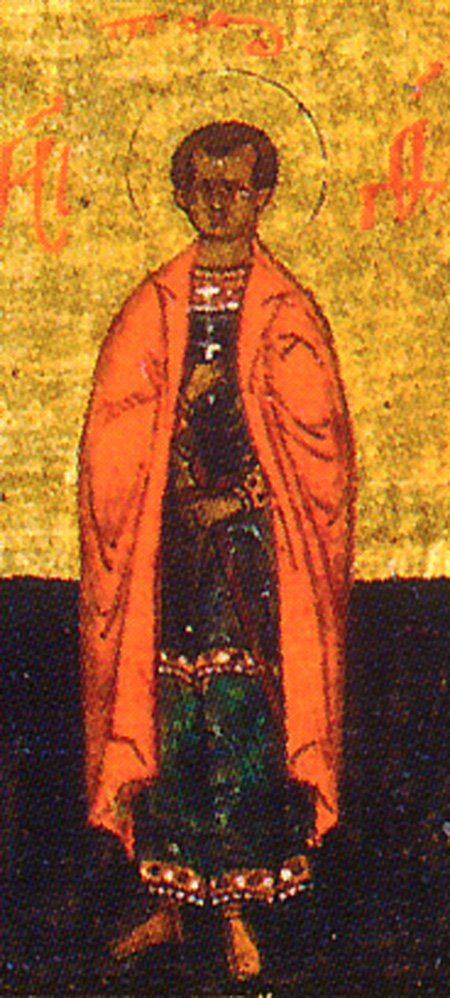
Hieromartyr Theodotus, Bishop of Ancyra
The Holy Martyr Theodotus lived in Ancyra of Galatia in the third century. He was distinguished by his kindliness and concern. At the height of the persecution under Diocletian (284-305) he provided Christians with everything they needed, and gave them shelter in his home. There they secretly celebrated church services.
The Holy Martyr Theodotus lived in Ancyra of Galatia in the third century. He was distinguished by his kindliness and concern. At the height of the persecution under Diocletian (284-305) he provided Christians with everything they needed, and gave them shelter in his home. There they secretly celebrated church services.
Saint Theodotus visited the Christian captives in prison, paid their bail, and reverently buried the bodies of martyrs who had been thrown to the wild beasts. Once he buried the bodies of seven holy women martyrs, who were drowned in the sea (May 18). This was reported to the governor.
After refusing to offer sacrifice to idols, and denouncing the folly of paganism, Saint Theodotus confessed Christ as God, for which they subjected him to terrible tortures and beheaded him with a sword. They wanted to burn the holy martyr’s body, but could not do so because of a storm which had arisen, so they gave his holy relics to a certain Christian for burial.
Saint Theodotus is also commemorated on May 18.
Troparion - Tone 4
Your holy martyr Theodotus and his companions, O Lord, / through their sufferings have received incorruptible crowns from You, our God. / For having Your strength, they laid low their adversaries, / and shattered the powerless boldness of demons. / Through their intercessions, save our souls!
Kontakion - Tone 2
You struggled well, O Theodotus, / together with your fellow athletes and passion-bearing virgins. / You have received crowns of honor. / Therefore, unceasingly pray to Christ God for us all.
Zenais the Martyr
Hieromartyr Marcellinus, pope of Rome (304)
Saint Marcellinus was Pope of Rome during the height of the persecution against Christians under Diocletian and Maximian (284-305), when 17,000 men were martyred a single month. During this time Saint Marcellinus was also arrested. Afraid of the fierce tortures, he burned incense and offered sacrifice to idols.
Saint Marcellinus was Pope of Rome during the height of the persecution against Christians under Diocletian and Maximian (284-305), when 17,000 men were martyred a single month. During this time Saint Marcellinus was also arrested. Afraid of the fierce tortures, he burned incense and offered sacrifice to idols. The emperor called him his friend and clothed him in splendid robes. Although he had encouraged others to undergo torture for Christ, he gave in to cowardice. He wept bitterly, filled with remorse.
During this time, a Synod of 180 bishops and presbyters met at the city of Sinuessa (in Campania). Saint Marcellinus appeared at the assembly in penitential sackcloth, his head sprinkled with ashes. He confessed his sin before the delegates and asked them to judge him. The Fathers of the Council said, “Judge yourself! From your lips this sin came forth, from your lips let judgment be pronounced. We know that even Saint Peter denied Christ out of fear, but he wept bitterly for his sin, and received forgiveness from the Lord.”
Then Marcellinus pronounced sentence upon himself, “I strip myself of the priestly dignity, of which I am unworthy. After death, do not bury my body, but instead throw it to the dogs. Cursed be the one who dares to bury it.”
Upon his return to Rome Marcellinus went to the emperor, threw down the fine clothing given him, and said that he regretted his renunciation of Christ. The enraged emperor had him tortured, and sentenced him to death.
Saint Marcellinus prayed to the Lord Jesus Christ, Who mercifully receives sinners who repent, then willingly placed his head beneath the sword. The holy martyrs Claudius, Cyrinus and Antoninus were beheaded with him.
The body of Saint Marcellinus lay for thirty-six days along the wayside. Appearing in a vision to the new bishop Marcellus, the holy Apostle Peter said, “Why have you not buried the body of Marcellinus?”
“I fear his curse,” replied Saint Marcellus.
“Perhaps you do not remember,” said the Apostle Peter, “that it is written: ‘He that humbles himself shall be exalted.’ Therefore, go bury his body with reverence.”
Fulfilling the command of the Apostle Peter, Saint Marcellus buried the body of Saint Marcellinus in a crypt, built for the burial of the bodies of martyrs by the illustrious Priscilla, along the Via Salaria.
Troparion - Tone 4
Your holy martyrs O Lord, / through their sufferings have received incorruptible crowns from You, our God. / For having Your strength, they laid low their adversaries, / and shattered the powerless boldness of demons. / Through their intercessions, save our souls!
St Daniel of Skete in Egypt (5th c.)
He was a disciple of St Arsenios the great and abbot of the Scetis in Egypt (the monastic system known as the “Skete” takes its name from Scetis). He lived the communal monastic life for forty years, then in 420 retired to the desert, where he remained until his repose.
From the Prologue: “A saint has a very sensitive conscience. What
He was a disciple of St Arsenios the great and abbot of the Scetis in Egypt (the monastic system known as the “Skete” takes its name from Scetis). He lived the communal monastic life for forty years, then in 420 retired to the desert, where he remained until his repose.
From the Prologue: “A saint has a very sensitive conscience. What ordinary people may consider a small sin, a saint sees as a great crime. It is said of Abba Daniel that highwaymen attacked him on three occasions and took him off to the mountains. Twice he was rescued, but the third time, in attempting to escape, he struck one of them with a stone and killed him, and then made his escape. That murder lay on his conscience like a lead weight. In perplexity as to what he should do, he went to Timothy, the Patriarch of Alexandria, and asked his advice. The Patriarch soothed him, and released him from all penance. But his conscience continued to gnaw at him, and he went to Rome, to the Pope. The Pope gave him the same reply as had the Patriarch. Still dissatisfied, Daniel visited the remaining patriarchs in turn; going to Constantinople, Antioch and Jerusalem, confessing to each of them and asking for advice. But he could find no peace. So he returned home to Alexandria and declared himself to the authorities as a murderer, and was flung into prison. At his trial before the governor, Daniel told how everything had come about, and pleaded that he might be killed too, that his soul might be saved from eternal fire. The governor was amazed at the whole thing, and said to him: ‘Go your way, Father, and pray to God for me, even if you kill seven more!’ Still dissatisfied with this, Daniel resolved to take a leper into his cell and care for him until he died, and then find another. He did as he had resolved, and in this way brought peace to his conscience.”
Scripture Readings
☩Epistle
Acts 17:1-15
1
Now when they had passed through Amphipolis and Apollonia, they came to Thessalonica, where was a synagogue of the Jews:
2
And Paul, as his manner was, went in unto them, and three sabbath days reasoned with them out of the scriptures,
3
Opening and alleging, that Christ must needs have suffered, and risen again from the dead; and that this Jesus, whom I preach unto you, is Christ.
4
And some of them believed, and consorted with Paul and Silas; and of the devout Greeks a great multitude, and of the chief women not a few.
5
But the Jews which believed not, moved with envy, took unto them certain lewd fellows of the baser sort, and gathered a company, and set all the city on an uproar, and assaulted the house of Jason, and sought to bring them out to the people.
6
And when they found them not, they drew Jason and certain brethren unto the rulers of the city, crying, These that have turned the world upside down are come hither also;
7
Whom Jason hath received: and these all do contrary to the decrees of Cesar, saying that there is another king, one Jesus.
8
And they troubled the people and the rulers of the city, when they heard these things.
9
And when they had taken security of Jason, and of the other, they let them go.
10
And the brethren immediately sent away Paul and Silas by night unto Berea: who coming thither went into the synagogue of the Jews.
11
These were more noble than those in Thessalonica, in that they received the word with all readiness of mind, and searched the scriptures daily, whether those things were so.
12
Therefore many of them believed; also of honourable women which were Greeks, and of men, not a few.
13
But when the Jews of Thessalonica had knowledge that the word of God was preached of Paul at Berea, they came thither also, and stirred up the people.
14
And then immediately the brethren sent away Paul to go as it were to the sea: but Silas and Timotheus abode there still.
15
And they that conducted Paul brought him unto Athens: and receiving a commandment unto Silas and Timotheus for to come to him with all speed, they departed.
☩Gospel
John 11:47-57
47
Then gathered the chief priests and the Pharisees a council, and said, What do we? for this man doeth many miracles.
48
If we let him thus alone, all men will believe on him: and the Romans shall come and take away both our place and nation.
49
And one of them, named Caiaphas, being the high priest that same year, said unto them, Ye know nothing at all,
50
Nor consider that it is expedient for us, that one man should die for the people, and that the whole nation perish not.
51
And this spake he not of himself: but being high priest that year, he prophesied that Jesus should die for that nation;
52
And not for that nation only, but that also he should gather together in one the children of God that were scattered abroad.
53
Then from that day forth they took counsel together for to put him to death.
54
Jesus therefore walked no more openly among the Jews; but went thence unto a country near to the wilderness, into a city called Ephraim, and there continued with his disciples.
55
And the Jews’ passover was nigh at hand: and many went out of the country up to Jerusalem before the passover, to purify themselves.
56
Then sought they for Jesus, and spake among themselves, as they stood in the temple, What think ye, that he will not come to the feast?
57
Now both the chief priests and the Pharisees had given a commandment, that, if any man knew where he were, he should shew it, that they might take him.
Liturgical data sourced from OCA.org and orthocal.info