
Fasting Rules
 Meat
Allowed
 Fish
Allowed
 Dairy
Allowed
 Oil
Allowed
 Wine
Allowed
Saints & Commemorations
Memorial Saturday
Today we remember all pious and Orthodox Christians who have fallen asleep in the Lord, and also recall the dread Day of Judgment. May Christ our God be merciful to them, and to us.
Two Epistles (Acts 28:1-31, I Thess. 4:13-17) and two Gospels (JN 21:14-25, JN 5:24-30) are appointed to be read at Liturgy.
Today we remember all pious and Orthodox Christians who have fallen asleep in the Lord, and also recall the dread Day of Judgment. May Christ our God be merciful to them, and to us.
Two Epistles (Acts 28:1-31, I Thess. 4:13-17) and two Gospels (JN 21:14-25, JN 5:24-30) are appointed to be read at Liturgy. The readings from Acts and the Gospel of Saint John, which began on Pascha, now come to an end. The book of Acts does not end, as might be expected, with the death of Saints Peter and Paul, but remains open-ended.
In his article “With all the Saints,” Father Justin Popovich says that the Lives of the Saints are nothing less than a “continuation of the Acts of the Apostles.” Just as the book of Acts describes the works of Christ which the Apostles accomplished through Christ, Who was dwelling in them and working through them, the saints also preach the same Gospel, live the same life, manifest the same righteousness, love, and power from on High. As we prepare for the Sunday of All Saints, we are reminded that each of us is called to a life of holiness.
On this seventh Saturday of Pascha, Saint John Chrysostom’s “Homily on Patience and Gratitude” is appointed to be read in church. It is also prescribed to be read at the funeral service of an Orthodox Christian.
Troparion - Tone 8
Only Creator, with wisdom profound, You mercifully order all things, / and give that which is needed to all men: / Give rest, O Lord, to the souls of Your servants who have fallen asleep, / for they have placed their trust in You, our Maker and Fashioner, and our God.
Kontakion - Tone 8
With the saints give rest, O Christ, to the souls of Your servants, / where there is neither sickness nor sorrow, and no more sighing, / but life everlasting.
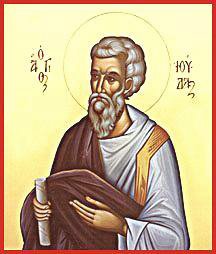
Holy Apostle Jude, Brother of the Lord
The Holy Apostle Jude, one of the twelve apostles of Christ, is descended from King David and Solomon, and was the son of Righteous Joseph the Betrothed (Sunday after the Nativity of the Lord) by his first wife.
The Holy Apostle John the Theologian writes in his Gospel, “... neither did his brethren believe in Him” (John. 7:5
The Holy Apostle Jude, one of the twelve apostles of Christ, is descended from King David and Solomon, and was the son of Righteous Joseph the Betrothed (Sunday after the Nativity of the Lord) by his first wife.
The Holy Apostle John the Theologian writes in his Gospel, “... neither did his brethren believe in Him” (John. 7:5). Saint Theophylact, Archbishop of Bulgaria, explains this passage. He says that at the beginning of the Lord Jesus Christ’s earthly ministry, Joseph’s sons, Jude among them, did not believe in His divine nature. Tradition says that when Saint Joseph returned from Egypt, he began to divide his possessions among his sons. He wanted to allot a share to Christ the Savior, born miraculously and incorruptibly from the All-Pure Virgin Mary. The brothers were opposed to this because Jesus was born of another mother. Only James, later called “The Brother of God,” offered to share his portion with Him.
Jude came to believe in Christ the Savior as the awaited Messiah, and he followed Him and was chosen as one of the twelve Apostles. Mindful of his sin, the Apostle Jude considered himself unworthy to be called the Lord’s brother, and in his Epistle he calls himself merely the brother of James.
The Holy Apostle Jude also had other names: the Evangelist Matthew terms him “Lebbaeus, whose surname was Thaddeus” (Mt. 10:3). The Holy Evangelist Mark also calls him Thaddeus (Mark 3:18), and in the Acts of the Holy Apostles he is called Barsabas (Acts 15: 22). This was customary at that time.
After the Ascension of the Lord Jesus Christ, Saint Jude traveled about preaching the Gospel. He propagated the faith in Christ at first in Judea, Galilee, Samaria and Idumaia, and later in the lands of Arabia, Syria and Mesopotamia. Finally, he went to the city of Edessa. Here he finished the work that was not completed by his predecessor, Saint Thaddeus, Apostle of the Seventy (August 21). There is a tradition that Saint Jude went to Persia, where he wrote his catholic Epistle in Greek. In the Epistle much profound truth was expressed in a few words.
Saint Jude’s Epistle speaks about the Holy Trinity, about the Incarnation of the Lord Jesus Christ, about the good and bad angels, and about the dread Last Judgment. The Apostle urges believers to guard themselves against fleshly impurity, to be diligent in prayer, faith and love, to convert the lost to the path of salvation, and to guard themselves from the teachings of heretics. He also says that it is not enough just to be converted to Christianity, but faith must be demonstrated by good works. He cites the rebellious angels and men punished by God (verse 6) to support this.
The Holy Apostle Jude died as a martyr around the year 80 near Mt. Ararat in Armenia, where he was crucified and pierced by arrows.
Troparion - Tone 1
Divinely we praise you, O Jude, as a faithful witness, / knowing you to be the brother of Christ. / You trampled on delusion, / and so preserved the faith. / Today as we celebrate your holy memory, / by your intercessions we receive remission of sins.
Kontakion - Tone 2
You were chosen as a disciple for your firmness of mind: / An unshakable pillar of the Church of Christ, / you proclaimed His word to the Gentiles, / telling them to believe in one Godhead. / You were glorified by Him, receiving the grace of healing, / healing the ills of all who came to you, / O most praised Apostle Jude!

Our Holy Father Païsius the Great of Egypt (400)
Saint Paisius the Great lived in Egypt. His parents, Christians, distributed generous alms to all the needy.
After the death of her husband his mother, on the suggestion of an angel, gave her young son Paisius to the clergy of the church.
The youth Paisius loved monastic life and spent his time in one of the Egyptian sketes.
Saint Paisius the Great lived in Egypt. His parents, Christians, distributed generous alms to all the needy.
After the death of her husband his mother, on the suggestion of an angel, gave her young son Paisius to the clergy of the church.
The youth Paisius loved monastic life and spent his time in one of the Egyptian sketes. Renouncing his own will, he lived under the spiritual guidance of Saint Pambo (July 18), finishing all the tasks assigned him. The Elder said that a new monk in particular needs to preserve his sight, in order to guard his senses from temptation. Paisius, heeding the instruction, went for three years with his eyes cast downwards. The saintly ascetic read spiritual books, and he was known for his ascetic fasting and prayer. At first he did not eat any food for a week, then two weeks. Sometimes, after partaking of the Holy Mysteries of Christ, he survived without food for seventy days.
Saint Paisius went into the Nitrian desert in search of solitude. There he lived in a cave carved out by his own hands. The saint was granted a wondrous vision: the Lord Jesus Christ revealed to him that through his labors the Nitrian wilderness would become inhabited by ascetics. He asked the Lord where the monks would obtain the necessities of life in the desert. The Lord said that if they would fulfill all His commandments, He Himself would provide all their necessities, and would deliver them from demonic temptations and cunning.
In time, a number of monks and laymen gathered around Saint Paisius, and a monastery was established. The most important rule of Saint Paisius was that no one would do anything by his own will, but in all things would fulfill the will of his elders.
Since his tranquility was being disturbed by so many people, the saint withdrew to another cave farther away. Once, he was transported to a paradisical monastery and partook of the immaterial divine food. After his ascetic labors for salvation, the Lord granted His saint the gift of prescience and healing the souls of men.
One of his disciples, with the saint’s blessing, went to sell his handicrafts in Egypt. On the way he encountered a Jew, who told the simple-minded monk that Christ the Savior is not the Messiah, and that another Messiah will come. Confused, the monk said, “Maybe what you say is true,” but he did not attribute any particular significance to his words. When he returned, he saw that Saint Paisius would not acknowledge his arrival, and he asked the reason for his anger. The saint said, “My disciple was a Christian. You are not a Christian, for the grace of Baptism has departed from you.” The monk repented with tears, and begged to have his sin forgiven. Only then did the holy Elder pray and ask the Lord to forgive the monk.
A certain monk on his own initiative left the desert and moved near a city. There he had encounters with a woman, who hated and blasphemed Christ the Savior. Under her influence, he not only left the monastery, but also scorned faith in Christ, and finally he reached a state of total disbelief.
Once, through the blessed Providence of God, Nitrian monks came by his home. Seeing them, the sinner remembered his own former life and he asked the monks to ask Saint Paisius to pray for him to the Lord. On hearing the request, the saint prayed fervently, and his prayer was heard. The Lord, appearing to His saint, promised to forgive the sinner. Soon the seduced monk’s woman companion died, and he returned to the desert where, weeping and distressed for his sins, he began to labor at deeds of repentance.
Saint Paisius distinguished himself by his great humility, and performed ascetic deeds of fasting and prayer, but he concealed them from others as far as possible. When the monks asked which virtue is the highest of all, the saint replied, “Those which are done in secret, and about which no one knows.”
Saint Paisius died in the fifth century at a great old age, and he was buried by the monks. After some time his relics were transferred by Saint Isidore of Pelusium (February 4) to his own monastery and placed beside the relics of his friend Saint Paul, with whom Saint Paisius was particularly close during his life.
Troparion - Tone 4
Fervently, let us honor the God-bearer Paϊsios, / an Angel in the flesh, the crown of Monastics, / an incorporeal man and a citizen of Heaven, / who celebrates with us, / granting grace to all who rejoice in his memory.
Kontakion - Tone 8
Let us, the faithful, sing praises to the godly-wise Paϊsios, / the adornment of the desert, equal of the Angels,
the friend of Christ, and the glory of Monastic Saints. / Let us cry to him: “Rejoice, O Father Paϊsios.”
Holy Martyr Zosima
Scripture Readings
☩Epistle
Acts 28:1-31
1
And when they were escaped, then they knew that the island was called Melita.
2
And the barbarous people shewed us no little kindness: for they kindled a fire, and received us every one, because of the present rain, and because of the cold.
3
And when Paul had gathered a bundle of sticks, and laid them on the fire, there came a viper out of the heat, and fastened on his hand.
4
And when the barbarians saw the venomous beast hang on his hand, they said among themselves, No doubt this man is a murderer, whom, though he hath escaped the sea, yet vengeance suffereth not to live.
5
And he shook off the beast into the fire, and felt no harm.
6
Howbeit they looked when he should have swollen, or fallen down dead suddenly: but after they had looked a great while, and saw no harm come to him, they changed their minds, and said that he was a god.
7
In the same quarters were possessions of the chief man of the island, whose name was Publius; who received us, and lodged us three days courteously.
8
And it came to pass, that the father of Publius lay sick of a fever and of a bloody flux: to whom Paul entered in, and prayed, and laid his hands on him, and healed him.
9
So when this was done, others also, which had diseases in the island, came, and were healed:
10
Who also honoured us with many honours; and when we departed, they laded us with such things as were necessary.
11
And after three months we departed in a ship of Alexandria, which had wintered in the isle, whose sign was Castor and Pollux.
12
And landing at Syracuse, we tarried there three days.
13
And from thence we fetched a compass, and came to Rhegium: and after one day the south wind blew, and we came the next day to Puteoli:
14
Where we found brethren, and were desired to tarry with them seven days: and so we went toward Rome.
15
And from thence, when the brethren heard of us, they came to meet us as far as Appii forum, and The three taverns: whom when Paul saw, he thanked God, and took courage.
16
And when we came to Rome, the centurion delivered the prisoners to the captain of the guard: but Paul was suffered to dwell by himself with a soldier that kept him.
17
And it came to pass, that after three days Paul called the chief of the Jews together: and when they were come together, he said unto them, Men and brethren, though I have committed nothing against the people, or customs of our fathers, yet was I delivered prisoner from Jerusalem into the hands of the Romans.
18
Who, when they had examined me, would have let me go, because there was no cause of death in me.
19
But when the Jews spake against it, I was constrained to appeal unto Cesar; not that I had ought to accuse my nation of.
20
For this cause therefore have I called for you, to see you, and to speak with you: because that for the hope of Israel I am bound with this chain.
21
And they said unto him, We neither received letters out of Judea concerning thee, neither any of the brethren that came shewed or spake any harm of thee.
22
But we desire to hear of thee what thou thinkest: for as concerning this sect, we know that every where it is spoken against.
23
And when they had appointed him a day, there came many to him into his lodging; to whom he expounded and testified the kingdom of God, persuading them concerning Jesus, both out of the law of Moses, and out of the prophets, from morning till evening.
24
And some believed the things which were spoken, and some believed not.
25
And when they agreed not among themselves, they departed, after that Paul had spoken one word, Well spake the Holy Ghost by Esaias the prophet unto our fathers,
26
Saying, Go unto this people, and say, Hearing ye shall hear, and shall not understand; and seeing ye shall see, and not perceive:
27
For the heart of this people is waxed gross, and their ears are dull of hearing, and their eyes have they closed; lest they should see with their eyes, and hear with their ears, and understand with their heart, and should be converted, and I should heal them.
28
Be it known therefore unto you, that the salvation of God is sent unto the Gentiles, and that they will hear it.
29
And when he had said these words, the Jews departed, and had great reasoning among themselves.
30
And Paul dwelt two whole years in his own hired house, and received all that came in unto him,
31
Preaching the kingdom of God, and teaching those things which concern the Lord Jesus Christ, with all confidence, no man forbidding him.
☩Gospel
John 21:15-25
15
So when they had dined, Jesus saith to Simon Peter, Simon, son of Jonas, lovest thou me more than these? He saith unto him, Yea, Lord; thou knowest that I love thee. He saith unto him, Feed my lambs.
16
He saith to him again the second time, Simon, son of Jonas, lovest thou me? He saith unto him, Yea, Lord; thou knowest that I love thee. He saith unto him, Feed my sheep.
17
He saith unto him the third time, Simon, son of Jonas, lovest thou me? Peter was grieved because he said unto him the third time, Lovest thou me? And he said unto him, Lord, thou knowest all things; thou knowest that I love thee. Jesus saith unto him, Feed my sheep.
18
Verily, verily, I say unto thee, When thou wast young, thou girdedst thyself, and walkedst whither thou wouldest: but when thou shalt be old, thou shalt stretch forth thy hands, and another shall gird thee, and carry thee whither thou wouldest not.
19
This spake he, signifying by what death he should glorify God. And when he had spoken this, he saith unto him, Follow me.
20
Then Peter, turning about, seeth the disciple whom Jesus loved following; which also leaned on his breast at supper, and said, Lord, which is he that betrayeth thee?
21
Peter seeing him saith to Jesus, Lord, and what shall this man do?
22
Jesus saith unto him, If I will that he tarry till I come, what is that to thee? follow thou me.
23
Then went this saying abroad among the brethren, that that disciple should not die: yet Jesus said not unto him, He shall not die; but, If I will that he tarry till I come, what is that to thee?
24
This is the disciple which testifieth of these things, and wrote these things: and we know that his testimony is true.
25
And there are also many other things which Jesus did, the which, if they should be written every one, I suppose that even the world itself could not contain the books that should be written. Amen.
Liturgical data sourced from OCA.org and orthocal.info