
Fasting Rules
 Meat
Allowed
 Fish
Allowed
 Dairy
Allowed
 Oil
Allowed
 Wine
Allowed
Saints & Commemorations
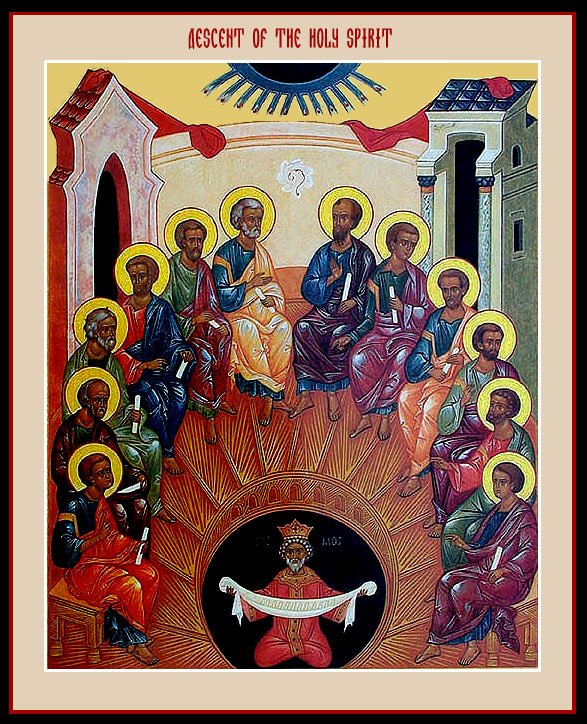
Holy Pentecost
In the Church’s annual liturgical cycle, Pentecost is “the last and great day.” It is the celebration by the Church of the coming of the Holy Spirit as the end—the achievement and fulfillment—of the entire history of salvation. For the same reason, however, it is also the celebration of the beginning: it is the “birthday” of the Church as the presence among us of the Holy Spirit, of the new life in Christ, of grace, knowledge, adoption to God and holiness.
This double
In the Church’s annual liturgical cycle, Pentecost is “the last and great day.” It is the celebration by the Church of the coming of the Holy Spirit as the end—the achievement and fulfillment—of the entire history of salvation. For the same reason, however, it is also the celebration of the beginning: it is the “birthday” of the Church as the presence among us of the Holy Spirit, of the new life in Christ, of grace, knowledge, adoption to God and holiness.
This double meaning and double joy is revealed to us, first of all, in the very name of the feast. Pentecost in Greek means fifty, and in the sacred biblical symbolism of numbers, the number fifty symbolizes both the fulness of time and that which is beyond time: the Kingdom of God itself. It symbolizes the fulness of time by its first component: 49, which is the fulness of seven (7 x 7): the number of time. And, it symbolizes that which is beyond time by its second component: 49 + 1, this one being the new day, the “day without evening” of God’s eternal Kingdom. With the descent of the Holy Spirit upon Christ’s disciples, the time of salvation, the Divine work of redemption has been completed, the fulness revealed, all gifts bestowed: it belongs to us now to “appropriate” these gifts, to be that which we have become in Christ: participants and citizens of His Kingdom.
The all-night Vigil service begins with a solemn invitation:
“Let us celebrate Pentecost, the coming of the Holy Spirit,
The appointed day of promise, and the fulfillment of hope,
The mystery which is as great as it is precious.”
In the coming of the Spirit, the very essence of the Church is revealed:
“The Holy Spirit provides all,
Overflows with prophecy, fulfills the priesthood,
Has taught wisdom to illiterates, has revealed fishermen as theologians,
He brings together the whole council of the Church.”
In the three readings of the Old Testament (Numbers 11:16-17, 24-29; Joel 2:23-32; Ezekiel 36:24-28) we hear the prophecies concerning the Holy Spirit. We are taught that the entire history of mankind was directed towards the day on which God “would pour out His Spirit upon all flesh.” This day has come! All hope, all promises, all expectations have been fulfilled. At the end of the Aposticha hymns, for the first time since Easter, we sing the hymn: “O Heavenly King, the Comforter, the Spirit of Truth...,” the one with which we inaugurate all our services, all prayers, which is, as it were, the life-breath of the Church, and whose coming to us, whose “descent” upon us in this festal Vigil, is indeed the very experience of the Holy Spirit “coming and abiding in us.”
Having reached its climax, the Vigil continues as an explosion of joy and light for “verily the light of the Comforter has come and illumined the world.” In the Gospel reading (John 20:19-23) the feast is interpreted to us as the feast of the Church, of her divine nature, power and authority. The Lord sends His disciples into the world, as He Himself was sent by His Father. Later, in the antiphons of the Liturgy, we proclaim the universality of the apostles’ preaching, the cosmical significance of the feast, the sanctification of the whole world, the true manifestation of God’s Kingdom.
The liturgical peculiarity of Pentecost is a very special Vespers of the day itself. Usually this service follows immediately the Divine Liturgy, is “added” to it as its own fulfillment. The service begins as a solemn “summing up” of the entire celebration, as its liturgical synthesis. We hold flowers in our hands symbolizing the joy of the eternal spring, inaugurated by the coming of the Holy Spirit. After the festal Entrance, this joy reaches its climax in the singing of the Great Prokeimenon:
“Who is so great a God as our God?”
Then, having reached this climax, we are invited to kneel. This is our first kneeling since Easter. It signifies that after these fifty days of Paschal joy and fulness, of experiencing the Kingdom of God, the Church now is about to begin her pilgrimage through time and history. It is evening again, and the night approaches, during which temptations and failures await us, when, more than anything else, we need Divine help, that presence and power of the Holy Spirit, who has already revealed to us the joyful End, who now will help us in our effort towards fulfillment and salvation.
All this is revealed in the three prayers which the celebrant reads now as we all kneel and listen to him. In the first prayer, we bring to God our repentance, our increased appeal for forgiveness of sins, the first condition for entering into the Kingdom of God.
In the second prayer, we ask the Holy Spirit to help us, to teach us to pray and to follow the true path in the dark and difficult night of our earthly existence. Finally, in the third prayer, we remember all those who have achieved their earthly journey, but who are united with us in the eternal God of Love.
The joy of Easter has been completed and we again have to wait for the dawn of the Eternal Day. Yet, knowing our weakness, humbling ourselves by kneeling, we also know the joy and the power of the Holy Spirit who has come. We know that God is with us, that in Him is our victory.
Thus is completed the feast of Pentecost and we enter “the ordinary time” of the year. Yet, every Sunday now will be called “after Pentecost”—and this means that it is from the power and light of these fifty days that we shall receive our own power, the Divine help in our daily struggle. At Pentecost we decorate our churches with flowers and green branches—for the Church “never grows old, but is always young.” It is an evergreen, ever-living Tree of grace and life, of joy and comfort. For the Holy Spirit—“the Treasury of Blessings and Giver of Life—comes and abides in us, and cleanses us from all impurity,” and fills our life with meaning, love, faith and hope.
Father Alexander Schmemann (1974)
Troparion - Tone 8
Blessed are You O Christ Our God / You have revealed the fishermen as most wise / by sending down upon them the Holy Spirit / through them You drew the world into Your net / O Lover of Man, Glory to You!
Kontakion - Tone 8
When the most High came down and confused the tongues, / He divided the nations; / but when he distributed the tongues of fire / He called all to unity. / Therefore, with one voice, we glorify the All-holy Spirit!

Hieromartyr Methodius, Bishop of Patar
The Hieromartyr Methodius, Bishop of Patara (Lycia in Asia Minor), was distinguished for his genuine monastic humility. Calmly and with mildness he instructed his flock, but he firmly defended the purity of Orthodoxy and he energetically contended against heresies, especially the widespread heresy of the Origenists.
The Hieromartyr Methodius, Bishop of Patara (Lycia in Asia Minor), was distinguished for his genuine monastic humility. Calmly and with mildness he instructed his flock, but he firmly defended the purity of Orthodoxy and he energetically contended against heresies, especially the widespread heresy of the Origenists. He left behind him a rich literary legacy: works in defense of Christianity against paganism, explications of Orthodox dogmas against the heresy of Origen, moral discourses, and explanations of Holy Scripture.
Saint Methodius was arrested by the pagans, steadfastly confessed before them his faith in Christ, and he was sentenced to death by beheading in the year 312.
Troparion - Tone 1
Your blood cries out to God from the earth like that of Abel, / divinely-wise holy hierarch, Methodius. / You openly preached the Incarnation of God, / putting the heresy of Origen to shame. / You were translated to the heavenly bridal chamber: / Pray to Christ God that our souls may be saved.
Kontakion - Tone 4
As a priest of the mysteries of the Holy Trinity, / and a preacher of the commandments of God that surpass understanding, / you were the confirmation of Orthodox Christians, O Methodius! / You denounced the errors of heretics; / for the sake of the True Faith you shed your blood as a hieromartyr. / Now as you stand before Christ with the angels, / pray that we may be saved.

St Kallistos I, Patriarch of Constantinople (1363)
Saint Callistus I, Patriarch of Constantinople, at first struggled on Athos under the spiritual guidance of Saint Gregory of Sinai (August 8), whose Life he wrote. In 1350, he was elected as Patriarch of Constantinople, serving in that position during the reign of the emperors John Kantakuzenos (1341-1355) and John Paleologos (1341-1376).
Saint Callistus I, Patriarch of Constantinople, at first struggled on Athos under the spiritual guidance of Saint Gregory of Sinai (August 8), whose Life he wrote. In 1350, he was elected as Patriarch of Constantinople, serving in that position during the reign of the emperors John Kantakuzenos (1341-1355) and John Paleologos (1341-1376).
In 1354, he withdrew to live in silence at the monastery he had built in honor of Saint Mamas at Tenedos. Later, he was elevated to the Patriarchal throne once again (1355-1363). The holy Patriarch Callistus reposed in the year 1363 in Serbia, where he had travelled with an embassy of Emperor John Paleologos. Saint Callistus is also known as a spiritual writer, and his edifying works appear in the PHILOKALIA with the writings of his close friend Ignatius of Xanthopoulos.
Troparion - Tone 1
You proved to be a divinely-wise Patriarch of the Queen of Cities, / and the boast of Mount Athos, / the treasury of Serres, / the friend and advocate of the divine hesychasts of Christ; / wherefore O Father Kállistos, / all of us sing hymns to you crying out with joy: / “Glory to Christ Who glorified you. / Glory to Him Who made you wondrous. / Glory to Him Who, through you, gives us that which is best.”1
Nicholas Cabasilas of Thessaloniki
The Venerable (Ὅσιος) Nicholas Cabasilas was born in Thessaloniki in 1322, and was the nephew of Neilos Cabasilas, who was the Archbishop of Thessaloniki. His father's surname was Khamaetos, but he preferred to use his uncle's name - Cabasilas.
Saint Nicholas received an excellent education, both at Thessaloniki and Constantinople, studying rhetoric, theology, philosophy, etc. For a
The Venerable (Ὅσιος) Nicholas Cabasilas was born in Thessaloniki in 1322, and was the nephew of Neilos Cabasilas, who was the Archbishop of Thessaloniki. His father's surname was Khamaetos, but he preferred to use his uncle's name - Cabasilas.
Saint Nicholas received an excellent education, both at Thessaloniki and Constantinople, studying rhetoric, theology, philosophy, etc. For a time, he served as an advisor to Emperor John VI Cantacuzenos (reigned 1347-1354), who entrusted him with several important missions in this time of civil war (1341–1347) and religious strife. In the last year of his life, the Emperor abdicated and was tonsured as a monk with the name Joasaph. He remained in the renowned Manganon Monastery (Μονή των Μαγγάνων) until his death. Saint Nicholas seems to have become a monk at Manganon at the same time, and it is possible that he was ordained as a Hieromonk.
He was a disciple of Saint Gregory of Sinai (August 8), and a supporter of Saint Gregory Palamas (November 14), both of whom were proponents of hesychasm (stillness), involving the unceasing prayer of the heart, which can lead to a vision of the Uncreated Light of Tabor. Saint Nicholas took part in the Hesychast controversies of his time, which ended when the Council of 1351 proclaimed the teachings of Saint Gregory Palamas as Orthodox.
The fame of Saint Nicholas rests mainly on his two books: Explanation of the Divine Liturgy (Ἑρμηνεία τῆς θείας Λειτουργίας), and Concerning the Life in Christ (Περί της εν Χριστώ ζωής), which describes the Church's Holy Mysteries, divine grace, and perfection in the divine virtues.
In his writings Saint Nicholas expounds the hesychastic (and Patristic) teaching that the life in Christ, which begins in this life, is perfected in the Kingdom. Sanctification comes only from Christ, but sanctity is achieved when our wills are in harmony with Christ's will.
Book 6 of Concerning the Life in Christ contains some very instructive comments on the Beatitudes. Saint Nicholas points out that those who study and meditate on these sayings of Christ shall become truly happy. He compares the Beatitudes to "a ladder by which we may ascend to (the life of blessedness)."
Some of his sermons have survived: on the Ascension, on the Annunciation, etc. There are also encomia in honor of Saint Demetrios, Saint Theodora, Saint Nicholas, and the Three Hierarchs.
The date of Saint Nicholas's blessed repose is uncertain, but it probably occurred before 1391. If that is true, then he must have been aware of the fall of Thessaloniki to the Turks in 1387.
Saint Nicholas Cabasilas was glorified as a saint on July 19,1983. The Troparion composed in his honor describes him as "a divine teacher, a wise interpreter of the dogmas of faith, and of the divine virtues."
Troparion - Tone 4
As a divine teacher, a wise interpreter of the dogmas of faith, and of the divine virtues, O Venerable Nicholas, / you shone forth in the world by your life and your word. / Wherefore, Thessaloniki boasts of your glory, / lovingly keeps festival, and celebrates your most exalted memory.
Blessed Studios (5th c.)
He was a prominent nobleman and consul in Constantinople. In the City he founded both the Church of St John the Forerunner in 463, and the monastery thereafter called the Studion in honor of him. The Studion monastery nurtured a long line of ascetics, teachers, and martyrs; perhaps the best known is St Theodore the Studite (November 11), the great defender of the holy icons.
He was a prominent nobleman and consul in Constantinople. In the City he founded both the Church of St John the Forerunner in 463, and the monastery thereafter called the Studion in honor of him. The Studion monastery nurtured a long line of ascetics, teachers, and martyrs; perhaps the best known is St Theodore the Studite (November 11), the great defender of the holy icons. The monastery was destroyed by the Crusaders in 1204, restored in 1293 by Emperor Andronicus II.
Scripture Readings
☩Epistle
Acts 2:1-11
1
And when the day of Pentecost was fully come, they were all with one accord in one place.
2
And suddenly there came a sound from heaven as of a rushing mighty wind, and it filled all the house where they were sitting.
3
And there appeared unto them cloven tongues like as of fire, and it sat upon each of them.
4
And they were all filled with the Holy Ghost, and began to speak with other tongues, as the Spirit gave them utterance.
5
And there were dwelling at Jerusalem Jews, devout men, out of every nation under heaven.
6
Now when this was noised abroad, the multitude came together, and were confounded, because that every man heard them speak in his own language.
7
And they were all amazed and marvelled, saying one to another, Behold, are not all these which speak Galileans?
8
And how hear we every man in our own tongue, wherein we were born?
9
Parthians, and Medes, and Elamites, and the dwellers in Mesopotamia, and in Judea, and Cappadocia, in Pontus, and Asia,
10
Phrygia, and Pamphylia, in Egypt, and in the parts of Libya about Cyrene, and strangers of Rome, Jews and proselytes,
11
Cretes and Arabians, we do hear them speak in our tongues the wonderful works of God.
☩Gospel
John 7:37-52, 8:12
37
In the last day, that great day of the feast, Jesus stood and cried, saying, If any man thirst, let him come unto me, and drink.
38
He that believeth on me, as the scripture hath said, out of his belly shall flow rivers of living water.
39
(But this spake he of the Spirit, which they that believe on him should receive: for the Holy Ghost was not yet given; because that Jesus was not yet glorified.)
40
Many of the people therefore, when they heard this saying, said, Of a truth this is the Prophet.
41
Others said, This is the Christ. But some said, Shall Christ come out of Galilee?
42
Hath not the scripture said, That Christ cometh of the seed of David, and out of the town of Bethlehem, where David was?
43
So there was a division among the people because of him.
44
And some of them would have taken him; but no man laid hands on him.
45
Then came the officers to the chief priests and Pharisees; and they said unto them, Why have ye not brought him?
46
The officers answered, Never man spake like this man.
47
Then answered them the Pharisees, Are ye also deceived?
48
Have any of the rulers or of the Pharisees believed on him?
49
But this people who knoweth not the law are cursed.
50
Nicodemus saith unto them, (he that came to Jesus by night, being one of them,)
51
Doth our law judge any man, before it hear him, and know what he doeth?
52
They answered and said unto him, Art thou also of Galilee? Search, and look: for out of Galilee ariseth no prophet.
12
Then spake Jesus again unto them, saying, I am the light of the world: he that followeth me shall not walk in darkness, but shall have the light of life.
Liturgical data sourced from OCA.org and orthocal.info