
Fasting Rules
 Meat
Allowed
 Fish
Allowed
 Dairy
Allowed
 Oil
Allowed
 Wine
Allowed
Saints & Commemorations
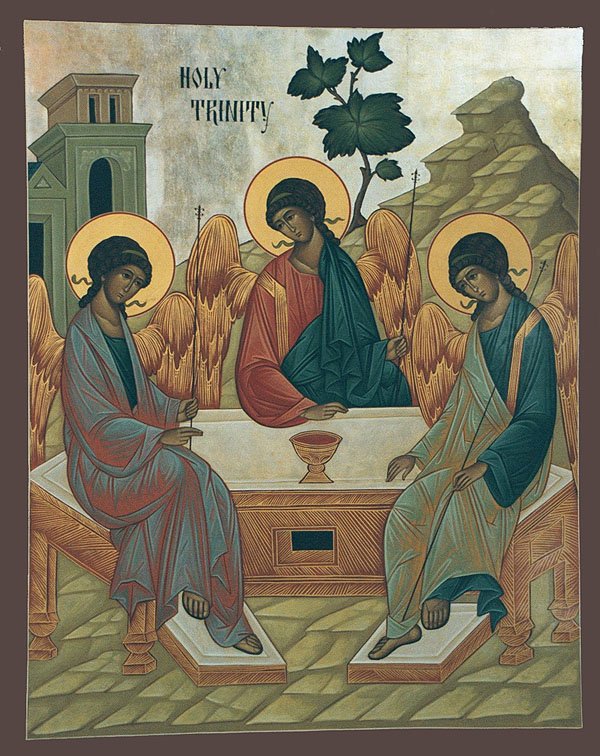
Day of the Holy Spirit
On the day after every Great Feast, the Orthodox Church honors the one through whom the Feast is made possible. On the day following the Nativity of the Lord, for example, we celebrate the Synaxis of the Most Holy Theotokos (December 26). On the day after Theophany, we commemorate Saint John the Baptist (January 7), and so on.
On the day after every Great Feast, the Orthodox Church honors the one through whom the Feast is made possible. On the day following the Nativity of the Lord, for example, we celebrate the Synaxis of the Most Holy Theotokos (December 26). On the day after Theophany, we commemorate Saint John the Baptist (January 7), and so on.
Today we honor the all-Holy, good, and life-creating Spirit, Who descended upon the Apostles at Pentecost in the form of fiery tongues in fulfillment of the Lord’s promise to send the Comforter to His disciples (JN 14:16). That same Holy Spirit remains within the Church throughout the ages, guiding it “into all truth” (JN 16:13).
One of the hymns at Vespers on Saturday evening tells us that the Holy Spirit “provides all things. He gushes forth prophecy, He perfects the priesthood, ... He holds together the whole institution of the Church.”
At Vespers on the day of Pentecost, we hear that the Holy Spirit is “the Fountain of goodness, through Whom the Father is known, and the Son is glorified.” He is “the living Fountain of spiritual gifts” Who “purifies us from our sins.” It is by the Holy Spirit that “the prophets, divine Apostles, and martyrs are crowned.” He is the source of life and of sanctification.
In the services of this day, we sing the same hymns as on Pentecost, except the Canon of the Holy Spirit, which is sung at Compline. The Vigil is not prescribed for the eve of today’s feast. We sing the Great Doxology at Matins, but not the Polyeleos. The Irmos of the Ninth Ode (“Hail, O Queen, glory of mothers and virgins...”) is sung in place of the Song of the Theotokos (“My soul magnifies the Lord...”).
At the Liturgy, the priest or deacon chants the Entrance Verse (“Be exalted in Thy strength, O Lord. We will sing and praise Thy power.”) as on the day of Pentecost. “Holy God” replaces “As many as have been baptized....” The dismissal of Pentecost is also used.
This whole week is fast-free, and the Leave-taking of Pentecost occurs on Saturday.
Troparion - Tone 8
Blessed are You O Christ Our God / You have revealed the fishermen as most wise / by sending down upon them the Holy Spirit / through them You drew the world into Your net / O Lover of Man, Glory to You!
Kontakion - Tone 8
When the most High came down and confused the tongues, / He divided the nations; / but when he distributed the tongues of fire / He called all to unity. / Therefore, with one voice, we glorify the All-holy Spirit!

Martyr Julian of Tarsus
The Holy Martyr Julian of Tarsus was born at Diocesarea in the province of Cilicia. He was the son of a pagan senator, but his mother was a Christian. After the death of her husband, she and Julian moved to Tarsus, where her son was baptized and raised in Christian piety. When Julian reached the age of eighteen, Emperor Diocletian (284-305) began to persecute Christians, issuing a decree that everyone had to offer sacrifice to the idols.
The Holy Martyr Julian of Tarsus was born at Diocesarea in the province of Cilicia. He was the son of a pagan senator, but his mother was a Christian. After the death of her husband, she and Julian moved to Tarsus, where her son was baptized and raised in Christian piety. When Julian reached the age of eighteen, Emperor Diocletian (284-305) began to persecute Christians, issuing a decree that everyone had to offer sacrifice to the idols. If they refused, they would be tortured. Among those arrested was Saint Julian. They brought him before the eparch Marcian to be tried, and for a long time they urged him to renounce Christ. Neither tortures nor threats, nor promises of gifts or honors could convince the devout young man to sacrifice to the idols and deny Christ, and so the holy confessor remained steadfast in his faith.
For a whole year they led the martyr through the cities of Cilicia, everywhere subjecting him to interrogation and torture, after which they threw him in prison. Saint Julian’s mother followed her son and prayed that the Lord would strengthen him. In the city of Aegea, she besought the eparch to let her to visit the prison, ostensibly to persuade her son to offer sacrifice to the idols. When she saw him, she did just the opposite. She spent three days in prison with Saint Julian, exhorting him to remain strong until the end.
Once again, Saint Julian was brought before the eparch. Thinking that his mother had persuaded her son to obey the imperial decree, Marcian tried to convince her to offer sacrifice, but she continued to confess Jesus Christ, and boldly denounced polytheism. Marcian then ordered that her feet be cut off, since she had followed her son from Tarsus.
Then Saint Julian was placed into a sack filled with sand and poisonous snakes, and it was thrown into the sea. The Martyr's body was carried by the waves to the shores of Alexandria. There his body was buried by a certain pious Christian. Saint Julian's death occurred around the year 305. Afterward, his relics were transferred to Antioch.
Saint John Chrysostom honored the holy Martyr Julian with an encomium, and fragments of the Saint's relics are found in the Monasteries of Pantokrator and Saint Panteleimon on Mount Athos.
We pray to Saint Julian to protect gardens and fields from creeping things, snakes, and harmful insects.
Troparion - Tone 5
Your mother guided you to become a glorious soldier of Christ, / and you were clad in the armor of the Spirit,1 / and entering the contest, you cast down the Enemy. / Now, O godly-minded Julian, pray to Christ God for all of us. Ephesians 6:13.
Kontakion - Tone 2
Your mother guided you to become a glorious soldier of Christ, / and you were clad in the armor of the Spirit,1 / and entering the contest, you cast down the Enemy. / Now, O godly-minded Julian, pray to Christ God for all of us.

Our Holy Fathers Julius and Julian (5th c.)
Saints Julius the presbyter and Julian the Deacon, brothers by birth, were natives of Myrmidonia. For his virtuous life Saint Julius was ordained to the priesthood, and his brother as a deacon. Inspired with zeal for the spreading of the Christian Faith, the holy brothers received permission for the building of churches and set off preaching to remote sections East and West within the Roman Empire, where pagan temples still existed and where offering of sacrifice to idols was still made.
Saints Julius the presbyter and Julian the Deacon, brothers by birth, were natives of Myrmidonia. For his virtuous life Saint Julius was ordained to the priesthood, and his brother as a deacon. Inspired with zeal for the spreading of the Christian Faith, the holy brothers received permission for the building of churches and set off preaching to remote sections East and West within the Roman Empire, where pagan temples still existed and where offering of sacrifice to idols was still made. Visiting several lands, they converted many pagans to Christianity, persuading them not only by word, but also by numerous miracles. At Constantinople they turned to the pious emperor Theodosius the Younger (408-450) requesting permission to build churches upon the sites of pagan temples.
Having received the blessing of the patriarch and the permission of the emperor, the holy brothers built many churches. The people considered it their duty to assist them in this matter. Once, some people went past a church under construction. Fearing that they would be talked into taking part in this work, they engaged in a deception, in order to get away. One of them feigned being dead, and when Saint Julius invited them to take part in the work, they excused themselves, saying that they had to bury a dead person. The saint asked, “You’re not lying, are you?” The passers-by persisted in their ruse. Then Saint Julian said to them, “Let it be according to your words.” Having continued on farther, they discovered that the one pretending to be dead really was dead. After this, no one else dared to lie to the holy brothers.
Foreseeing his own impending end, Saint Julius set off in search of a place to build his one hundredth church, which he believed would be his last. Reaching Lake Mukoros, he saw a beautiful island. Because of the huge quantity of snakes on it, no one was able to settle there. Saint Julius decided to build a church upon this island. Having prayed, he sailed off to the island on his mantle as though on a boat, and set up a cross on it. In the Name of God, the holy ascetic ordered all the snakes to gather together and leave the island. All the venomous vipers slithered into the lake and re-established themselves upon Mount Kamunkin.
On the island Saint Julius built a church in honor of the holy Twelve Apostles. At this time his brother, Saint Julian, finished construction on a church near the city of Gaudiana and decided to build a crypt for his brother Julius by the church. Saint Julius paid his brother a visit and advised him to hurry with the construction of the crypt, prophetically foretelling that he would lie in it. Indeed, Saint Julian the Deacon soon died and was buried in the crypt built by him. Saint Julius the Presbyter reverently buried his brother and returned to the island, where he soon died and was buried in the church of the Twelve Apostles he had built. From his grave many of the sick received healing. The blessed end of the holy brothers occurred after the first half of the fifth century.
Troparion - Tone 8
By a flood of tears you made the desert fertile, / and your longing for God brought forth fruits in abundance. / By the radiance of miracles you illumined the whole universe! / O our holy father Julius, pray to Christ our God to save our souls!
Scripture Readings
☩Epistle
Ephesians 5:8-19
8
For ye were sometimes darkness, but now are ye light in the Lord: walk as children of light:
9
(For the fruit of the Spirit is in all goodness and righteousness and truth;)
10
Proving what is acceptable unto the Lord.
11
And have no fellowship with the unfruitful works of darkness, but rather reprove them.
12
For it is a shame even to speak of those things which are done of them in secret.
13
But all things that are reproved are made manifest by the light: for whatsoever doth make manifest is light.
14
Wherefore he saith, Awake thou that sleepest, and arise from the dead, and Christ shall give thee light.
15
See then that ye walk circumspectly, not as fools, but as wise,
16
Redeeming the time, because the days are evil.
17
Wherefore be ye not unwise, but understanding what the will of the Lord is.
18
And be not drunk with wine, wherein is excess; but be filled with the Spirit;
19
Speaking to yourselves in psalms and hymns and spiritual songs, singing and making melody in your heart to the Lord;
☩Gospel
Matthew 18:10-20
10
Take heed that ye despise not one of these little ones; for I say unto you, That in heaven their angels do always behold the face of my Father which is in heaven.
11
For the Son of man is come to save that which was lost.
12
How think ye? if a man have an hundred sheep, and one of them be gone astray, doth he not leave the ninety and nine, and goeth into the mountains, and seeketh that which is gone astray?
13
And if so be that he find it, verily I say unto you, he rejoiceth more of that sheep, than of the ninety and nine which went not astray.
14
Even so it is not the will of your Father which is in heaven, that one of these little ones should perish.
15
Moreover if thy brother shall trespass against thee, go and tell him his fault between thee and him alone: if he shall hear thee, thou hast gained thy brother.
16
But if he will not hear thee, then take with thee one or two more, that in the mouth of two or three witnesses every word may be established.
17
And if he shall neglect to hear them, tell it unto the church: but if he neglect to hear the church, let him be unto thee as an heathen man and a publican.
18
Verily I say unto you, Whatsoever ye shall bind on earth shall be bound in heaven: and whatsoever ye shall loose on earth shall be loosed in heaven.
19
Again I say unto you, That if two of you shall agree on earth as touching any thing that they shall ask, it shall be done for them of my Father which is in heaven.
20
For where two or three are gathered together in my name, there am I in the midst of them.
Liturgical data sourced from OCA.org and orthocal.info