
Fasting Rules
 Meat
Allowed
 Fish
Allowed
 Dairy
Allowed
 Oil
Allowed
 Wine
Allowed
Saints & Commemorations
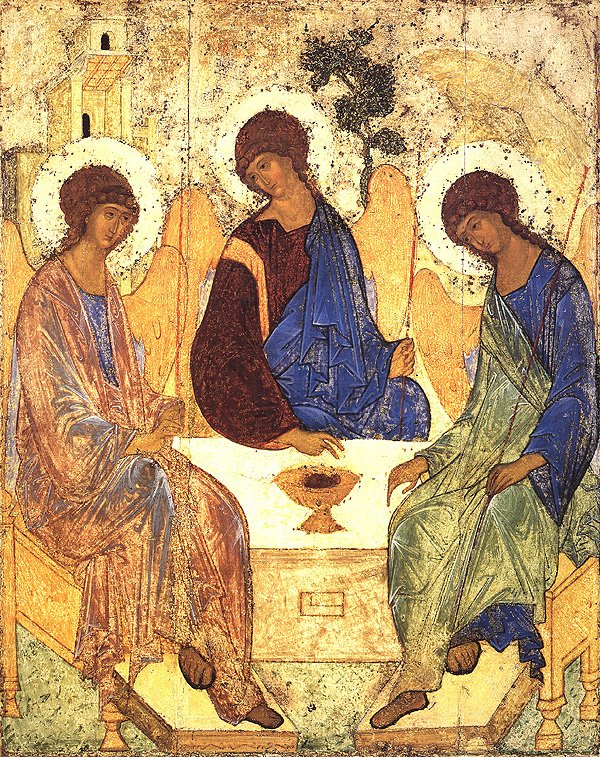
Third Day of the Trinity
Many of the hymns of Pentecost are repeated in the postfestal services of this week, and references to the Holy Spirit, and to fire, abound. In particular, we are reminded of the Unburnt Bush (Exodus 3:2), the zealous Prophet Elias who ascended to Heaven in a chariot of fire, the three youths in the fiery furnace, and the Lord descending on Mt.
Many of the hymns of Pentecost are repeated in the postfestal services of this week, and references to the Holy Spirit, and to fire, abound. In particular, we are reminded of the Unburnt Bush (Exodus 3:2), the zealous Prophet Elias who ascended to Heaven in a chariot of fire, the three youths in the fiery furnace, and the Lord descending on Mt. Sinai in fire (Exodus 19:18).
As we commemorate the Holy Spirit this week, we look forward to the Sunday of All Saints, those righteous men and women of all nations and in every age, who were perfected and sanctified by the same Holy Spirit.
Troparion - Tone 8
Blessed are You O Christ Our God / You have revealed the fishermen as most wise / by sending down upon them the Holy Spirit / through them You drew the world into Your net / O Lover of Man, Glory to You!
Kontakion - Tone 8
When the most High came down and confused the tongues, / He divided the nations; / but when he distributed the tongues of fire / He called all to unity. / Therefore, with one voice, we glorify the All-holy Spirit!
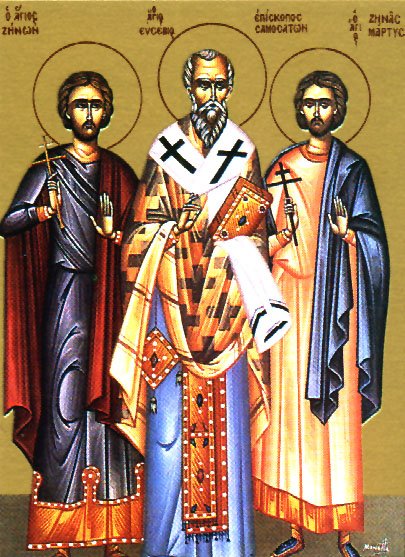
Hieromartyr Eusebius, Bishop of Samosata
The Hieromartyr Eusebios (his name means pious) the Bishop of Samosata, stood firmly for the Orthodox Confession of Faith, proclaimed at the First Ecumenical Synod at Nicea in the year 325. Therefore, he suffered persecution by the Arians, and was repeatedly deprived of his See and banished. Emperor Constantius (337-361), who supported the Arians, learned that Saint Eusebios kept a conciliar decree regarding the election of the Orthodox Archbishop Meletios (February 12) to the See of Antioch.
The Hieromartyr Eusebios (his name means pious) the Bishop of Samosata, stood firmly for the Orthodox Confession of Faith, proclaimed at the First Ecumenical Synod at Nicea in the year 325. Therefore, he suffered persecution by the Arians, and was repeatedly deprived of his See and banished. Emperor Constantius (337-361), who supported the Arians, learned that Saint Eusebios kept a conciliar decree regarding the election of the Orthodox Archbishop Meletios (February 12) to the See of Antioch. He was ordered to surrender the decree, but the Saint boldly refused to obey him. The enraged Emperor sent a message that if he did not surrender the decree, then his right hand would be cut off. Saint Eusebios stretched forth both hands to the emissary saying, “Cut them off, but I will not give up the conciliar decree, which denounces the wickedness and iniquity of the Arians.”
Emperor Constantius marveled at the hierarch's audacity, but did not harm him.
During the reign of Emperor Julian the Apostate (361-363), even more difficult times ensued, and an open persecution against Christians began. Saint Eusebios concealed his identity and went about in the garb of a soldier all across Syria, Phoenicia and Palestine, urging Christians not to abandon the Orthodox Faith. He ordained priests and deacons for the desolated churches, and he consecrated hierarchs who renounced the Arian heresy. After Julian the Apostate’s death, he was succeeded by the devout Emperor Jovian (363-364), during whose reign the persecutions stopped. Returning from exile, Saint Meletios convened a local Council at Antioch in the year 379 on the advice of Saint Eusebios. Twenty-seven hierarchs participated, and the Council reaffirmed the Orthodox teaching of the First Ecumenical Council. The Arians signed the conciliar decree, fearing the steadfast defenders of Orthodoxy: the holy hierarchs Meletios, Eusebios and Pelagios, who had great influence with the Emperor. After Jovian's death, the Arian Valentinian (364-378) came to power.
The Orthodox were again subjected to persecution. Saint Meletios was banished to Armenia, Saint Pelagios to Arabia, and Saint Eusebios was condemned to exile in Thrace. After receiving the imperial decree, Saint Eusebios left Samosata by night, in order to prevent tumult among the people who esteemed him. When they learned of the hierarch's departure, the faithful followed after him with tears and begged him to return. The Saint refused the entreaty of those who had come, saying that he had to obey the authorities. The Saint urged his flock to hold fast to Orthodoxy, then blessed them and went to the place of his exile. The Arian Eunomios became Bishop of Samosata, but the people did not accept this heretic. The Orthodox would not go to his church and avoided meeting with him. The heretical Arian perceived that it was impossible to induce the Orthodox flock to follow him.
Emperor Gratian (375-383) succeeded to the throne, and all the Orthodox hierarchs who had been banished under the Arians were brought back from exile. Saint Eusebios also returned to Samosata and continued with the task of building up the Church. Along with Saint Meletios, he appointed Orthodox hierarchs and clergy to the Arian parishes. In the year 380 he arrived in the Arian city of Dolikhina to establish the Orthodox Bishop Marinus there. An Arian woman threw a roof tile at the holy hierarch’s head. As he lay dying, Saint Eusebios asked her for wine and begged those around not to harm her. The Saint's body was taken to Samosata and was buried by his flock. The Saint’s nephew Antiokhos succeeded him and the Church of Samosata continued to confess the Orthodox Faith, which was firmly spread by the efforts of the holy Hieromartyr Eusebios
Troparion - Tone 4
By sharing in the ways of the Apostles, / you became a successor to their throne. / Through the practice of virtue, you found the way to divine contemplation, O divinely-inspired one: / by rightly dividing the Word of truth, you defended the Faith, even to the shedding of your blood. / O Hieromartyr Eusebios, entreat Christ God to save our souls.
Kontakion - Tone 4
As one who lived piously among Hierarchs and who underwent martyrdom, / O divinely-wise one, / you abolished the sacrifices of idolatry and showed yourself as the protector of your flock. / Therefore, we cry fervently to you: / “By your intercessions, deliver us from all misfortunes, O Eusebios our Father.”
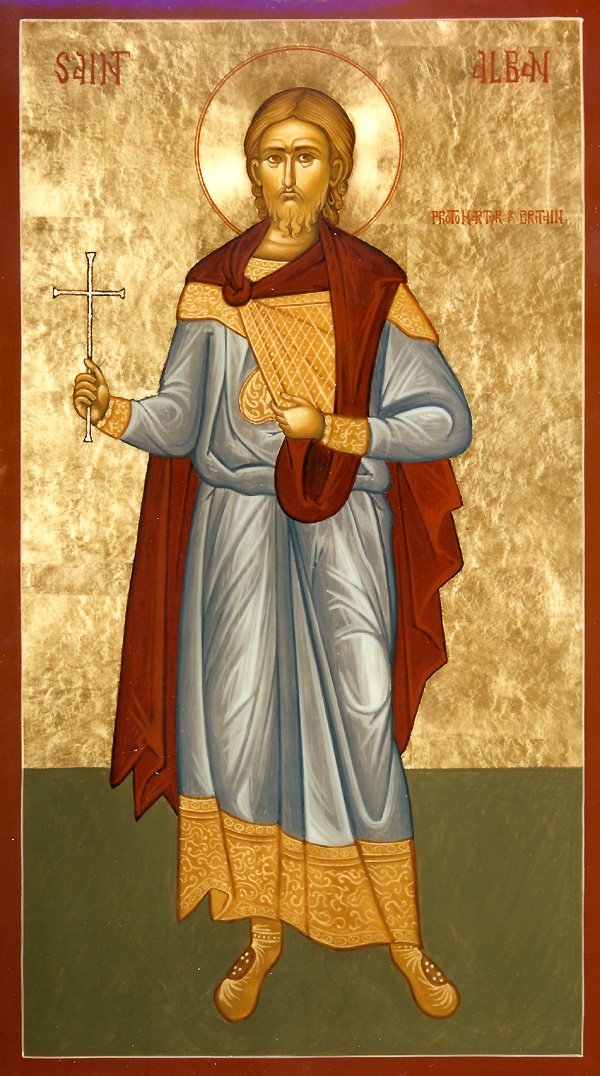
St Alban, First Martyr of Great Britain (early 3rd c.)
Saint Alban (or Albanus), the protomartyr of Britain, was a Roman citizen who lived at Verulamium (modern Saint Albans), a few miles northwest of London, during a time of persecution. Nothing is known about his family or his occupation.
The chief magistrate of the city had orders to arrest all Christian clergy.
Saint Alban (or Albanus), the protomartyr of Britain, was a Roman citizen who lived at Verulamium (modern Saint Albans), a few miles northwest of London, during a time of persecution. Nothing is known about his family or his occupation.
The chief magistrate of the city had orders to arrest all Christian clergy. One of them, a priest named Amphibalus, fled to Alban’s home in order to hide from the soldiers who wished to kill him. Alban was impressed by the priest’s constant prayer and vigil, and so he questioned Amphibalus about his beliefs. As a result, Alban came to believe in Christ and asked to be baptized.
Eventually, Amphibalus was forced to move on, and Alban changed clothes with him so that he could get away. The soldiers heard there was a priest hiding in Alban’s house, so they came to search it. Seeing Alban dressed in the priest’s clothes, they arrested him and brought him before the judge.
The magistrate was offering sacrifice to idols when Saint Alban appeared before him. After questioning him, he discovered how Alban and the priest had switched clothes. Furious because Alban had allowed a fugitive to escape, the magistrate threatened him with death unless he returned to paganism and revealed where Amphibalus had gone. Saint Alban replied, “I am also a Christian, and I worship the true God.”
After having the saint beaten and tortured, the magistrate threatened him with execution. Saint Alban rejoiced and glorified God. The magistrate ordered the soldiers to take Saint Alban to the Holmhurst Hill to be beheaded. When they came to the river Ver, they saw that the bridge was crowded with people who had come to witness Alban’s martyrdom. Since they could not proceed because of the multitude of people, Saint Alban prayed and made the Sign of the Cross over the river. At once, the waters parted so that they were able to cross over to the other side.
The executioner was so astonished by the miracle that he threw down his sword and refused to behead the saint. He was arrested, and another man was found to behead them both. There is a tradition that Saint Alban became thirsty while climbing the hill and asked for water. A small spring gushed forth near the top of the hill, and he was able to drink from it. Pilgrims used to come and drink from Saint Alban’s well, but it is now dry.
The date of Saint Alban’s martyrdom is uncertain, but it is believed that it took place during the reign of Decius (ca. 251) or Valerian (ca. 257). The eighteenth century Turin manuscript (which may be based on a fifth century source) suggests that Saint Alban may have been executed as early as 209, when the emperor Septimus Severus and his two sons were in Britain. The name of the executioner who was converted has not been preserved. The priest Amphibalus was ultimately caught and put to death at a place called Redbourn, four miles from Verulamium.
When people began to cry out against the magistrate, he put an end to the persecution. In later years a cathedral was built on the site of the martyrdom, and the relics of Saint Alban, the priest Amphibalus, and perhaps even the executioner were enshrined within. Saint Bede (May 27) tells us that miracles frequently took place at Saint Alban’s tomb. When the Danes invaded England in 860, the relics were removed for safekeeping, then later returned.
A new chapel and shrine were built for the relics in the early fourteenth century. Two hundred years later, during the dissolution of the monasteries under Henry VIII, the marble shrine was destroyed. Much later, the fragments of the shrine were reassembled on its former site. What happened to the relics is uncertain, but it is probable that they were either destroyed or buried in an unmarked spot.
Although Saint Alban is sometimes depicted in military garb, there is no evidence that he was a soldier. After all, he was living in a private home when he was arrested, and not in a barracks. There is a medieval painting in the south aisle beside the Choir in the Abbey which depicts Saint Alban with red hair. A medieval seal, now in the Durham Cathedral Chapter Library, shows him with a thick beard. He is stocky, with a high, round and balding forehead, and a cloak covers his left side and right shoulder.
Troparion - Tone 4
In his struggle your holy martyr Alban, / gained the crown of life, O Christ our God. / For strengthened by you and in purity of heart, / he spoke boldly before the judges of this world, / offering up his head to you, the Judge of all!
Kontakion - Tone 2
You appeared as a bright star announcing Christ with your radiance, / which is repulsive to this world, O Martyr Alban; / extinguishing the allure of false gods, / you enlighten the faithful, / always interceding for us all.
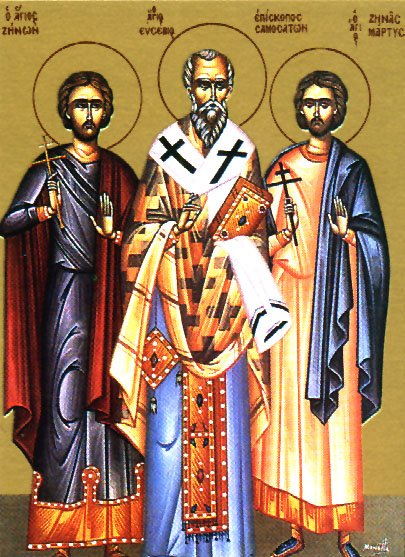
Martyrs Zeno and Zenas of Philadelphia
The Holy Martyrs Zeno and Zenas lived in the Arabian city of Philadelphia, and led a pious life. Saint Zeno possessed a large fortune, but he distributed his substance to the poor and manumitted slaves. Together with his devoted servant Zenas, he went to the governor and urged him to give up idolatry and accept Christ.
The Holy Martyrs Zeno and Zenas lived in the Arabian city of Philadelphia, and led a pious life. Saint Zeno possessed a large fortune, but he distributed his substance to the poor and manumitted slaves. Together with his devoted servant Zenas, he went to the governor and urged him to give up idolatry and accept Christ. They were tied to pillars, struck with iron hooks, and their wounds were rubbed with vinegar and salt.
Their sides and chests were scorched with fire, they were thrown in a pit, and boiling oil was poured over the sufferers. The saints endured all the tortures with forbearance and by the power of God they remained alive. Finally, the martyrs were beheaded with a sword (+ 304).
Troparion - Tone 4
Your holy martyrs Zeno and Zenas, O Lord, / through their sufferings have received incorruptible crowns from You, our God. / For having Your strength, they laid low their adversaries, / and shattered the powerless boldness of demons. / Through their intercessions, save our souls!
Scripture Readings
☩Epistle
Romans 1:1-7, 13-17
1
Paul, a servant of Jesus Christ, called to be an apostle, separated unto the gospel of God,
2
(Which he had promised afore by his prophets in the holy scriptures,)
3
Concerning his Son Jesus Christ our Lord, which was made of the seed of David according to the flesh;
4
And declared to be the Son of God with power, according to the spirit of holiness, by the resurrection from the dead:
5
By whom we have received grace and apostleship, for obedience to the faith among all nations, for his name:
6
Among whom are ye also the called of Jesus Christ:
7
To all that be in Rome, beloved of God, called to be saints: Grace to you and peace from God our Father, and the Lord Jesus Christ.
13
Now I would not have you ignorant, brethren, that oftentimes I purposed to come unto you, (but was let hitherto,) that I might have some fruit among you also, even as among other Gentiles.
14
I am debtor both to the Greeks, and to the Barbarians; both to the wise, and to the unwise.
15
So, as much as in me is, I am ready to preach the gospel to you that are at Rome also.
16
For I am not ashamed of the gospel of Christ: for it is the power of God unto salvation to every one that believeth; to the Jew first, and also to the Greek.
17
For therein is the righteousness of God revealed from faith to faith: as it is written, The just shall live by faith.
☩Gospel
Matthew 4:25-5:13
25
And there followed him great multitudes of people from Galilee, and from Decapolis, and from Jerusalem, and from Judea, and from beyond Jordan.
1
And seeing the multitudes, he went up into a mountain: and when he was set, his disciples came unto him:
2
And he opened his mouth, and taught them, saying,
3
Blessed are the poor in spirit: for theirs is the kingdom of heaven.
4
Blessed are they that mourn: for they shall be comforted.
5
Blessed are the meek: for they shall inherit the earth.
6
Blessed are they which do hunger and thirst after righteousness: for they shall be filled.
7
Blessed are the merciful: for they shall obtain mercy.
8
Blessed are the pure in heart: for they shall see God.
9
Blessed are the peacemakers: for they shall be called the children of God.
10
Blessed are they which are persecuted for righteousness’ sake: for theirs is the kingdom of heaven.
11
Blessed are ye, when men shall revile you, and persecute you, and shall say all manner of evil against you falsely, for my sake.
12
Rejoice, and be exceeding glad: for great is your reward in heaven: for so persecuted they the prophets which were before you.
13
Ye are the salt of the earth: but if the salt have lost his savour, wherewith shall it be salted? it is thenceforth good for nothing, but to be cast out, and to be trodden under foot of men.
Liturgical data sourced from OCA.org and orthocal.info