
Fasting Rules
 Meat
Allowed
 Fish
Allowed
 Dairy
Allowed
 Oil
Allowed
 Wine
Allowed
Saints & Commemorations
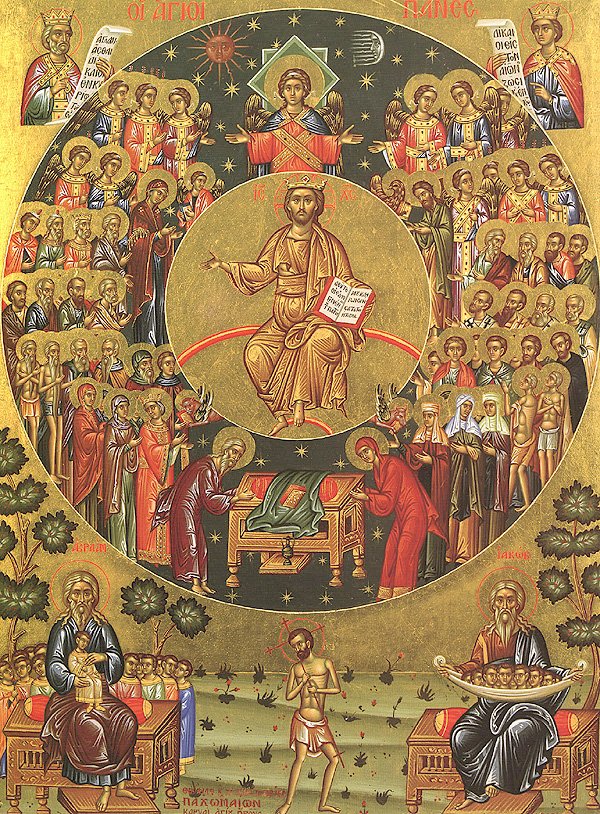
All Saints
The Sunday following Pentecost is dedicated to All Saints, both those who are known to us, and those who are known only to God. There have been saints at all times, and they have come from every corner of the earth. They were Apostles, Martyrs, Prophets, Hierarchs, Monastics, and Righteous, yet all were perfected by the same Holy Spirit.
The Sunday following Pentecost is dedicated to All Saints, both those who are known to us, and those who are known only to God. There have been saints at all times, and they have come from every corner of the earth. They were Apostles, Martyrs, Prophets, Hierarchs, Monastics, and Righteous, yet all were perfected by the same Holy Spirit.
The Descent of the Holy Spirit makes it possible for us to rise above our fallen state and to attain sainthood, thereby fulfilling God’s directive to “be holy, for I am holy” (Lev. 11:44, 1 Peter 1:16, etc.). Therefore, it is fitting to commemorate All Saints on the first Sunday after Pentecost.
This feast may have originated at an early date, perhaps as a celebration of all martyrs, then it was broadened to include all men and women who had borne witness to Christ by their virtuous lives, even if they did not shed their blood for Him.
Saint Peter of Damascus, in his “Fourth Stage of Contemplation,” mentions five categories of saints: Apostles, Martyrs, Prophets, Hierarchs, and Monastic Saints ( Philokalia [in English] Vol. 3, p.131). He is actually quoting from the Octoechos , Tone 2 for Saturday Matins, kathisma after the first stichology.
Saint Νikόdēmos of the Holy Mountain (July 14) adds the Righteous to Saint Peter’s five categories. The list of Saint Νikόdēmos is found in his book The Fourteen Epistles of Saint Paul (Venice, 1819, p. 384) in his discussion of I Corinthians 12:28.
The hymnology for the feast of All Saints also lists six categories: “Rejoice, assembly of the Apostles, Prophets of the Lord, loyal choirs of the Martyrs, divine Hierarchs, Monastic Fathers, and the Righteous....”
Some of the saints are described as Confessors, a category which does not appear in the above lists. Since they are similar in spirit to the martyrs, they are regarded as belonging to the category of Martyrs. They were not put to death as the Martyrs were, but they boldly confessed Christ and came close to being executed for their faith. Saint Maximus the Confessor (January 21) is such a saint.
The order of these six types of saints seems to be based on their importance to the Church. The Apostles are listed first, because they were the first to spread the Gospel throughout the world.
The Martyrs come next because of their example of courage in professing their faith before the enemies and persecutors of the Church, which encouraged other Christians to remain faithful to Christ even unto death.
Although they come first chronologically, the Prophets are listed after the Apostles and Martyrs. This is because the Old Testament Prophets saw only the shadows of things to come, whereas the Apostles and Martyrs experienced them firsthand. The New Testament also takes precedence over the Old Testament.
The holy Hierarchs comprise the fourth category. They are the leaders of their flocks, teaching them by their word and their example.
The Monastic Saints are those who withdrew from this world to live in monasteries, or in seclusion. They did not do this out of hatred for the world, but in order to devote themselves to unceasing prayer, and to do battle against the power of the demons. Although some people erroneously believe that monks and nuns are useless and unproductive, Saint John Climacus had a high regard for them: “Angels are a light for monks, and the monastic life is a light for all men” (LADDER, Step 26:31).
The last category, the Righteous, are those who attained holiness of life while living “in the world.” Examples include Abraham and his wife Sarah, Job, Saints Joachim and Anna, Saint Joseph the Betrothed, Saint Juliana of Lazarevo, and others.
The feast of All Saints achieved great prominence in the ninth century, in the reign of the Byzantine Emperor Leo VI the Wise (886-911). His wife, the Holy Empress Theophano (December 16) lived in the world, but was not attached to worldly things. She was a great benefactor to the poor, and was generous to the monasteries. She was a true mother to her subjects, caring for widows and orphans, and consoling the sorrowful.
Even before the death of Saint Theophano in 893 or 894, her husband started to build a church, intending to dedicate it to Theophano, but she forbade him to do so. It was this emperor who decreed that the Sunday after Pentecost be dedicated to All Saints. Believing that his wife was one of the righteous, he knew that she would also be honored whenever the Feast of All Saints was celebrated.
Troparion - Tone 4
Adorned in the blood of Your Martyrs throughout all the world, / as if clothed in purple and linen, / through them Your Church cries out to You, O Christ God: / “Bestow Your bounties upon Your people, / grant peace to Your habitation, and great mercy to our souls.”
Kontakion - Tone 8
(Original Melody)
As the first fruits of nature offered to the Planter of all creation, O Lord, / the inhabited earth brings the God-bearing Martyrs. / By their supplications, and the intercession of the Theotokos, / preserve Your Church in profound peace, O greatly Merciful One.

Ven. Sampson the Hospitable of Constantinople
Saint Sampson (Σαμψών) was born in Rome, the son of wealthy, but devout and virtuous parents. He received an excellent education, studying philosophy and medicine, among other subjects. From his earliest childhood, he lived an exemplary Christian life. After the death of his parents he transformed the family estate into a clinic for the sick. Word
Saint Sampson (Σαμψών) was born in Rome, the son of wealthy, but devout and virtuous parents. He received an excellent education, studying philosophy and medicine, among other subjects. From his earliest childhood, he lived an exemplary Christian life. After the death of his parents he transformed the family estate into a clinic for the sick. Word of his healing skills spread, and so many people came to him that he had to hire a staff to care for the increasing numbers of people who sought his help. When he had an adequate staff, he donated all of his wealth to the clinic, and was content to live in poverty (Luke 12:33-34).
Saint Sampson went to Constantinople, where he hoped to spend the rest of his life in asceticism. He found, however, that there was just as much need for his skill in Constantinople as there had been in Rome. He bought a modest home and began to treat the sick. God blessed Saint Sampson's work and gave him the grace of working miracles. He healed the sick not only by his medical skill, but also as one filled with the grace of God. News of Saint Sampson spread rapidly throughout the Queen of Cities.
His piety and love for his neighbor brought him to the attention of Patriarch Menas of Constantinople (August 25), who ordained him to the holy priesthood. When Emperor Justinian became ill, and his physicians were unable to provide any relief for him, Patriarch Menas suggested that he send for Sampson, who healed the Emperor. Justinian offered him gold and silver to show his gratitude, but the saint refused, saying that he had already given all his wealth away. Instead, he asked Justinian to build a hospice for travelers.
His Life was written by Saint Symeon Metaphrastes. The historian Procopius, however, implies that Sampson lived before the sixth century, and that the hospice had existed before his own time (Buildings, I, 2, 14). When Sampson's hospice (xenon) was burnt and destroyed in 532, Justinian rebuilt it and endowed it with a generous annual income. It was intended for the destitute, and those who suffered from serious illnesses, as well as those who had lost their property or their health.
Saint Sampson reposed quietly, following a brief illness, in the year 530 at a ripe old age. He was buried in the church of Saint Mokios (Μώκιος), which was built by Saint Constantine the Great. Many miracles of healing took place at the tomb of Saint Sampson.
Even after his death, the Saint continued to watch over his hospice. Twice he appeared to a lazy worker, and chastised him for his negligence. Later, the hospice became a church, and a new building for the homeless was constructed beside it. A terrible fire once raged in Constantinople, but did not damage the church or the new building. Through the prayers of Saint Sampson, a heavy rain extinguished the flames.
The appointed Scriptural readings for his Feast are from Galatians 5:23-6:2 and from Luke 12:32-40.
Through the prayers of Saint Sampson, may we also find the treasure which does not fail, in Heaven.
Troparion - Tone 8
Through your patience, your unceasing prayer, your love for the poor and the help you gave to them, / you became worthy of your reward, O holy Sampson. / Intercede with Christ God that He may save our souls.
Kontakion - Tone 8
We honor your relics, for you are an excellent physician and powerful intercessor; / as we gather to praise you with psalms and hymns, divinely-wise and Venerable Sampson, / we glorify Christ, who granted you the grace of healing.
St Severus the Priest (6th c.)
“He lived in central Italy. A man of rare holiness, he was once called to hear the confession of, and give Communion to, a man at the point of death. He tarried, working in his vineyard, and the news was brought to him there that the sick man had died. Stricken with grief, as if he had himself killed the man, he wept bitter tears over the corpse, and God raised the dead man to life again in response to his fervent prayer. T
“He lived in central Italy. A man of rare holiness, he was once called to hear the confession of, and give Communion to, a man at the point of death. He tarried, working in his vineyard, and the news was brought to him there that the sick man had died. Stricken with grief, as if he had himself killed the man, he wept bitter tears over the corpse, and God raised the dead man to life again in response to his fervent prayer. Then Severus confessed him and gave him Communion, preparing him for a Christian leaving of this world, and on the eighth day the man died again.” (Prologue)
St Joanna the Myrrh-bearer (1st c.)
This is Joanna the wife of Chuza, a servant in Herod’s household (Luke 8:3). When Herod had John the Baptist beheaded, it was Joanna who recovered the head and buried it on the Mount of Olives. She reposed in peace.
Scripture Readings
☩Epistle
Hebrews 11:33-12:2
33
Who through faith subdued kingdoms, wrought righteousness, obtained promises, stopped the mouths of lions,
34
Quenched the violence of fire, escaped the edge of the sword, out of weakness were made strong, waxed valiant in fight, turned to flight the armies of the aliens.
35
Women received their dead raised to life again: and others were tortured, not accepting deliverance; that they might obtain a better resurrection:
36
And others had trial of cruel mockings and scourgings, yea, moreover of bonds and imprisonment:
37
They were stoned, they were sawn asunder, were tempted, were slain with the sword: they wandered about in sheepskins and goatskins; being destitute, afflicted, tormented;
38
(Of whom the world was not worthy:) they wandered in deserts, and in mountains, and in dens and caves of the earth.
39
And these all, having obtained a good report through faith, received not the promise:
40
God having provided some better thing for us, that they without us should not be made perfect.
1
Wherefore seeing we also are compassed about with so great a cloud of witnesses, let us lay aside every weight, and the sin which doth so easily beset us, and let us run with patience the race that is set before us,
2
Looking unto Jesus the author and finisher of our faith; who for the joy that was set before him endured the cross, despising the shame, and is set down at the right hand of the throne of God.
☩Gospel
Matthew 10:32-33, 37-38, 19:27-30
32
Whosoever therefore shall confess me before men, him will I confess also before my Father which is in heaven.
33
But whosoever shall deny me before men, him will I also deny before my Father which is in heaven.
37
He that loveth father or mother more than me is not worthy of me: and he that loveth son or daughter more than me is not worthy of me.
38
And he that taketh not his cross, and followeth after me, is not worthy of me.
27
Then answered Peter and said unto him, Behold, we have forsaken all, and followed thee; what shall we have therefore?
28
And Jesus said unto them, Verily I say unto you, That ye which have followed me, in the regeneration when the Son of man shall sit in the throne of his glory, ye also shall sit upon twelve thrones, judging the twelve tribes of Israel.
29
And every one that hath forsaken houses, or brethren, or sisters, or father, or mother, or wife, or children, or lands, for my name’s sake, shall receive an hundredfold, and shall inherit everlasting life.
30
But many that are first shall be last; and the last shall be first.
Liturgical data sourced from OCA.org and orthocal.info