
Fasting Rules
 Meat
Abstain
 Fish
Abstain
 Dairy
Abstain
 Oil
Abstain
 Wine
Abstain
Saints & Commemorations
Trans. Rel. Ven. Cyrus and John
They are counted among the Unmercenary Physicians. For their lives, see January 31.
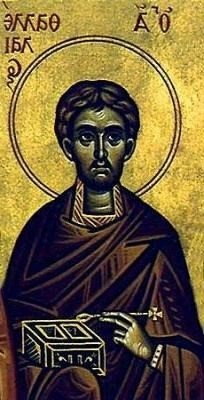
St. Paul the Physician, of Corinth
Saint Paul the Physician, from the city of Corinth, in his youth took monastic tonsure at one of the monasteries. Here the saint toiled much and became an experienced ascetic.
Once Paul, through demonic malice, was slandered by a woman. She came to the monastery with a newborn infant and said, that Saint Paul was the father.
Saint Paul the Physician, from the city of Corinth, in his youth took monastic tonsure at one of the monasteries. Here the saint toiled much and became an experienced ascetic.
Once Paul, through demonic malice, was slandered by a woman. She came to the monastery with a newborn infant and said, that Saint Paul was the father. The Elder with humility and joy endured the slander, he did not deny it and he took the infant, as though it were his own son. When they began to reproach the saint for breaking his monastic vows, Saint Paul said, “Brethren, let us ask the infant who his father is!” The newborn, pointing his hand at the blacksmith, said, “Here is my father and not the monk Paul.” Seeing this miracle, people bowed down to the Elder, asking forgiveness. From this time Saint Paul received from God the gift of healing the sick, whereby he received the name physician. Saint Paul died at age 70.
Troparion - Tone 8
By a flood of tears you made the desert fertile, / and your longing for God brought forth fruits in abundance. / By the radiance of miracles you illumined the whole universe! / O our holy father Paul, pray to Christ our God to save our souls!
Sts Sergius and Herman (1353), abbots of Valaam
After helping to establish Orthodoxy among the Karelian Finns, they founded the famous Valaam Monastery on Lake Ladoga in northern Russia. Both reposed in the same year.
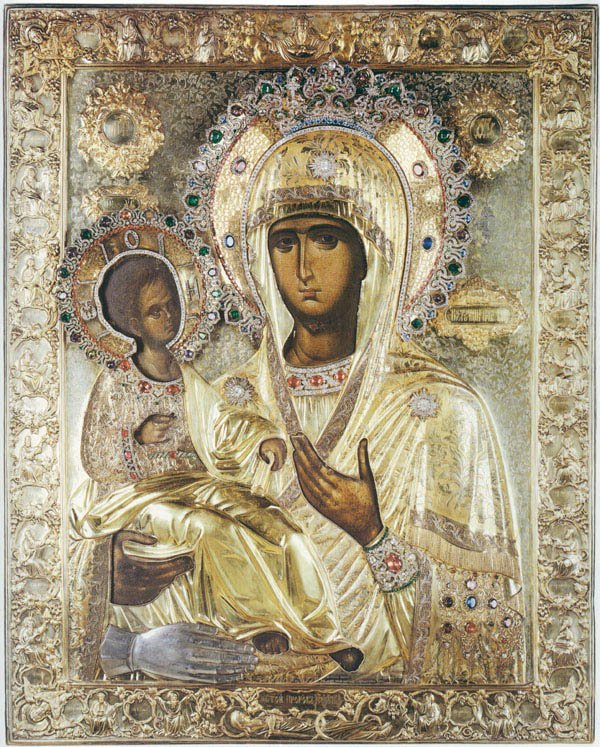
Synaxis of the Icon of our Most Holy Lady the Theotokos "Of the Three Hands"
The Icon of the Mother of God, “Of the Three Hands”: In the eighth century during the time of the Iconoclasts, Saint John of Damascus (December 4) was zealous in his veneration of holy icons. Because of this, he was slandered by the emperor and iconoclast Leo III the Isaurian (717-740), who informed the Damascus caliph that Saint John was committing treasonous acts against him. The
The Icon of the Mother of God, “Of the Three Hands”: In the eighth century during the time of the Iconoclasts, Saint John of Damascus (December 4) was zealous in his veneration of holy icons. Because of this, he was slandered by the emperor and iconoclast Leo III the Isaurian (717-740), who informed the Damascus caliph that Saint John was committing treasonous acts against him. The caliph gave orders to cut off the hand of the monk and take it to the marketplace. Towards evening Saint John, having asked the caliph for the cut-off hand, put it to its joint and fell to the ground before the icon of the Mother of God. The monk begged Our Lady to heal the hand, which had written in defense of Orthodoxy. After long prayer he fell asleep and saw in a dream that the All-Pure Mother of God had turned to him promising him quick healing.
Before this the Mother of God bid him toil without fail with this hand. Having awakened from sleep, Saint John saw that his hand was unharmed. In thankfulness for this healing Saint John placed on the icon a hand fashioned of silver, from which the icon received its name “Of Three Hands.” (Some iconographers, in their ignorance, have mistakenly depicted the Most Holy Theotokos with three arms and three hands.) According to Tradition, Saint John wrote a hymn of thanksgiving to the Mother of God: “All of creation rejoices in You, O Full of Grace,” which appears in place of the hymn “It is Truly Meet” in the Liturgy of Saint Basil the Great.
Saint John Damascene accepted monasticism at the monastery of Saint Savva the Sanctified and there bestowed his wonderworking icon. The Lavra presented the icon “Of Three Hands” in blessing to Saint Savva, Archbishop of Serbia (+ 1237, January 12). During the time of an invasion of Serbia by the Turks, some Christians who wanted to protect the icon, entrusted it to the safekeeping of the Mother of God Herself. They placed it upon a donkey, which without a driver proceeded to Athos and stopped in front of the Hilandar monastery. The monks put the icon in the monastery’s cathedral church (katholikon). During a time of discord over the choice of igumen, the Mother of God deigned to head the monastery Herself, and from that time Her holy icon has occupied the igumen’s place in the temple. At the Hilandar monastery there is chosen only a vicar, and from the holy icon the monks take a blessing for every obedience.
In Greek usage, this Icon is commemorated on June 28; but on July 12 in Slavic usage.
Troparion - Tone 4
From Palestine, the godly-minded Savva brought your divine Icon to us, / O holy Bride of God, known as the Icon “Of the Three Hands." / Wherefore, since the Monastery of Hilandar has acquired it as their boast, / they hymn you, O Theotokos, crying out in exultation: / Hail, full of grace, the Lord is with you.
Kontakion - Tone 8
Come, let us venerate the most revered Icon of "Of the Three Hands” with faith and piety. / O Maiden, preserve your Monastery from all misfortunes and adversities, / and also those who cry to you; "Hail, defender of all."
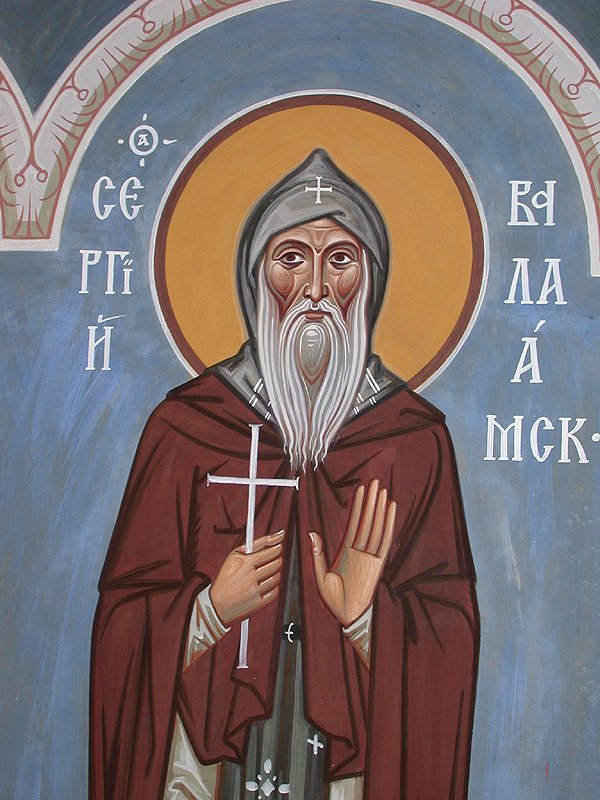
Sergius and Herman, Wonderworkers of Valaam
Saints Sergius and Herman settled on the island of Valaam in 1329. The brethren gathered by them spread the light of Orthodoxy in this frontier land. The Karelian people began to regard Christianity with renewed suspicion, with its authority in the fourteenth century being undermined by the Swedes, who sought to spread Catholicism by means of the sword.
Saints Sergius and Herman settled on the island of Valaam in 1329. The brethren gathered by them spread the light of Orthodoxy in this frontier land. The Karelian people began to regard Christianity with renewed suspicion, with its authority in the fourteenth century being undermined by the Swedes, who sought to spread Catholicism by means of the sword.
Saints Sergius and Herman died about the year 1353. They are also commemorated on September 11 (the translation of their holy relics).
Troparion - Tone 4
Fulfilling the Gospel of Christ and loving him alone, / despising earthly cares you settled on an island. / There you fought against the invisible foe, / subjecting your bodies to the Spirit by fasting, vigil and prayer. / Crowned with glory and now standing before the Trinity, / pray, O Fathers Sergius and Herman, / that our souls may be saved!
Kontakion - Tone 4
You left the world to follow in Christ’s footsteps, / reaching Lake Neva and the island of Valaam. / There you lived the angelic life / and were translated to the heavenly bridal chamber. / As you stand with the angels remember the children whom you gathered, / that we may joyfully cry to you: / Rejoice, blessed Fathers Sergius and Herman!”
Our Holy Father Sennuphius the Standard-Bearer (4th c.)
“A great ascetic and wonderworker of the Egyptian desert, he was a contemporary of Patriarch Theophilus and the Emperor Theodosius the Great. He is called ‘the Standard-Bearer’ because he once helped the Emperor Theodosius to gain a victory over enemy forces by his prayers. When the Emperor summoned him to Constantinople, he replied that he was unable to go, but sent his torn and patched monastic habit and his staff. Going
“A great ascetic and wonderworker of the Egyptian desert, he was a contemporary of Patriarch Theophilus and the Emperor Theodosius the Great. He is called ‘the Standard-Bearer’ because he once helped the Emperor Theodosius to gain a victory over enemy forces by his prayers. When the Emperor summoned him to Constantinople, he replied that he was unable to go, but sent his torn and patched monastic habit and his staff. Going out to battle, the Emperor put on Sennuphius’s habit and carried his staff in his hand, and returned victorious from the battle.” (Prologue)
Pappias the Martyr
Numerous Christians were slaughtered during the persecution under Diocletian and Maximian in the early IV century,
and Saint Pappias was one of those arrested for preaching the Gospel. The idol-worshippers tried to force him to
sacrifice to the pagan gods, but he refused to deny Christ. Therefore, he was imprisoned and tortured for several days.
W
Numerous Christians were slaughtered during the persecution under Diocletian and Maximian in the early IV century,
and Saint Pappias was one of those arrested for preaching the Gospel. The idol-worshippers tried to force him to
sacrifice to the pagan gods, but he refused to deny Christ. Therefore, he was imprisoned and tortured for several days.
When he remained unshakeable in his faith, he was beheaded, and his soul ascended victoriously into Heaven.
Troparion - Tone 3
Your holy martyr Pappias, O Lord, / through his sufferings has received an incorruptible crown from You, our God. / For having Your strength, he laid low his adversaries, / and shattered the powerless boldness of demons. / Through his intercessions, save our souls!
Kontakion - Tone 2
You appeared as a bright star announcing Christ with your radiance, / which is repulsive to this world, O Martyr Pappias; / extinguishing the allure of false gods, / you enlighten the faithful, / always interceding for us all.
Scripture Readings
☩Epistle
Romans 2:28-3:18
28
For he is not a Jew, which is one outwardly; neither is that circumcision, which is outward in the flesh:
29
But he is a Jew, which is one inwardly; and circumcision is that of the heart, in the spirit, and not in the letter; whose praise is not of men, but of God.
1
What advantage then hath the Jew? or what profit is there of circumcision?
2
Much every way: chiefly, because that unto them were committed the oracles of God.
3
For what if some did not believe? shall their unbelief make the faith of God without effect?
4
God forbid: yea, let God be true, but every man a liar; as it is written, That thou mightest be justified in thy sayings, and mightest overcome when thou art judged.
5
But if our unrighteousness commend the righteousness of God, what shall we say? Is God unrighteous who taketh vengeance? (I speak as a man)
6
God forbid: for then how shall God judge the world?
7
For if the truth of God hath more abounded through my lie unto his glory; why yet am I also judged as a sinner?
8
And not rather, (as we be slanderously reported, and as some affirm that we say,) Let us do evil, that good may come? whose damnation is just.
9
What then? are we better than they? No, in no wise: for we have before proved both Jews and Gentiles, that they are all under sin;
10
As it is written, There is none righteous, no, not one:
11
There is none that understandeth, there is none that seeketh after God.
12
They are all gone out of the way, they are together become unprofitable; there is none that doeth good, no, not one.
13
Their throat is an open sepulchre; with their tongues they have used deceit; the poison of asps is under their lips:
14
Whose mouth is full of cursing and bitterness:
15
Their feet are swift to shed blood:
16
Destruction and misery are in their ways:
17
And the way of peace have they not known:
18
There is no fear of God before their eyes.
☩Gospel
Matthew 6:31-34, 7:9-11
31
Therefore take no thought, saying, What shall we eat? or, What shall we drink? or, Wherewithal shall we be clothed?
32
(For after all these things do the Gentiles seek:) for your heavenly Father knoweth that ye have need of all these things.
33
But seek ye first the kingdom of God, and his righteousness; and all these things shall be added unto you.
34
Take therefore no thought for the morrow: for the morrow shall take thought for the things of itself. Sufficient unto the day is the evil thereof.
9
Or what man is there of you, whom if his son ask bread, will he give him a stone?
10
Or if he ask a fish, will he give him a serpent?
11
If ye then, being evil, know how to give good gifts unto your children, how much more shall your Father which is in heaven give good things to them that ask him?
Notes
["Beginning of Apostles' Fast"]
Liturgical data sourced from OCA.org and orthocal.info