
Fasting Rules
 Meat
Abstain
 Fish
Abstain
 Dairy
Abstain
 Oil
Abstain
 Wine
Abstain
Saints & Commemorations
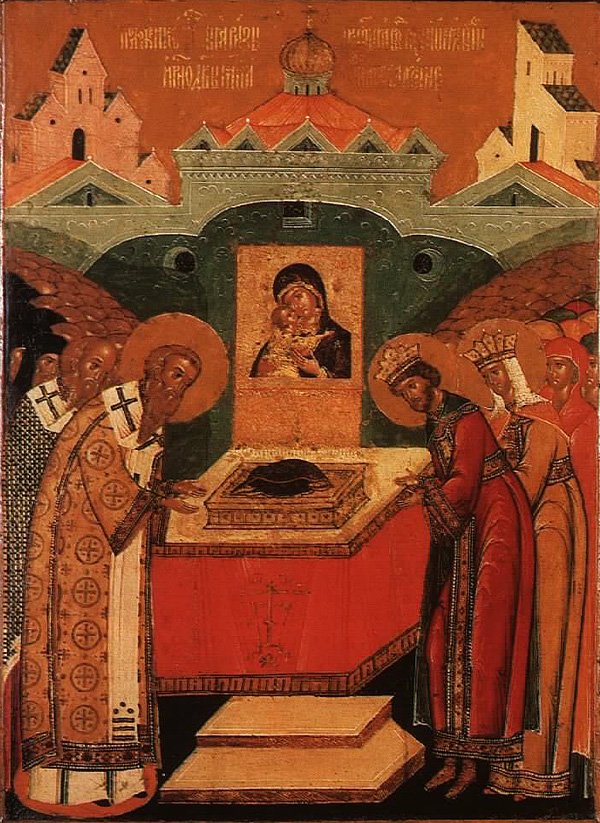
Robe of the Theotokos at Blachernae
The Placing of the Venerable Robe of the Most Holy Theotokos at Blachernae: During the reign of the Byzantine Emperor Leo the Great (457-474), the brothers Galbius and Candidus, associates of the emperor, set out from Constantinople to Palestine to venerate the holy places. In a small settlement near Nazareth they stayed in the home of a certain old Jewish woman.
The Placing of the Venerable Robe of the Most Holy Theotokos at Blachernae: During the reign of the Byzantine Emperor Leo the Great (457-474), the brothers Galbius and Candidus, associates of the emperor, set out from Constantinople to Palestine to venerate the holy places. In a small settlement near Nazareth they stayed in the home of a certain old Jewish woman. In her house they noticed a room where many lamps were lit, incense burned, and sick people were gathered. When they asked her what the room contained, the pious woman did not want to give an answer for a long time. After persistent requests, she said that she had a very precious sacred item: the Robe of the Mother of God, which performed many miracles and healings. Before Her Dormition the Most Holy Virgin bequeathed one of her garments to a pious Jewish maiden, an ancestor of the old woman, instructing her to leave it to another virgin after her death. Thus, the Robe of the Mother of God was preserved in this family from generation to generation.
The jewelled chest, containing the sacred Robe, was transferred to Constantinople. Saint Gennadius, Patriarch of Constantinople (August 31), and the emperor Leo, having learned of the sacred treasure, were convinced of the incorrupt state of the holy Robe, and they certified its authenticity. At Blachernae, near the seacoast, a new church in honor of the Mother of God was constructed. On June 2, 458 Saint Gennadius transferred the sacred Robe into the Blachernae church with appropriate solemnity, placing it within a new reliquary.
Afterwards, the maphorion (i.e., the outer robe) of the Mother of God, and part of Her belt were also put into the reliquary with Her Robe. This circumstance also influenced the Orthodox iconography of the Feast, in connecting the two events: the Placing of the Robe, and the Placing of the Belt of the Mother of God in Blachernae. The Russian pilgrim Stephen of Novgorod, visiting Constantinople in about the year 1350, testifies: “We arrived at Blachernae, where the Robe lies upon an altar in a sealed reliquary.”
More than once, during the invasion of enemies, the Most Holy Theotokos saved the city to which She had given Her holy Robe. Thus it happened during the time of a siege of Constantinople by the Avars in 626, by the Persians in 677, and by the Arabs in the year 717. Especially relevant for us are events of the year 860, intimately connected with the history of the Russian Church.
On June 18, 860 the Russian fleet of Prince Askold, a force comprising more than 200 ships, laid waste the coastal regions of the Black Sea and the Bosphorus, then entered into the Golden Horn and threatened Constantinople. The Russian ships sailed within sight of the city, setting ashore troops who “proceeded before the city, stretching forth their swords.” The emperor Michael III (842-867), interrupted his campaign against the Arabs and returned to the capital. All night he prayed prostrated upon the stone tiles of the church of the Mother of God at Blachernae. The holy Patriarch Photius spoke to his flock, calling for tears of repentance to wash away sins, and to seek the intercession of the Most Holy Theotokos with fervent prayer.
The danger grew with each passing hour. “The city was barely able to stand against a spear,” says Patriarch Photius in another of his homilies. Under these conditions the decision was made to save the church’s sacred objects, especially the holy Robe of the Mother of God, which was kept in the Blachernae church, not far from the shore.
After serving an all-night Vigil, and taking it out from the Blachernae church, they carried the sacred Robe of the Mother of God in a procession around the city walls. They dipped its edge into the waters of the Bosphorus, and then they transported it to the center of Constantinople into the church of Hagia Sophia. The Mother of God protected the city and quelled the fury of the Russian warriors. An honorable truce was concluded, and Askold lifted the siege of Constantinople.
On June 25 the Russian army began to leave, taking with them a large tribute payment. A week afterwards, on July 2, the wonderworking Robe of the Mother of God was solemnly returned to its place in the reliquary of the Blachernae church. In remembrance of these events an annual feastday of the Placing of the Robe of the Mother of God was established on July 2 by holy Patriarch Photius.
Soon, in October-November of the year 860, a Russian delegation arrived in Constantinople to conclude a treaty “in love and peace.” Some of the conditions of the peace treaty included articles concerning the Baptism of Kievan Rus, the payment of an annual tribute by the Byzantines to the Russians, permission for them to serve with the Byzantine army, an agreement to trade in the territory of the Empire (primarily in Constantinople), and to send a diplomatic mission to Byzantium.
Most important was the point about the Baptism of Rus. The continuator of the Byzantine “Theophanes Chronicles” relates that “their delegation arrived in Constantinople with a request for them to receive holy Baptism, which also was fulfilled.” An Orthodox mission was sent to Kiev to fulfill this mutual wish of the Russians and the Greeks. Not very long before this (in 855) Saint Cyril the Philosopher (February 14 and May 11) had created a Slavonic alphabet and translated the Gospel. Saint Cyril was sent with his brother, Saint Methodius (April 6 and May 11), on a mission to Kiev with books translated into Slavonic. This was at the initiative of Saint Photius, whose student Saint Cyril was. The brothers spent the winter of 860/861 at Cherson, and in the spring of 861 they were at the River Dniepr, with Prince Askold.
Prince Askold was faced with a difficult choice, just as holy Prince Vladimir faced: both the Jews on the one hand, and the Moslems on the other, wanted him to accept their faith. But under the influence of Saint Cyril, the prince chose Orthodoxy. At the end of the year 861, Saints Cyril and Methodius returned to Constantinople and carried letters with them from Prince Askold to Emperor Michael III. Askold thanked the emperor for sending him “such men, who showed by both word and by example, that the Christian Faith is holy.” “Persuaded that this is the true Faith,” Askold further wrote, “we bid them to baptize in the hope that we may also attain sanctity. We are all friends of the Kingdom and prepared to be of service to you, as requested.”
Askold accepted holy Baptism with the name Nicholas, and many of his retinue were also baptized. Directly from Constantinople, the capital of Orthodoxy, through the efforts of the holy Apostles to the Slavs both the Slavonic divine services and the Slavonic written language arrived in Rus.
Saint Photius appointed Metropolitan Michael to Kiev, and the Russian metropolitan district was entered into the lists of dioceses of the Patriarchate of Constantinople. Patriarch Photius in an encyclical of the year 867 called the Baptism of the Bulgarians and the Russians as among the chief accomplishments of his archpastoral service. “The Russians, who lifted their hand against the Roman might,” he wrote, almost quoting literally from the missive of Askold, “have now replaced the impious teaching which they held to formerly, with the pure and genuine Christian Faith, and with love having established themselves in the array of our friends and subjects.” (The Byzantines counted as “subjects” all accepting Baptism from Constantinople and entering into military alliance with the Empire.) “The desire and zeal of faith has flared up within them to such an extent, that they have accepted bishops and pastors, and they embrace Christian sanctity with great zeal and fervor.”
The Feast of the Placing of the Robe of the Most Holy Theotokos in Blachernae also marks the canonical establishment of the Russian Orthodox metropolitanate in Kiev. By the blessing of the Mother of God and by the miracle from Her holy Robe not only was the deliverence of Constantinople from the most terrible siege in all its history accomplished, but also the liberation of the Russians from the darkness of pagan superstition to life eternal. Together with this, the year 860 brought recognition to Kievan Rus from Byzantium, and signified the emergence of the young Russian realm into the arena of history.
The attempt of Prince Askold to renew the Christian evangelization begun by the holy Apostle Andrew the First-Called, which he intended as a religious and state reform, ended unsuccessfully. The time for the spread of Christianity in the Russian Land had not yet come. The adherents of the old paganism were too strong, and the princely power was too weak. In the clash of Askold with the pagan Oleg in 882 the Kievans betrayed their prince. Askold, lured into the camp of his enemies for talks, received a martyr’s death at the hand of hired killers.
But the deed of Blessed Askold (the Ioakimov Chronicle calls him such) was not extinguished in the Russian Church. Oleg the Sage, who killed Askold, occupied the Kiev princedom after him, and called Kiev the “Mother of Russian Cities.”
The most ancient chronicles of Kiev preserved the grateful memory of the first Kievan Christian prince: the church of the Prophet of God Elias, built by Askold and later mentioned in Igor’s Treaty with the Greeks (in 944), is on the site where the present church of this name now stands, and there is also the church of Saint Nicholas the Wonderworker, built in the 950s by Saint Olga over Askold’s grave.
The most important achievement of Askold, entering forever into the Church inheritance not only of Rus, but of also all Orthodox Slavs, is the Slavonic Gospel and Slavonic services, translated by Saints Cyril and Methodius. Their apostolic activity among the Slavs began in Kiev at the court of Askold in 861, and continued afterwards in Moravia and Bulgaria. Following Blessed Askold, in the words of the ancient Alphabetic Prayers, “the Slavonic tribe now soars in flight, all striving toward Baptism.”
Several outstanding works of Byzantine Church hymnology and homiletics are connected with the miracle of the Robe of the Most Holy Theotokos at Blachernae. There are two homilies of Saint Photius, one of which he preached within days of the siege of Constantinople, and the other soon after the departure of the Russian forces. Also associated with the campaign of Askold against Constantinople is the composition of a remarkable “Akathist to the Most Holy Theotokos,” which certain Church histories ascribe also to holy Patriarch Photius. This Akathist forms an integral part of the services of Praise to the Most Holy Theotokos (i.e., the “Saturday of the Akathist,” Fifth Saturday of Great Lent).
It is not only Byzantine sources that relate the events of the year 860, but also Russian historical chronicles. Saint Nestor the Chronicler, stressing the significance of the Russian campaign against Constantinople, notes that from this time “it was begun to be called the Russian Land.” Certain of the chronicles, among them the Ioakimov and Nikonov, preserved accounts of the Baptism of Prince Askold and Kievan Rus after the campaign against Constantinople. The popular commemoration of this event is firmly associated with the names of the Kievan princes Askold and Dir, although in the opinion of historians, Dir was prince of Kiev somewhat earlier than Askold.
The veneration of the feast of the Placing of the Robe was long known in the Russian Church. Saint Andrew Bogoliubsky (July 4) built a church in honor of this feastday in the city of Vladimir at the Golden Gates. At the end of the fourteenth century, part of the Robe of the Mother of God was transferred from Constantinople to Rus by Saint Dionysius, Archbishop of Suzdal (June 26).
The holy Robe of the Mother of God, which previously saved Constantinople, later saved Moscow from hostilities. Tatars of the Horde of the princeling Mazovshi approached the walls of Moscow in the summer of 1451. Saint Jonah, Metropolitan of Moscow, with constant prayer and church services, encouraged the defenders of the capital. On the night of July 2, the Chronicle relates, great confusion occurred within the Tatar camp. The enemy abandoned their plundered goods and speedily departed in disarray. In memory of the miraculous deliverance of Moscow, Saint Jonah built the church of the Placing of the Robe in the Kremlin, making it his primary church. It burned, but in its place in the years 1484-1486 a new church, also dedicated to the Feast of the Placing of the Robe of the Mother of God, was built thirty years later. This temple, standing at present, continued to serve as the primary church of Russian metropolitans and patriarchs until the cathedral of the Twelve Apostles was built under Patriarch Nikon.
Troparion - Tone 8
Ever-Virgin Theotokos, protectress of mankind, you have given your people a powerful legacy: / the robe and sash of your most honored body, which remained incorrupt throughout your seedless childbearing; for through you time and nature are renewed! / Therefore we implore you: “Grant peace to your people and to our souls great mercy!”
Kontakion - Tone 4
O Pure One, full of the grace of God, / you have given your sacred robe as a garment of incorruption to all the faithful, / with it you covered your holy body, O divine protection of all mankind. / We celebrate its enshrinement in Blachernae with love and we cry aloud with awe: / “Rejoice, O Virgin, boast of Christians.”

St John (Maximovich), Archbishop of Shanghai and San Francisco (1966) (June 19 OC)
Our Father among the Saints John (Maximovitch), Archbishop of Shanghai and San Francisco (1896-1966), was a diocesan bishop of the Russian Orthodox Church Outside Russia (ROCOR) who served widely from China to France to the United States.
Saint John departed this life on June 19 (O.S.) / July 2 (N.S.), 1966, and was officially glorified by the Russian Orthodox Church Abroad on July 2, 1994.
Our Father among the Saints John (Maximovitch), Archbishop of Shanghai and San Francisco (1896-1966), was a diocesan bishop of the Russian Orthodox Church Outside Russia (ROCOR) who served widely from China to France to the United States.
Saint John departed this life on June 19 (O.S.) / July 2 (N.S.), 1966, and was officially glorified by the Russian Orthodox Church Abroad on July 2, 1994. His glorification was later recognized for universal veneration by the Patriarchate of Moscow on July 2, 2008.
The future Saint John was born on June 4, 1896, in the village of Adamovka in Kharkiv province to pious aristocrats, Boris and Glafira Maximovitch. He was given the baptismal name of Michael, after the Holy Archangel Michael. In his youth, Michael was sickly and had a poor appetite, but he displayed an intense religious interest. He was educated at the Poltava Military School (1907-14); Kharkiv Imperial University, from which he received a law degree (in 1918); and the University of Belgrade (where he completed his theological education in 1925).
He and his family fled their country as the Bolshevik revolutionaries descended on the country, emigrating to Yugoslavia. There, he enrolled in the Department of Theology of the University of Belgrade. He was tonsured a monk in 1926 by Metropolitan Anthony (Khrapovitsky) of Kharkov (later the first primate of the Russian Orthodox Church Outside of Russia). Metropolitan Anthony later in 1926 ordained him hierodeacon. Bishop Gabriel of Chelyabinsk ordained him hieromonk on November 21, 1926. Subsequent to his ordination he began an active life of teaching in a Serbian high school and serving, at the request of local Greeks and Macedonians, in the Greek language. With the growth of his popularity, the bishops of the Russian Church Aboard resolved to elevate him to the episcopate.
Hieromonk John was consecrated bishop on May 28, 1934, with Metropolitan Anthony serving as principal consecrator, after which he was assigned to the Diocese of Shanghai. Twelve years later he was named Archbishop of China. Upon his arrival in Shanghai, Bishop John began working to restore unity among the various Orthodox nationalities. In time, he worked to build a large cathedral church that was dedicated to Surety of Sinners Icon to the Mother of God, with a bell tower and large parish house. Additionally, he inspired many activities: building of churches, hospitals, and orphanages among the Orthodox and Russians of Shanghai. He was intensely active, constantly praying and serving the daily cycle of services, while also visiting the sick with the Holy Gifts. He often would walk barefooted even in the coldest days. Yet to avoid the appearance of secular glory, he would pretend to act the fool.
With the end of World War II and the coming to power of the communists in China, Bishop John led the exodus of his community from Shanghai in 1949. Initially, he helped some 5,000 refugees to a camp on the island of Tubabao in the Philippines, while he travelled successfully to Washington, D.C., to lobby to amend the law to allow these refugees to enter the United States. It was while on this trip that Bishop John took time to establish a parish in Washington dedicated to Saint John the Forerunner.
In 1951, Archbishop John was assigned to the Archdiocese of Western Europe with his cathedra in Paris. During his time there, he also served as archpastor of the Orthodox Church of France, whose restored Gallican liturgy he studied and then celebrated. He was the principal consecrator of the Orthodox Church of France's first modern bishop, Jean-Nectaire (Kovalevsky) of Saint-Denis, and ordained to the priesthood the man who would become its second bishop, Germain (Bertrand-Hardy) of Saint-Denis.
In 1962, Archbishop John was assigned to the Diocese of San Francisco, succeeding his long time friend Archbishop Tikhon. Archbishop John's days in San Francisco were to prove sorrowful as he attempted to heal the great disunity in his community. He was able to bring peace such that the new cathedral, dedicated to the Joy of all Who Sorrow Icon of the Mother of God, was completed.
Deeply revering Saint John of Kronstadt, Archbishop John played an active role in preparation of his canonization.
He reposed during a visit to Seattle on July 2, 1966, while accompanying a tour of the Kursk-Root Icon of the Mother of God. He was laid to rest in a crypt chapel under the main altar of the new cathedral.
Troparion - Tone 5
Your care for your flock in its sojourn prefigured your prayers, / which you always offer up for the whole world. / Thus we believe, having come to know your love, O holy hierarch and wonderworker John. / Wholly sanctified by God through the ministry of the all-pure Mysteries, / and ever strengthened by them yourself, / you hastened to the suffering, O healer, easing their afflictions. / Hasten now to help us, who honor you with all our heart.
Kontakion - Tone 4
Your heart went out to all who entreat you with love, O hierarch John, / and who remember the struggle of your life, and thy painless and easy repose, / O faithful servant of the all-pure Directress.*
* Directress refers to the Mother of God as Hodēgḗtria (She who shows the way).
St Juvenal, Patriarch of Jerusalem (458)
Saint Juvenal, Patriarch of Jerusalem, occupied the throne of the Holy City during the years 420-458. During this period great luminaries of the Church enlightened the world: Saints Euthymios the Great (January 20), Simeon the Stylite (September 1), Gerasimos of Jordan (March 4), and many others.
Saint Juvenal was a friend and converser with Saint Euthymios the Great.
Saint Juvenal, Patriarch of Jerusalem, occupied the throne of the Holy City during the years 420-458. During this period great luminaries of the Church enlightened the world: Saints Euthymios the Great (January 20), Simeon the Stylite (September 1), Gerasimos of Jordan (March 4), and many others.
Saint Juvenal was a friend and converser with Saint Euthymios the Great. During Saint Juvenal’s archpastoral service, the Eastern Church was troubled by dangerous false teachings, which he opposed with a pastoral zeal, safeguarding the flock of Christ.
The Third Ecumenical Council was convened in the city of Ephesus in 431. It condemned the heresy of Nestorius, which was opposed to the Orthodox teaching about the divine nature of Jesus Christ. Saint Cyril of Alexandria (June 9) presided at this Council, and among his colleagues was Patriarch Juvenal.
In 451, the Fourth Ecumenical Council met in the city of Chalcedon. It condemned the Eutchian [Monophysite] heresy, which taught that the human nature in Christ was completely swallowed up and absorbed by the divine nature. The Holy Fathers, among them Saint Juvenal, condemned the heresy of Eutychios and affirmed the Orthodox doctrine of the union of two natures in the Lord Jesus Christ, the divine and the human, without separation and without mixture. The heretics, however, continued to confuse the minds of Christians.
At the head of the heretics stood Theodosius, who lived at Jerusalem, and who had won to his side Eudokia, the widow of Emperor Theodosios the Younger (+ 450), who lived at Jerusalem. He demanded that Patriarch Juvenal repudiate the Council of Chalcedon; that is to say, that he should renounce the Orthodox dogma of the two natures in Christ.
Saint Juvenal would not agree to embrace falsehood, and bravely confessed the Chalcedonian doctrine before the heretics. Theodosius and his adherents then deposed Patriarch Juvenal from the patriarchal throne. The Saint fled to Constantinople, to Patriarch Anatolios (July 3) and the Emperor Marcian. The heretic Theodosios, under Eudokia's patronage, occupied the patriarchal throne in Palestine, but only for twenty months. Emperor Marcian, holding Saint Juvenal in high esteem, placed him on the patriarchal throne once more, and so the Holy Confessor returned to Jerusalem.
The Saint made many efforts to restore Church peace. At the suggestion of Saint Simeon the Stylite, Empress Eudokia repented before Saint Juvenal and returned to communion with the Orthodox. A large part of the Jerusalem flock, who had been led astray by the heretics, followed her. After defeating the pernicious heresies, and establishing oneness of mind and propriety, Patriarch Juvenal reposed peacefully among his faithful flock, after serving as a bishop for thirty-eight years.
Troparion - Tone 4
O successor of the Brother of the Lord on the archpastoral throne of the holy city of Jerusalem, / you are worthy of praise. / With the divinely-wise Fathers of Chalcedon / you expounded the Incarnation of the Son of God, / Who came to renew the world and to deify all men, / united with Him in His Church. O Hierarch Father Juvenal, / now as you stand before the throne of Father of Lights in the Kingdom, / pray for those who lovingly honor you, / and may the peace and mercy of the Savior be with us.
St Juvenaly, First Martyr of America and Alaska (1796)
“St Juvenal was (together with St Herman, see Dec. 12) a member of the first mission sent from Russia to proclaim the Gospel in the New World. He was a priest-monk, and a zealous follower of the Apostles, and baptized hundreds of the natives of Alaska. He was martyred by enraged pagans in 1796.” (Great Horologion)
Scripture Readings
☩Epistle
Romans 5:17-6:2
17
For if by one man’s offence death reigned by one; much more they which receive abundance of grace and of the gift of righteousness shall reign in life by one, Jesus Christ.)
18
Therefore as by the offence of one judgment came upon all men to condemnation; even so by the righteousness of one the free gift came upon all men unto justification of life.
19
For as by one man’s disobedience many were made sinners, so by the obedience of one shall many be made righteous.
20
Moreover the law entered, that the offence might abound. But where sin abounded, grace did much more abound:
21
That as sin hath reigned unto death, even so might grace reign through righteousness unto eternal life by Jesus Christ our Lord.
1
What shall we say then? Shall we continue in sin, that grace may abound?
2
God forbid. How shall we, that are dead to sin, live any longer therein?
☩Gospel
Matthew 9:14-17
14
Then came to him the disciples of John, saying, Why do we and the Pharisees fast oft, but thy disciples fast not?
15
And Jesus said unto them, Can the children of the bridechamber mourn, as long as the bridegroom is with them? but the days will come, when the bridegroom shall be taken from them, and then shall they fast.
16
No man putteth a piece of new cloth unto an old garment, for that which is put in to fill it up taketh from the garment, and the rent is made worse.
17
Neither do men put new wine into old bottles: else the bottles break, and the wine runneth out, and the bottles perish: but they put new wine into new bottles, and both are preserved.
Liturgical data sourced from OCA.org and orthocal.info