
Fasting Rules
 Meat
Allowed
 Fish
Allowed
 Dairy
Allowed
 Oil
Allowed
 Wine
Allowed
Saints & Commemorations
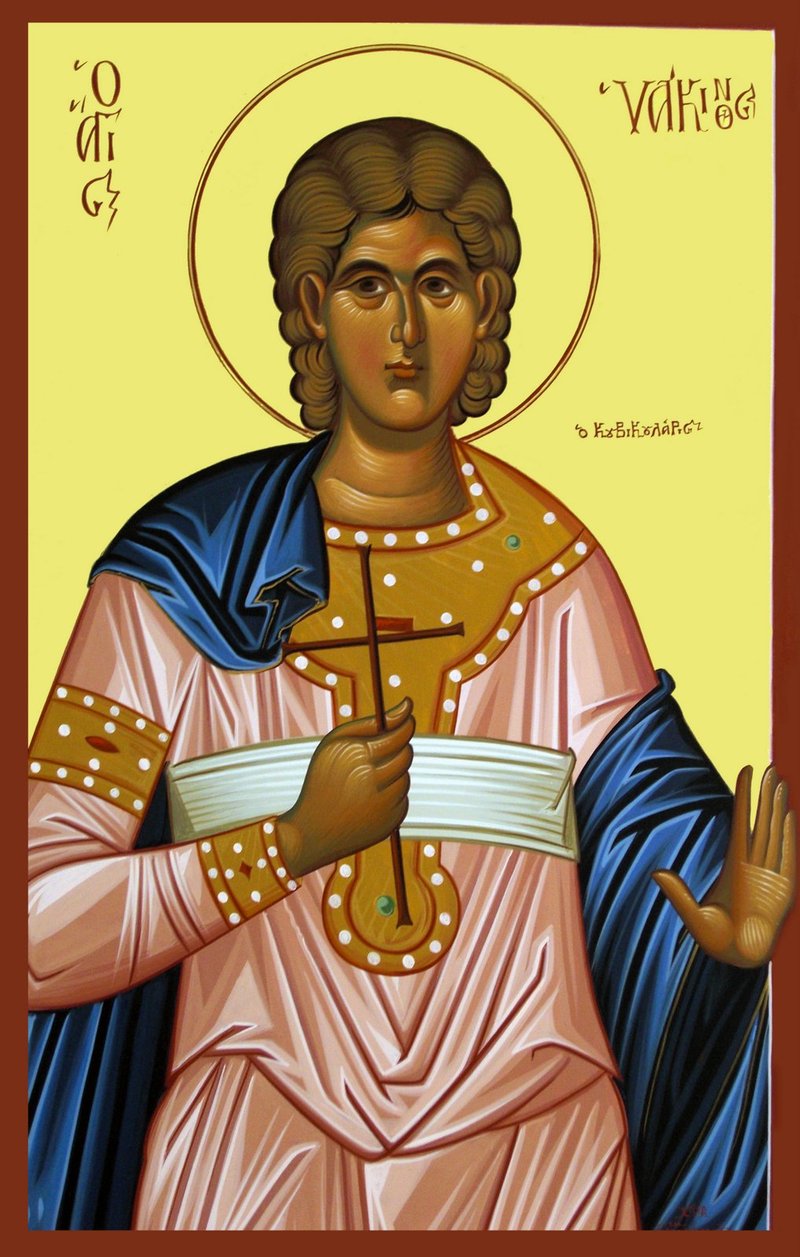
Martyr Hyacinth
Saint Hyacinth, a native of Caesarea in Cappadocia, was raised in a Christian family. The emperor Trajan made the boy his “cubicularius” (chamberlain), unaware that he was a secret Christian.
One day, while the emperor and his entourage were offering sacrifice to idols, the young Hyacinth remained at the palace, shut himself up in a small room, and prayed fervently to the Lord Jesus Christ. One
Saint Hyacinth, a native of Caesarea in Cappadocia, was raised in a Christian family. The emperor Trajan made the boy his “cubicularius” (chamberlain), unaware that he was a secret Christian.
One day, while the emperor and his entourage were offering sacrifice to idols, the young Hyacinth remained at the palace, shut himself up in a small room, and prayed fervently to the Lord Jesus Christ. One of the servants overheard him praying and denounced him to the emperor. He said that although Hyacinth was entrusted with an imperial position, he did not honor the Roman gods, and was secretly praying to Christ.
Hyacinth was brought to trial before Trajan, who tried to persuade him to deny Christ and sacrifice to the deaf and dumb idols, but the holy martyr remained steadfast and declared that he was a Christian. He was whipped and thrown into prison, where the only food given to him was what had already been offered to the idols. They hoped that he would be overcome with hunger and thirst and eat it. Saint Hyacinth did not eat the food, and he died after thirty-eight days. When they came to torture him again, they found his dead body.
The jailer saw two angels in the cell. One covered the saint’s body with his own garment, and the other placed a crown of glory on his head.
The twelve-year-old Hyacinth suffered for Christ in the year 108 in the city of Rome. Later, the saint’s relics were transferred to Caesarea.
Saints Diomedes, Eulampius, Asclepiodotus, and Golinduc also suffered with Saint Hyacinth.
Troparion - Tone 4
Like a fragrant hyacinth of the Church of Christ, O all-blessed Hyacinth, / you radiate grace to the ends of the world. / By the brilliance of your confession of faith, / you were illustrious in contest in emulation of God the Word / and you ever illumine those who acclaim you.
Kontakion - Tone 2
Come, you faithful, / plait a crown of unfading hyacinths today for the Martyr Hyacinth, / and let us cry to Him: / “Rejoice, glory of martyrs.”
Trans. Rel. Philip, Metr. Moscow
Our Holy Father Isaiah the Solitary (491)
One of the Desert Fathers, he lived in asceticism first at Scetis in Egypt, then in Palestine; he died in Gaza. His instructive writings are often quoted by the Fathers.
Abba Isaiah said: The crown of all good works consists in this: that a man place all his hope in God, that he flee to Him once and for all with all his heart and strength, that he
One of the Desert Fathers, he lived in asceticism first at Scetis in Egypt, then in Palestine; he died in Gaza. His instructive writings are often quoted by the Fathers.
Abba Isaiah said: The crown of all good works consists in this: that a man place all his hope in God, that he flee to Him once and for all with all his heart and strength, that he be filled with compassion for all and weep before God, imploring His help and mercy.
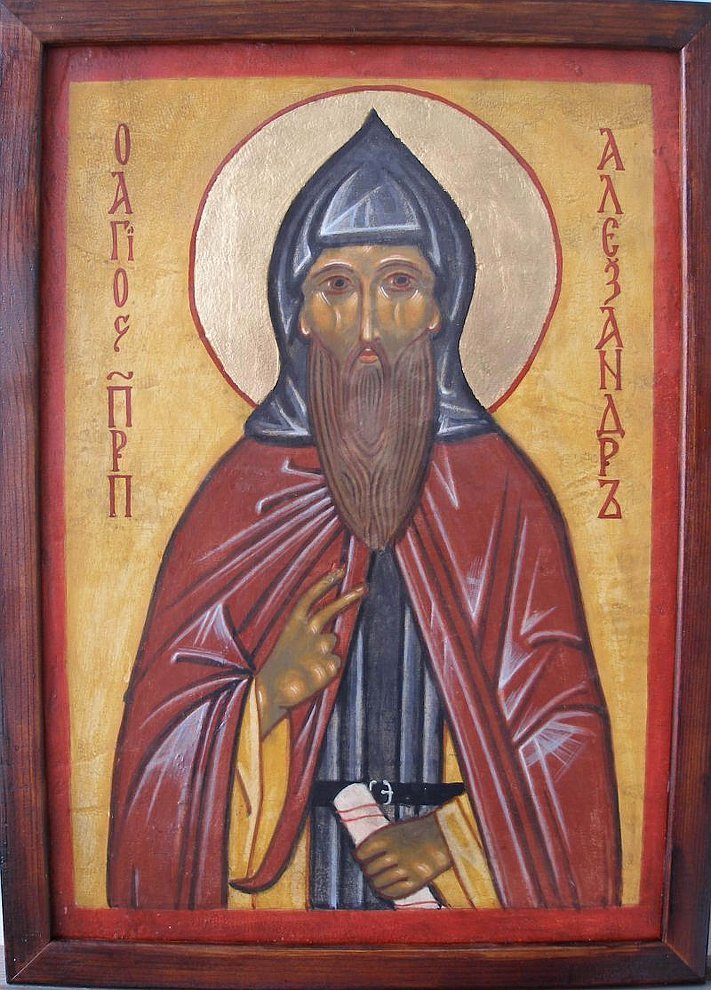
Our Holy Father Alexander, founder of the Monastery of the Unsleeping Ones (430)
Saint Alexander, Founder of the Monastery of the “Unsleeping Ones,” was born in Asia and received his education at Constantinople. He spent some time in military service but, sensing a call to other service, he left the world and accepted monastic tonsure in one of the Syrian wilderness monasteries near Antioch, under the guidance of igumen Elias. He
Saint Alexander, Founder of the Monastery of the “Unsleeping Ones,” was born in Asia and received his education at Constantinople. He spent some time in military service but, sensing a call to other service, he left the world and accepted monastic tonsure in one of the Syrian wilderness monasteries near Antioch, under the guidance of igumen Elias. He spent four years in strict obedience and monastic effort, after which he received from the igumen blessing to dwell in the desert. Going into the wilderness, the monk took with him nothing from the monastery, except the Gospel. The monk then struggled in the desert for seven years. Afterwards, the Lord summoned him to preach to pagans.
The saint converted to Christ the local city ruler named Rabul, who afterwards was consecrated a bishop and for 30 years occupied the bishop’s cathedra of the city of Edessa. Together with Rabul all the local inhabitants accepted Baptism, and before receiving the sacrament they burned their idols in the city square. Having confirmed the newly-converted in the Faith, Saint Alexander again went into the desert, where by chance he came upon a cave of robbers. Unafraid of the danger that threatened him, he preached the Gospel to them and urged them to repent. In fact, all the robbers did repent. They accepted holy Baptism, and they transformed their cave into a monastery, where they dwelt in prayer and penitence. Saint Alexander appointed an igumen for them, gave them a monastic rule, and he himself resettled still farther in the desert.
For several years he lived in complete solitude. But even there lovers of solitude began to flock to the monk. A monastery emerged, numbering 400 monks. Desiring at this monastery to establish uninterrupted praise to the Lord, the monk prayed for three years, that the Creator would reveal to him His will, and having then received the revelation, he initiated at the monastery the following order: all the monks were divided into 24 watches of prayer. Changing shifts each hour, day and night they sang in two choirs the Psalms of David, interrupting this only for the times of the divine services. The monastery received the name “ the Unsleeping Ones,” because the monks sang praise to God throughout the day and night.
Saint Alexander guided the monastery on the Euphrates for twelve years. Afterwards, leaving one of his disciples, the experienced Elder Trophimus as its igumen, he set out with some chosen brethren through the cities bordering on Persia, preaching the Gospel among the pagans. After this missionary journeying, Saint Alexander lived with his monks for a certain while at Antioch. There he built a church for the city-dwellers, and a home for the sick and homeless with the money that charitable Antiochians put at his disposal. However, through the intrigues of the jealous, Saint Alexander was compelled to move to Constantinople.
Here he founded a new monastery, in which he also initiated a monastic rule of “unceasing vigilance.” Saint Alexander and his monks suffered at Constantinople under the Nestorian heretics, enduring beatings and imprisonment. After this, when the storm of unrest abated, Saint Alexander spent the last days of his life at the Constantinople monastery he founded. He died in extreme old age in about the year 430, after 50 years of incessant monastic effort. He is also commemorated on February 23.
Troparion - Tone 8
By a flood of tears you made the desert fertile, / and your longing for God brought forth fruits in abundance. / By the radiance of miracles you illumined the whole universe! / O our holy father Alexander, pray to Christ our God to save our souls!
Our Father among the Saints Anatolios, Archbishop of Constantinople (458)
He was a priest from Alexandria. At the ‘Robber Council’ at Ephesus in 449, Dioscoros, the monophysite who occupied the Patriarchal throne in Alexandria, had Anatolios installed as Patriarch of Constantinople, thinking that he would prove an ally. But Anatolios quickly emerged as a fervent champion of Orthodoxy: he convened a council of bishops just before the Council of Chalcedon in 451, at which Pope Leo’s Orthodox “Tome” (see February 18) was approved, though Dioscoros had not allowed it to be read at the Robber Council. At the Co
He was a priest from Alexandria. At the ‘Robber Council’ at Ephesus in 449, Dioscoros, the monophysite who occupied the Patriarchal throne in Alexandria, had Anatolios installed as Patriarch of Constantinople, thinking that he would prove an ally. But Anatolios quickly emerged as a fervent champion of Orthodoxy: he convened a council of bishops just before the Council of Chalcedon in 451, at which Pope Leo’s Orthodox “Tome” (see February 18) was approved, though Dioscoros had not allowed it to be read at the Robber Council. At the Council of Chalcedon, Anatolios condemned Nestorius, Eutyches, and his frustrated patron Dioscoros. He reposed in peace in 458.
Anatolios is believed to be the author of the ‘Anatolian Stichera’ found in the weekly Vespers and Matins services; but these may have been composed by another Anatolios, a monk and a disciple of St Theodore the Studite.
Scripture Readings
☩Epistle
Romans 3:19-26
19
Now we know that what things soever the law saith, it saith to them who are under the law: that every mouth may be stopped, and all the world may become guilty before God.
20
Therefore by the deeds of the law there shall no flesh be justified in his sight: for by the law is the knowledge of sin.
21
But now the righteousness of God without the law is manifested, being witnessed by the law and the prophets;
22
Even the righteousness of God which is by faith of Jesus Christ unto all and upon all them that believe: for there is no difference:
23
For all have sinned, and come short of the glory of God;
24
Being justified freely by his grace through the redemption that is in Christ Jesus:
25
Whom God hath set forth to be a propitiation through faith in his blood, to declare his righteousness for the remission of sins that are past, through the forbearance of God;
26
To declare, I say, at this time his righteousness: that he might be just, and the justifier of him which believeth in Jesus.
☩Gospel
Matthew 7:1-8
1
Judge not, that ye be not judged.
2
For with what judgment ye judge, ye shall be judged: and with what measure ye mete, it shall be measured to you again.
3
And why beholdest thou the mote that is in thy brother’s eye, but considerest not the beam that is in thine own eye?
4
Or how wilt thou say to thy brother, Let me pull out the mote out of thine eye; and, behold, a beam is in thine own eye?
5
Thou hypocrite, first cast out the beam out of thine own eye; and then shalt thou see clearly to cast out the mote out of thy brother’s eye.
6
Give not that which is holy unto the dogs, neither cast ye your pearls before swine, lest they trample them under their feet, and turn again and rend you.
7
Ask, and it shall be given you; seek, and ye shall find; knock, and it shall be opened unto you:
8
For every one that asketh receiveth; and he that seeketh findeth; and to him that knocketh it shall be opened.
Liturgical data sourced from OCA.org and orthocal.info