
Fasting Rules
 Meat
Allowed
 Fish
Allowed
 Dairy
Allowed
 Oil
Allowed
 Wine
Allowed
Saints & Commemorations
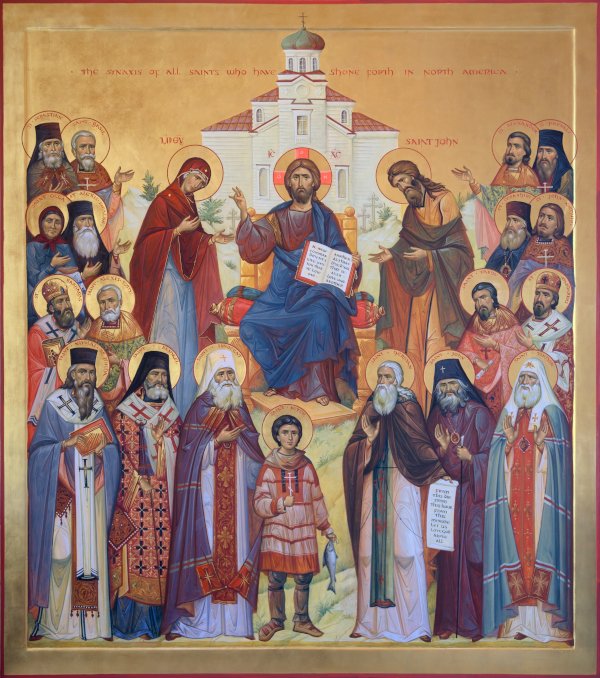
All Saints of America, All Saints of Russia
On the second Sunday after Pentecost, each local Orthodox Church commemorates all the saints, known and unknown, who have shone forth in its territory. Accordingly, the Orthodox Church in America remembers the saints of North America on this day.
Saints of all times, and in every country are seen as the fulfillment of God’s promise to redeem fallen humanity. T
On the second Sunday after Pentecost, each local Orthodox Church commemorates all the saints, known and unknown, who have shone forth in its territory. Accordingly, the Orthodox Church in America remembers the saints of North America on this day.
Saints of all times, and in every country are seen as the fulfillment of God’s promise to redeem fallen humanity. Their example encourages us to “lay aside every weight, and the sin which so easily besets us” and to “run with patience the race that is set before us” (Hebrews 12:1). The saints of North America also teach us how we should live, and what we must expect to endure as Christians
Although it is a relatively young church, the Orthodox Church in America has produced saints in nearly all of the six major categories of saints: Apostles (and Equals of the Apostles); Martyrs (and Confessors); Prophets; Hierarchs; Monastic Saints; and the Righteous. Prophets, of course, lived in Old Testament times and predicted the coming of Christ.
The first Divine Liturgy in what is now American territory (northern latitude 58 degrees, 14 minutes, western longitude 141 degrees) was celebrated on July 20, 1741, the Feast of the Prophet Elias, aboard the ship Peter under the command of Vitus Bering. Hieromonk Hilarion Trusov and the priest Ignatius Kozirevsky served together on that occasion. Several years later, the Russian merchant Gregory I. Shelikov visited Valaam monastery, suggesting to the abbot that it would be desirable to send missionaries to Russian America.
On September 24, 1794, after a journey of 7,327 miles (the longest missionary journey in Orthodox history) and 293 days, a group of monks from Valaam arrived on Kodiak Island in Alaska. The mission was headed by Archimandrite Joasaph, and included Hieromonks Juvenal, Macarius, and Athanasius, the Hierodeacons Nectarius and Stephen, and the monks Herman and Joasaph. Saint Herman of Alaska (December 13, August 9), the last surviving member of the mission, fell asleep in the Lord in 1837.
Throughout the Church’s history, the seeds of faith have always been watered by the blood of the martyrs. The Protomartyr Juvenal was killed near Lake Iliamna by natives in 1799, thus becoming the first Orthodox Christian to shed his blood for Christ in the New World. In 1816, Saint Peter the Aleut was put to death by Spanish missionaries in California when he refused to convert to Roman Catholicism.
Missionary efforts continued in the nineteenth century, with outreach to the native peoples of Alaska. Two of the most prominent laborers in Christ’s Vineyard were Saint Innocent Veniaminov (March 31 and October 6) and Saint Jacob Netsvetov (July 26), who translated Orthodox services and books into the native languages. Father Jacob Netsvetev died in Sitka in 1864 after a life of devoted service to the Church. Father John Veniaminov, after his wife’s death, received monastic tonsure with the name Innocent. He died in 1879 as the Metropolitan of Moscow.
As the nineteenth century was drawing to a close, an event of enormous significance for the North American Church took place. On March 25, 1891, Bishop Vladimir went to Minneapolis to receive Saint Alexis Toth (May 7) and 361 of his parishioners into the Orthodox Church. This was the beginning of the return of many Uniates to Orthodoxy.
Saint Tikhon (Bellavin), the future Patriarch of Moscow (April 7, October 9), came to America as bishop of the diocese of the Aleutians and Alaska in September 1898. As the only Orthodox bishop on the continent, Saint Tikhon traveled extensively throughout North America in order to minister to his widely scattered and diverse flock. He realized that the local church here could not be a permanent extension of the Russian Church. Therefore, he focused his efforts on giving the American Church a diocesan and parish structure which would help it mature and grow.
Saint Tikhon returned to Russia in 1907, and was elected as Patriarch of Moscow ten years later. He died in 1925, and for many years his exact burial place remained unknown. Saint Tikhon’s grave was discovered on February 22, 1992 in the smaller cathedral of Our Lady of the Don in the Don Monastery when a fire made renovation of the church necessary.
Saint Raphael of Brooklyn (February 27) was the first Orthodox bishop to be consecrated in North America. Archimandrite Raphael Hawaweeny was consecrated by Bishop Tikhon and Bishop Innocent (Pustynsky) at Saint Nicholas Cathedral in New York on March 13, 1904. As Bishop of Brooklyn, Saint Raphael was a trusted and capable assistant to Saint Tikhon in his archpastoral ministry. Saint Raphael reposed on February 27, 1915.
The first All American Council took place March 5-7, 1907 at Mayfield, PA, and the main topic was “How to expand the mission.” Guidelines and directions for missionary activity, and statutes for the administrative structure of parishes were also set forth.
In the twentieth century, in the aftermath of the Russian Revolution, countless men, women, and children received the crown of martyrdom rather than renounce Christ. Saints John Kochurov (October 31) and Alexander Hotovitzky (December 4 and August 7) both served the Church in North America before going back to Russia. Saint John became the first clergyman to be martyred in Russia on October 31, 1917 in Saint Petersburg. Saint Alexander Hotovitzky, who served in America until 1914, was killed in 1937.
In addition to the saints listed above, we also honor those saints who are known only to God, and have not been recognized officially by the Church. As we contemplate the lives of these saints, let us remember that we are also called by God to a life of holiness.
Troparion - Tone 8
As the bountiful harvest of Your sowing of salvation, / the lands of North America offer to You, O Lord, all the saints who have shone in them. / By their prayers keep the Church and our land in abiding peace / through the Theotokos, O most Merciful One.
Kontakion - Tone 3
Today the choir of Saints who were pleasing to God in the lands of North America / now stands before us in the Church and invisibly prays to God for us. / With them the angels glorify Him, / and all the saints of the Church of Christ keep festival with them; / and together they all pray for us to the Pre-Eternal God.

St Andrew of Crete
Saint Andrew, Archbishop of Crete, was born in the city of Damascus into a pious Christian family. Up until seven years of age the boy was mute and did not talk. However, after communing the Holy Mysteries of Christ he found the gift of speech and began to speak. And from that time the lad began earnestly to study Holy Scripture and the discipline of theology.
Saint Andrew, Archbishop of Crete, was born in the city of Damascus into a pious Christian family. Up until seven years of age the boy was mute and did not talk. However, after communing the Holy Mysteries of Christ he found the gift of speech and began to speak. And from that time the lad began earnestly to study Holy Scripture and the discipline of theology.
At fourteen years of age he went off to Jerusalem and there he accepted monastic tonsure at the monastery of Saint Savva the Sanctified. Saint Andrew led a strict and chaste life, he was meek and abstinent, such that all were amazed at his virtue and reasoning of mind. As a man of talent and known for his virtuous life, over the passage of time he came to be numbered among the Jerusalem clergy and was appointed a secretary for the Patriarchate -- a writing clerk. In the year 680 the locum tenens of the Jerusalem Patriarchate, Theodore, included archdeacon Andrew among the representatives of the Holy City sent to the Sixth Ecumenical Council, and here the saint contended against heretical teachings, relying upon his profound knowledge of Orthodox doctrine. Shortly after the Council he was summoned back to Constantinople from Jerusalem and he was appointed archdeacon at the church of Hagia Sophia, the Wisdom of God. During the reign of the emperor Justinian II (685-695) Saint Andrew was ordained bishop of the city of Gortineia on the island of Crete. In his new position he shone forth as a true luminary of the Church, a great hierarch -- a theologian, teacher and hymnographer.
Saint Andrew composed many inspired writings, including the Great Canon of Repentance which is sung on Monday through Thursday of the first week of Lent, after the usual beginning of Compline, and following Psalm 69/70. In current Greek practice the Great Canon begins after the Doxology. The Great Canon of Repentance includes 250 troparia within its 9 Odes. Before each Troparion of the Canon, we make the Sign of the Cross and bow and sing "Have mercy upon me, O God, have mercy upon me." On Thursday of the fifth week, the Great Canon is sung continuously in its entirety. After Psalm 90/91 "God is with us," is read plainly and without a melody (outside of Great Lent). During Lent, however, the verses are sung slowly by the choir with the refrain "For God is with us" after each verse. 1
Saint Andrew has also composed the Canon for the Feast of the Nativity of Christ, three Odes for Compline of Palm Sunday, and also in the first four days of Passion Week, as well as verses for the Feast of the Meeting of the Lord, and many other Church hymns. His hymnographic legacy was continued by other great composers of following ages: Saints John of Damascus (December 4), Cosmas of Maiuma (October 12), Joseph the Hymnographer (April 4), Theophánēs the Branded (October 11), etc.
Church historians are not of the same opinion as to the date of death of the saint. One suggests the year 712, while others -- the year 726. He died on the island of Mytilene, while returning to Crete from Constantinople, where he had been on churchly business. His relics were transferred to Constantinople. In the year 1350 the pious Russian pilgrim Stephen Novgorodets saw the relics at the Constantinople monastery named for Saint Andrew of Crete.
1 For further information consult The Lention Triodion by Mother Mary and Archimandrite Kállistos Ware.
Troparion - Tone 5
Emulating David / you sang a new song in the assembly of the righteous. / As an initiate of the Holy Spirit
you guided us with hymns of grace / and the word of righteousness for our salvation, / O Andrew, glory
of the Fathers.
Kontakion - Tone 2
Trumpeting forth divine melodies, / you were shown as a far-shining luminary for the world. / You
shone forth with the radiant light of the Trinity, O Venerable Andrew. / Therefore we all cry to you: "Do
not cease to intercede for us all.
Holy Royal Martyrs of Russia: Tsar Nicholas II, Tsaritsa Alexandra, Crown Prince Alexei, and Grand duchesses Olga, Tatiana, Maria, and Anastasia, and those martyred with them (1918).
“Tsar Nicholas II was the son of Alexander III, who had reposed in the arms of St John of Kronstadt. Having been raised in piety, Tsar Nicholas ever sought to rule in a spirit consonant with the precepts of Orthodoxy and the best traditions of his nation. Tsaritsa Alexandra, a grand-daughter of Queen Victoria of England, and a convert from Lutheranism, was noted for her piety and compassion for the poor and suffering. T
“Tsar Nicholas II was the son of Alexander III, who had reposed in the arms of St John of Kronstadt. Having been raised in piety, Tsar Nicholas ever sought to rule in a spirit consonant with the precepts of Orthodoxy and the best traditions of his nation. Tsaritsa Alexandra, a grand-daughter of Queen Victoria of England, and a convert from Lutheranism, was noted for her piety and compassion for the poor and suffering. Their five children were beloved of all for their kindness, modesty, and guilelessness.
“Amidst the political turmoil of 1917, Tsar Nicholas selflessly abdicated the throne for what he believed was the good of his country. Although he had abdicated willingly, the revolutionaries put him and his family under house arrest, then sent them under guard to Tobolsk and finally Ekaterinburg. A letter written from Tobolsk by Grand Duchess Olga, the eldest of the children, shows their nobility of soul. She writes, ‘My father asks that I convey to all those who have remained devoted to him… that they should not take vengeance on his account, because he has forgiven everyone and prays for them all. Nor should they avenge themselves. Rather, they should bear in mind that this evil which is now present in the world will become yet stronger, but that evil will not conquer evil, but only love shall do so.’
“After enduring sixteen months of imprisonment, deprivation, and humiliation with a Christian patience which moved even their captors, they and those who were with them gained their crowns of martyrdom when they were shot and stabbed to death in the cellar of the Ipatiev house in Ekaterinburg in 1918.
“Together with them are also commemorated those who faithfully served them, and were either slain with them, or on their account…” (Great Horologion)

St Martha, mother of St Symeon of the Wonderful Mountain (551)
Saint Martha, mother of Saint Simeon of Wonderful Mountain (May 24), lived during the sixth century and was a native of Antioch. From her early years she yearned for monasticism, but her parents persuaded her to marry. Her husband, John, soon died, and righteous Martha with all her strength devoted herself to the raising of her son.
Saint Martha, mother of Saint Simeon of Wonderful Mountain (May 24), lived during the sixth century and was a native of Antioch. From her early years she yearned for monasticism, but her parents persuaded her to marry. Her husband, John, soon died, and righteous Martha with all her strength devoted herself to the raising of her son. She was an example of high Christian temperament for her son. She often visited the temple of God, she attended church services attentively and with piety, and frequently received the Holy Mysteries of Christ.
Saint Martha rose up to pray each night, and her prayers were offered with heartfelt warmth and tears. She particularly venerated Saint John the Forerunner, who was for her a protector, frequently appearing to her in visions. Saint Martha was charitable towards the poor, she fed and clothed them, she visited the convalescent and she attended to the sick, she buried the dead, and for those preparing to receive holy Baptism she made the baptismal garments with her own hands.
Saint Martha was reserved, and no one heard from her a frivolous, false or vain word, no one saw her angry, nor fighting with anyone nor bitter. She was a model of chaste and pious life and by her example she guided many on the pathway to salvation. When her son, Saint Simeon, had become a renowned ascetic, she urged him not to exalt himself for his own efforts, but to thank God for everything.
The time of her death was revealed to Saint Martha. She beheld angels with candles saying that they would come for her in another year’s time. The saint was also granted visions of Paradise, and the All-Pure Virgin Herself showed to her the heavenly habitations prepared for the righteous.
Saint Martha’s death was peaceful, and her body was buried on Wonderful Mountain, at the place of the ascetic deeds of her son, Saint Simeon the Stylite.
Troparion - Tone 4
By your pure life and love for the Most Pure Mother of God, / you acquired a glorious gift of childbearing, / a lamp for the world, the wondrous Simeon; / therefore we praise you, O Martha, / as a mother who rejoices in a child,1 / and we glorify you in song.1 Psalm 112/113: 9
Kontakion - Tone 2
By your pure life and love for the Most Pure Mother of God, / you acquired a glorious gift of childbearing, / a lamp for the world, the wondrous Simeon; / therefore we praise you, O Martha, / as a mother who rejoices in a child,1 / and we glorify you in song.

St Andrew (Rublev), iconographer (1430)
Saint Andrew Rublev, Russia’s greatest iconographer, was born near Moscow sometime between 1360 and 1370. While still very young, he went to the Holy Trinity Monastery, and was profoundly impressed by Saint Sergius of Radonezh (September 25).
After the death of Saint Sergius in 1392, Saint Nikon (November 17) succeeded him as igumen. S
Saint Andrew Rublev, Russia’s greatest iconographer, was born near Moscow sometime between 1360 and 1370. While still very young, he went to the Holy Trinity Monastery, and was profoundly impressed by Saint Sergius of Radonezh (September 25).
After the death of Saint Sergius in 1392, Saint Nikon (November 17) succeeded him as igumen. Saint Andrew became a novice in the monastery under Saint Nikon. Sometime before 1405 he moved to the Spaso-Andronikov Monastery founded by Saint Andronicus (June 13), with the blessing of Saint Nikon.There Saint Andrew received monastic tonsure and was taught iconography by Theophanes the Greek and the monk Daniel, Saint Andrew’s friend and fellow-ascetic.
Saint Andrew is first mentioned in the Chronicles in 1405, when he, Theophanes, and Prochorus painted the cathedral of the Annunciation. His next important project, which he undertook with the monk Daniel, was to paint the frescoes in the Dormition Cathedral in Vladimir in 1408.
Saint Nikon of Radonezh asked Saint Andrew and Daniel to paint the new church in the reconstructed monastery of the Holy Trinity, which had been destroyed by the Tatars in 1408. At this time Saint Andrew painted his most famous icon: the Holy Trinity (actually, the Hospitality of Abraham).
Saint Andrew fell asleep in the Lord between 1427-1430, and was buried in the Andronikov Monastery. He was over seventy years old at the time of his death. The monk Daniel, who died before Saint Andrew, appeared to his friend and urged him to join him in eternal blessedness.
Troparion - Tone 3
Shining with the rays of divine light, / O venerable Andrew, / you knew Christ the wisdom and power of God. / By means of the image of the Holy Trinity / you preached to all the world the Holy Trinity in unity. / And we, with amazement and joy, cry out to you: / As you have boldness before the Most Holy Trinity / Pray that the Uncreated Light / may illumine our souls!
Kontakion - Tone 2
Like a trumpet, you clearly sounded the sweetness of divine hymns, / and were revealed as a brilliant beacon shining on the world with the light of the Trinity. / Therefore, we all cry to you, venerable Andrew: / “Unceasingly pray for us all.”
Scripture Readings
☩Epistle
Romans 2:10-16
10
But glory, honour, and peace, to every man that worketh good, to the Jew first, and also to the Gentile:
11
For there is no respect of persons with God.
12
For as many as have sinned without law shall also perish without law: and as many as have sinned in the law shall be judged by the law;
13
(For not the hearers of the law are just before God, but the doers of the law shall be justified.
14
For when the Gentiles, which have not the law, do by nature the things contained in the law, these, having not the law, are a law unto themselves:
15
Which shew the work of the law written in their hearts, their conscience also bearing witness, and their thoughts the mean while accusing or else excusing one another;)
16
In the day when God shall judge the secrets of men by Jesus Christ according to my gospel.
☩Gospel
Matthew 4:18-23
18
And Jesus, walking by the sea of Galilee, saw two brethren, Simon called Peter, and Andrew his brother, casting a net into the sea: for they were fishers.
19
And he saith unto them, Follow me, and I will make you fishers of men.
20
And they straightway left their nets, and followed him.
21
And going on from thence, he saw other two brethren, James the son of Zebedee, and John his brother, in a ship with Zebedee their father, mending their nets; and he called them.
22
And they immediately left the ship and their father, and followed him.
23
And Jesus went about all Galilee, teaching in their synagogues, and preaching the gospel of the kingdom, and healing all manner of sickness and all manner of disease among the people.
Liturgical data sourced from OCA.org and orthocal.info