
Fasting Rules
 Meat
Allowed
 Fish
Allowed
 Dairy
Allowed
 Oil
Allowed
 Wine
Allowed
Saints & Commemorations
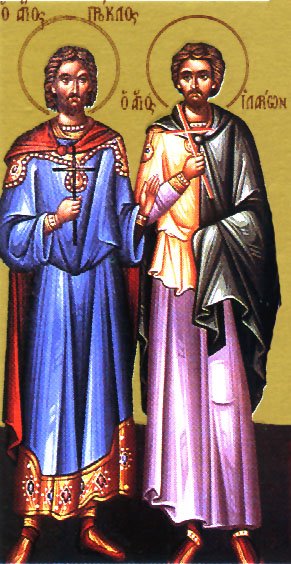
Martyrs Proclus and Hilary of Ancyra
The Holy Martyrs Proclus and Hilarion were natives of the village of Kallippi, near Ancyra, and they suffered during the time of a persecution under the emperor Trajan (98-117). Saint Proclus was put under arrest first. Brought before the governor Maximus, he fearlessly confessed his faith in Christ.
The Holy Martyrs Proclus and Hilarion were natives of the village of Kallippi, near Ancyra, and they suffered during the time of a persecution under the emperor Trajan (98-117). Saint Proclus was put under arrest first. Brought before the governor Maximus, he fearlessly confessed his faith in Christ. The governor decided to compel the saint to submit himself to the emperor and offer sacrifice to the pagan gods. During his tortures, the martyr predicted to Maximus that soon he himself would be compelled to confess Christ as the true God. They forced the martyr to run after the chariot of the governor, heading towards the village Kallippi. Exhausted, Saint Proclus prayed that the Lord would halt the chariot. By the power of God the chariot halted, and no force could move it from the spot. The dignitary sitting in it became petrified. The martyr told him that he would remain unmoving until such time as he would sign a document with a confession of Christ. Only after this could the chariot continue on its way with the governor.
The humiliated pagan took fierce revenge on Saint Proclus. He commanded that Proclus be led out beyond the city, tied to a pillar and shot with arrows. The soldiers, leading Saint Proclus to execution, told him to give in and save his life, but the saint said that they should follow their orders.
Along the way to the place of execution, they met Hilarion, the nephew of Saint Proclus, who with tears embraced his uncle and also confessed himself a Christian. The soldiers seized him, and he was thrown into prison. The holy Martyr Proclus prayed for his tormentors and surrendered his soul to God beneath a hail of arrows.
Saint Hilarion was brought to trial and, with the same courage as Saint Proclus, confessed himself a Christian. After tortures he was sentenced to death. They tied the martyr’s hands and dragged him by his feet through the city, wounded and bloody, and then they beheaded him three days after the death of his uncle, the holy Martyr Proclus. Christians buried them together in a single grave.
Troparion - Tone 4
Your holy martyrs Proclus and Hilary, O Lord, / through their sufferings have received incorruptible crowns from You, our God. / For having Your strength, they laid low their adversaries, / and shattered the powerless boldness of demons. / Through their intercessions, save our souls!
Kontakion - Tone 4
Like the morning star, / your glorious sufferings enlighten us with holy miracles. / We celebrate your memory, Proclus and Hilary; / pray to Christ God for us / that He will save our souls.
Our Holy Father Michael of Maleinus
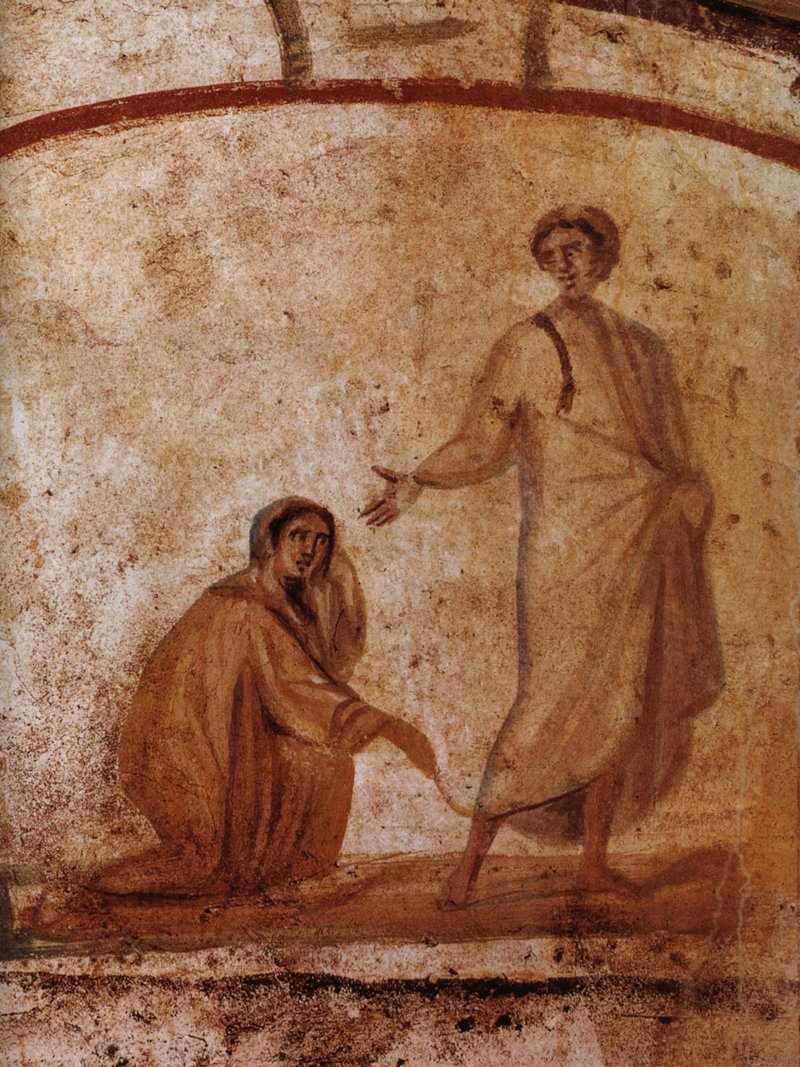
St Veronica, the woman with the issue of blood who was healed by the Savior
The account of the woman with an issue of blood, who had the unusual name of Veronica, may be found in the Gospel according to Saint Matthew (9:20-22), in Saint Mark's Gospel (5:25-34), and also in Saint Luke's Gospel (8:43-49).
The Synaxaristes of Saint Νikόdēmos of the Holy Mountain states that this Saint was from the city of Paneada. Wh
The account of the woman with an issue of blood, who had the unusual name of Veronica, may be found in the Gospel according to Saint Matthew (9:20-22), in Saint Mark's Gospel (5:25-34), and also in Saint Luke's Gospel (8:43-49).
The Synaxaristes of Saint Νikόdēmos of the Holy Mountain states that this Saint was from the city of Paneada. When the Lord healed her issue of blood, she was very grateful, because for twelve years she had "suffered much under many physicians, and had spent all that she had, and nothing had helped, but instead she became worse" (Mark 5:26).
She had heard of Christ, and decided to go to Him, believing that she would be healed merely by touching His garment. When she did this, the Savior felt that power had gone forth from Him. Turning to the crowd, He asked who had touched His garment. His disciples were puzzled by the question, since many people were pressing Him on all sides. Saint Veronica came forward and fell down before Him in fear and trembling, and admitted what she had done. The Lord said, "Daughter, your faith has made you well; go in peace, and be healed of your affliction" (Mark 5:34).
In her gratitude, she made a statue of Him and placed it in front of her house, where everyone could venerate it. A healing plant grew at the base of the statue, which was able to cure various diseases.
Later, Saint Veronica became a member of the early Church. After living a life of holiness, she surrendered her soul to God.
Roman Catholics venerate a saint named Veronica, who is said to have wiped the Savior's face with her veil as He carried His Cross to Golgotha. She is not the saint who is commemorated by the Orthodox Church. That cloth was called the "Veronica," or true image (from vera and iconica) of Christ's face. Saint Gregory of Tours uses this word (Vita Patrum chapter 12) for an image (see the Greek word εικόνα). This incident, is not mentioned in the Gospels.
Some uninformed iconographers confuse these two women and depict our Saint Veronica holding a cloth with the imprint of Christ's face, which is not in accordance with Orthodox Tradition. On August 16, the Orthodox Church commemorates the Image not made by hands, the cloth which Christ sent to King Abgar with the imprint of His Face.
Troparion - Tone 8
The image of God was truly preserved in you, O Mother, / for you took up the Cross and followed Christ. / By so doing, you taught us to disregard the flesh, for it passes away, / but to care instead for the soul, since it is immortal. / Therefore your spirit, O Holy Mother Veronica, rejoices with the Angels!
Saint Païsios of the Holy Mountain (1994) (June 29 OC)
Venerable Father Paisios (Paϊsios) of the Holy Mountain was born to devout parents, Pródromos (Prodromos) and Eulampίa Enzepίde (Enzepίdē), at Pharasa (Phárasa) in Cappadocia on July 25, 1924. Shortly before the family left for Greece because of the exchange of populations, 1 he was baptized by Saint Arsenios of Cappadocia (November 10). His go
Venerable Father Paisios (Paϊsios) of the Holy Mountain was born to devout parents, Pródromos (Prodromos) and Eulampίa Enzepίde (Enzepίdē), at Pharasa (Phárasa) in Cappadocia on July 25, 1924. Shortly before the family left for Greece because of the exchange of populations, 1 he was baptized by Saint Arsenios of Cappadocia (November 10). His godfather wanted to name the child Christos, after his grandfather, but Archimandrite Arsenios, the parish priest, refused saying, "Not so! He shall be called Arsenios. You shall have many other children, but I am a monk; I will have no children. I want him to be a reminder of me."
Archimandrite Arsenios, a man who lived a most holy life, also foretold that he was leaving a monk in his place. He gave the child a special blessing, and so, like Elijah and Elisha, 2 grace passed from the Spiritual Father to his child. He also predicted that he himself would not live more than forty days after he arrived in Greece. Forty days after their arrival in Greece, Saint Arsenios went to the Lord and was buried on the island of Kephalonia (Kephaloniá).
In Greece, the family of little Arsenios settled in Konitsa in Epeiros, where he spent his childhood and youth. Nurtured with stories about the wondrous life of Saint Arsenios, the boy, at the age of five, declared that he would become a monk. When he learned to read, he was loved by those who had not been taught. He went into the forest to study and pray in silence. Delighting in the Lives of the Saints, he tried to imitate their ascetical contests with fervent zeal and astonishing exactness. At the same time, he cultivated the virtues of humility and love.
After completing his studies, Arsenios did not wish to continue with his education, preferring to imitate Christ, and so he learned the trade of a carpenter, which he practiced with diligence and skill.
At the age of fifteen, he was deemed worthy of seeing the Lord, because of one philotimo 3 thought, by which he repelled a demonic assault and a temptation toward impiety. From that time, the fire of God's love increased in him even more, as well as a longing for the monastic life.
Times of turmoil and upheaval followed for Greece, because of foreign occupation and civil war (1945-1949). However, he was both a citizen and a soldier during his service, displaying unparalleled courage and self-sacrifice. Sometimes he volunteered to take the place of married men with families, who were about to be sent to the Front. He was willing to give every moment, and even his life, to save others. In fact, he was often in the line of fire. Not only did he protect many soldiers by his fervent prayers, but he also guarded himself in a miraculous way.
For most of his military service Arsenios served as a radio operator. He said that they all felt secure only when they communicated with their Division every hour. "When our communication was limited to every two hours," he revealed later, "we felt a bit insecure. Sometimes, when we could be in touch with them just twice a day, we felt uncomfortable, lonely, and lost. The same thing applies to our prayers. The more we pray, the more we feel secure, on a spiritual basis, of course."
After all these things, he wanted to embrace the angelic life of monasticism, which gives wings of divine love. 4 Thus, he went to the Holy Mountain seeking a guide to a life of godly silence. However, he did not manage to fulfill his desire right away. At the same time, people found themselves in great economic difficulty when they called on him for help. Thus, he returned to Konitsa and worked as a carpenter. In 1953, at the age of 29, he forsook the world and went to the Holy Mountain.
After visiting various Sketes (Skḗtēs) and Kalyves, 5 the Saint finally followed the advice of a venerable Elder and joined the brotherhood of the Holy Monastery of Ἐsphigmenou, known at the time for its strictness. There he lived in the midst of everyone and engaged in severe asceticism, surpassing the others in his labors for the grace of Christ and his brethren. Then, on March 27, 1954, he was tonsured and received the name Averkios. But desiring a stricter life of asceticism, he received the Igoumen's blessing and went to live in the Holy Monastery of Philotheou, which was then idiorhythmic. Under the guidance of a hermit, they lived a very strict ascetical life. When his Elder reposed, he left and went to another hermit. This Elder would greet people he had never met by name, and that is what he did with Father Averkios. However, he did not permit Father to live with him. Instead, he told him to take care of another old and sick hermit, and then come back to him for Confession. In this way, Father Averkios prepared himself for the eremitic life, under the guidance of a wise monk, Elder Simeon.
On March 12, 1956 he was tonsured into the Small Schema and received the name Paisios (which means "child"), thanks to Metropolitan Paisios II of Caesarea, who was also his compatriot.
In August 1958, heeding divine counsel, he did not move to the desert, for which he was being prepared, but into the ruined Monastery of the Mother of God of Stomio, which is located near Konitsa. There he lived for four years, living an angelic life, struggling with temptation, working for the people of the region, saving many from the false teachings of Protestant sects who were active in their midst, and restored the Monastery with a great deal of labor.
In 1962, when the work of restoration and the danger from heterodox groups was ended, he left. The Saint pleaded fervently with God to remove the temptations which besieged him every day, and to show him the path he must follow. So, he accepted the invitation of a certain Hierodeacon to accompany him to the God-trodden Mount Sinai. In this waterless place, in the kelli 6 of Saints Galaktion and Episteme (Epistḗmē) (November 5) near Saint Katherine's Monastery, living in solitude and in asceticism. One day, as he searched for matches to light his lamp in order to read, a light shone in his cell showing where the matches were. Father Paisios did not trust this, so he made the Sign of the Cross, and the light disappeared. At last he lived as he had wanted to live for years, alone and near God.
He was beloved by the Bedouins, giving them food and money which he earned by selling to the pilgrims wooden crosses that he made himself. The Arab children in the area often visited Father Paisios. He wished that he had something to give them, but when he brought his handiwork to the Monastery he asked for some cookies and was told that he had to bring more handiwork to obtain cookies. Father Paisios shortened his Prayer Rule and spent more time for his handiwork so that he might have cookies for the children. By this act of love, he discerned that he received even more grace from God.
Returning to Mount Athos in 1964, he did not cease his ascetical contests despite his bodily ailments, but maintained his former fervor in his soul. So, living as a stranger and a sojourner on the earth (Genesis 23:4, LXX), he became a citizen of the Heavens. He attained the heights and became a partaker of divine mysteries, with the blessing of the Mother of God. In addition, he conversed with the Saints who appeared before him, and he had a vision of his Guardian Angel. He also heard angelic hymns, and he shone with heavenly light.
In 1966 he became seriously ill and was admitted to the Center for Thoracic Diseases of Northern Greece (Papanikolaou Hospital). He had a major operation, which resulted in the partial removal of his lungs. Some young women who wished to become nuns donated their blood for his operation. When he recovered he helped them to establish their Convent at Sourote (Sourotḗ), and was able return to the Holy Mountain. He recuperated at the Holy Monastery of Saint John the Evangelist in Sourote in Thessaloniki, and returned to the Holy Mountain after his recovery.
In 1967, he moved to Katounákia, specifically to the Lavriote kelli of Hypatios (Vlachika), where he had a vision of the Uncreated Light. He also saw various Saints, the Mother of God, and even Christ Himself. On one occasion, he was visited by Saint Euphemίa, with whom he discussed certain Church matters.
On August 12, 1968, Saint Paisios came to the Holy Monastery of Stavronikita and lived alone in the kelli of the Holy Cross. There he was tonsured into the Great Schema by the Russian Elder Tikhon, who had the gift of tears. After the latter's repose, Father Paisios would visit the Elder's grave to ask him questions, and Father Tikhon would reply from the grave.
Saint Paisios became ill shortly afterward, and had to leave the Holy Mountain. Then he lived for a time in a monastery in northern Greece. As a consolation, he took with him the relics of Saint Arsenios, who had baptized him. Father Paisios did return to Mount Athos and settled in a cell.
In 1979 he left Holy Cross and, looking for a kelli, went to the Panagouda kelli of Koutloumousίou Monastery, near Karyes. He worked hard to create a kelli with a "Confessor", where he stayed until the end of his life. From the time he settled in Panagouda, a large number of people visited him. In fact, it got so crowded that there were special markers showing the way to his cell, so that the monks would not be disturbed by so many visitors. He also received too many letters. As the Saint said, he became very upset by reading the letters, because he learned only about divorces and mental or physical illnesses. Despite his busy schedule, he continued his intense ascetical life, pausing to rest only two or three hours a day. But he continued to receive and help visitors. He also used to make small printed icons which he gave to them as a blessing.
To the daily fatigue of Saint Paisios, some health problems were added, which tormented him. In the final years of his life, the pains of various diseases such as colitis, which left him permanently dyspeptic, an inguinal hernia, and especially from the cancer with which he had been diagnosed. There was more and more of this, nevertheless, he was calm and did not complain at all. On the contrary, he continued to pray for everyone.
In the early 1980s he moved near Karyes, to a kelli at Koutloumousίou.
After 1993 he began to hemorrhage, for which he was hospitalized, saying that "everything will be done, it is convenient for me." In November of the same year, he left the Holy Mountain for the last time, and went to Sourote, to the Monastery of Saint John the Theologian for its Feast Day; and later for the Feast of Saint Arsenios (November 10). He stayed for a few days, but when he was preparing to leave, he fell ill and was taken to Theageneio, where he was diagnosed with a tumor in the large intestine.
He asked God to grant him bodily and spiritual health. On February 4, 1994, he underwent surgery. The disease was not halted, but it metastasized to the lungs and to the liver. The Saint announced his desire to return to the Holy Mountain on June 13, but a high fever and shortness of breath forced him to remain. At the end of June, his doctors announced that he had only two or three weeks to live at most. On Monday, July 11, 1994 (the Feast of Saint Euphemia), Father Paisios received Holy Communion for the last time, kneeling by his bed. In the last days of his life he decided not to take medicines or painkillers, despite the horrible pains of his sickness. He reposed on Tuesday, July 12, 1994 at 11:00 and was buried in the Holy Hesychasterion of Saint John the Theologian in Sourotei, Thessaloniki, next to Saint Arsenios of Cappadocia, whose Life was written by Saint Paisios.
On January 13, 2015, the Holy Synod of the Ecumenical Patriarchate of Constantinople met and decided to include Saint Paisios of the Holy Mountain in the Hagiologion of the Orthodox Church. May his blessing be upon us.
1 Under the terms of the Treaty of Lausanne, Greeks living in Asia Minor were forced to move to Greece, and Turks living in Greece had to return to Turkey.
2 4 Kings 2:15 (Septuagint).
3 According to Saint Paisios, philotimo is a reverent distribution of goodness, the love shown by humble persons, from which every trace of self (ego) has been rooted out. Their hearts are filled with gratitude toward God and to their fellow man; and out of spiritual sensitivity, they try to repay the slightest good which others do to them.
4 "Life is blessed for those in the wilderness, as they fly upon the wings of divine love" (Sunday Matins: Hymn of Degrees, Tone 5, First Antiphon).
5 Skete: Typically a settlement of hermits near a common church, known as the kyriakon. Kalyva: cells gathered around a church.
6 A monk's cell, or a monastic establishment consisting of a building with a chapel in it, and some land. Usually, a kelli was inhabited by three monks.
Troparion - Tone 1
O you faithful, let us honor Paϊsios, the offspring of Phárasa, / the glory of Athos, emulator of the Holy Ascetics of old, and equal to them in honor; / O grace-filled vessel, who hastens speedily to the pious faithful who cry out: / “Glory to Him Who strengthened you. / Glory to Him Who crowned you. / Glory to Him Who, through you, works healings for all.”
Kontakion - Tone 8
Let us praise the most renowned ascetic of the Holy Mountain, / and the newly-shining luminary of the Church; / let us praise him with hymns with all our heart, / for he guides the faithful toward a life of excellence, filling them with rivers of gifts; / therefore we cry out: “Rejoice, Father Paϊsios.”
Scripture Readings
☩Epistle
Romans 9:18-33
18
Therefore hath he mercy on whom he will have mercy, and whom he will he hardeneth.
19
Thou wilt say then unto me, Why doth he yet find fault? For who hath resisted his will?
20
Nay but, O man, who art thou that repliest against God? Shall the thing formed say to him that formed it, Why hast thou made me thus?
21
Hath not the potter power over the clay, of the same lump to make one vessel unto honour, and another unto dishonour?
22
What if God, willing to shew his wrath, and to make his power known, endured with much longsuffering the vessels of wrath fitted to destruction:
23
And that he might make known the riches of his glory on the vessels of mercy, which he had afore prepared unto glory,
24
Even us, whom he hath called, not of the Jews only, but also of the Gentiles?
25
As he saith also in Osee, I will call them my people, which were not my people; and her beloved, which was not beloved.
26
And it shall come to pass, that in the place where it was said unto them, Ye are not my people; there shall they be called the children of the living God.
27
Esaias also crieth concerning Israel, Though the number of the children of Israel be as the sand of the sea, a remnant shall be saved:
28
For he will finish the work, and cut it short in righteousness: because a short work will the Lord make upon the earth.
29
And as Esaias said before, Except the Lord of Sabaoth had left us a seed, we had been as Sodoma, and been made like unto Gomorrha.
30
What shall we say then? That the Gentiles, which followed not after righteousness, have attained to righteousness, even the righteousness which is of faith.
31
But Israel, which followed after the law of righteousness, hath not attained to the law of righteousness.
32
Wherefore? Because they sought it not by faith, but as it were by the works of the law. For they stumbled at that stumblingstone;
33
As it is written, Behold, I lay in Sion a stumblingstone and rock of offence: and whosoever believeth on him shall not be ashamed.
☩Gospel
Matthew 11:2-15
2
Now when John had heard in the prison the works of Christ, he sent two of his disciples,
3
And said unto him, Art thou he that should come, or do we look for another?
4
Jesus answered and said unto them, Go and shew John again those things which ye do hear and see:
5
The blind receive their sight, and the lame walk, the lepers are cleansed, and the deaf hear, the dead are raised up, and the poor have the gospel preached to them.
6
And blessed is he, whosoever shall not be offended in me.
7
And as they departed, Jesus began to say unto the multitudes concerning John, What went ye out into the wilderness to see? A reed shaken with the wind?
8
But what went ye out for to see? A man clothed in soft raiment? behold, they that wear soft clothing are in kings’ houses.
9
But what went ye out for to see? A prophet? yea, I say unto you, and more than a prophet.
10
For this is he, of whom it is written, Behold, I send my messenger before thy face, which shall prepare thy way before thee.
11
Verily I say unto you, Among them that are born of women there hath not risen a greater than John the Baptist: notwithstanding he that is least in the kingdom of heaven is greater than he.
12
And from the days of John the Baptist until now the kingdom of heaven suffereth violence, and the violent take it by force.
13
For all the prophets and the law prophesied until John.
14
And if ye will receive it, this is Elias, which was for to come.
15
He that hath ears to hear, let him hear.
Liturgical data sourced from OCA.org and orthocal.info