
Fasting Rules
 Meat
Allowed
 Fish
Allowed
 Dairy
Allowed
 Oil
Allowed
 Wine
Allowed
Saints & Commemorations
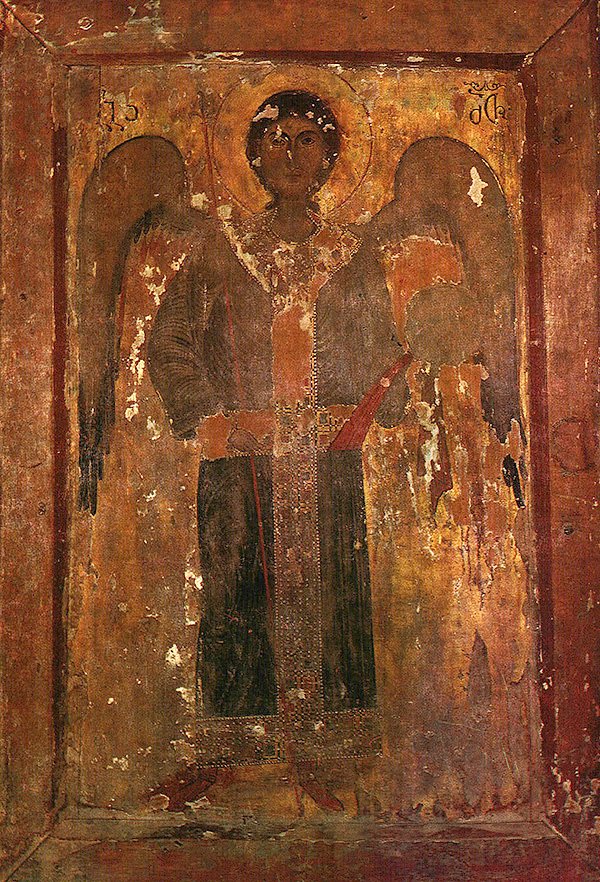
Synaxis of Archangel Gabriel
The Synaxis of the Archangel Gabriel is celebrated on the day after the Annunciation, and a second time on July 13. It was instituted in the ninth century, perhaps to celebrate the dedication of a church at Constantinople. Originally, the Feast was observed on October 16 (Juan Mateos, Le Typikon De La Grande Eglise ).
The Synaxis of the Archangel Gabriel is celebrated on the day after the Annunciation, and a second time on July 13. It was instituted in the ninth century, perhaps to celebrate the dedication of a church at Constantinople. Originally, the Feast was observed on October 16 (Juan Mateos, Le Typikon De La Grande Eglise ).
An account of the Holy Archangel Gabriel is found under March 26 and November 8.
Troparion - Tone 4
Gabriel, commander of the heavenly hosts, / we who are unworthy beseech you, / by your prayers encompass us beneath the wings of your immaterial glory, / and faithfully preserve us who fall down and cry to you: / “Deliver us from all harm, for you are the commander of the powers on high!”
Kontakion - Tone 2
You look upon God’s glory in heaven, / and bring grace from on high to earth, / wise Gabriel, leader of angels, / minister of God’s glory, and divine defender of the world! / Save and preserve those who cry to you: / “Be our defense, so that no one can be against us!”
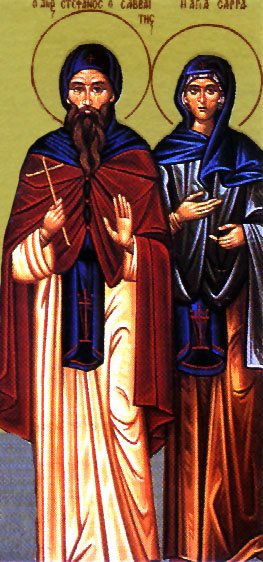
Stephen of Mar Sabbas Monastery
Saint Stephen of Saint Savva’s Monastery, the nephew of Saint John of Damascus (December 4), was born in the year 725. When he was ten years old he entered the Lavra of Saint Savva the Sanctified (December 5) and was tonsured as a monk. He spent his whole life at this monastery, sometimes going out into the desert to live in solitude and devote himself to spiritual struggles.
Saint Stephen of Saint Savva’s Monastery, the nephew of Saint John of Damascus (December 4), was born in the year 725. When he was ten years old he entered the Lavra of Saint Savva the Sanctified (December 5) and was tonsured as a monk. He spent his whole life at this monastery, sometimes going out into the desert to live in solitude and devote himself to spiritual struggles.
Saint Stephen’s holy life was so pleasing to God that he was given the gifts of wonderworking and clairvoyance. He also healed the sick, cast out devils, and was able to discern the thoughts of those who came to him for counsel. He fell asleep in the Lord in the year 794, foretelling in advance the day of his death. The Life of Saint Stephen was compiled by his disciple Leontius.
Today’s saint should not be confused with the other Saint Stephen of Saint Savva’s Monastery who is commemorated on October 28.
Troparion - Tone 8
By a flood of tears you made the desert fertile, / and your longing for God brought forth fruits in abundance. / By the radiance of miracles you illumined the whole universe! / O our holy father Stephen, pray to Christ our God to save our souls!
Marcian the Martyr of Iconium
The Holy Martyr Marcian, a native of Lycian Iconium, while still at a youthful age converted many to Christ by his fiery preaching. For his zeal the idol-worshippers subjected the saint to bodily punishment, and then sent him to Cappadocia to the governor Perennias. By persuasion and threats, he attempted to turn the youth away from the Truth, Christ.
The Holy Martyr Marcian, a native of Lycian Iconium, while still at a youthful age converted many to Christ by his fiery preaching. For his zeal the idol-worshippers subjected the saint to bodily punishment, and then sent him to Cappadocia to the governor Perennias. By persuasion and threats, he attempted to turn the youth away from the Truth, Christ.
Saint Marcian fearlessly testified about the truthfulness of the Christian Faith, and he accused Perennias of worshipping inanimate idols. The enraged governor gave orders to subject the saint to severe torments, but in his sufferings the saint remained steadfast in his faithfulness to Christ. They cut off his head while he prayed, giving thanks to God for his fate (+258).
Troparion - Tone 3
Your holy martyr Marcian, O Lord, / through his sufferings has received an incorruptible crown from You, our God. / For having Your strength, he laid low his adversaries, / and shattered the powerless boldness of demons. / Through his intercessions, save our souls!
Kontakion - Tone 2
You appeared as a bright star announcing Christ with your radiance, / which is repulsive to this world, O Martyr Marcian; / extinguishing the allure of false gods, / you enlighten the faithful, / always interceding for us all.
Serapion the Martyr
The Holy Martyr Serapion, suffered for Christ before the Emperor Severus (193-211). As a Christian he was brought to judgment before the governor Achilles. The holy martyr firmly proclaimed to the pagans his faith in Christ, and he was subjected to inhuman torments. Afterwards, he was thrown into prison.
The Holy Martyr Serapion, suffered for Christ before the Emperor Severus (193-211). As a Christian he was brought to judgment before the governor Achilles. The holy martyr firmly proclaimed to the pagans his faith in Christ, and he was subjected to inhuman torments. Afterwards, he was thrown into prison.
Healed by the Lord Jesus Christ, he was brought to the judgment place and he presented himself before the judge completely healthy. The enraged pagans sentenced the saint to be burned alive. In the midst of the flames, he gave up his soul to God (+ ca. 205).
Troparion - Tone 3
Your holy martyr Serapion, O Lord, / through his sufferings has received an incorruptible crown from You, our God. / For having Your strength, he laid low his adversaries, / and shattered the powerless boldness of demons. / Through his intercessions, save our souls!
Kontakion - Tone 2
You appeared as a bright star announcing Christ with your radiance, / which is repulsive to this world, O Martyr Serapion; / extinguishing the allure of false gods, / you enlighten the faithful, / always interceding for us all.
Holy Martyr Golinduc of Persia (6th c.)
She was a Persian noblewoman during the reign of Chosroës II (590-628). Through a vision of an angel, she came to belief in Christ and received holy baptism; her name in baptism was Maria. Her furious husband reported her to King Chosroës, who had her thrown into a foul dungeon known as Oblivion for eighteen years. D
She was a Persian noblewoman during the reign of Chosroës II (590-628). Through a vision of an angel, she came to belief in Christ and received holy baptism; her name in baptism was Maria. Her furious husband reported her to King Chosroës, who had her thrown into a foul dungeon known as Oblivion for eighteen years. During these years she was repeatedly told to renounce Christ and was tormented in many ways. She was thrown to venomous snakes, which refused to harm her. Some lawless young men were sent to her cell to defile her, but God made her invisible to them. Many Persians, amazed and inspired by her patient sufferings, accepted Christ. She was finally set free through the visitation of an angel, traveled to Jerusalem and Constantinople, and reposed in peace.
She is commemorated July 12 on the Slavic calendar. Oddly, she is called a Martyr in all accounts, though she died free and in peace; presumably her eighteen years of cruel imprisonment earned her the title.
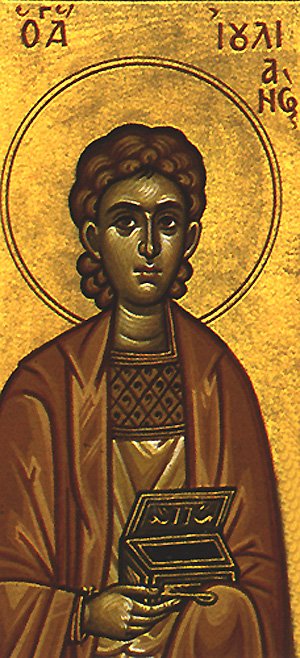
Saint Julian, Bishop of Cenomanis (Le Mans) (1st c.)
Saint Julian, Bishop of Cenomanis, was elevated to bishop by the Apostle Peter. Some believe that he is the same person as Simon the Leper (Mark 14:3), receiving the name Julian in Baptism.
The Apostle Peter sent Saint Julian to preach the Gospel in Gaul. He arrived in Cenomanis (the region of the River Po in the north of present day Italy) and settled into a small hut out beyond a city (probably Cremona), and he began to preach among the pagans.
Saint Julian, Bishop of Cenomanis, was elevated to bishop by the Apostle Peter. Some believe that he is the same person as Simon the Leper (Mark 14:3), receiving the name Julian in Baptism.
The Apostle Peter sent Saint Julian to preach the Gospel in Gaul. He arrived in Cenomanis (the region of the River Po in the north of present day Italy) and settled into a small hut out beyond a city (probably Cremona), and he began to preach among the pagans. The idol-worshippers at first listened to him with distrust, but the preaching of the saint was accompanied by great wonders. By prayer Saint Julian healed many of the sick. Gradually, a great multitude of people began to flock to him, asking for help. In healing bodily infirmities, Saint Julian healed also the souls, enlightening those coming to him by the light of faith in Christ.
In order to quench the thirst of his numerous visitors, Saint Julian, having prayed to the Lord, struck his staff on the ground, and from that dry place there came forth a spring of water. This wonder converted many pagans to Christianity. One time the holy bishop wanted to see the local prince. At the gate of the prince’s dwelling there sat a blind man whom Saint Julian pitied, and having prayed, gave him his sight. The prince came out towards the holy bishop, and having only just learned that he had worked this miracle, he fell down at the feet of the bishop, requesting Baptism. Having catechized the prince and his family, Saint Julian imposed on them a three-day fast, and then he baptized them.
On the example of the prince, the majority of his subjects also converted to Christ. The prince donated his own home to the bishop to build a temple in it, and he provided the Church with means. Saint Julian fervently concerned himself with the spiritual enlightenment of his flock, and he healed the sick as before. Deeply affected by the grief of parents, the holy bishop prayed that God would restore their dead children to life. The holy Bishop Julian remained long on his throne, teaching his flock the way to Heaven. The holy bishop died in extreme old age. To the end of his days he preached about Christ and he completely eradicated idolatry in the land of Cenomanis.
Troparion - Tone 4
In truth you were revealed to your flock as a rule of faith, / an image of humility and a teacher of abstinence; / your humility exalted you; / your poverty enriched you. / Hierarch Father Julian, / entreat Christ our God / that our souls may be saved.
Repose of Photios Kontoglou (1965) (June 30 OC)
He is called “Blessed Photios” by many, but has not yet been officially glorified. In the twentieth century, he almost singlehandedly restored the practice of true Byzantine iconography to the Church. He was born in 1895 in one of the many Greek towns of Asia Minor. He and his family fled to Greece during the “exchange of populations” of 1923, when more than a million Greeks were driven from Turkey and resettled in Greece. He stud
He is called “Blessed Photios” by many, but has not yet been officially glorified. In the twentieth century, he almost singlehandedly restored the practice of true Byzantine iconography to the Church. He was born in 1895 in one of the many Greek towns of Asia Minor. He and his family fled to Greece during the “exchange of populations” of 1923, when more than a million Greeks were driven from Turkey and resettled in Greece. He studied to be a secular artist, but was increasingly drawn to Byzantine iconography, the practice of which had almost disappeared: he learned the iconographic ethos and technique by copying ancient models and studying with the few monks on the Holy Mountain who still practiced true iconography. Initially his work was scorned, since secular western standards had come to dominate even the art of the Church. Slowly, through his tireless labors, an understanding of Orthodoxy iconography was restored to the Church, not only in Greece, but throughout the world. Though married, he lived his life in poverty, often donating his work to churches or performing it for nominal fees. His deeply spiritual writings are greatly honored in Greece, though most remain untranslated into English.
Scripture Readings
☩Epistle
Romans 10:11-11:2
11
For the scripture saith, Whosoever believeth on him shall not be ashamed.
12
For there is no difference between the Jew and the Greek: for the same Lord over all is rich unto all that call upon him.
13
For whosoever shall call upon the name of the Lord shall be saved.
14
How then shall they call on him in whom they have not believed? and how shall they believe in him of whom they have not heard? and how shall they hear without a preacher?
15
And how shall they preach, except they be sent? as it is written, How beautiful are the feet of them that preach the gospel of peace, and bring glad tidings of good things!
16
But they have not all obeyed the gospel. For Esaias saith, Lord, who hath believed our report?
17
So then faith cometh by hearing, and hearing by the word of God.
18
But I say, Have they not heard? Yes verily, their sound went into all the earth, and their words unto the ends of the world.
19
But I say, Did not Israel know? First Moses saith, I will provoke you to jealousy by them that are no people, and by a foolish nation I will anger you.
20
But Esaias is very bold, and saith, I was found of them that sought me not; I was made manifest unto them that asked not after me.
21
But to Israel he saith, All day long I have stretched forth my hands unto a disobedient and gainsaying people.
1
I say then, Hath God cast away his people? God forbid. For I also am an Israelite, of the seed of Abraham, of the tribe of Benjamin.
2
God hath not cast away his people which he foreknew. Wot ye not what the scripture saith of Elias? how he maketh intercession to God against Israel, saying,
☩Gospel
Matthew 11:16-20
16
But whereunto shall I liken this generation? It is like unto children sitting in the markets, and calling unto their fellows,
17
And saying, We have piped unto you, and ye have not danced; we have mourned unto you, and ye have not lamented.
18
For John came neither eating nor drinking, and they say, He hath a devil.
19
The Son of man came eating and drinking, and they say, Behold a man gluttonous, and a winebibber, a friend of publicans and sinners. But wisdom is justified of her children.
20
Then began he to upbraid the cities wherein most of his mighty works were done, because they repented not:
Liturgical data sourced from OCA.org and orthocal.info