Today

Fasting Rules

Meat not allowed Meat Abstain
Fish not allowed Fish Abstain
Dairy not allowed Dairy Abstain
Oil not allowed Oil Abstain
Wine not allowed Wine Abstain

☦ Saints & Commemorations

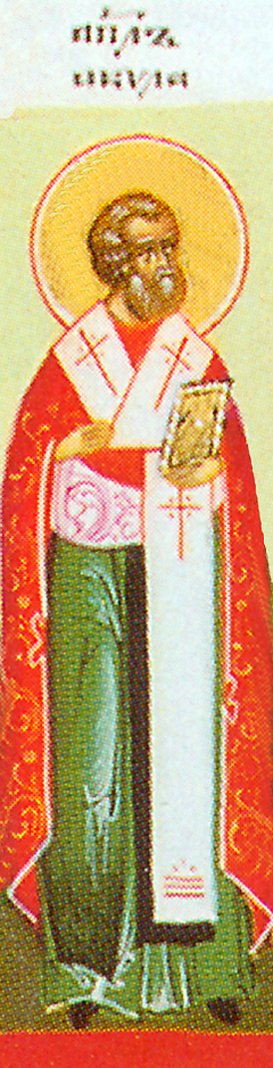
Apostle Aquila of the Seventy and St Priscilla

Apostle Aquila of the Seventy and St Priscilla

Saint Aquila, Apostle of the 70: It is possible that he was a disciple of the Apostle Paul, a native of Pontus and a Jew, living in the city of Rome with his wife Priscilla (they are commemorated on February 13 on the Greek Calendar). During the reign of the emperor Claudius (41-54) all the Jews were banished from Rome, so Saint Aquilla and his wife were compelled to leave. Saint Aquila, Apostle of the 70: It is possible that he was a disciple of the Apostle Paul, a native of Pontus and a Jew, living in the city of Rome with his wife Priscilla (they are commemorated on February 13 on the Greek Calendar). During the reign of the emperor Claudius (41-54) all the Jews were banished from Rome, so Saint Aquilla and his wife were compelled to leave. They settled in Corinth. A short while later, the holy Apostle Paul arrived there from Athens preaching the Gospel. Having made the acquaintance of Aquila, he began to live at his house and labored together with him, making tents. Having received Baptism from the Apostle Paul, Aquila and Priscilla bacame his devoted and zealous disciples. They accompanied the apostle to Ephesus. The Apostle Paul instructed them to continue the preaching of the Gospel at Ephesus, and he himself went to Jerusalem, in order to be present for the feast of Pentecost. At Ephesus, Aquila and Priscilla heard the bold preaching of a newcomer from Alexandria, the Jew Apollos. He had been instructed in the fundamentals of the Faith, but knew only the baptism of John the Forerunner. They called him over and explained more precisely about the way of the Lord. After the death of the emperor Claudius, Jews were permitted to return to Italy, and Aquila and Priscilla then returned to Rome. The Apostle Paul in his Epistle to the Romans recalls his faithful disciples, “Greet Priscilla and Aquila, my coworkers in Christ Jesus, who put forth their heads for my soul, whom I do not alone thank, but also all the Church of the Gentiles and the church of their household” (Rom. 16: 3-4). Saint Aquila did not long dwell in Rome: the Apostle Paul made him a bishop in Asia. Saint Aquila zealously labored at preaching the Gospel in Asia, Achaia and Heraklia. He converted pagans to Christ, he confirmed newly-converted Christians in the faith, he established presbyters and destroyed idols. Saint Priscilla constantly assisted him in the apostolic work. Saint Aquila ended his life a martyr: pagans murdered him. According to the Tradition of the Church, Saint Priscilla was killed together with him.

Troparion - Tone 1

As a disciple and companion of Paul / you received in your soul the grace of preaching. / You shone in the night of error and struggled for the Lord’s glory. / Sacred minister of the Savior, Aquila, we all acclaim you.

Kontakion - Tone 4

The Church has acquired you, O Aquila, / who shine like a great sun. / With the splendor of your teaching / she enlightens those who honor you with faith, / glorious Apostle of the Lord.
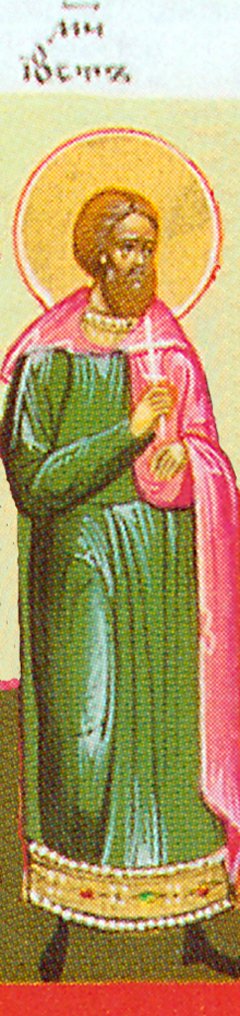
Justus the Martyr

Justus the Martyr

The Holy Martyr Justus was a Roman soldier, to whom the Life-Creating Cross of the Lord appeared in a vision. Justus believed in Christ and gave away his possessions to the poor. By decree of the official of Magnesia, Justus was taken to trial as a Christian. After various tortures, the holy martyr was thrown into a fire and gave up his soul to God, but the flames did not harm his body.

Troparion - Tone 3

Your holy martyr Justus, O Lord, / through his sufferings has received an incorruptible crown from You, our God. / For having Your strength, he laid low his adversaries, / and shattered the powerless boldness of demons. / Through his intercessions, save our souls!

Kontakion - Tone 2

You appeared as a bright star announcing Christ with your radiance, / which is repulsive to this world, O Martyr Justus; / extinguishing the allure of false gods, / you enlighten the faithful, / always interceding for us all.

Our Father among the Saints Joseph, Archbishop of Thessalonika (833)

He was the brother of St Theodore the Studite (November 11), and is also sometimes called Studite. He is one of the inspired composers of the canons in the Lenten Triodion, many of which bear the title “by Joseph”. (He should not be confused with St Joseph the Hymnographer, who is commemorated April 3.) As Archbishop of Thessalonika, he suffered gre He was the brother of St Theodore the Studite (November 11), and is also sometimes called Studite. He is one of the inspired composers of the canons in the Lenten Triodion, many of which bear the title “by Joseph”. (He should not be confused with St Joseph the Hymnographer, who is commemorated April 3.) As Archbishop of Thessalonika, he suffered greatly for his zealous defense of the holy icons: he was imprisoned, and was exiled three times.

St Nikodemos of the Holy Mountain, spiritual writer (1809)

He is best known for his collections of Orthodox writings, most importantly the Philokalia, a five-volume compendium of writings on asceticism and prayer, especially the Jesus Prayer, by the holy Fathers of the Church. (The first four volumes have been translated into English). He produced an Orthodox edition of Unseen Warfare, originally by Lorenzo Scupoli, a Roman Catholic. He is best known for his collections of Orthodox writings, most importantly the Philokalia, a five-volume compendium of writings on asceticism and prayer, especially the Jesus Prayer, by the holy Fathers of the Church. (The first four volumes have been translated into English). He produced an Orthodox edition of Unseen Warfare, originally by Lorenzo Scupoli, a Roman Catholic. (This was further revised by St Theophan the Recluse). He also edited the Pedalion (Rudder), a collection of the canons of the Orthodox Church with his commentary. Note: The English edition of the Rudder needs to be read with care, since it includes additional comments by the translator, not clearly distinguished from those of the Saint.

Scripture Readings

☩Epistle

Romans 11:2-12

2 God hath not cast away his people which he foreknew. Wot ye not what the scripture saith of Elias? how he maketh intercession to God against Israel, saying,
3 Lord, they have killed thy prophets, and digged down thine altars; and I am left alone, and they seek my life.
4 But what saith the answer of God unto him? I have reserved to myself seven thousand men, who have not bowed the knee to the image of Baal.
5 Even so then at this present time also there is a remnant according to the election of grace.
6 And if by grace, then is it no more of works: otherwise grace is no more grace. But if it be of works, then is it no more grace: otherwise work is no more work.
7 What then? Israel hath not obtained that which he seeketh for; but the election hath obtained it, and the rest were blinded
8 (According as it is written, God hath given them the spirit of slumber, eyes that they should not see, and ears that they should not hear;) unto this day.
9 And David saith, Let their table be made a snare, and a trap, and a stumblingblock, and a recompence unto them:
10 Let their eyes be darkened, that they may not see, and bow down their back alway.
11 I say then, Have they stumbled that they should fall? God forbid: but rather through their fall salvation is come unto the Gentiles, for to provoke them to jealousy.
12 Now if the fall of them be the riches of the world, and the diminishing of them the riches of the Gentiles; how much more their fulness?

☩Gospel

Matthew 11:20-26

20 Then began he to upbraid the cities wherein most of his mighty works were done, because they repented not:
21 Woe unto thee, Chorazin! woe unto thee, Bethsaida! for if the mighty works, which were done in you, had been done in Tyre and Sidon, they would have repented long ago in sackcloth and ashes.
22 But I say unto you, It shall be more tolerable for Tyre and Sidon at the day of judgment, than for you.
23 And thou, Capernaum, which art exalted unto heaven, shalt be brought down to hell: for if the mighty works, which have been done in thee, had been done in Sodom, it would have remained until this day.
24 But I say unto you, That it shall be more tolerable for the land of Sodom in the day of judgment, than for thee.
25 At that time Jesus answered and said, I thank thee, O Father, Lord of heaven and earth, because thou hast hid these things from the wise and prudent, and hast revealed them unto babes.
26 Even so, Father: for so it seemed good in thy sight.

Liturgical data sourced from OCA.org and orthocal.info