
Fasting Rules
 Meat
Allowed
 Fish
Allowed
 Dairy
Allowed
 Oil
Allowed
 Wine
Allowed
Saints & Commemorations
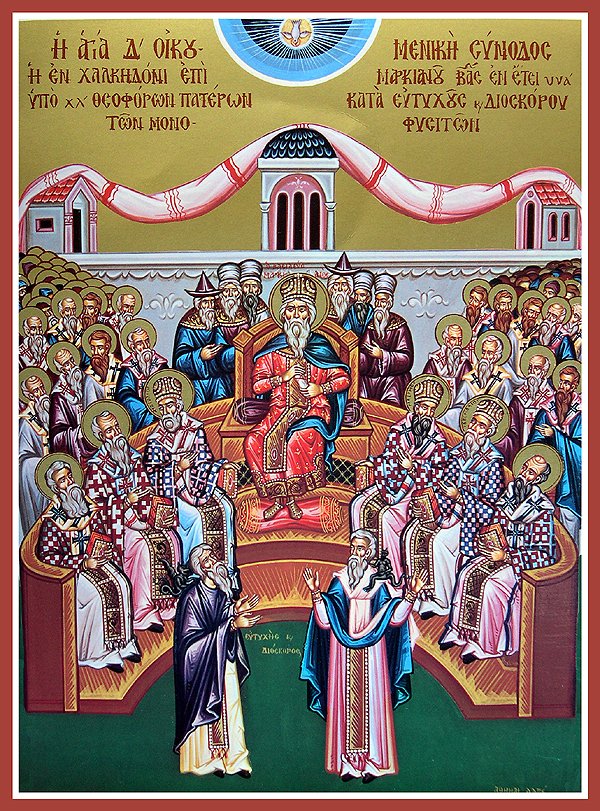
Fathers of the 1st Six Ecumenical Councils
The Commemoration of the Holy Fathers of the First Six Ecumenical Councils.
In the Ninth Article of the Nicea-Constantinople Symbol of Faith proclaimed by the holy Fathers of the First and Second Ecumenical Councils, we confess our faith in “One, Holy, Catholic, and Apostolic Church.” By virtue of the catholic nature of the Church, an Ecumenical Council is the Church’s supreme authority, and possesses the competence to resolve major questions of church life. An Ec
The Commemoration of the Holy Fathers of the First Six Ecumenical Councils.
In the Ninth Article of the Nicea-Constantinople Symbol of Faith proclaimed by the holy Fathers of the First and Second Ecumenical Councils, we confess our faith in “One, Holy, Catholic, and Apostolic Church.” By virtue of the catholic nature of the Church, an Ecumenical Council is the Church’s supreme authority, and possesses the competence to resolve major questions of church life. An Ecumenical Council is comprised of archpastors and pastors of the Church, and representatives of all the local Churches, from every land of the “oikumene” (i.e. from all the whole inhabited world).
The Orthodox Church acknowledges Seven Holy Ecumenical Councils:
The First Ecumenical Council (Nicea I) (May 29, and also on seventh Sunday after Pascha) was convened in the year 325 against the heresy of Arius, in the city of Nicea in Bithynia under Saint Constantine the Great, Equal of the Apostles.
The Second Ecumenical Council (Constantinople I) (May 22) was convened in the year 381 against the heresy of Macedonias, by the emperor Theodosius the Great.
The Third Ecumenical Council (Ephesus) (September 9) was convened in the year 431 against the heresy of Nestorius, in the city of Ephesus by the emperor Theodosius the Younger.
The Fourth Ecumenical Council (Chalcedon) (July 16) was convened in the year 451, against the Monophysite heresy, in the city of Chalcedon under the emperor Marcian.
The Fifth Ecumenical Council (Constantinople II) (July 25) “Concerning the Three Chapters,” was convened in the year 553, under the emperor Justinian the Great.
The Sixth Ecumenical Council (Constantinople III) (January 23) met during the years 680-681, to fight the Monothelite heresy, under the emperor Constantine Pogonatos.
The fact that the Seventh Ecumenical Council (Nicea II) is not commemorated today testifies to the antiquity of today’s celebration. The Seventh Council, commemorated on the Sunday nearest to October 11, was convened at Nicea in the year 787 against the Iconoclast heresy, under the emperor Constantine and his mother Irene.
The Church venerates the Holy Fathers of the Ecumenical Councils because Christ has established them as “lights upon the earth,” guiding us to the true Faith. “Clad in the garment of truth,” the doctrine of the Fathers, based upon the preaching of the Apostles, has established one faith for the Church. The Ecumenical Councils, are the highest authority in the Church. Such Councils, guided by the grace of the Holy Spirit, and accepted by the Church, are infallible.
The Orthodox Church’s conciliar definitions of dogma have the highest authority, and such definitions always begin with the Apostolic formula: “It seemed good to the Holy Spirit and to us...” (Acts 15: 28).
The Ecumenical Councils were always convened for a specific reason: to combat false opinions and heresies, and to clarify the Orthodox Church’s teaching. But the Holy Spirit has thus seen fit, that the dogmas, the truths of faith, immutable in their content and scope, constantly and consequently are revealed by the conciliar mind of the Church, and are given precision by the holy Fathers within theological concepts and terms in exactly such measure as is needed by the Church itself for its economy of salvation. The Church, in expounding its dogmas, is dealing with the concerns of a given historical moment, “not revealing everything in haste and thoughtlessly, nor indeed, ultimately hiding something” (Saint Gregory the Theologian).
A brief summary of the dogmatic theology of the First Six Ecumenical Councils is formulated and contained in the First Canon of the Council of Trullo (also known as Quinisext), held in the year 692. The 318 Holy Fathers of the First Ecumenical Council are spoken of in this Canon I of Trullo as having: “with unanimity of faith revealed and declared to us the consubstantiality of the three Persons of the Divine nature and, ... instructing the faithful to adore the Father, Son, and Holy Spirit with one worship, they cast down and dispelled the false teaching about different degrees of Divinity.”
The 150 Holy Fathers of the Second Ecumenical Council left their mark on the theology of the Church concerning the Holy Spirit, “repudiating the teaching of Macedonius, as one who wished to divide the inseparable Unity, so that there might be no perfect mystery of our hope.”
The 200 God-bearing Fathers of the Third Ecumenical Council expounded the teaching that “Christ, the Incarnate Son of God is One.” They also confessed that “she who bore Him without seed was the spotless Ever-Virgin, glorifying her as truly the Mother of God.
The 630 Holy Fathers of the Fourth Ecumenical Council decreed that “the One Christ, the Son of God... must be glorified in two natures.”
The 165 God-bearing Holy Fathers of the Fifth Ecumenical Council “in synod anathematized and repudiated Theodore of Mopsuestia (the teacher of Nestorius), and Origen, and Didymus, and Evagrius, renovators of the Hellenic teaching about the transmigration of souls and the transmutation of bodies and the impieties they raised against the resurrection of the dead.”
The 170 Holy Fathers of the Sixth Ecumenical Council “taught that we ought to confess two natural volitions, or two wills [trans. note: one divine, and the other human], and two natural operations (energies) in Him Who was incarnate for our salvation, Jesus Christ, our true God.”
In decisive moments of Church history, the holy Ecumenical Councils promulgated their dogmatic definitions, as trustworthy delimitations in the spiritual battle for the purity of Orthodoxy, which will last until such time, as “all shall come into the unity of faith, and of the knowledge of the Son of God” (Eph. 4: 13). In the struggle with new heresies, the Church does not abandon its former dogmatic concepts nor replace them with some sort of new formulations. The dogmatic formulae of the Holy Ecumenical Councils need never be superseded, they remain always contemporary to the living Tradition of the Church. Therefore the Church proclaims:
“The faith of all in the Church of God hath been glorified by men, which were luminaries in the world, cleaving to the Word of Life, so that it be observed firmly, and that it dwell unshakably until the end of the ages, conjointly with their God-bestown writings and dogmas. We reject and we anathematize all whom they have rejected and anathematized, as being enemies of Truth. And if anyone does not cleave to nor admit the aforementioned pious dogmas, and does not teach or preach accordingly, let him be anathema” (Canon I of the Council of Trullo).
In addition to their dogmatic definitions, the Holy Fathers of the Ecumenical Councils exerted great efforts towards the strengthening of church discipline. Local Councils promulgated their disciplinary canons according to the circumstances of the time and place, frequently differing among themselves in various particulars.
The universal unity of the Orthodox Church required unity also in canonical practice, i.e. a conciliar deliberation and affirmation of the most important canonical norms by the Fathers of the Ecumenical Councils. Thus, according to conciliar judgment, the Church has accepted: 20 Canons from the First, 7 Canons from the Second, 8 Canons from the Third, and 30 Canons from the Fourth Ecumenical Synods. The Fifth and the Sixth Councils concerned themselves only with resolving dogmatic questions, and did not leave behind any disciplinary canons.
The need to establish in codified form the customary practices during the years 451-680, and ultimately to compile a canonical codex for the Orthodox Church, occasioned the convening of a special Council, which was wholly devoted to the general application of churchly rules. This was convened in the year 692. The Council “in the Imperial Palace” or “Under the Arches” (in Greek “en trullo”), came to be called the Council in Trullo. It is also called the “Quinisext” [meaning the “fifth and sixth”], because it is considered to have completed the activities of the Fifth and Sixth Councils, or rather that it was simply a direct continuation of the Sixth Ecumenical Council itself, separated by just a few years.
The Council in Trullo, with its 102 Canons (more than of all the Ecumenical Synods combined), had a tremendous significance in the history of the canonical theology of the Orthodox Church. It might be said that the Fathers of this Council produced a complete compilation of the basic codex from the relevant sources for the Orthodox Church’s canons. Listing through in chronological order, and having been accepted by the Church the Canons of the Holy Apostles, and the Canons of the Holy Ecumenical and the Local Councils and of the holy Fathers, the Trullo Council declared: “Let no one be permitted to alter or to annul the aforementioned canons, nor in place of these put forth, or to accept others, made of spurious inscription” (2nd Canon of the Council in Trullo).
Church canons, sanctified by the authority of the first Six Ecumenical Councils (including the rules of the Seventh Ecumenical Council in 787, and the Constantinople Councils of 861 and 879, which were added later under the holy Patriarch Photius), form the basis of THE RUDDER, or KORMCHAYA KNIGA (a canon law codex known as “Syntagma” or “Nomokanon” in 14 titles). In its repository of grace is expressed a canonical norm, a connection to every era, and a guide for all the local Orthodox Churches in churchly practice.
New historical conditions can lead to the change of some particular external aspect of the life of the Church. This makes creative canonical activity necessary in the conciliar reasoning of the Church, in order to reconcile the external norms of churchly life with historical circumstances. The details of canonical regulation are not fully developed for the various eras of churchly organization all at once. With every push to either forsake the literal meaning of a canon, or to fulfill and develop it, the Church again and again turns for reasoning and guidance to the eternal legacy of the Holy Ecumenical Councils, to the inexhaustable treasury of dogmatic and canonical truths.
Troparion - Tone 8
You are most glorious, O Christ our God, / You have established the Fathers as lights upon the earth, /
and through them, You have guided all of us to the true Faith! / O greatly compassionate one, glory to You.
Kontakion - Tone 8
The preaching of the Apostles and the dogmas of the Fathers have confirmed one faith for the Church; / and She, clad in the garment of truth woven from heavenly theology, / teaches aright and glorifies the great mystery of piety.
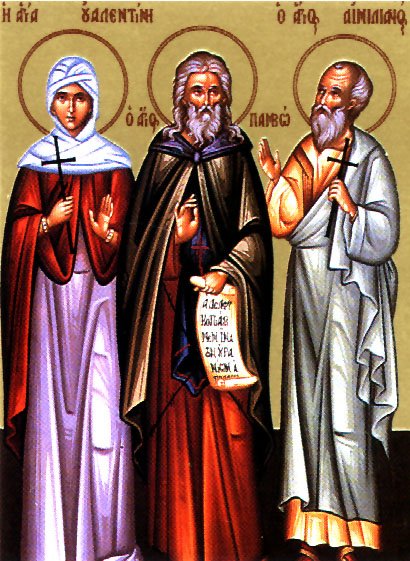
Martyr Emilian of Silistria
The Holy Martyr Emilian, who was a Slav, suffered for Christ during the reign of Emperor Julian the Apostate (361-363). Julian wanted to restore the cult of the pagan gods throughout the Roman Empire, and he issued an edict, according to which all Christians who failed to honor the pagan gods would be subject to death.
The Holy Martyr Emilian, who was a Slav, suffered for Christ during the reign of Emperor Julian the Apostate (361-363). Julian wanted to restore the cult of the pagan gods throughout the Roman Empire, and he issued an edict, according to which all Christians who failed to honor the pagan gods would be subject to death.
Saint Emilian lived in the Thracian city of Dorostolum on the banks of the River Dunaj (Danube).The imperial edict was read in the city square, but the people of Dorostolum declared that there were no Christians in the city.
Saint Emilian was a slave of a cruel and fanatical idolater, and was a secret Christian. Some sources state that he was the son of a local officer named Sabbatianus. When the father learned that Emilian believed in Christ, he was so enraged that he insulted him with vulgar words and had him whipped. He pointed out that he could expect even worse things to happen to him if he remained a Christian.
Instead of being intimidated by these threats, Saint Emilian’s faith in Christ was strengthened. The next day he went into a pagan temple and smashed the statues with a hammer.
An angry crowd started to beat a certain Christian, who was passing by. Saint Emilian then shouted out loudly that they should not harm that innocent man, since he himself was the one who had damaged the pagan temple.
The saint was seized and brought to Capitolinus the governor for judgment. In spite of further threats, Saint Emilian would not deny Christ. “He is my Lord, and I will never deny Him,” the martyr exclaimed. The governor ordered that Saint Emilian be beaten mercilessly, and then to be burned alive. He did not perish when he was thrown into the fire, but instead the flames consumed many of the pagans who were standing about. When the fire had gone out, Saint Emilian lay down upon the dying embers, and gave up his soul to the Lord. The wife of the pagan ruler was also a secret Christian, and she gathered up the saint’s relics and buried them. Afterward, a church dedicated to the holy Martyr Emilian was built at Constantinople, where his relics were transferred.
Troparion - Tone 4
Holy martyr Emilian, / you defended the Church against the idolatry of the pagans. / Because of your faith in Christ, / you were martyred by fire and through a glorious death received your crown. / Pray to Christ God that He may grant us great mercy.
Kontakion - Tone 3
You did not fear the fire, your fellow-servant, / for you were enflamed with divine zeal. / You willingly entered the flames, unconsumed by the fury, / offering yourself in sacrifice to the Lord. / Glorious martyr Emilian, entreat Christ God to grant us His great mercy.
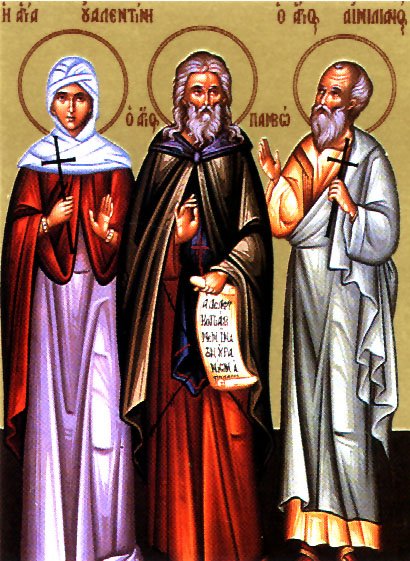
St Pambo, hermit of Egypt (374? 386?)
Saint Pambo lived the ascetic life in the Nitrian desert in Egypt. Saint Anthony the Great (January 17) said, that the Monk Pambo by the fear of God inspired within himself the Holy Spirit. And the Monk Pimen the Great (August 27) said: “We beheld three things in Father Pambo: hunger every day, silence and handcrafts”. The
Saint Pambo lived the ascetic life in the Nitrian desert in Egypt. Saint Anthony the Great (January 17) said, that the Monk Pambo by the fear of God inspired within himself the Holy Spirit. And the Monk Pimen the Great (August 27) said: “We beheld three things in Father Pambo: hunger every day, silence and handcrafts”. The Monk Theodore the Studite termed Saint Pambo “exalted in deed and in word.”
At the beginning of his monasticism, Saint Pambo heard the verses from the 38th [39th] Psalm of David: “preserve mine path, that I sin not by my tongue”. These words sank deep into his soul, and he attempted to follow them always. Thus, when they asked him about something, he answered only after long pondering and prayer. He would say, “I must think first, and perhaps I can, in time, give an answer, with God’s help.” Saint Pambo was a model of a lover of work for his disciples. Each day he worked until exhausted, and lived by the bread acquired by his own toil.
The disciples of Saint Pambo became great ascetics: Dioscorus, afterwards Bishop of Hermopolis (this Dioscorus, bishop of Hermopolis, is distinguished from another Dioscorus, an arch-heretic and Patriarch of Constantinople who lived rather later and was condemned by the Fourth Ecumenical Council), and also Ammonius, Eusebius and Euthymius, mentioned in the life of Saint John Chrysostom. One time Saint Melania the Younger (December 31) brought Saint Pambo a large amount of silver for the needs of the monastery, but he did not leave off from his work nor even glance at the money that was brought. Only after the incessant requests of Saint Melania did he permit her to give the alms to a certain monastic brother for distribution to the needs of the monastery. Saint Pambo was distinguished by his humility, but together with this he highly esteemed the vocation of monk and he taught the laypeople to be respectful of monastics, who often converse with God.
It was said that sometimes Saint Pambo’s face shone like lightning, as did the face of Moses. Yet, speaking to the brethren who stood about his deathbed, Saint Pambo said: “I go to the Lord as one who has not yet begun to serve Him.” He died at the age of 70.
Troparion - Tone 8
By a flood of tears you made the desert fertile, / and your longing for God brought forth fruits in abundance. / By the radiance of miracles you illumined the whole universe! / O our holy father Pambo, pray to Christ our God to save our souls!
Scripture Readings
☩Epistle
Romans 6:18-23
18
Being then made free from sin, ye became the servants of righteousness.
19
I speak after the manner of men because of the infirmity of your flesh: for as ye have yielded your members servants to uncleanness and to iniquity unto iniquity; even so now yield your members servants to righteousness unto holiness.
20
For when ye were the servants of sin, ye were free from righteousness.
21
What fruit had ye then in those things whereof ye are now ashamed? for the end of those things is death.
22
But now being made free from sin, and become servants to God, ye have your fruit unto holiness, and the end everlasting life.
23
For the wages of sin is death; but the gift of God is eternal life through Jesus Christ our Lord.
☩Gospel
Matthew 8:5-13
5
And when Jesus was entered into Capernaum, there came unto him a centurion, beseeching him,
6
And saying, Lord, my servant lieth at home sick of the palsy, grievously tormented.
7
And Jesus saith unto him, I will come and heal him.
8
The centurion answered and said, Lord, I am not worthy that thou shouldest come under my roof: but speak the word only, and my servant shall be healed.
9
For I am a man under authority, having soldiers under me: and I say to this man, Go, and he goeth; and to another, Come, and he cometh; and to my servant, Do this, and he doeth it.
10
When Jesus heard it, he marvelled, and said to them that followed, Verily I say unto you, I have not found so great faith, no, not in Israel.
11
And I say unto you, That many shall come from the east and west, and shall sit down with Abraham, and Isaac, and Jacob, in the kingdom of heaven.
12
But the children of the kingdom shall be cast out into outer darkness: there shall be weeping and gnashing of teeth.
13
And Jesus said unto the centurion, Go thy way; and as thou hast believed, so be it done unto thee. And his servant was healed in the selfsame hour.
Liturgical data sourced from OCA.org and orthocal.info