
Fasting Rules
 Meat
Allowed
 Fish
Allowed
 Dairy
Allowed
 Oil
Allowed
 Wine
Allowed
Saints & Commemorations
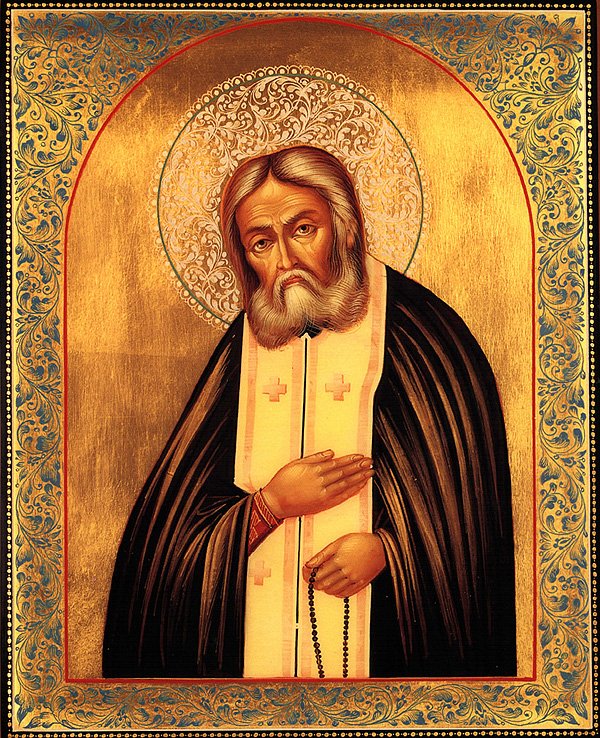
Unc. Rel. Ven. Seraphim of Sarov
Uncovering of the Relics of Saint Seraphim, Wonderworker of Sarov: The glorification of Saint Seraphim of Sarov (January 2), took place in 1903, seventy years after his repose. On July 3, 1903 Metropolitan Anthony of Saint Petersburg, assisted by Bishop Nazarius of Nizhni-Novgorod and Bishop Innocent of Tambov, transferred the saint’s relics from their original burial place to the church of Saints Zosimus and Sabbatius. T
Uncovering of the Relics of Saint Seraphim, Wonderworker of Sarov: The glorification of Saint Seraphim of Sarov (January 2), took place in 1903, seventy years after his repose. On July 3, 1903 Metropolitan Anthony of Saint Petersburg, assisted by Bishop Nazarius of Nizhni-Novgorod and Bishop Innocent of Tambov, transferred the saint’s relics from their original burial place to the church of Saints Zosimus and Sabbatius. Tsar Nicholas II and Tsarina Alexandra provided a new cypress coffin to receive the relics. This cypress coffin was then placed inside an oak coffin and remained in the church until the day of the saint’s glorification.
At noon on July 16, the first day of the festivities, Metropolitan Anthony offered a Memorial Service for the ever-memorable Hieromonk Seraphim in the Dormition Cathedral. Services also took place in the monastery’s other churches.
The next day Metropolitan Anthony and Bishop Nazarius served a Memorial Liturgy in the Dormition Cathedral. At 5:00 that afternoon, the bells of Sarov began to ring, announcing the arrival of Tsar Nicholas and his family. Metropolitan Anthony greeted them and then led them to the Dormition Cathedral for a Service of Thanksgiving.
The royal family attended the early Liturgy on July 18th and received the Holy Mysteries. Later that morning, the final Memorial Service for the repose of Hieromonk Seraphim’s soul was offered in the Cathedral. These would be the last prayers offered for him as a departed servant of God. From that time forward, prayers would be addressed to him as a saint. At 6 P.M. the bells rang for Vigil, the first service with hymns honoring Saint Seraphim, and during which his relics would be exposed for public veneration.
At the time of the Litia during Vespers, the saint’s coffin was carried from the church of Saints Zosimus and Sabbatius and into the Dormition Cathedral. Several people were healed of various illnesses during this procession. During Matins, as “Praise ye the Name of the Lord” was sung, the coffin was opened. After the Gospel, Metropolitan Anthony and the other hierarchs kissed the holy relics. They were followed by the royal family, the officiating clergy, and all the people in the cathedral.
On July 19, the saint’s birthday, the late Liturgy began at 8 o’clock. At the Little Entrance, twelve Archimandrites lifted the coffin from the middle of the church, carried it around the altar, then placed it into a special shrine. The long awaited event was accompanied by numerous miraculous healings of the sick, who had gathered at Sarov in large numbers. More than 200,000 people came to Sarov from all across Russia.
The festivities at Sarov came to an end with the dedication of the first two churches to Saint Seraphim. The first church to be consecrated was over his monastic cell in Sarov. The second church was consecrated on July 22 at the Diveyevo convent.
In 1991, Saint Seraphim’s relics were rediscovered after being hidden in a Soviet anti-religious museum for seventy years. Widely esteemed in his lifetime, Saint Seraphim is one of the most beloved saints of the Orthodox Church.
Troparion - Tone 4
You loved Christ from your youth, O blessed one, / and longing to work for Him alone you struggled in the wilderness in constant prayer and labor. / With penitent heart and great love for Christ you were favored by the Mother of God. / Therefore we cry to you: / “Save us by your prayers, venerable Seraphim, our father.”
Kontakion - Tone 2
Forsaking the beauty as well as the corruption of this world, you settled in the monastery of Sarov, O Saint. / There you lived an angelic life, / becoming for many the way to salvation. / Therefore, Christ has glorified you, Father Seraphim, enriching you with abundant healing and miracles. / So we cry to you: “Save us by your prayers, venerable Seraphim, our father.”
Dius, Abbot of Antioch
Saint Dius was born in Antioch, Syria towards the end of the fourth century into a pious Christian family. From his youth he was noted for his temperance. He ate food in small quantities, but not every day, and his flesh was humbled by vigil and unceasing prayer. For these deeds the Lord granted Saint Dius dispassion and the gift of wonderworking.
Saint Dius was born in Antioch, Syria towards the end of the fourth century into a pious Christian family. From his youth he was noted for his temperance. He ate food in small quantities, but not every day, and his flesh was humbled by vigil and unceasing prayer. For these deeds the Lord granted Saint Dius dispassion and the gift of wonderworking.
In a vision, the Lord ordered Saint Dius to go to Constantinople and there to serve both Him and the people. Saint Dius settled beyond the city in a solitary place, where people feared to live. Saint Dius bravely contended with the evil spirits which tried to expel him from this place. The Lord heard the prayer of His saint: his staff took root, began to grow and with time was transformed into an immense oak, which stood for a long time even after the death of Saint Dius.
The surrounding inhabitants began to come to the saint for advice and guidance, and they sought healing from illnesses of body and soul. Saint Dius doctored the infirm with prayer, and whatever was offered him he distributed to the poor, the homeless and the sick.
Reports of Saint Dius reached even the emperor Theodosius the Younger. He came to Saint Dius for a blessing together with Patriarch Atticus of Constantinople (406-425). The emperor wanted a monastery to be built on the place of Saint Dius’ efforts, and he provided the means for its construction. The Patriarch ordained the monk as a priest and made him the igumen. Soon numerous monastic brethren gathered to Saint Dius. The monastery was in need of a well, and they dug for a long time without success. Through the prayers of the monk the Lord brought forth a spring of pure water, which soon filled up the entire well. Once, through his prayers, the monk raised up a drowned man. The Lord worked many other miracles through His saint.
In extreme old age Saint Dius became grievously ill. He took his leave of the brethren, received the Holy Mysteries, and lay upon his cot like one dead. At the monastery His Holiness Patriarch Atticus (Comm. on Cheesefare Saturday) came for the funeral service and also Patriarch Alexander of Alexandria, who was then at Constantinople. The holy Elder unexpectedly rose up from his death bed and said, “The Lord has granted me fifteen more years of life.” Great was the joy of the brethren.
Saint Dius did live another fifteen years, helping all with guidance and counsel, healing the sick, and being concerned for the poor and homeless. Shortly before his death, a radiant man in priestly garb appeared to him in the altar of the church and told him of his impending death. Having given thanks to the Lord for this news, Saint Dius quietly died and was buried in his monastery.
Troparion - Tone 8
By a flood of tears you made the desert fertile, / and your longing for God brought forth fruits in abundance. / By the radiance of miracles you illumined the whole universe! / O our holy father Dius, pray to Christ our God to save our souls!
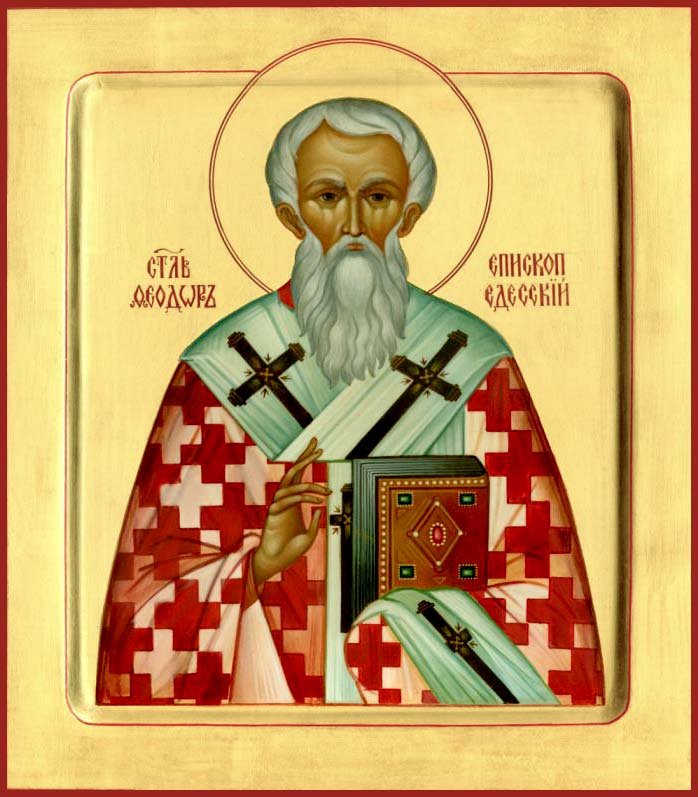
Saint Theodore, Bishop of Edessa
The Saint’s father was named Symeon, and his mother’s name was Maria. He received a good education and was distinguished for his philosophical knowledge, as well as for rhetoric.
At the age of ten he was left as an orphan and gave half of his parents’ wealth to his sister, and kept the other half himself. Shari
The Saint’s father was named Symeon, and his mother’s name was Maria. He received a good education and was distinguished for his philosophical knowledge, as well as for rhetoric.
At the age of ten he was left as an orphan and gave half of his parents’ wealth to his sister, and kept the other half himself. Sharing this with the poor, he departed for Jerusalem. There he venerated the holy places and, when he was nineteen years old, he became a monk in the Lavra of Saint Savva.
Saint Theodore remained there for twenty-four years, leading an ascetic and virtuous life, and became a renowned ascetic. Hearing of his great virtues, the Patriarch of Jerusalem made him Bishop of Edessa in 836. He was an excellent Archpastor, with his vast theological knowledge, his many virtues, and above all, his great love, which he bestowed abundantly upon his flock. At that time Edessa was plagued with many heresies: Arian, Nestorian, Eutychian, etc. The holy hierarch instructed his flock in the Orthodox Faith in order to combat these errors. Saint Theodore also went to see the Persian king in Babylon, asking him to protect the Orthodox Christians of Edessa from the malevolence of the heretics.
The King was very sick, but the Saint healed him and spoke to him about Christ. After many days the King was baptized with the name John. After returning to Edessa, Saint Theodore was informed in a vision that King John and his three bodyguards, who had been baptized with him, proclaimed their faith openly and received the unfading crown of martyrdom.
Sensing the approach of death, Saint Theodore retired to the Lavra of Saint Savva. After calling the clergy and laity of Edessa together and blessing them, he surrendered his holy soul to the Heavenly Father in the year 848.
Bishop Basil of Emessa wrote the Saint’s life in Greek, which is preserved at the Ivḗron Monastery on Mount Athos.
Troparion - Tone 4
In truth you were revealed to your flock as a rule of faith, / an image of humility and a teacher of abstinence; / your humility exalted you; your poverty enriched you. / Hierarch Father Theodore, / entreat Christ our God that our souls may be saved.
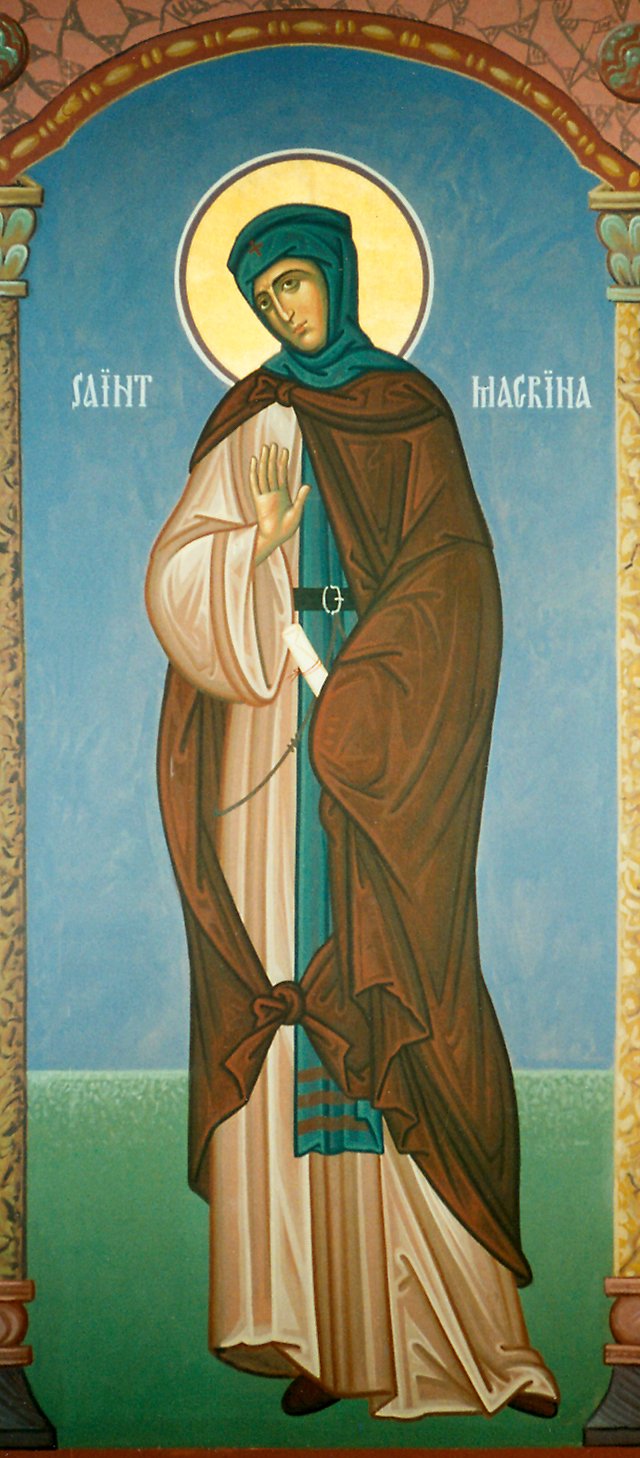
St Macrina, sister of St Basil the Great and St Gregory of Nyssa (380)
Saint Macrina was the sister of the holy hierarchs Basil the Great and Gregory of Nyssa, and was born in Cappadocia at the beginning of the fourth century. Her mother, Emilia, saw an angel in a dream, naming her unborn child Thekla, in honor of the holy Protomartyr Thekla. Saint Emilia (January 1) fulfilled the will of God and named her daughter Thekla.
Saint Macrina was the sister of the holy hierarchs Basil the Great and Gregory of Nyssa, and was born in Cappadocia at the beginning of the fourth century. Her mother, Emilia, saw an angel in a dream, naming her unborn child Thekla, in honor of the holy Protomartyr Thekla. Saint Emilia (January 1) fulfilled the will of God and named her daughter Thekla. Another daughter was named Macrina, in honor of a grandmother, who suffered during the time of persecution under the emperor Maximian Galerius.
Besides Macrina, there were nine other children. Saint Emila herself guided the upbringing and education of her daughter Macrina. She taught her reading and writing in the Scriptural books and Psalms of David, selecting examples from the sacred books which spoke of a pious and God-pleasing life. Saint Emilia taught her daughter to pray and to attend church services. Macrina was also taught the proper knowledge of domestic governance and various handicrafts. She was never left idle and did not participate in childish games or amusements.
When Macrina grew up, her parents betrothed her to a certain pious youth, but the bridegroom soon died. Many young men sought marriage with her, but Macrina refused them all, having chosen the life of a virgin and not wanting to be unfaithful to the memory of her dead fiancé. Saint Macrina lived in the home of her parents, helping them fulfill the household tasks as an overseer together with the servants, and she helped with the upbringing of her younger brothers and sisters. After the death of her father she became the chief support for the family.
When all the children grew up and left the parental home, Saint Macrina convinced her mother, Saint Emilia, to leave the world, to set their slaves free, and to settle in a women’s monastery. Several of their servants followed their example. Having taken monastic vows, they lived together as one family, they prayed together, they worked together, they possessed everything in common, and in this manner of life nothing distinguished one from another.
After the death of her mother, Saint Macrina guided the sisters of the monastery. She enjoyed the deep respect of all who knew her. Strictness towards herself and temperance in everything were characteristic of the saint all her life. She slept on boards and had no possessions. Saint Macrina was granted the gift of wonderworking. There was an instance (told by the sisters of the monastery to Saint Gregory of Nyssa after the death of Saint Macrina), when she healed a girl of an eye-affliction. Through the prayers of the saint, there was no shortage of wheat at her monastery in times of famine.
Saint Macrina died in the year 380, after a final prayer of thanks to the Lord for having received His blessings over all the course of her life. She was buried in the same grave with her parents.
Troparion - Tone 8
The image of God was truly preserved in you, O Mother, / for you took up the Cross and followed Christ. / By so doing, you taught us to disregard the flesh, for it passes away, / but to care instead for the soul, since it is immortal. / Therefore your spirit, O Holy Mother Macrina, rejoices with the Angels!
Scripture Readings
☩Epistle
Romans 12:4-5, 15-21
4
For as we have many members in one body, and all members have not the same office:
5
So we, being many, are one body in Christ, and every one members one of another.
15
Rejoice with them that do rejoice, and weep with them that weep.
16
Be of the same mind one toward another. Mind not high things, but condescend to men of low estate. Be not wise in your own conceits.
17
Recompense to no man evil for evil. Provide things honest in the sight of all men.
18
If it be possible, as much as lieth in you, live peaceably with all men.
19
Dearly beloved, avenge not yourselves, but rather give place unto wrath: for it is written, Vengeance is mine; I will repay, saith the Lord.
20
Therefore if thine enemy hunger, feed him; if he thirst, give him drink: for in so doing thou shalt heap coals of fire on his head.
21
Be not overcome of evil, but overcome evil with good.
☩Gospel
Matthew 12:9-13
9
And when he was departed thence, he went into their synagogue:
10
And, behold, there was a man which had his hand withered. And they asked him, saying, Is it lawful to heal on the sabbath days? that they might accuse him.
11
And he said unto them, What man shall there be among you, that shall have one sheep, and if it fall into a pit on the sabbath day, will he not lay hold on it, and lift it out?
12
How much then is a man better than a sheep? Wherefore it is lawful to do well on the sabbath days.
13
Then saith he to the man, Stretch forth thine hand. And he stretched it forth; and it was restored whole, like as the other.
Liturgical data sourced from OCA.org and orthocal.info