
Fasting Rules
 Meat
Allowed
 Fish
Allowed
 Dairy
Allowed
 Oil
Allowed
 Wine
Allowed
Saints & Commemorations
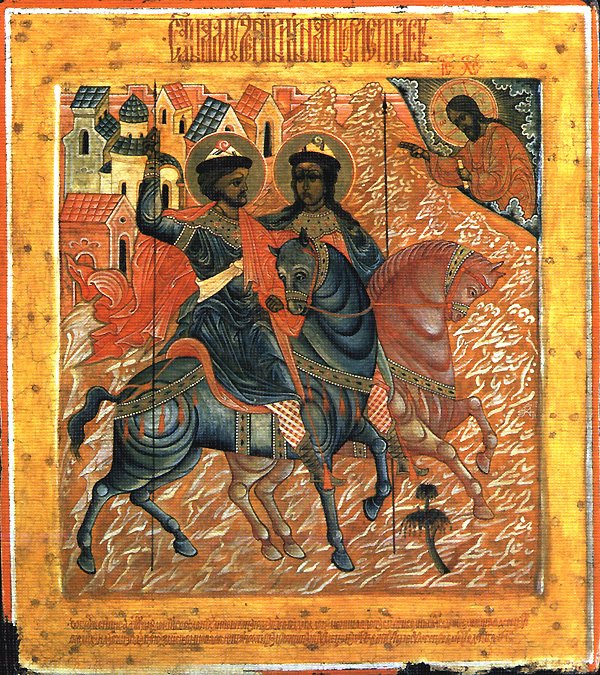
Martyrs Boris and Gleb, Passionbearers
Saints Boris and Gleb were sons of Saint Vladimir (July 15). Saint Boris was named Romanus and Saint Gleb was named David at their Baptism. After their father’s death the eldest son Sviatopolk planned to kill his brothers Boris, Gleb, and Yaroslav in order to seize power. He sent a message to Boris, pretending that he wished to live in peace with him, and to increase Boris’s land holdings inherited from their father.
So
Saints Boris and Gleb were sons of Saint Vladimir (July 15). Saint Boris was named Romanus and Saint Gleb was named David at their Baptism. After their father’s death the eldest son Sviatopolk planned to kill his brothers Boris, Gleb, and Yaroslav in order to seize power. He sent a message to Boris, pretending that he wished to live in peace with him, and to increase Boris’s land holdings inherited from their father.
Some of Vladimir’s advisers told Boris that he should take the army and establish himelf as ruler of Kiev. Saint Boris, however, said that he could never lift his hand against his own brother. Unfortunately, Sviatopolk was not so scrupulous. He came to the town of Vyshegorod to ask its leaders if they were loyal to him. They assured him that they were ready to die for him.
Sviatopolk sent assassins to the Alta to kill Boris, who already knew that his brother wanted him dead. When they arrived they heard him chanting psalms and praying before an icon of Christ. He asked the Lord to strengthen him for the suffering he was about to endure. He also prayed for Sviatopolk, asking God not to count this against him as sin.
Then he lay down upon his couch, and the assassins stabbed him with their lances, and also killed some of Boris’s servants. Wrapping Boris in a cloth, they threw him onto a wagon and drove off with him. When Sviatopolk saw that he was still breathing, he sent some men to finish him off with swords.
After Sviatopolk had killed Boris, he wondered, “Now how can I kill Gleb?” He sent him a message saying that their father was ill and wished to see him. As he was on his way, he received word from Yaroslav that their father had died and that Sviatopolk had murdered Boris.
Saint Gleb wept for his father and brother, and was lamenting them when the assassins arrived. They seized his boat and drew their weapons, but it was Gleb’s cook Torchin who stabbed him with a knife.
The martyr’s body was thrown onto the shore between two trees. Later, he was buried beside Saint Boris in the church of Saint Basil.
Saints Boris and Gleb received the crown of martyrdom in 1015. They became known as Passion-Bearers, since they did not resist evil with violence.
The holy martyrs Princes Boris and Gleb are also commemorated on May 2.
Troparion - Tone 2
Righteous passion-bearers and true fulfillers of the Gospel of Christ, / chaste Boris and guileless Gleb, / you did not resist the attacks of your brother, the enemy, / when he killed your bodies but could not touch your souls. / Therefore, let the evil lover of power mourn / while you rejoice with the angels standing before the Holy Trinity. / Pray that those who honor your memory may be pleasing to God, / and that all Orthodox Christians may be saved.
Kontakion - Tone 3
Today your most glorious memory shines forth, / noble participants in the passion of Christ, holy Boris and Gleb, / for you call us together to sing praises to Christ our God! / Praying to Him before your sacred images, / we receive the gift of healing by your prayers, / for you are indeed divine healers.
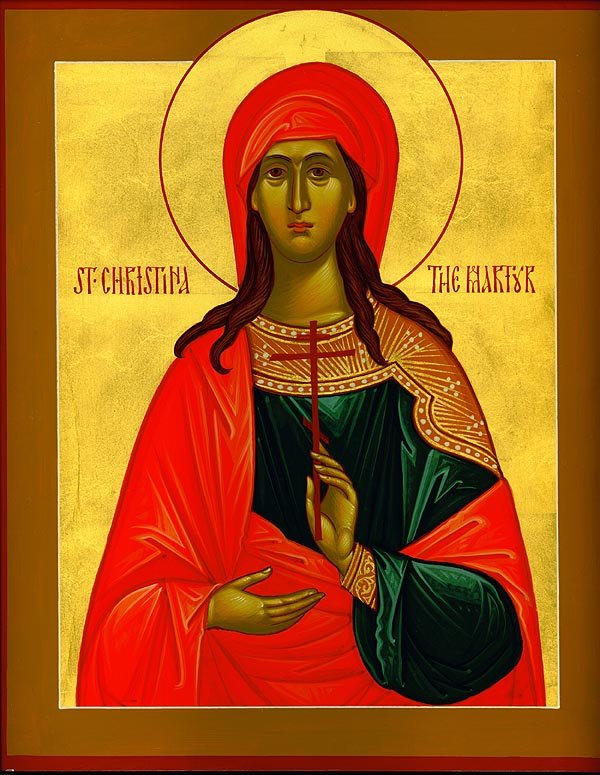
Martyr Christina of Tyre (200)
The Martyr Christina lived during the third century. She was born into a rich family, and her father was governor of Tyre. By the age of 11 the girl was exceptionally beautiful, and many wanted to marry her. Christina’s father, however, envisioned that his daughter should become a pagan priestess. To this end he placed her in a special dwelling where he had set up many gold and silver idols, and he commanded his daughter to burn incense before them. T
The Martyr Christina lived during the third century. She was born into a rich family, and her father was governor of Tyre. By the age of 11 the girl was exceptionally beautiful, and many wanted to marry her. Christina’s father, however, envisioned that his daughter should become a pagan priestess. To this end he placed her in a special dwelling where he had set up many gold and silver idols, and he commanded his daughter to burn incense before them. Two servants attended Christina.
In her solitude, Christina began to wonder who had created this beautiful world. From her room she was delighted by the stars of the heavens and she constantly came back to the thought about the Creator of all the world. She was convinced, that the voiceless and inanimate idols in her room could not create anything, since they themselves were created by human hands. She began to pray to the One God with tears, entreating Him to reveal Himself. Her soul blazed with love for the Unknown God, and she intensified her prayer all the more, and combined it with fasting.
One time Christina was visited by an angel, who instructed her in the true faith in Christ, the Savior of the world. The angel called her a bride of Christ and told her about her future suffering. The holy virgin smashed all the idols standing in her room and threw them out the window. In visiting his daughter Christina’s father, Urban, asked her where all the idols had disappeared. Christina was silent. Then, having summoned the servants, Urban learned the truth from them.
In a rage the father began to slap his daughter’s face. At first, the holy virgin remained quiet, but then she told her father about her faith in the One True God, and that she had destroyed the idols with her own hands. Urban gave orders to kill all the servants in attendance upon his daughter, and he gave Christina a fierce beating and threw her in prison. Having learned about what had happened, Saint Christina’s mother came in tears, imploring her to renounce Christ and to return to her ancestral beliefs. But Christina remained unyielding. On another day, Urban brought his daughter to trial and urged her to offer worship to the gods, and to ask forgiveness for her misdeeds. Instead, he saw her firm and steadfast confession of faith in Christ.
The torturers tied her to an iron wheel, beneath which they lit a fire. The body of the martyr, turning round on the wheel, was scorched on all sides. They then threw her into prison.
An angel of God appeared at night, healing her wounds and strengthening her with food. Her father, seeing her unharmed, gave orders to drown her in the sea. An angel sustained the saint while the stone sank down, and Christina miraculously came out of the water and reappeared before her father. In terror, her father imputed this to sorcery and decided to execute her in the morning. That night he himself suddenly died. Another governor, Dion, was sent in his place. He summoned the holy martyr and also tried to persuade her to renounce Christ, but seeing her unyielding firmness, he again subjected her to cruel tortures. The holy martyr was for a long while in prison. People began to flock to her, and she converted them to the true faith in Christ. Thus about 300 were converted.
In place of Dion, a new governor Julian arrived and resumed the torture of the saint. After various torments, Julian gave orders to throw her into a red-hot furnace and lock her in it. After five days they opened the furnace and found the martyr alive and unharmed. Seeing this miracle take place, many believed in Christ the Savior, and the torturers executed Saint Christina with a sword.
Troparion - Tone 5
You abandoned your father's error, most revered one, / you received divine illumination, / and were betrothed to Christ as a glorious virgin; / therefore, you contested steadfastly and overcame the Enemy, O Great Martyr Christina. / Pray unceasingly that we may receive great mercy.
Kontakion - Tone 4
You appeared as a luminous dove with golden wings, / and flew to the heights of heaven, O revered Christina, and came to rest. / We faithfully celebrate your glorious feast / and venerate the shrine of your relics, / from which divine healing of souls and bodies flows abundantly for all.
Scripture Readings
☩Epistle
Romans 8:14-21
14
For as many as are led by the Spirit of God, they are the sons of God.
15
For ye have not received the spirit of bondage again to fear; but ye have received the Spirit of adoption, whereby we cry, Abba, Father.
16
The Spirit itself beareth witness with our spirit, that we are the children of God:
17
And if children, then heirs; heirs of God, and joint-heirs with Christ; if so be that we suffer with him, that we may be also glorified together.
18
For I reckon that the sufferings of this present time are not worthy to be compared with the glory which shall be revealed in us.
19
For the earnest expectation of the creature waiteth for the manifestation of the sons of God.
20
For the creature was made subject to vanity, not willingly, but by reason of him who hath subjected the same in hope,
21
Because the creature itself also shall be delivered from the bondage of corruption into the glorious liberty of the children of God.
☩Gospel
Matthew 9:9-13
9
And as Jesus passed forth from thence, he saw a man, named Matthew, sitting at the receipt of custom: and he saith unto him, Follow me. And he arose, and followed him.
10
And it came to pass, as Jesus sat at meat in the house, behold, many publicans and sinners came and sat down with him and his disciples.
11
And when the Pharisees saw it, they said unto his disciples, Why eateth your Master with publicans and sinners?
12
But when Jesus heard that, he said unto them, They that be whole need not a physician, but they that are sick.
13
But go ye and learn what that meaneth, I will have mercy, and not sacrifice: for I am not come to call the righteous, but sinners to repentance.
Liturgical data sourced from OCA.org and orthocal.info