
Fasting Rules
 Meat
Allowed
 Fish
Allowed
 Dairy
Allowed
 Oil
Allowed
 Wine
Allowed
Saints & Commemorations
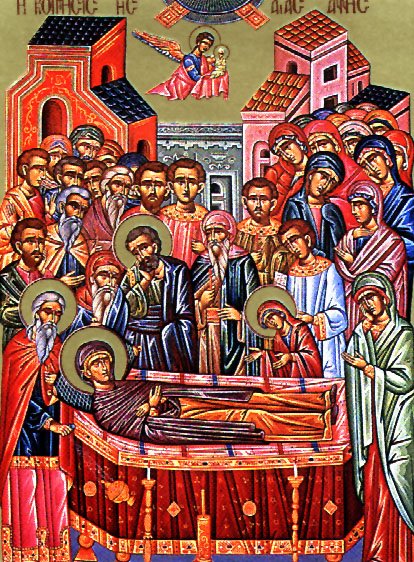
Dormition Righteous Anna, Mother of Theotokos
Saint Anna was the daughter of the priest Matthan and his wife Mary. She was of the tribe of Levi and the lineage of Aaron. According to Tradition, she died peacefully in Jerusalem at age 79, before the Annunciation to the Most Holy Theotokos.
During the reign of Saint Justinian the Emperor (527-565), a church was built in her honor at Deutera.
Saint Anna was the daughter of the priest Matthan and his wife Mary. She was of the tribe of Levi and the lineage of Aaron. According to Tradition, she died peacefully in Jerusalem at age 79, before the Annunciation to the Most Holy Theotokos.
During the reign of Saint Justinian the Emperor (527-565), a church was built in her honor at Deutera. Emperor Justinian II (685-695; 705-711) restored her church, since Saint Anna had appeared to his pregnant wife. It was at this time that her body and maphorion (veil) were transferred to Constantinople.
Portions of Saint Anna’s holy relics may be found on Mount Athos: Stavronikita Monastery (part of her left hand), Saint Anna’s Skete (part of her incorrupt left foot), Koutloumousiou Monastery (part of her incorrupt right foot). Fragments of her relics may also be found in her Monastery at Lygaria, Lamia, and in the Monastery of Saint John the Theologian at Sourota. Part of the saint’s incorrupt flesh is in the collection of Saints’ relics of the International Catholic Crusaders. The church of Saint Paul Outside the Walls in Rome has one of the saint’s wrists.
Saint Anna is also commemorated on September 9.
Troparion - Tone 4
Divinely-wise Anna, you carried in your womb the pure Mother of God, who gave life to our Life. / Therefore, you are now carried joyfully to the inheritance of heaven, / to the abode of those who rejoice in glory, / where you seek forgiveness of sins for those who faithfully honor you, ever blessed one.
Kontakion - Tone 2
We celebrate the memory of the progenitors of Christ, / and with faith we ask their help, / that deliverance from every affliction be granted to those who cry out: / “Be with us, O God, who in Your good pleasure glorified them.”
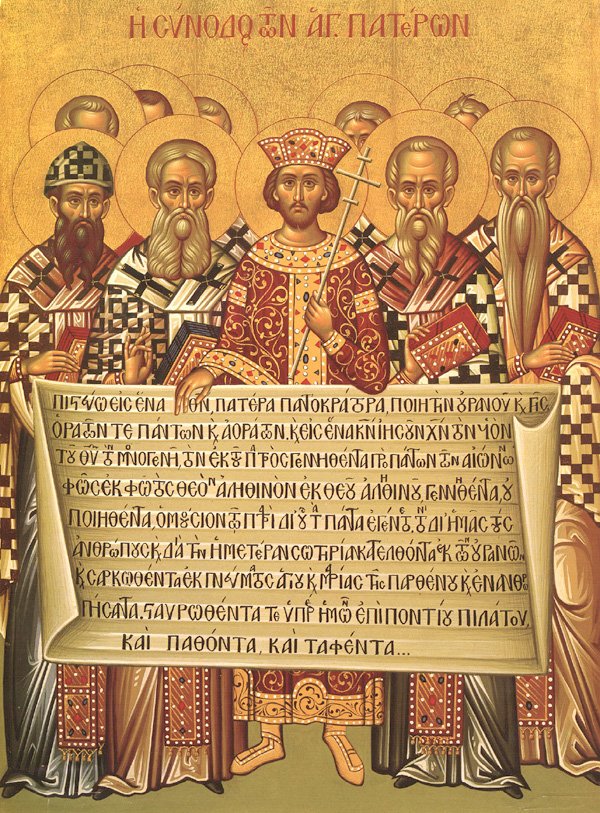
Commemoration of the holy 165 Fathers of the Fifth Ecumenical Council (553)
The Fifth Ecumenical Council (Constantinople II) was held at Constantinople, under the holy Emperor Saint Justinian I (527-565) in the year 553, to determine the Orthodoxy of three dead bishops: Theodore of Mopsuetia, Theodoret of Cyrrhus and Ibas of Edessa, who had expressed Nestorian opinions in their writings in the time of the Third Ecumenical Council (September 9).
The Fifth Ecumenical Council (Constantinople II) was held at Constantinople, under the holy Emperor Saint Justinian I (527-565) in the year 553, to determine the Orthodoxy of three dead bishops: Theodore of Mopsuetia, Theodoret of Cyrrhus and Ibas of Edessa, who had expressed Nestorian opinions in their writings in the time of the Third Ecumenical Council (September 9).
These three bishops had not been condemned at the Fourth Ecumenical Council (July 16), which condemned the Monophysites, and in turn had been accused by the Monophysites of Nestorianism. Therefore, to deprive the Monophysites of the possibility of accusing the Orthodox of sympathy for Nestorianism, and also to dispose the heretical party towards unity with the followers of the Council of Chalcedon, the emperor Saint Justinian issued an edict. In it “the Three Chapters” (the three deceased bishops) were condemned. But since the edict was issued on the emperor’s initiative, and since it was not acknowledged by representatives of all the Church (particularly in the West, and in Africa), a dispute arose about the “Three Chapters.” The Fifth Ecumenical Council was convened to resolve this dispute.
165 bishops attended this Council. Pope Vigilius, though present in Constantinople, refused to participate in the Council, although he was asked three times to do so by official deputies in the name of the gathered bishops and the Emperor himself. The Council opened with Saint Eutychius, Patriarch of Constantinople (552-565, 577-582), presiding. In accordance with the imperial edict, the matter of the “Three Chapters” was carefully examined in eight prolonged sessions from May 4 to June 2, 553.
Anathema was pronounced against the person and teachings of Theodore of Mopsuetia. In the case of Theodore and Ibas, the condemnations were confined only to certain of their writings, while they personally had been cleared by the Council of Chalcedon, because of their repentance. Thus, they were spared from the anathema.
This measure was necessary because certain of the proscribed works contained expressions used by the Nestorians to interpret the definitions of the Council of Chalcedon for their own ends. But the leniency of the Fathers of the Fifth Ecumenical Council, in a spirit of moderate economy regarding the persons of Bishops Theodore and Ibas, instead embittered the Monophysites against the decisions of the Council. Besides which, the emperor had given the orders to promulgate the Conciliar decisions together with a decree of excommunication against Pope Vigilius, for being like-minded with the heretics. The Pope afterwards concurred with the mind of the Fathers, and signed the Conciliar definition. The bishops of Istria and all the region of the Aquilea metropolia, however, remained in schism for more than a century.
At the Council the Fathers likewise examined the errors of presbyter Origen, a renowned Church teacher of the third century. His teaching about the pre-existence of the human soul was condemned. Other heretics, who did not admit the universal resurrection of the dead, were also condemned.
It pleased the Lord that the Holy Spirit should inspire the Fathers of the Council in a further definition of Orthodoxy that preserves the integrity and dignity both of God and of mankind, without the distortion of either that occurs within the Nestorian or Monophysite heresies.
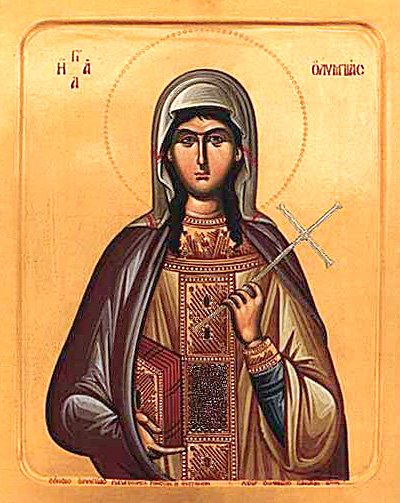
St Olympias the Deaconess (408)
Saint Olympias the Deaconess was the daughter of the senator Anicius Secundus, and by her mother she was the granddaughter of the noted eparch Eulalios (he is mentioned in the life of Saint Nicholas). Before her marriage to Anicius Secundus, Olympias’s mother had been married to the Armenian emperor Arsak and became widowed. W
Saint Olympias the Deaconess was the daughter of the senator Anicius Secundus, and by her mother she was the granddaughter of the noted eparch Eulalios (he is mentioned in the life of Saint Nicholas). Before her marriage to Anicius Secundus, Olympias’s mother had been married to the Armenian emperor Arsak and became widowed. When Saint Olympias was still very young, her parents betrothed her to a nobleman. The marriage was supposed to take place when Saint Olympias reached the age of maturity. The bridegroom soon died, however, and Saint Olympias did not wish to enter into another marriage, preferring a life of virginity.
After the death of her parents she became the heir to great wealth, which she began to distribute to all the needy: the poor, the orphaned and the widowed. She also gave generously to the churches, monasteries, hospices and shelters for the downtrodden and the homeless.
Holy Patriarch Nectarius (381-397) appointed Saint Olympias as a deaconess. The saint fulfilled her service honorably and without reproach.
Saint Olympias provided great assistance to hierarchs coming to Constantinople: Amphilochius, Bishop of Iconium, Onesimus of Pontum, Gregory the Theologian, Saint Basil the Great’s brother Peter of Sebaste, Epiphanius of Cyprus, and she attended to them all with great love. She did not regard her wealth as her own but rather God’s, and she distributed not only to good people, but also to their enemies.
Saint John Chrysostom (November 13) had high regard for Saint Olympias, and he showed her good will and spiritual love. When this holy hierarch was unjustly banished, Saint Olympias and the other deaconesses were deeply upset. Leaving the church for the last time, Saint John Chrysostom called out to Saint Olympias and the other deaconesses Pentadia, Proklia and Salbina. He said that the matters incited against him would come to an end, but scarcely more would they see him. He asked them not to abandon the Church, but to continue serving it under his successor. The holy women, shedding tears, fell down before the saint.
Patriarch Theophilus of Alexandria (385-412), had repeatedly benefited from the generosity of Saint Olympias, but turned against her for her devotion to Saint John Chrysostom. She had also taken in and fed monks, arriving in Constantinople, whom Patriarch Theophilus had banished from the Egyptian desert. He levelled unrighteous accusations against her and attempted to cast doubt on her holy life.
After the banishment of Saint John Chrysostom, someone set fire to a large church, and after this a large part of the city burned down.
All the supporters of Saint John Chrysostom came under suspicion of arson, and they were summoned for interrogation. They summoned Saint Olympias to trial, rigorously interrogating her. They fined her a large sum of money for the crime of arson, despite her innocence and a lack of evidence against her. After this the saint left Constantinople and set out to Kyzikos (on the Sea of Marmara). But her enemies did not cease their persecution. In the year 405 they sentenced her to prison at Nicomedia, where the saint underwent much grief and deprivation. Saint John Chrysostom wrote to her from his exile, consoling her in her sorrow. In the year 409 Saint Olympias entered into eternal rest.
Saint Olympias appeared in a dream to the Bishop of Nicomedia and commanded that her body be placed in a wooden coffin and cast into the sea. “Wherever the waves carry the coffin, there let my body be buried,” said the saint. The coffin was brought by the waves to a place named Brokthoi near Constantinople. The inhabitants, informed of this by God, took the holy relics of Saint Olympias and placed them in the church of the holy Apostle Thomas.
Afterwards, during an invasion of enemies, the church was burned, but the relics were preserved. Under the Patriarch Sergius (610-638), they were transferred to Constantinople and put in the women’s monastery founded by Saint Olympias. Miracles and healings occurred from her relics.
Scripture Readings
☩Epistle
Romans 10:1-10
1
Brethren, my heart’s desire and prayer to God for Israel is, that they might be saved.
2
For I bear them record that they have a zeal of God, but not according to knowledge.
3
For they being ignorant of God’s righteousness, and going about to establish their own righteousness, have not submitted themselves unto the righteousness of God.
4
For Christ is the end of the law for righteousness to every one that believeth.
5
For Moses describeth the righteousness which is of the law, That the man which doeth those things shall live by them.
6
But the righteousness which is of faith speaketh on this wise, Say not in thine heart, Who shall ascend into heaven? (that is, to bring Christ down from above:)
7
Or, Who shall descend into the deep? (that is, to bring up Christ again from the dead.)
8
But what saith it? The word is nigh thee, even in thy mouth, and in thy heart: that is, the word of faith, which we preach;
9
That if thou shalt confess with thy mouth the Lord Jesus, and shalt believe in thine heart that God hath raised him from the dead, thou shalt be saved.
10
For with the heart man believeth unto righteousness; and with the mouth confession is made unto salvation.
☩Gospel
Matthew 8:28-9:1
28
And when he was come to the other side into the country of the Gergesenes, there met him two possessed with devils, coming out of the tombs, exceeding fierce, so that no man might pass by that way.
29
And, behold, they cried out, saying, What have we to do with thee, Jesus, thou Son of God? art thou come hither to torment us before the time?
30
And there was a good way off from them an herd of many swine feeding.
31
So the devils besought him, saying, If thou cast us out, suffer us to go away into the herd of swine.
32
And he said unto them, Go. And when they were come out, they went into the herd of swine: and, behold, the whole herd of swine ran violently down a steep place into the sea, and perished in the waters.
33
And they that kept them fled, and went their ways into the city, and told every thing, and what was befallen to the possessed of the devils.
34
And, behold, the whole city came out to meet Jesus: and when they saw him, they besought him that he would depart out of their coasts.
1
And he entered into a ship, and passed over, and came into his own city.
Liturgical data sourced from OCA.org and orthocal.info