
Fasting Rules
 Meat
Allowed
 Fish
Allowed
 Dairy
Allowed
 Oil
Allowed
 Wine
Allowed
Saints & Commemorations
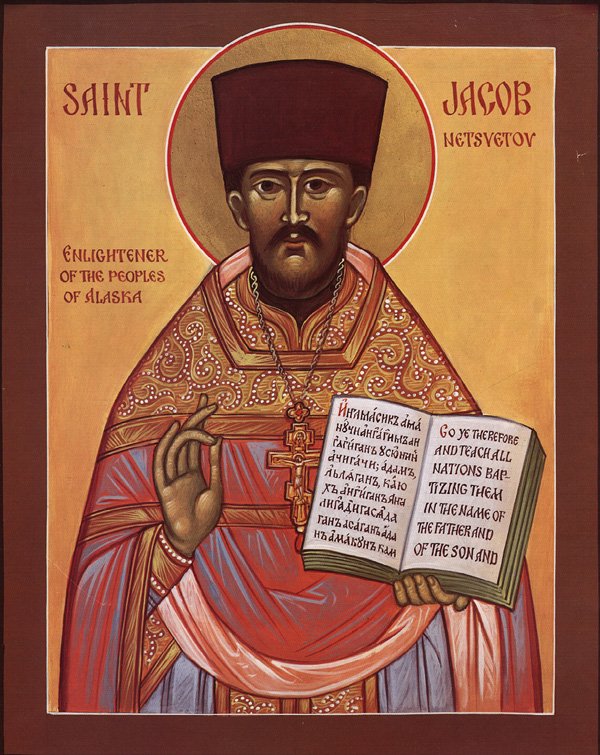
Repose of St Jacob Netsvetov, Enlightener of the Peoples of Alaska
Father Jacob (Netsvetov) of Alaska was born of pious parents in 1802 on Atka Island, Alaska. His father, Yegor Vasil’evich Netsvetov was a Russian from Tobolsk. His mother, Maria Alekseevna, was an Aleut from Atka island. Yegor and Maria had four children who survived infancy; Jacob was the first born, followed by Osip (Joseph), Elena, and Antony. Y
Father Jacob (Netsvetov) of Alaska was born of pious parents in 1802 on Atka Island, Alaska. His father, Yegor Vasil’evich Netsvetov was a Russian from Tobolsk. His mother, Maria Alekseevna, was an Aleut from Atka island. Yegor and Maria had four children who survived infancy; Jacob was the first born, followed by Osip (Joseph), Elena, and Antony. Yegor and Maria were devoted to their children and, though of meager means, did all they could to provide them with the education which would help them in this life as well as in the life to come. Osip and Antony were eventually able to study at the Saint Petersburg Naval Academy in Russia, becoming a naval officer and a shipbuilder, respectively. Their sister, Elena, married a successful and respected clerk for the Russian-American Company. But Jacob yearned for a different kind of success, a success that the world might consider failure for “the righteous live forever, their reward is with the Lord” (Wis. Sol. 5:15). And so, when the family moved to Irkutsk in 1823, Jacob enrolled in the Irkutsk Theological Seminary and placed all his hope in Christ by seeking first the Kingdom of God (Mt. 6:33).
Jacob was tonsured as a Subdeacon on October 1, 1825. He married a Russian woman (perhaps also a Creole) named Anna Simeonovna, and in 1826 graduated from the Seminary with certificates in history and theology. On October 31, 1826, he was ordained to the Holy Diaconate and assigned to serve the altar of the Holy Trinity-Saint Peter Church in Irkutsk. Two years later, on March 4, 1828, Archbishop Michael, who had earlier ordained Father John Veniaminov (Saint Innocent), elevated the godly deacon Jacob to the Holy Priesthood. This, however, was no ordinary ordination. As if he were a new Patrick, hearing the mystical call of his distant flock, Father Jacob yearned to return to his native Alaska. And the all-good God, who “satisfies the longing soul and fills the hungry soul with goodness” (Ps.107:9) heard the prayer of his servant.
Archbishop Michael provided Father Jacob with two antimensia: one for the new Church which would be dedicated to the glory of God in honor of Saint Nicholas the Wonderworker in Atka, and one to be used for missionary activity. On May 1, 1828 a molieben for travelers was served, and Father Jacob, his father, Yegor, (now tonsured as reader for the Atka Church), and his matushka, Anna, set out for Alaska.
Who can tell of the perils and trials associated with such a journey? Travel in those days was never easy, either overland or over the waves of the sea. Nevertheless, aided by prayer and confidence in God’s providence, the Netsvetov family arrived safely in Atka over a year later, on June 15, 1829. The new assignment for the newly-ordained Father Jacob would also prove to be quite a challenge. The Atka “parish” comprised a territory stretching for nearly 2,000 miles and included Amchitka, Attu, Copper, Bering and Kurile Islands. But this did not deter the godly young priest, for when he was clothed in the garments of the Priesthood, he was found to be “clad with zeal as a cloak’ (Is. 59:17), and so he threw himself wholly into his sacred ministry. His deep love for God and for his flock was evident in everything that he did. Both in Atka and in the distant villages and settlements which he visited, Father Jacob offered himself as a “living sacrifice” (Rom 12:1). Having “no worry about his life” (Mt. 6:25 ff), the holy one endured manifold tortures of cold, wet, wind, illness, hunger and exhaustion, for to him life was Christ (Phil 1:21). Showing himself as a “rule of faith,” his example brought his people to a deep commitment to their own salvation. Being fully bilingual and bicultural, Father Jacob was uniquely blessed by God to care for the souls of his fellow Alaskans.
When he arrived in Atka, the Church of Saint Nicholas had not yet been built. So, with his own hands Father Jacob constructed a large tent (Acts 18:3) in which he conducted the services. For Father Jacob the services of the Church were life: life for his people and life for himself. It was in the worship of God that he found both strength and joy. Later he would transport this tent with him on his missionary journeys, and like Moses in the wilderness, the grace of God was found wherever this tent was taken (Num 4:1 ff; 10:17 ff).
When his first six months had ended (end of 1829), Father Jacob recorded that he had baptized 16, chrismated 442, married 53 couples, and buried 8.
Once the church was constructed, Father Jacob turned his attention to the building of a school in which the children would learn to read and write both Russian and Unangan Aleut. The Russian American Company provided some of the support initially, with the students providing the remainder. This continued until 1841, when it was reorganized as a parish school and ties with the company ceased. Father Jacob proved to be a talented educator and translator whose students became distinguished Aleut leaders in the next generation.
Father Netsvetov led an active physical and intellectual life, hunting and gathering for his own subsistence needs, preparing specimens of fish and marine animals for the natural history museums of Moscow and Saint Petersburg, corresponding with Saint Innocent (Veniaminov) on matters of linguistics and translations. He labored over the creation of an adequate alphabet for the Unangan-Aleut language, and the translation of the Holy Scriptures and other appropriate literature into that language. Saint Innocent praised the young pastor for his holiness of life, his teaching, and for continuing this work of translating which he, himself, had begun earlier among the native peoples. After fifteen years of service, Father Jacob was awarded the Nabedrennik, Kamilavka, and Gold Cross. Later, he would be made Archpriest and receive the Order of Saint Anna.
These ecclesiastical awards do not tell of the personal sufferings of this warrior for Christ. In March of 1836, his precious wife, Anna, died of cancer; his home burned to the ground in July of 1836; and his dear father, Yegor, died of an undetermined illness in 1837. Who can utter the depth of sorrow felt by this God-pleaser? Yet he lifted up his voice with that ancient sufferer and cried, “shall we indeed accept good from God and shall we not accept adversity? In all this he did not sin with his lips” (Job 2:10). In his journal Father Jacob attributed all to “the Will of Him whose Providence and Will are inscrutable and whose actions toward men are incomprehensible.” He patiently endured hardships and sufferings like the Holy Apostle Paul. He saw in these misfortunes not a Victory by the hater of men’s souls (i.e. the devil) but a call from God to even greater spiritual struggles. With this in mind, Father Jacob petitioned his ruling bishop to return to Irkutsk in order to enter the monastic life. A year later, word reached him that permission was granted contingent upon the arrival of a replacement. None ever came.
Instead, Bishop Innocent soon came to Atka and asked Father Jacob to accompany him on a voyage by ship to Kamchatka. Who can know the heavenly discourse enjoyed by these two lovers of Christ as they traveled over the waves? This, however, is clear, the holy archpastor was able to accomplish three things in Father Netsvetov. Firstly, he applied the healing salve of the Spirit with words of comfort; secondly, he dissuaded Father Jacob from entering the monastery; and thirdly, he revealed to the godly priest the true plan of the Savior for his life, that he ‘might preach (Christ) among the Gentiles” (Gal. 1: 16) deep in the Alaskan interior. Father Jacob continued to serve his far-flung flock of the Atka parish until December 30, 1844. A new zeal had taken hold of him, and it was then that Saint Innocent appointed him to head the new Kvikhpak Mission in order to bring the light of Christ to the people of the Yukon. Here, aided by two young Creole assistants, Innokentii Shayashnikov and Konstantin Lukin, together with his young nephew, Vasilii Netsvetov, Father Jacob “settled’ in the wilderness of Alaska.
He learned new languages, embraced new peoples and cultures, devised another alphabet, built another church and Orthodox community, and for the next twenty years, until his health and eyesight failed, continued to be an evangelical beacon of the grace of God in southwestern Alaska.
Establishing his headquarters in the Yup’ik Eskimo village of Ikogmiute (today’s ‘Russian Mission’) he traveled to native settlements hundreds of miles up and down Alaska’s longest river (the Yukon) as well as the Kuskokwim River region. At the insistence of Indian leaders, he traveled as far as the middle of the Innoko River baptizing hundreds of Indians from various, and often formerly hostile, tribes. “Behold how good and how pleasant it is for brethren to dwell together in unity” (Ps 133:1). He built the first Christian temple in this region, and dedicated it to the feast of the Elevation of the Holy Cross. Here Father Jacob, in spite of failing health, joyfully celebrated the Church’s cycle of services, including all of the services prescribed for Holy Week and Pascha.
Finally, in 1863, the evil One, who “walks about like a roaring lion, seeking whom he may devour” (I Pet 5:8), sought one last time to get the better of the righteous one. So the devil, the father of lies, (John 8:44), inspired an assistant of Father Jacob to level spurious and slanderous charges against his master. This resulted in a summons to Sitka, issued by Bishop Peter. The godly pastor was quickly cleared of all charges, but due to his ever-worsening health, he remained in Sitka for his final year serving a Tlingit chapel. He died on July 26, 1864 at the age of 60 and was buried on the third day at the entry of the chapel. During his final missionary travels in the Kuskokwim/Yukon delta region, he had baptized 1,320 people—distinguishing himself as the evangelizer of the Yup’ik Eskimo and Athabascan Indian peoples.
This brief history has recounted the basic chronology of the saint’s life and labors, but we must not neglect to relate his other deeds, that the light be not “hidden under a bushel” (Mt.5:15). In 1841, Father Jacob encountered a group of women from his flock in Amlia who had fallen victim to certain demonic influences and teachings. Blaming himself for the seduction and fall of his spiritual children by the evil one, he informed the leader among them that he was going to pay them a visit.
Upon arriving, he found one of the women paralyzed, semi-conscious and unable to speak. He ordered that she be removed to another house apart, and on the next day when this was accomplished, he lit the lampada before the icons of the beautiful corner, vested himself in his priestly epitrachilion (stole), sprinkled holy water throughout the room, and began the first prayers of exorcism. He then left.
During the night he was notified that the woman had begun to speak but incoherently. He came immediately to her and performed a second exorcism. This time, she sprang out of her bed and stood next to the saint, joined her prayer to his, and accompanied them with prostrations. When the prayers were finished, Father Jacob again sprinkled her with holy water and gave her the precious cross to kiss. She regained full consciousness, a state of health and true reason—that is, even the false teachings of the evil spirits had no more part in her.
Once in November of 1845, Father Jacob was preaching in the village of Kalskag, where the local chief was also the head shaman. He spoke for all of the villagers and resisted the Word of God forcefully. But the saint, calm and full of the Holy Spirit, continued to sow the seeds of right belief and piety. After many hours, the chief fell silent and finally came to believe. The villagers, in solidarity with their leader, also joyously expressed their belief in the Triune God and sought Holy Baptism.
Father Jacob was a physician of bodies as well as souls. He often cared for the sick among his flock even to his own detriment. During the winter of 1850-1851 the saint was himself ravaged with illness. Yet he cared for the sick and dispensed medicine to them every day. Father Jacob’s preaching often brought together in the Holy Faith tribes who were traditional enemies. One example from his journal reads:
“Beginning in the morning, upon my invitation, all the Kol’chane and Ingalit from the Yukon and the local ones gathered at my place and I preached the word of God, concluding at noon. Everyone listened to the preaching with attention and without discussion or dissent, and in the end they all expressed faith and their wish to accept Holy Baptism, both the Kol’chane and the Ingatit (formerly traditional enemies). I made a count by families and in groups, and then in the afternoon began the baptismal service. First I baptized 50 Kol’chane and Ingalit men, the latter from the Yukon and Innoko. It was already evening when I completed the service. March 21, 1853.”
So it was that this apostolic man, this new Job, conducted himself during his earthly course. There are many other deeds and wonders which he performed, many known and many more known only to God. Few missionaries in history have had to endure the hardships which Father Jacob faced, yet he did so with patience and humility. His life of faith and piety are the legacy which he leaves to us, his spiritual children in America, and indeed to all Christians throughout the world.
Troparion - Tone 4
Righteous Father Jacob, / adornment of Atka and the Yukon delta, / offspring of Russian America, / flower of brotherly unity, / healer of sickness, / and terror of demons, / you offered yourself as a living sacrifice / to bring light to a searching people. / Pray to Christ God that our souls may be saved!
Kontakion - Tone 3
Holy Father Jacob, / teacher of the knowledge of God, / you revealed your love for your people, / taking up your cross and following Christ, / enduring hardships like the apostle Paul. / Pray on our behalf to Christ our God / to grant us great mercy!
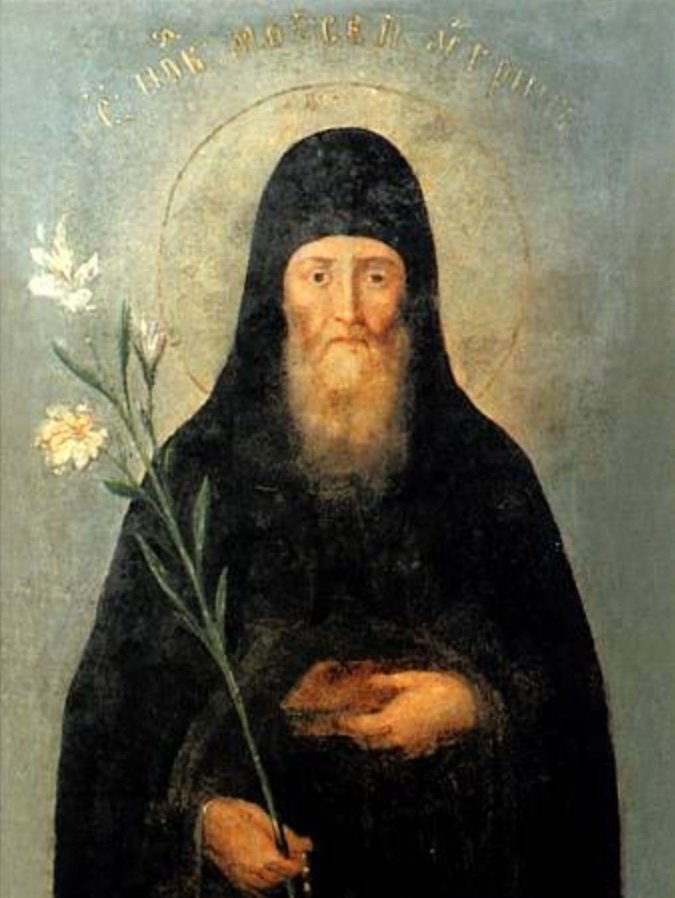
Moses the Hungarian
Venerable Moses of the Kiev Caves, a Hungarian by birth, was the brother of Venerable Ephraim of Novy Torg (+ January 28, 1053) and George. Together with them he entered the service of the holy Prince Boris (+ July 24, 1015). After the murder of Saint Boris in 1015 on the Alta River, with whom George died, Saint Moses fled and hid himself in Kiev with Predislava, the sister of Prince Yaroslav.
Venerable Moses of the Kiev Caves, a Hungarian by birth, was the brother of Venerable Ephraim of Novy Torg (+ January 28, 1053) and George. Together with them he entered the service of the holy Prince Boris (+ July 24, 1015). After the murder of Saint Boris in 1015 on the Alta River, with whom George died, Saint Moses fled and hid himself in Kiev with Predislava, the sister of Prince Yaroslav. In 1018, the Polish king Bolesław captured Kiev, and Saint Moses, along with others, went to Poland as a prisoner.
A tall and slender handsome man, Saint Moses attracted the attention of a wealthy Polish widow who was aflame with passion for him, and wanted to make him her husband, after she ransomed him from captivity. Saint Moses firmly refused to exchange captivity for slavery to a woman. His long cherished dream was to receive the angelic Schema. The Polish woman, however, ransomed the prisoner despite his refusal.
She tried in every possible way to seduce the young man, but he preferred pangs of hunger to magnificent feasts. Then the Polish woman rode with Saint Moses through her lands, thinking that he would be impressed by her power and wealth. Saint Moses told her that he would not exchange spiritual riches for the perishable things of this world, and that he would become a monk.
An Athonite Hieromonk who was passing through the area tonsured Saint Moses in secret. He spoke to him and taught him many things about spiritual and physical purity. When the woman found out about this she had Moses tortured. Father Moses was stretched on the ground, and he was beaten with iron rods until the earth was saturated with his blood. She obtained permission from Bolesław to do whatever she wished with her prisoner. The shameless woman ordered that the Saint be placed in bed with her by force. Then she kissed and embraced him, but she achieved nothing by this. Saint Moses said, "Out of the fear of God I despise you as unclean." Hearing this, the Polish woman commanded that the Saint be given a hundred blows every day, and then to be emasculated. Soon Bolesław began a persecution against all the monks in the country, but unexpectedly he died. A rebellion broke out in Poland, during which the widow was also killed.
After recovering from his ordeal Venerable Moses came to the Monastery of the Caves, bearing the wounds of a Martyr and the crown of a Confessor, as a brave and victorious soldier of Christ. The Lord also gave him strength against the passions. A certain brother was possessed by an unclean passion and came to Saint Moses, begging for his help saying: "I promise to keep until death everything you tell me to do.” Saint Moses said: “As long as you live, do not speak a word to any woman.” The brother promised to obey the Saint's counsel. Father Moses had a staff in his hand, without which he was unable to walk, because of the wounds which he had received. With this staff Saint Moses struck the chest of the brother who had come to him, and immediately he was delivered from temptation.
Saint Moses engaged in ascetical contests (podvigs) in the Monastery of the Caves for ten years. He reposed around 1043 and was buried in the Near Caves. By venerating the holy relics of Saint Moses and praying fervently to him, the monks of the Kiev Caves were delivered from their carnal temptations.
Troparion - Tone 3
O great lover of purity and chastity, we sinners praise you with sacred hymns as another Joseph, / O Moses, / revered by all, and equal of the Angels. We pray diligently to you: / “Entreat Christ God that He may heal all our passions and grant us great mercy.”
Kontakion - Tone 3
Seeking God alone in Heaven, you despised all earthly things. / You did not care for your body, but valiantly gave yourself up to torments, hunger, thirst, and bonds; / in prison you endured beatings, shedding your blood, / and having parts of your body cut off, for the sake of purity. / You preserved your virginity courageously, / and now with the assembly of virgins you stand before the Most Holy Trinity. / Entreat Him to deliver from all their temptations those who cry out to you: / “Rejoice, Most Blessed Father Moses.”
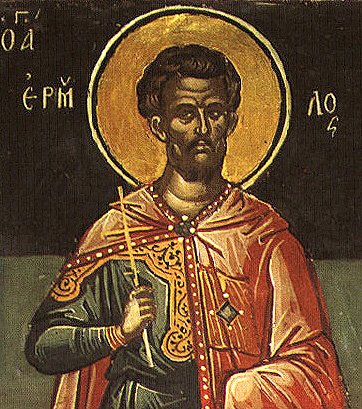
Holy Hieromartyrs Hermolaus (305), Hermippus, and Hermocrates at Nicomedia
Hieromartyrs Hermolaus, Hermippus and Hermocrates of Nicomedia, were among the small number of those remaining alive after 20,000 Christians were burned alive in a church at Nicomedia in the year 303 (December 28), on the orders of the emperor Maximian (284-305). They lived in remote places and did not cease to preach Christianity to the pagans.
Hieromartyrs Hermolaus, Hermippus and Hermocrates of Nicomedia, were among the small number of those remaining alive after 20,000 Christians were burned alive in a church at Nicomedia in the year 303 (December 28), on the orders of the emperor Maximian (284-305). They lived in remote places and did not cease to preach Christianity to the pagans.
The young pagan named Pantoleon (Holy Great Martyr Panteleimon, July 27) often passed by the house in which Saint Hermolaus had concealed himself. Once Saint Hermolaus chanced to meet the youth and asked him to stop by his house. In their conversation Saint Hermolaus began to explain to his guest the falseness, impiety and vanity of worshipping the pagan gods. From that day on, Pantoleon began to visit Saint Hermolaus daily and received holy Baptism from him.
When the trial of the holy Great Martyr Panteleimon was being held, Saints Hermolaus, Hermippus and Hermocrates, were also arrested. The Lord Jesus Christ appeared to Saint Hermolaus one evening and revealed to him that on the following day he would suffer for Him and receive a martyr’s crown.
Saints Hermippus and Hermocrates were arrested and brought to trial after Saint Hermolaus. All three were given the chance to deny Christ and offer sacrifice to idols. But they resolutely refused, confessed their faith in the Lord Jesus Christ and were prepared gladly to die for Him.
The pagans began to threaten the holy priests with torture and death. Suddenly, a strong earthquake occurred, and the idols and pagan temple collapsed and shattered. This was reported to the emperor. The enraged Maximian gave the holy martyrs over to torture and pronounced upon them a sentence of death. Bravely enduring all the torments, the holy Hieromartyrs Hermolaus, Hermippus and Hermocrates were beheaded in about the year 305.
Troparion - Tone 4
O God of our Fathers, / always act with kindness towards us; / take not Your mercy from us, / but guide our lives in peace / through the prayers of the hierarchs Hermolaus, Hermippus, and Hermocrates.
Kontakion - Tone 8
The Church glorifies you as teachers of virtue and adornments of hierarchs, / singing: “By your intercessions for those who lovingly honor you, / grant progress in virtue, and deliverance from temptations.”
Holy Righteous Martyr Paraskeve (140)
She was born near Rome to pious parents. Since she was born on a Friday, she was named Paraskeve (Friday in Greek; literally “preparation” or “preparedness” because Friday was the Biblical Day of Preparation for the Sabbath). From early childhood she studied the scriptures, consecrated herself to a monastic life, and brought many to faith in Christ by her example and teaching. During
She was born near Rome to pious parents. Since she was born on a Friday, she was named Paraskeve (Friday in Greek; literally “preparation” or “preparedness” because Friday was the Biblical Day of Preparation for the Sabbath). From early childhood she studied the scriptures, consecrated herself to a monastic life, and brought many to faith in Christ by her example and teaching. During the reign of Antoninus she was arrested because she was a Christian. When ordered to worship the idols, she answered “Let the gods that have not made heaven and the earth perish from off the earth” (Jeremiah 10:11). For this, after severe tortures she was beheaded in 140.
Scripture Readings
☩Epistle
Romans 16:17-24
17
Now I beseech you, brethren, mark them which cause divisions and offences contrary to the doctrine which ye have learned; and avoid them.
18
For they that are such serve not our Lord Jesus Christ, but their own belly; and by good words and fair speeches deceive the hearts of the simple.
19
For your obedience is come abroad unto all men. I am glad therefore on your behalf: but yet I would have you wise unto that which is good, and simple concerning evil.
20
And the God of peace shall bruise Satan under your feet shortly. The grace of our Lord Jesus Christ be with you. Amen.
21
Timotheus my workfellow, and Lucius, and Jason, and Sosipater, my kinsmen, salute you.
22
I Tertius, who wrote this epistle, salute you in the Lord.
23
Gaius mine host, and of the whole church, saluteth you. Erastus the chamberlain of the city saluteth you, and Quartus a brother.
24
The grace of our Lord Jesus Christ be with you all. Amen.
☩Gospel
Matthew 13:10-23
10
And the disciples came, and said unto him, Why speakest thou unto them in parables?
11
He answered and said unto them, Because it is given unto you to know the mysteries of the kingdom of heaven, but to them it is not given.
12
For whosoever hath, to him shall be given, and he shall have more abundance: but whosoever hath not, from him shall be taken away even that he hath.
13
Therefore speak I to them in parables: because they seeing see not; and hearing they hear not, neither do they understand.
14
And in them is fulfilled the prophecy of Esaias, which saith, By hearing ye shall hear, and shall not understand; and seeing ye shall see, and shall not perceive:
15
For this people’s heart is waxed gross, and their ears are dull of hearing, and their eyes they have closed; lest at any time they should see with their eyes, and hear with their ears, and should understand with their heart, and should be converted, and I should heal them.
16
But blessed are your eyes, for they see: and your ears, for they hear.
17
For verily I say unto you, That many prophets and righteous men have desired to see those things which ye see, and have not seen them; and to hear those things which ye hear, and have not heard them.
18
Hear ye therefore the parable of the sower.
19
When any one heareth the word of the kingdom, and understandeth it not, then cometh the wicked one, and catcheth away that which was sown in his heart. This is he which received seed by the way side.
20
But he that received the seed into stony places, the same is he that heareth the word, and anon with joy receiveth it;
21
Yet hath he not root in himself, but dureth for a while: for when tribulation or persecution ariseth because of the word, by and by he is offended.
22
He also that received seed among the thorns is he that heareth the word; and the care of this world, and the deceitfulness of riches, choke the word, and he becometh unfruitful.
23
But he that received seed into the good ground is he that heareth the word, and understandeth it; which also beareth fruit, and bringeth forth, some an hundredfold, some sixty, some thirty.
Liturgical data sourced from OCA.org and orthocal.info