
Fasting Rules
 Meat
Allowed
 Fish
Allowed
 Dairy
Allowed
 Oil
Allowed
 Wine
Allowed
Saints & Commemorations
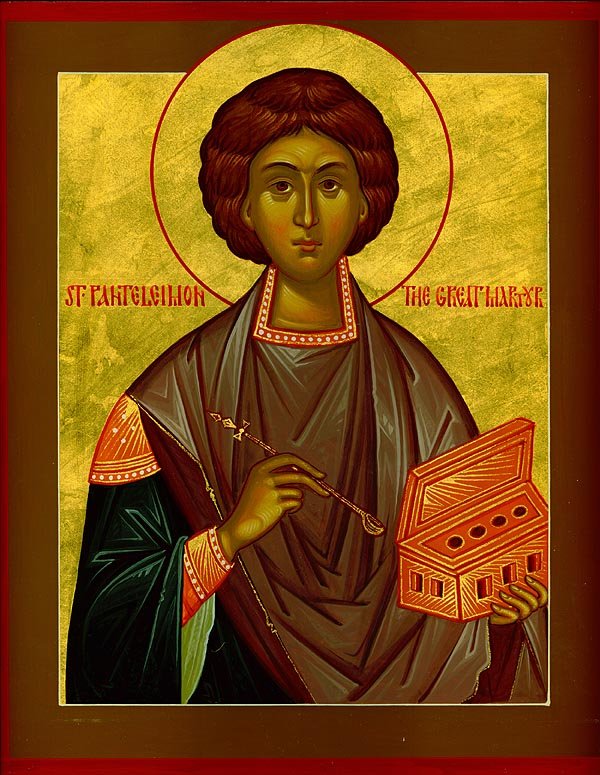
Great Martyr and Healer Panteleimon
The Great Martyr and Healer Panteleimon was born in the city of Nicomedia into the family of the illustrious pagan Eustorgius, and he was named Pantoleon. His mother Saint Euboula (March 30) was a Christian. She wanted to raise her son in the Christian Faith, but she died when the future martyr was just a young child.
The Great Martyr and Healer Panteleimon was born in the city of Nicomedia into the family of the illustrious pagan Eustorgius, and he was named Pantoleon. His mother Saint Euboula (March 30) was a Christian. She wanted to raise her son in the Christian Faith, but she died when the future martyr was just a young child. His father sent Pantoleon to a pagan school, after which the young man studied medicine at Nicomedia under the renowned physician Euphrosynus. Pantoleon came to the attention of the emperor Maximian (284-305), who wished to appoint him as royal physician when he finished his schooling.
The hieromartyrs Hermolaus, Hermippus and Hermocrates, survivors of the massacre of 20,000 Christians in 303 (December 28), were living secretly in Nicomedia at that time. Saint Hermolaus saw Pantoleon time and again when he came to the house where they were hiding. Once, the priest invited the youth to the house and spoke about the Christian Faith. After this Pantoleon visited Saint Hermolaus every day.
One day the saint found a dead child on the street. He had been bitten by a great snake, which was still beside the child’s body. Pantoleon began to pray to the Lord Jesus Christ to revive the dead child and to destroy the venomous reptile. He firmly resolved that if his prayer were fulfilled, he would become a follower of Christ and receive Baptism. The child rose up alive, and the snake died before Pantoleon’s eyes.
After this miracle, Pantoleon was baptized by Saint Hermolaus with the name Panteleimon (meaning “all-merciful”). Speaking with Eustorgius, Saint Panteleimon prepared him to accept Christianity. When the father saw how his son healed a blind man by invoking Jesus Christ, he then believed in Christ and was baptized by Saint Hermolaus together with the man whose sight was restored.
After the death of his father, Saint Panteleimon dedicated his life to the suffering, the sick, the unfortunate and the needy. He treated all those who turned to him without charge, healing them in the name of Jesus Christ. He visited those held captive in prison. These were usually Christians, and he healed them of their wounds. In a short time, reports of the charitable physician spread throughout the city. Forsaking the other doctors, the inhabitants began to turn only to Saint Panteleimon.
The envious doctors told the emperor that Saint Panteleimon was healing Christian prisoners. Maximian urged the saint to refute the charge by offering sacrifice to idols. Saint Panteleimon confessed himself a Christian, and suggested that a sick person, for whom the doctors held out no hope, should be brought before the emperor. Then the doctors could invoke their gods, and Panteleimon would pray to his God to heal the man. A man paralyzed for many years was brought in, and pagan priests who knew the art of medicine invoked their gods without success. Then, before the very eyes of the emperor, the saint healed the paralytic by calling on the name of Jesus Christ. The ferocious Maximian executed the healed man, and gave Saint Panteleimon over to fierce torture.
The Lord appeared to the saint and strengthened him before his sufferings. They suspended the Great Martyr Panteleimon from a tree and scraped him with iron hooks, burned him with fire and then stretched him on the rack, threw him into a cauldron of boiling tar, and cast him into the sea with a stone around his neck. Throughout these tortures the martyr remained unhurt, and denounced the emperor.
At this time the priests Hermolaus, Hermippus and Hermocrates were brought before the court of the pagans. All three confessed their faith in the Savior and were beheaded (July 26).
By order of the emperor they brought the Great Martyr Panteleimon to the circus to be devoured by wild beasts. The animals, however, came up to him and licked his feet. The spectators began to shout, “Great is the God of the Christians!” The enraged Maximian ordered the soldiers to stab with the sword anyone who glorified Christ, and to cut off the head of the Great Martyr Panteleimon.
They led the saint to the place of execution and tied him to an olive tree. While the martyr prayed, one of the soldiers struck him with a sword, but the sword became soft like wax and inflicted no wound. The saint completed his prayer, and a Voice was heard from Heaven, calling the passion-bearer by his new name and summoning him to the heavenly Kingdom.
Hearing the Voice, the soldiers fell down on their knees before the holy martyr and begged forgiveness. They refused to continue with the execution, but Saint Panteleimon told them to fulfill the emperor’s command, because otherwise they would have no share with him in the future life. The soldiers tearfully took their leave of the saint with a kiss.
When the saint was beheaded, the olive tree to which the saint was tied became covered with fruit. Many who were present at the execution believed in Christ. The saint’s body was thrown into a fire, but remained unharmed, and was buried by Christians. Saint Panteleimon’s servants Laurence, Bassos and Probus witnessed his execution and heard the Voice from Heaven. They recorded the life, the sufferings and death of the saint.
Portions of the holy relics of the Great Martyr Panteleimon were distributed throughout all the Christian world. His venerable head is now located at the Russian monastery of Saint Panteleimon on Mt. Athos.
The veneration of the holy martyr in the Russian Orthodox Church was already known in the twelfth century. Prince Izyaslav (in Baptism, Panteleimon), the son of Saint Mstislav the Great, had an image of Saint Panteleimon on his helmet. Through the intercession of the saint he remained alive during a battle in the year 1151. On the Feast of the Great Martyr Panteleimon, Russian forces won two naval victories over the Swedes (in 1714 near Hanhauze and in 1720 near Grenham).
Saint Panteleimon is venerated in the Orthodox Church as a mighty saint, and the protector of soldiers. This aspect of his veneration is derived from his first name Pantoleon, which means “a lion in everything”. His second name, Panteleimon, given him at Baptism, which means “all-merciful”, is manifest in the veneration of the martyr as a healer. The connection between these two aspects of the saint is readily apparent in that soldiers, receiving wounds more frequently than others, are more in need of a physician-healer. Christians waging spiritual warfare also have recourse to this saint, asking him to heal their spiritual wounds.
The holy Great Martyr and Healer Panteleimon is invoked in the Mystery of Anointing the Sick, at the Blessing of Water, and in the Prayers for the Sick.
Troparion - Tone 3
O holy prizewinner and Healer Panteleimon, / intercede with the merciful God, / that He grant unto our souls the forgiveness of our offenses.
Kontakion - Tone 5
Since you are an emulator of the Merciful One and have received from Him the grace of healing, /
O Passion-bearer and Martyr of Christ God; / by your prayers, heal our spiritual infirmities, / always
driving away the temptations of the Enemy / from those who cry unceasingly: “Save us, O Lord.”
Nicholas of Novgorod the fool-for-Christ
Blessed Nicholas Kochanov, Novgorod Fool-for-Christ (+ 1392), was born at Novgorod into a rich and illustrious family. From his youthful years he loved piety, he went to church faithfully, and he loved fasting and prayer. Seeing his virtuous life, people began to praise him. Blessed Nicholas, disdaining glory from men, began the difficult exploit of folly for the Lord’s sake. H
Blessed Nicholas Kochanov, Novgorod Fool-for-Christ (+ 1392), was born at Novgorod into a rich and illustrious family. From his youthful years he loved piety, he went to church faithfully, and he loved fasting and prayer. Seeing his virtuous life, people began to praise him. Blessed Nicholas, disdaining glory from men, began the difficult exploit of folly for the Lord’s sake. He ran about the city in the bitter cold dressed in rags, enduring beatings, insults and mockery. Blessed Nicholas and another Novgorod fool, Blessed Theodore (January 19), pretended to be irreconcilable foes, and graphically demonstrated to the people of Novgorod the pernicious character of their internecine strife.
Once, having overcome his sham opponent, Blessed Nicholas went along the Volkhov as if on dry land, and threw a head of cabbage at Blessed Theodore, therefore he was called “Kochanov” (i.e. “cabbage-head”). The Lord glorified Blessed Nicholas with the gift of miracles and clairvoyance.
Once, after being turned away by servants from a feast to which he had been invited, he left. Immediately, the wine disappeared from the barrel. Only upon the return of the fool, and through his prayer, did it reappear again. When he died, Blessed Nicholas was buried at the end of the cemetery by the Yakovlev cathedral.
The relics of Blessed Nicholas rest under a crypt in the church of the Great Martyr Panteleimon which was built over his grave.
Anthousa the Righteous Confessor
Venerable Anthousa the Confessor lived during the reign of Emperor Constantine Copronymos (ca. 741). She lived at Mantinea, Paphlygonia in Asia Minor during the VIII century. Her parents, Stratḗgios and Febronia, were distinguished for their piety, and raised their daughter in the same way.
Despite all the marriage proposals Anthousa received, she remained a virgin. A
Venerable Anthousa the Confessor lived during the reign of Emperor Constantine Copronymos (ca. 741). She lived at Mantinea, Paphlygonia in Asia Minor during the VIII century. Her parents, Stratḗgios and Febronia, were distinguished for their piety, and raised their daughter in the same way.
Despite all the marriage proposals Anthousa received, she remained a virgin. After her parents reposed, she did not change her mind, but devoted her parental inheritance to charitable and sacred causes. Forsaking the world at a young age, Saint Anthousa lived a life of asceticism in the mountains in complete solitude. She received the monastic tonsure from Hieromonk Sisinios, and became Igoumeness of a Monastery with ninety nuns. These nuns were known for their obedience to their Igoumeness and for their spiritual discipline. Saint Anthousa built two monasteries: Mantineos, with a church dedicated to Saint Anna; and another in honor of the Holy Apostles, which was a women's monastery.
When Emperor Constantine Copronymos ordered a harsh persecution against the Holy Icons and those who venerated them. Saint Anthousa's Monastery became one of the most ardent defenders of Orthodoxy. The Emperor sent his agent to say that she would be left alone if she ceased to venerate the Icons. When she refused, she and her nuns were subjected to torture, for disobeying the Emperor’s decree. Soldiers tied them up and flogged them. Then burning icons were placed on the Saint's head, and her feet were burnt with red-hot coals. Finally, she was exiled.
But when the Holy Igoumeness predicted that the sick Empress would escape death, and would give birth to twins, then she loved Anthousa very much, and supported her Monastery in various ways. Among those who had witnessed her torture was the Emperor’s wife, to whom the Saint predicted the birth of a son and a daughter. When Saint Anthousa's prediction was fulfilled, she was allowed to return to her convent, where she reposed at an advanced age. The daughter born to the Emperor’s wife was also named Anthousa (April 12).
After living a life pleasing to God, the Holy Confessor Anthousa reposed in 759 (or 775, or 794), and now lives with Him forever. She was buried in her cell.
Troparion - Tone 8
By a flood of tears you made the desert fertile, / and your longing for God brought forth fruits in abundance. / By the radiance of miracles you illumined the whole universe! / O our holy mother Anthusa, pray to Christ our God to save our souls!
St Clement, Archbishop of Ochrid (916)
He was a disciple of Saints Methodius and Cyril, working with them in their missionary labors in Moravia. After the death of St Methodius, Clement and many others of their mission were driven out of Moravia by the Germans, and traveled south. Clement, with his companions Gorazd, Nahum, Sava and Angelarius, crossed the Danube, stayed for a time with King Boris Michael, and settled in near Ochrid (in what is now Kosova, Yugoslavia).
He was a disciple of Saints Methodius and Cyril, working with them in their missionary labors in Moravia. After the death of St Methodius, Clement and many others of their mission were driven out of Moravia by the Germans, and traveled south. Clement, with his companions Gorazd, Nahum, Sava and Angelarius, crossed the Danube, stayed for a time with King Boris Michael, and settled in near Ochrid (in what is now Kosova, Yugoslavia). He founded a monastery at Belica, then moved to Ochrid, where he built a church dedicated to St Panteleimon. There he continued the work of Sts Cyril and Methodius, producing many books in the new Slavonic script for the help of the Slavic Orthodox people. Saint Clement performed miracles in his own lifetime and after his repose: his wonder-working relics are still venerated in a church dedicated to him. He reposed in peace.
Scripture Readings
☩Epistle
1 Corinthians 1:1-9
1
Paul, called to be an apostle of Jesus Christ through the will of God, and Sosthenes our brother,
2
Unto the church of God which is at Corinth, to them that are sanctified in Christ Jesus, called to be saints, with all that in every place call upon the name of Jesus Christ our Lord, both theirs and ours:
3
Grace be unto you, and peace, from God our Father, and from the Lord Jesus Christ.
4
I thank my God always on your behalf, for the grace of God which is given you by Jesus Christ;
5
That in every thing ye are enriched by him, in all utterance, and in all knowledge;
6
Even as the testimony of Christ was confirmed in you:
7
So that ye come behind in no gift; waiting for the coming of our Lord Jesus Christ:
8
Who shall also confirm you unto the end, that ye may be blameless in the day of our Lord Jesus Christ.
9
God is faithful, by whom ye were called unto the fellowship of his Son Jesus Christ our Lord.
☩Gospel
Matthew 13:24-30
24
Another parable put he forth unto them, saying, The kingdom of heaven is likened unto a man which sowed good seed in his field:
25
But while men slept, his enemy came and sowed tares among the wheat, and went his way.
26
But when the blade was sprung up, and brought forth fruit, then appeared the tares also.
27
So the servants of the householder came and said unto him, Sir, didst not thou sow good seed in thy field? from whence then hath it tares?
28
He said unto them, An enemy hath done this. The servants said unto him, Wilt thou then that we go and gather them up?
29
But he said, Nay; lest while ye gather up the tares, ye root up also the wheat with them.
30
Let both grow together until the harvest: and in the time of harvest I will say to the reapers, Gather ye together first the tares, and bind them in bundles to burn them: but gather the wheat into my barn.
Liturgical data sourced from OCA.org and orthocal.info