
Fasting Rules
 Meat
Abstain
 Fish
Abstain
 Dairy
Abstain
 Oil
Abstain
 Wine
Abstain
Saints & Commemorations
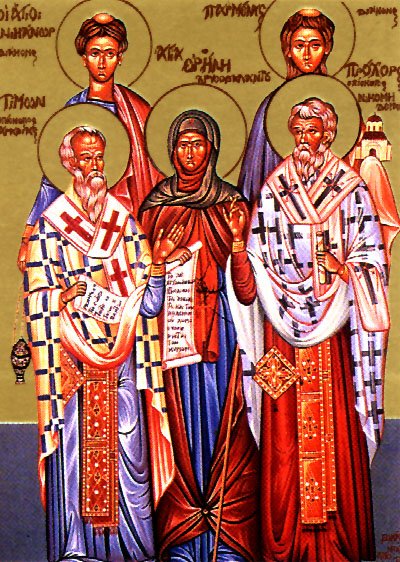
Apostles of 70 Prochorus, Nicanor, Timon, Parmenas
Saints Prochorus, Nicanor, Timon and Parmenas, Apostles of the Seventy were among the first deacons in the Church of Christ.
In the Acts of the Holy Apostles (6:1-6) it is said that the twelve Apostles chose seven men: Stephen, Philip, Prochorus, Nicanor, Timon, Parmenas and Nicholas, full of the Holy Spirit and wisdom, and appointed them to serve as deacons.
They are commemorated together on July 28, although they died at various times and in various places.
At first, Saint Prochorus accompanied the holy Apostle Peter, who made him bishop in the city of Nicomedia. After the Dormition of the Most Holy Theotokos, Prochorus was a companion and coworker of the holy Apostle John the Theologian and was banished with him to the island of Patmos. There he wrote down the Book of Revelation concerning the final fate of the world. Upon returning to Nicomedia, Saint Prochorus converted pagans to Christ in the city of Antioch, where he suffered martyrdom.
Although Saint Nicanor suffered on the same day that the holy Protomartyr Stephen (December 27) and many other Christians were killed by stoning, he is also commemorated on December 28.
Saint Timon was later appointed by the Apostles as bishop of the city of Bostra in Arabia and suffered from the Jews and pagans for preaching the Gospel. He was thrown into a furnace, but by the power of God he came out of it unharmed. The tradition of the Roman Church says that Saint Timon died by crucifixion. Saint Timon is also commemorated on December 30.
Saint Parmenas zealously preached Christ in Macedonia. He died after being afflicted with an illness. Some say that Saint Parmenas suffered martyrdom under Trajan (98-117) in the final year of his reign.
Troparion - Tone 3
O holy apostle Prochorus, / entreat the merciful God, / to grant our souls forgiveness of transgressions.
Kontakion - Tone 1
You were holy deacons and eye-witnesses of the Word, / and chosen vessel of the faith, / O glorious Nicanor, Prochorus, Parmenas and Timon. / Therefore today we celebrate your sacred memory, / blessing you in gladness of heart.
Our Righteous Father Paul of Xeropotamou
St Irene, Abbess of the Convent of Chrysovalantou (912)
“Saint Irene, who was from Cappadocia, flourished in the ninth century. Because of her great beauty and virtue, she was brought to Constantinople as a prospective bride for the young Emperor Michael (8422-867); however, as St Joannicius the Great foretold, it was God’s will that she assume the monastic habit instead. She
“Saint Irene, who was from Cappadocia, flourished in the ninth century. Because of her great beauty and virtue, she was brought to Constantinople as a prospective bride for the young Emperor Michael (8422-867); however, as St Joannicius the Great foretold, it was God’s will that she assume the monastic habit instead. She shone forth in great ascetical labors, and suffered many attacks from the demons; while yet a novice, she attained to the practice of St Arsenius the Great, of praying the whole night long with arms stretched out towards Heaven (see May 8). God showed forth great signs and wonders in her, and she became the Abbess of the Convent of Chrysovalantou. She was granted the gift of clairvoyance and knew the thoughts of all that came to her. She appeared in a vision to the king and rebuked him for unjustly imprisoning a nobleman who had been falsely accused. Through a sailor from Patmos to whom he had appeared, St John the Theologian sent her fragrant and wondrous apples from Paradise. She reposed at the age of 103, still retaining the youthful beauty of her countenance. After her repose, marvellous healings beyond number have been wrought by her to the present day.” (Great Horologion)
Scripture Readings
☩Epistle
1 Corinthians 2:9-3:8
9
But as it is written, Eye hath not seen, nor ear heard, neither have entered into the heart of man, the things which God hath prepared for them that love him.
10
But God hath revealed them unto us by his Spirit: for the Spirit searcheth all things, yea, the deep things of God.
11
For what man knoweth the things of a man, save the spirit of man which is in him? even so the things of God knoweth no man, but the Spirit of God.
12
Now we have received, not the spirit of the world, but the spirit which is of God; that we might know the things that are freely given to us of God.
13
Which things also we speak, not in the words which man’s wisdom teacheth, but which the Holy Ghost teacheth; comparing spiritual things with spiritual.
14
But the natural man receiveth not the things of the Spirit of God: for they are foolishness unto him: neither can he know them, because they are spiritually discerned.
15
But he that is spiritual judgeth all things, yet he himself is judged of no man.
16
For who hath known the mind of the Lord, that he may instruct him? But we have the mind of Christ.
1
And I, brethren, could not speak unto you as unto spiritual, but as unto carnal, even as unto babes in Christ.
2
I have fed you with milk, and not with meat: for hitherto ye were not able to bear it, neither yet now are ye able.
3
For ye are yet carnal: for whereas there is among you envying, and strife, and divisions, are ye not carnal, and walk as men?
4
For while one saith, I am of Paul; and another, I am of Apollos; are ye not carnal?
5
Who then is Paul, and who is Apollos, but ministers by whom ye believed, even as the Lord gave to every man?
6
I have planted, Apollos watered; but God gave the increase.
7
So then neither is he that planteth any thing, neither he that watereth; but God that giveth the increase.
8
Now he that planteth and he that watereth are one: and every man shall receive his own reward according to his own labour.
☩Gospel
Matthew 13:31-36
31
Another parable put he forth unto them, saying, The kingdom of heaven is like to a grain of mustard seed, which a man took, and sowed in his field:
32
Which indeed is the least of all seeds: but when it is grown, it is the greatest among herbs, and becometh a tree, so that the birds of the air come and lodge in the branches thereof.
33
Another parable spake he unto them; The kingdom of heaven is like unto leaven, which a woman took, and hid in three measures of meal, till the whole was leavened.
34
All these things spake Jesus unto the multitude in parables; and without a parable spake he not unto them:
35
That it might be fulfilled which was spoken by the prophet, saying, I will open my mouth in parables; I will utter things which have been kept secret from the foundation of the world.
36
Then Jesus sent the multitude away, and went into the house: and his disciples came unto him, saying, Declare unto us the parable of the tares of the field.
Liturgical data sourced from OCA.org and orthocal.info