
Fasting Rules
 Meat
Abstain
 Fish
Abstain
 Dairy
Abstain
 Oil
Abstain
 Wine
Abstain
Saints & Commemorations
Trans. Rel. Protomartyr Stephen
After the First Martyr Stephen was stoned to death, his body was left for the dogs; but his teacher Gamaliel had his body secretly taken to a place outside Jerusalem and buried by night. About the year 427, a Fr Lucian, the parish priest near the place, was told in a dream where the relics of the Protomartyr were buried.
After the First Martyr Stephen was stoned to death, his body was left for the dogs; but his teacher Gamaliel had his body secretly taken to a place outside Jerusalem and buried by night. About the year 427, a Fr Lucian, the parish priest near the place, was told in a dream where the relics of the Protomartyr were buried. He told Patriarch John of Jerusalem, and they went together to the place revealed. Digging there they found a box labeled with the word “Stephen” in Aramaic letters. They took the sacred relics to Jerusalem in solemn procession.
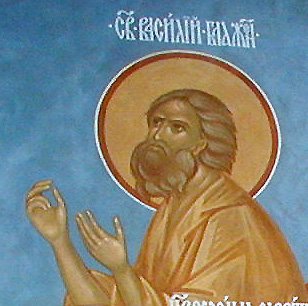
Bl. Vasily, Fool-for-Christ
Saint Basil the Blessed, Wonderworker of Moscow, was born in December 1468 on the portico of the Elokhov church in honor of the Vladimir Icon of the Most Holy Theotokos outside Moscow. His parents were commoners and sent their son to be trained as a cobbler.
During Basil’s apprenticeship, the master happened to witness a remarkable occurrence, which showed him that his student was no ordinary man. A
Saint Basil the Blessed, Wonderworker of Moscow, was born in December 1468 on the portico of the Elokhov church in honor of the Vladimir Icon of the Most Holy Theotokos outside Moscow. His parents were commoners and sent their son to be trained as a cobbler.
During Basil’s apprenticeship, the master happened to witness a remarkable occurrence, which showed him that his student was no ordinary man. A certain merchant had brought grain to Moscow on a barge and then went to order boots, specifying that they be made in a particular way, since he would not pick them up for a year. Blessed Basil wept and said, “I wish you would cancel the order, since you will never wear them.”
When the perplexed master questioned his apprentice he explained that the man would not wear the boots, for he would soon die. After several days the prediction came true.
When he was sixteen, the saint arrived in Moscow and began the difficult exploit of foolishness for Christ. In the burning summer heat and in the winter’s harsh frost, he walked about barefoot through the streets of Moscow. His actions were strange: here he would upset a stand with kalachi, and there he would spill a jug with kvas. Angry merchants throttled the blessed one, but he endured the beatings with joy and he thanked God for them. Then it was discovered that the kalachi were poorly cooked, and the kvas was badly prepared. The reputation of Saint Basil quickly grew, and people saw him as a holy fool, a man of God, and a denouncer of wrong.
A certain merchant wanted to build a stone church on Pokrovna in Moscow, but its arches collapsed three times. The merchant turned to the saint for advice, and he pointed him toward Kiev. “Find there John the Cripple,” he said. “He will advise you how to construct the church.”
Traveling to Kiev, the merchant sought out John, who sat in a poor hut and rocked an empty cradle. “Whom do you rock?” asked the merchant. “I weep for my beloved mother, who was made poor by my birth and upbringing.” Only then did the merchant remember his own mother, whom he had thrown out of the house. Then it became clear to him why he was not able to build the church. Returning to Moscow, he brought his mother home, begged her forgiveness, and built the church.
Preaching mercy, the blessed one helped those who were ashamed to ask for alms, but who were more in need of help than others. Once, he gave away a rich imperial present to a foreign merchant who was left without anything at all. Although the man had eaten nothing for three days, he was not able to beg for food, since he wore fine clothing.
The saint harshly condemned those who gave alms for selfish reasons, not out of compassion for the poor and destitute, but hoping for an easy way to attract God’s blessings upon their affairs. Once, the saint saw a devil in the guise of a beggar. He sat at the gates of the All-Pure Virgin’s church, and he gave speedy help in their affairs to everyone who gave alms. The saint exposed the wicked trick and drove the devil away.
For the salvation of his neighbor, Saint Basil also visited the taverns, where he tried to see a grain of goodness, even in people very much gone to ruin, and to strengthen and encourage them by kindness. Many observed that when the saint passed by a house in which they made merry and drank, he wept and clutched the corners of that house. They inquired of the fool what this meant, and he answered: “Angels stand in sorrow at the house and are distressed by the sins of the people, but I entreat them with tears to pray to the Lord for the conversion of sinners.”
Purified by great deeds and by the prayer of his soul, the saint was also given the gift of foreseeing the future. In 1547 he predicted the great fire of Moscow; through prayer he extinguished a fire at Novgorod; and once he reproached Tsar Ivan the Terrible, because during the divine services he was preoccupied with thoughts of building a palace on the Vorobiev hills.
Saint Basil died on August 2, 1557. Saint Macarius, Metropolitan of Moscow served the saint’s funeral with many clergy. His body was buried in the cemetery of Trinity church, where in 1554, the Protection cathedral was built in memory of the conquest of Kazan. His Holiness Patriarch Job glorified Saint Basil the Blessed at a Council on August 2, 1588.
In an early icon, Saint Basil is portrayed as old, with white hair curling at the ears, and a short, curly white beard. He is completely naked, and holds a handkerchief in his hand. The veneration of Saint Basil the Blessed was always so strong that the Trinity temple and the attached Protection church were renamed for him [the famous Saint Basil’s Cathedral in Moscow].
The saint’s chains are preserved at the Moscow Spiritual Academy.
Troparion - Tone 8
Your life, O Basil, was true and your chastity undefiled. / For the sake of Christ you exhausted your body
with fasting, vigil, with frost and the scorching sun, in snow and in rain, / yet your face was radiant like the
sun. / And now the people of Russia come to you, glorifying your holy falling asleep. / Therefore, pray to
Christ God that He may deliver us from pagan captivity and from civil war, / and grant peace to the world,
and great mercy to our souls.
Kontakion - Tone 1
Led by the Spirit of God, most blessed Basil, / you renounced the turmoil of the world, and despised the anxieties of life. / You stripped yourself of your earthly clothing, / and were clothed in the garment of dispassion. / You fled from the temptation of false worldly power, / and were a stranger among your own people. / Having chosen the treasure of Heaven instead of earthly wealth, / you won a crown of patience. / And now, most blessed Basil, / pray to Christ God for us who celebrate your holy memory, that we may cry: "Hail, most blessed Basil."

Hieromartyr Stephen, Pope of Rome (257), and those with him
The Hieromartyr Stephen, Pope of Rome, suffered in the year 257 during the reign of the emperor Valerian (253-259). Saint Stephen, occupying the throne (253-257) of the holy First Bishop of Rome, zealously contended against the heresy of Novatus, which taught that it is not proper to receive back those returning from heresy.
The Hieromartyr Stephen, Pope of Rome, suffered in the year 257 during the reign of the emperor Valerian (253-259). Saint Stephen, occupying the throne (253-257) of the holy First Bishop of Rome, zealously contended against the heresy of Novatus, which taught that it is not proper to receive back those returning from heresy.
While hiding during a persecution against Christians, Saint Stephen baptized many pagans, including the military tribune Nemesius. He converted to Christ after the saint healed his daughter Lucilla. Nemesius, who was ordained as a deacon, was beheaded along with his daughter.
Their steward Symphronius was brought by the tribune Olympius into the temple of Mars for torture. His prayer shattered the golden idol, after which the tribune with his wife Exuperia and his son Theodolus believed and were baptized. They were all burned alive, and their remains were buried by holy Pope Stephen.
Then twelve of his clergy were beheaded: Bonus, Faustus, Maurus, Primitivus, Calumniosus, John, Exuperantus, Cyril, Theodore, Basil, Castelus, Honoratus and Tertullinus, all converted by Saint Stephen. Finally, Saint Stephen himself was led before the emperor Valerian (253-259) , who condemned him to beheading with a sword in the temple of Mars.
By the prayers of the saint, a large part of the pagan temple was destroyed, and the soldiers fled. The saint concealed himself in the catacombs (the resting place of Saint Lucina or Lucy), where he was later killed by soldiers while he was teaching Christians.
Troparion - Tone 4
By sharing in the ways of the Apostles, / you became a successor to their throne. / Through the practice of virtue, you found the way to divine contemplation, O inspired one of God; / by teaching the word of truth without error, you defended the Faith, even to the shedding of your blood. / Hieromartyr Stephen entreat Christ God to save our souls.
Scripture Readings
☩Epistle
1 Corinthians 5:9-6:11
9
I wrote unto you in an epistle not to company with fornicators:
10
Yet not altogether with the fornicators of this world, or with the covetous, or extortioners, or with idolaters; for then must ye needs go out of the world.
11
But now I have written unto you not to keep company, if any man that is called a brother be a fornicator, or covetous, or an idolater, or a railer, or a drunkard, or an extortioner; with such an one no not to eat.
12
For what have I to do to judge them also that are without? do not ye judge them that are within?
13
But them that are without God judgeth. Therefore put away from among yourselves that wicked person.
1
Dare any of you, having a matter against another, go to law before the unjust, and not before the saints?
2
Do ye not know that the saints shall judge the world? and if the world shall be judged by you, are ye unworthy to judge the smallest matters?
3
Know ye not that we shall judge angels? how much more things that pertain to this life?
4
If then ye have judgments of things pertaining to this life, set them to judge who are least esteemed in the church.
5
I speak to your shame. Is it so, that there is not a wise man among you? no, not one that shall be able to judge between his brethren?
6
But brother goeth to law with brother, and that before the unbelievers.
7
Now therefore there is utterly a fault among you, because ye go to law one with another. Why do ye not rather take wrong? why do ye not rather suffer yourselves to be defrauded?
8
Nay, ye do wrong, and defraud, and that your brethren.
9
Know ye not that the unrighteous shall not inherit the kingdom of God? Be not deceived: neither fornicators, nor idolaters, nor adulterers, nor effeminate, nor abusers of themselves with mankind,
10
Nor thieves, nor covetous, nor drunkards, nor revilers, nor extortioners, shall inherit the kingdom of God.
11
And such were some of you: but ye are washed, but ye are sanctified, but ye are justified in the name of the Lord Jesus, and by the Spirit of our God.
☩Gospel
Matthew 13:54-58
54
And when he was come into his own country, he taught them in their synagogue, insomuch that they were astonished, and said, Whence hath this man this wisdom, and these mighty works?
55
Is not this the carpenter’s son? is not his mother called Mary? and his brethren, James, and Joses, and Simon, and Judas?
56
And his sisters, are they not all with us? Whence then hath this man all these things?
57
And they were offended in him. But Jesus said unto them, A prophet is not without honour, save in his own country, and in his own house.
58
And he did not many mighty works there because of their unbelief.
Liturgical data sourced from OCA.org and orthocal.info