
Fasting Rules
 Meat
Abstain
 Fish
Abstain
 Dairy
Abstain
 Oil
Abstain
 Wine
Abstain
Saints & Commemorations
Ven. Isaac, Dalmatius, Faustus
St Isaac is also commemorated May 30; see his life there. St Dalmatus was a soldier in the Imperial army, but along with his son Faustus left all to become a monk at the monastery founded by St Isaac. He was present at the Third Ecumenical Council at Ephesus in 431; there he labored zealously for the Orthodox faith against Patriarch Nestorius.
St Isaac is also commemorated May 30; see his life there. St Dalmatus was a soldier in the Imperial army, but along with his son Faustus left all to become a monk at the monastery founded by St Isaac. He was present at the Third Ecumenical Council at Ephesus in 431; there he labored zealously for the Orthodox faith against Patriarch Nestorius. He was made Archimandrite of all the monasteries in Constantinople, and reposed in peace, having lived for more than eighty years.
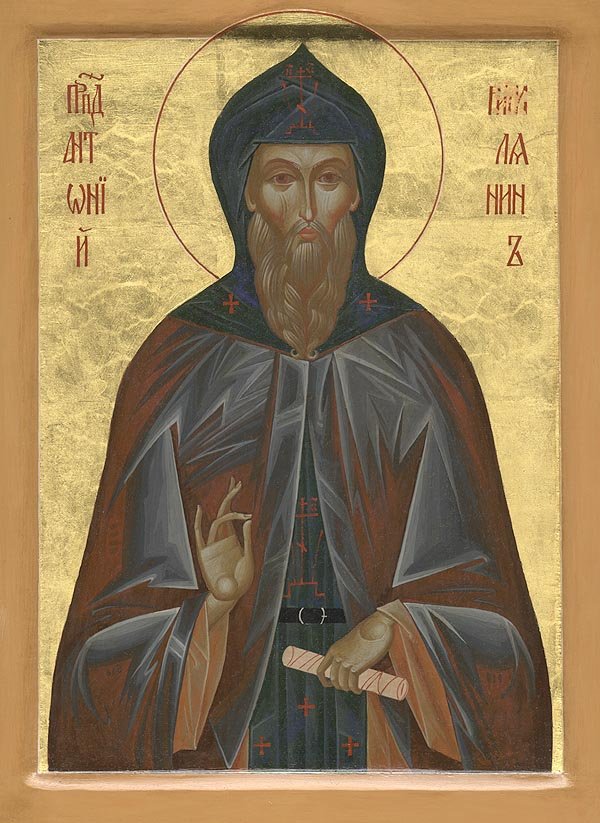
Ven. Anthony the Roman of Novgorod
Saint Anthony the Roman was born at Rome in 1067 to rich parents who adhered to the Orthodox Faith, and they raised him in piety. After losing his parents at age 17, he took up the study of the Fathers in the Greek language. Afterwards, he distributed part of his inheritance to the poor, and the other portion he put into a wooden barrel and threw it into the sea.
Saint Anthony the Roman was born at Rome in 1067 to rich parents who adhered to the Orthodox Faith, and they raised him in piety. After losing his parents at age 17, he took up the study of the Fathers in the Greek language. Afterwards, he distributed part of his inheritance to the poor, and the other portion he put into a wooden barrel and threw it into the sea. Then he was tonsured at one of the wilderness monasteries, where he lived for 20 years.
A persecution of the Latins against the Orthodox forced the brethren to separate. Saint Anthony wandered from place to place until he came upon a large rock upon the shore of the sea, where he lived for a whole year in fasting and prayer. On September 5, 1105 a terrible storm tore away the stone on which Saint Anthony stood, and threw it into the sea. By divine Providence, the stone floated to Novgorod. On the Feast of the Nativity of the Most Holy Theotokos, the stone halted 3 versts from Novgorod on the banks of the River Volkhov near the village of Volkhov. This event is testified to in the Novgorod Chronicles.
At this place the monk, with the blessing of Saint Nikḗtas the Hermit (May 14), founded a monastery in honor of the Nativity of the Most Holy Theotokos. In another year, fishermen recovered the barrel containing Saint Anthony’s inheritance, cast into the sea many years before. The saint recognized his barrel, but the fishermen did not want to give it to him. Before a judge, Saint Anthony described the contents of the barrel, and it was returned to him. The saint used the money to buy land for the monastery. Spiritual asceticism was combined at the monastery with intense physical labor.
Saint Anthony was concerned that help should be given to the needy, orphans and widows from monastery funds. In 1117, the saint built a stone church in honor of the Nativity of the Most Holy Theotokos. The church, built during the lifetime of Saint Anthony in the years 1117-1119 by the renowned Novgorod architect Peter, and adorned with frescoes in the year 1125, has been preserved to the present time. In 1131, Saint Niphon of Novgorod made Saint Anthony igumen of the monastery. He died on August 3, 1147 and was buried by Saint Niphon.
Saint Anthony was glorified in 1597. His memory is also celebrated (uncovering of his relics) on the first Friday after the Feast of the Foremost Apostles Peter and Paul (June 29), and on January 17, on the same day that Saint Anthony the Great is commemorated. The first Life of Saint Anthony the Roman was written soon after his death by his disciple and successor as igumen, the hieromonk Andrew. A Life, with an account of the uncovering of the relics, was written by a novice of the Antoniev monastery, the monk Niphon, in the year 1598.
Troparion - Tone 4
Leaving old Rome, your fatherland, / you mounted a rock, as if it were a swift ship. / On it you crossed
the sea like one without a body, / above the laws of nature, guided by the reasoning of the Divine Mind. / You reached Great Novgorod and established a monastery, / in which you left your body as a sanctified gift. / Therefore, we entreat you, Father Antony: / "Pray to Christ God, / that He may save our souls."
Kontakion - Tone 8
You were raised in Rome, and blossomed gracefully in Great Novgorod, / where you pleased God by your
many labors and struggles. / Therefore, you received from Him the gift of working miracles, / and your body was preserved incorrupt for many years. / As we kiss it, we cry joyfully to you from our souls: "Hail, Father Anthony."
Holy Myrrh-bearer Salome
She was the mother of the Apostles James and John, the wife of Zebedee, and the daughter of Joseph the Betrothed, who was a widower when he became betrothed to the Mother of God. She was a disciple of the Lord and one of the Myrrh-bearing women who first brought tidings of the Resurrection to the world.
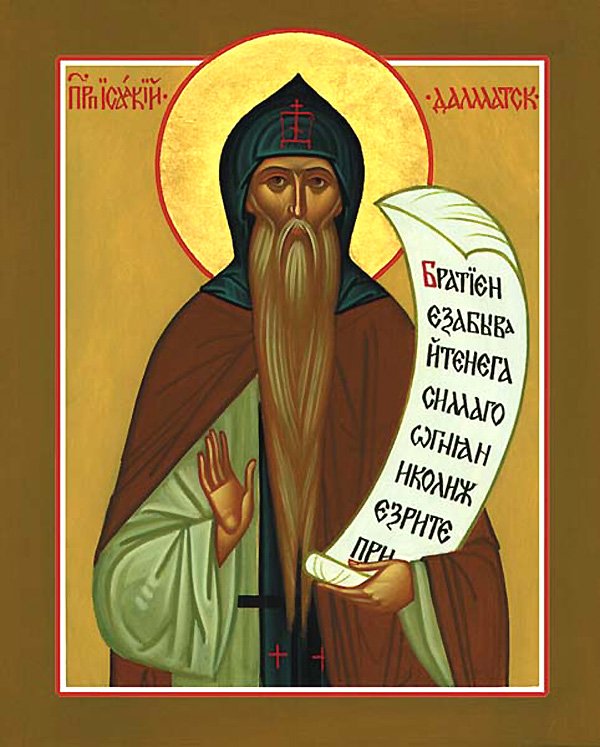
St Isaac, Founder of the Dalmatian Monastery
Saint Isaac (May 30) was a soldier before he became a monk. After he was tonsured, he attained such a degree of spiritual perfection that he was accounted worthy of beholding divine visions.
When Saint Isaac heard about how the Emperor Valens had fallen into the Arian heresy and was persecuting the Orthodox Christians, he left his monastery and traveled to Constantinople to confront the emperor.
Saint Isaac (May 30) was a soldier before he became a monk. After he was tonsured, he attained such a degree of spiritual perfection that he was accounted worthy of beholding divine visions.
When Saint Isaac heard about how the Emperor Valens had fallen into the Arian heresy and was persecuting the Orthodox Christians, he left his monastery and traveled to Constantinople to confront the emperor. At that time Valens was planning a campaign against the Goths. Saint Isaac tried to change the emperor’s mind several times, but was unable to convince him. He prophesied that Valens would die in flames because of his actions. The emperor ordered that Saint Isaac be thrown into prison, and promised to deal with him when he returned from his expedition. On August 9, 378 Valens was defeated at Adrianople and died in a fire after hiding in a barn, just as the saint had predicted.
Emperor Theodosius the Great, who had a great love for the saint, released him from prison and banned Arianism. Saint Isaac attended the Second Ecumenical Council (381), where he defended the Orthodox Faith against the Arian heresy.
Saint Isaac hoped to return to his monastic life in the wilderness, but a wealthy man built a monastery for him at Constantinople, and he became its first igumen. The monastery was later named for his disciple Dalmatus.
When Saint Isaac was approaching the end of his earthly life, he named Saint Dalmatus to succeed him as igumen. He lived to a ripe old age and reposed in the year 383.
Troparion - Tone 4
O God of our Fathers, / always act with kindness towards us; / take not Your mercy from us, / but guide our lives in peace / through the prayers of Venerable Isaac, Dalmatus, and Faustus.
Kontakion - Tone 2
Through asceticism you shone like lights in the world / and by your faith you overthrew heresies. / We praise you with hymns, Isaac, Dalmatus, and Faustus, / as servants of Christ who are praying for us all.
Scripture Readings
☩Epistle
1 Corinthians 6:20-7:12
20
For ye are bought with a price: therefore glorify God in your body, and in your spirit, which are God’s.
1
Now concerning the things whereof ye wrote unto me: It is good for a man not to touch a woman.
2
Nevertheless, to avoid fornication, let every man have his own wife, and let every woman have her own husband.
3
Let the husband render unto the wife due benevolence: and likewise also the wife unto the husband.
4
The wife hath not power of her own body, but the husband: and likewise also the husband hath not power of his own body, but the wife.
5
Defraud ye not one the other, except it be with consent for a time, that ye may give yourselves to fasting and prayer; and come together again, that Satan tempt you not for your incontinency.
6
But I speak this by permission, and not of commandment.
7
For I would that all men were even as I myself. But every man hath his proper gift of God, one after this manner, and another after that.
8
I say therefore to the unmarried and widows, It is good for them if they abide even as I.
9
But if they cannot contain, let them marry: for it is better to marry than to burn.
10
And unto the married I command, yet not I, but the Lord, Let not the wife depart from her husband:
11
But and if she depart, let her remain unmarried, or be reconciled to her husband: and let not the husband put away his wife.
12
But to the rest speak I, not the Lord: If any brother hath a wife that believeth not, and she be pleased to dwell with him, let him not put her away.
☩Gospel
Matthew 14:1-13
1
At that time Herod the tetrarch heard of the fame of Jesus,
2
And said unto his servants, This is John the Baptist; he is risen from the dead; and therefore mighty works do shew forth themselves in him.
3
For Herod had laid hold on John, and bound him, and put him in prison for Herodias’ sake, his brother Philip’s wife.
4
For John said unto him, It is not lawful for thee to have her.
5
And when he would have put him to death, he feared the multitude, because they counted him as a prophet.
6
But when Herod’s birthday was kept, the daughter of Herodias danced before them, and pleased Herod.
7
Whereupon he promised with an oath to give her whatsoever she would ask.
8
And she, being before instructed of her mother, said, Give me here John Baptist’s head in a charger.
9
And the king was sorry: nevertheless for the oath’s sake, and them which sat with him at meat, he commanded it to be given her.
10
And he sent, and beheaded John in the prison.
11
And his head was brought in a charger, and given to the damsel: and she brought it to her mother.
12
And his disciples came, and took up the body, and buried it, and went and told Jesus.
13
When Jesus heard of it, he departed thence by ship into a desert place apart: and when the people had heard thereof, they followed him on foot out of the cities.
Liturgical data sourced from OCA.org and orthocal.info