
Fasting Rules
 Meat
Abstain
 Fish
Abstain
 Dairy
Abstain
 Oil
Abstain
 Wine
Abstain
Saints & Commemorations
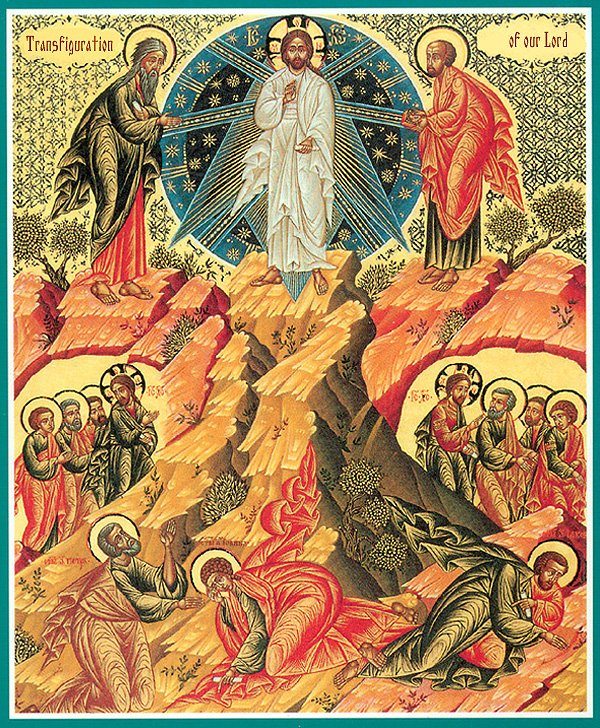
Afterfeast of the Transfiguration
The hymns of Vespers remind us that the Transfiguration is not merely a historical event, but something which also has implications for us. Those who “desire to see and hear things past understanding” must ascend from earthly concerns to “the height of the contemplation of the virtues.” This may be achieved by “directing our minds to heavenly things” a
The hymns of Vespers remind us that the Transfiguration is not merely a historical event, but something which also has implications for us. Those who “desire to see and hear things past understanding” must ascend from earthly concerns to “the height of the contemplation of the virtues.” This may be achieved by “directing our minds to heavenly things” and by “being formed anew in piety into the image of Christ.”
Troparion - Tone 7
You were Transfigured on the Mount, O Christ God, / revealing Your glory to Your disciples as far as they could bear it. / Let Your everlasting Light shine upon us sinners! / Through the prayers of the Theotokos, O Giver of Light, glory to You!
Kontakion - Tone 7
On the Mountain You were Transfigured, O Christ God, / and Your disciples beheld Your glory as far as they could see it; / so that when they would behold You crucified, / they would understand that Your suffering was voluntary, / and would proclaim to the world, / that You are truly the Radiance of the Father!
Holy Martyrs Archdeacon Lawrence and Pope Sixtus of Rome
“This Saint, who was born in Spain, was the Archdeacon of the Church of Rome, caring for the sacred vessels of the Church and distributing money to the needy. About the year 257, a harsh persecution was raised up against the Christians by Valerian. Pope Sixtus, who was from Athens, was commanded to worship the idols, and refused; before his martyrdom by beheading, he committed to Laurence all the sacred vessels of the Church. W
“This Saint, who was born in Spain, was the Archdeacon of the Church of Rome, caring for the sacred vessels of the Church and distributing money to the needy. About the year 257, a harsh persecution was raised up against the Christians by Valerian. Pope Sixtus, who was from Athens, was commanded to worship the idols, and refused; before his martyrdom by beheading, he committed to Laurence all the sacred vessels of the Church. When Laurence was arrested and brought before the Prefect, he was questioned concerning the treasures of the Church; he asked for three days’ time to prepare them. He then proceeded to gather all the poor and needy, and presented them to the Prefect and said, “Behold the treasures of the Church.” The Prefect became enraged at this and gave command that Laurence be racked, then scourged with scorpions (a whip furnished with sharp iron points — compare II Chron. 10:11), then stretched out on a red-hot iron grill. But the courageous athlete of Christ endured without groaning. After he had been burned on one side, he said, “My body is done on one side; turn me over on the other.” And when this had taken place, the Martyr said to the tyrants, “My flesh is now well done, you may taste of it.” And when he had said this, and had prayed for his slayers in imitation of Christ, he gave up his spirit on August 10, 258.” (Great Horologion). His icon shows him stretched on the grill.
Martyrs Felicissimus and Agapitus, Deacons (258)
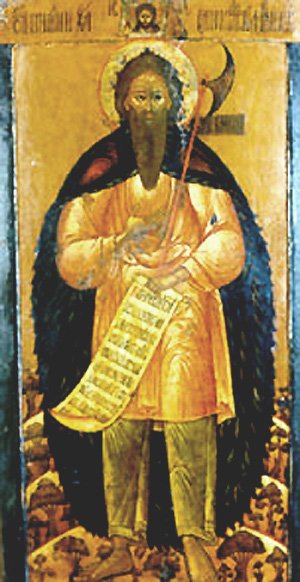
Blessed Lawrence, Fool-for-Christ, at Kaluga (1515)
Blessed Laurence, the Fool-for-Christ and Wonderworker of Kaluga, lived at the beginning of the XVI century at a distance of half a verst from old Kaluga, near a forest church dedicated to the Nativity of Christ, set upon a high hill.
There was a long underground entrance from his dwelling place to the church, where he attended services.
Blessed Laurence, the Fool-for-Christ and Wonderworker of Kaluga, lived at the beginning of the XVI century at a distance of half a verst from old Kaluga, near a forest church dedicated to the Nativity of Christ, set upon a high hill.
There was a long underground entrance from his dwelling place to the church, where he attended services. He also lived at the home of the Kaluga Prince Simeon. It is thought that Blessed Laurence was descended from the noble Khitrov family, since his name is at the head of their memorial at the Peremyshl’sk Liutykov Monastery in the Kaluga diocese.
Blessed Laurence went barefoot both winter and summer, dressed in a shirt and sheepskin coat. By his ascetical struggles he had risen to such heights of virtue that during his lifetime, he was glorified by gifts of grace. He healed many diseases of the eyes through his prayers.
When the Crimean Tatars attacked Kaluga in May 1512, Blessed Laurence, then in the Prince's home, suddenly shouted in a loud voice: “Give me my sharp axe, for the curs are attacking Prince Simeon and I must defend him!” Saying this, he grabbed the axe and left. Suddenly, he was on board a ship next to the Prince. The Holy Fool Laurence inspired and encouraged the soldiers, and at that very hour they defeated the enemy.
Sometimes, he is depicted on icons with an axe in his right hand, set upon a long handle. It is certain that Prince Simeon (+ 1518), who owed his life to Blessed Laurence, built a monastery on the site of the Saint’s ascetical struggles and dedicated it to him.
Blessed Laurence reposed on August 10, 1515, on his Name Day. The Saint is also commemorated on July 8, perhaps in remembrance of his first posthumous miracle in Kaluga in 1621. 1
In that year, the paralyzed boyar Lev Andreevich Kologrivov, who could not move his hands and legs, and was unable to speak, was placed near the tomb of Saint Laurence. During a Moleben, as the Gospel was read, the paralyzed man spoke and began to believe. Raising his right hand, he made the Sign of the Cross; then he stood up, went to the tomb and attached himself to it. By the end of the Moleben, he was able to speak normally, and became perfectly healthy.
Blessed Laurence seems to have been glorified in the second half of the XVI century. Tsar Ivan the Terrible wrote the following on a deed granting land to the monastery in 1565: “To the Monastery of the Nativity of Christ, where Laurence, the Fool-for-Christ lies."
During the Napoleonic invasion of Russia, the intercession of Blessed Lawrence for his native land was shown in a vivid manner. Kaluga became "the limit of the (French) offensive and the beginning of the enemy's retreat and destruction," according to an inscription on the Maloyaroslavets monument commemorating the battle on October 12, 1812.
In August 2018, some of Saint Laurence's relics were discovered in a storeroom of the Moscow Central Museum of the Armed Forces. On August 10/23, a portion of the holy relics was given to the Monastery in Kaluga where the body of Saint Laurence was once buried.
1 The latter commemoration does not seem to be listed on the Calendar of the Russian Orthodox Church.
Scripture Readings
☩Epistle
1 Corinthians 10:5-12
5
But with many of them God was not well pleased: for they were overthrown in the wilderness.
6
Now these things were our examples, to the intent we should not lust after evil things, as they also lusted.
7
Neither be ye idolaters, as were some of them; as it is written, The people sat down to eat and drink, and rose up to play.
8
Neither let us commit fornication, as some of them committed, and fell in one day three and twenty thousand.
9
Neither let us tempt Christ, as some of them also tempted, and were destroyed of serpents.
10
Neither murmur ye, as some of them also murmured, and were destroyed of the destroyer.
11
Now all these things happened unto them for ensamples: and they are written for our admonition, upon whom the ends of the world are come.
12
Wherefore let him that thinketh he standeth take heed lest he fall.
☩Gospel
Matthew 16:6-12
6
Then Jesus said unto them, Take heed and beware of the leaven of the Pharisees and of the Sadducees.
7
And they reasoned among themselves, saying, It is because we have taken no bread.
8
Which when Jesus perceived, he said unto them, O ye of little faith, why reason ye among yourselves, because ye have brought no bread?
9
Do ye not yet understand, neither remember the five loaves of the five thousand, and how many baskets ye took up?
10
Neither the seven loaves of the four thousand, and how many baskets ye took up?
11
How is it that ye do not understand that I spake it not to you concerning bread, that ye should beware of the leaven of the Pharisees and of the Sadducees?
12
Then understood they how that he bade them not beware of the leaven of bread, but of the doctrine of the Pharisees and of the Sadducees.
Liturgical data sourced from OCA.org and orthocal.info