Today

Fasting Rules

Meat not allowed Meat Abstain
Fish not allowed Fish Abstain
Dairy not allowed Dairy Abstain
Oil not allowed Oil Abstain
Wine not allowed Wine Abstain

☦ Saints & Commemorations

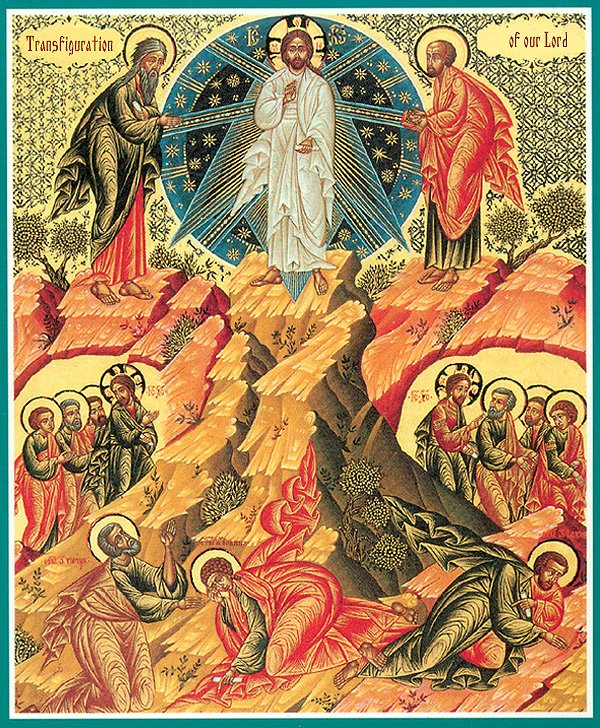
Afterfeast of the Transfiguration

Afterfeast of the Transfiguration

The hymns of the fifth day of the Afterfeast of the Transfiguration invite us to acquire the virtues and become radiant so that we may stand upon the holy mountain and behold the Lord’s Transfiguration as He shines with glory, “filling the world with light.” We are also assured that those who excel in virtue “shall be made worthy of divine glory.”

Troparion - Tone 7

You were Transfigured on the Mount, O Christ God, / revealing Your glory to Your disciples as far as they could bear it. / Let Your everlasting Light shine upon us sinners! / Through the prayers of the Theotokos, O Giver of Light, glory to You!

Kontakion - Tone 7

On the Mountain You were Transfigured, O Christ God, / and Your disciples beheld Your glory as far as they could see it; / so that when they would behold You crucified, / they would understand that Your suffering was voluntary, / and would proclaim to the world, / that You are truly the Radiance of the Father!
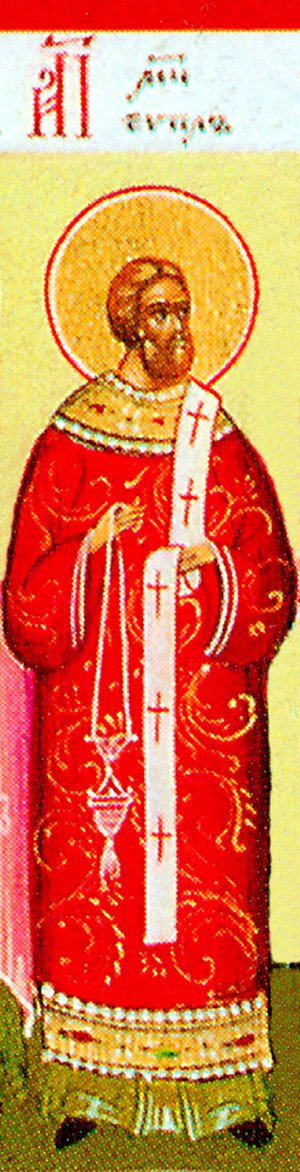
Holy Martyr and Archdeacon Euplus of Catania

Holy Martyr and Archdeacon Euplus of Catania

The Martyr Archdeacon Euplus suffered in the year 304 under the emperors Diocletian (284-305) and Maximian (305-311). He served in the Sicilian city of Catania. Always carrying the Gospel with him, Saint Euplus preached constantly to the pagans about Christ. Once, while he read and explained the Gospel to the gathered crowd, they arrested him and took him to the governor of the city, Calvisianus. The Martyr Archdeacon Euplus suffered in the year 304 under the emperors Diocletian (284-305) and Maximian (305-311). He served in the Sicilian city of Catania. Always carrying the Gospel with him, Saint Euplus preached constantly to the pagans about Christ. Once, while he read and explained the Gospel to the gathered crowd, they arrested him and took him to the governor of the city, Calvisianus. Saint Euplus confessed himself a Christian and denounced the impiety of idol-worship. For this they sentenced him to torture. They threw the injured saint into prison, where he remained in prayer for seven days. The Lord made a spring of water flow into the prison for the martyr to quench his thirst. Brought to trial a second time, strengthened and rejoicing, he again confessed his faith in Christ and denounced the torturer for spilling the blood of innocent Christians. The judge commanded that the saint’s ears be torn off, and that he be beheaded. When they led the saint to execution, they hung the Gospel around his neck. Having asked time for prayer, the archdeacon began to read and explain the Gospel to the people, and many of the pagans believed in Christ. The soldiers beheaded the saint with a sword. His holy relics are in the village of Vico della Batonia, near Naples.

Troparion - Tone 4

As a holy deacon and righteous minister of the Church of Christ, / you contended superbly. / You sailed over the sea of many torments and afflictions, / O all-blessed Euplus. / Guide us into the haven of heaven.

Kontakion - Tone 1

When the love of Christ was your only defense, / you stood in the midst of your fight and said: / I endure this struggle willingly and with confidence! / You rejoiced, O Euplus, to offer your head to the sword and so complete your course!

The Holy Martyr Susanna the Virgin, and those with her (295-296)

The Holy Martyr Susanna the Virgin was the daughter of Presbyter Gavinius and a niece of the Holy Bishop Caius of Rome (283-296). She was raised in strict Christian piety and in her youthful years dedicated herself to God. The family of the saint was related to the emperor Diocletian (284-305), who heard reports of her virtue and beauty. The Holy Martyr Susanna the Virgin was the daughter of Presbyter Gavinius and a niece of the Holy Bishop Caius of Rome (283-296). She was raised in strict Christian piety and in her youthful years dedicated herself to God. The family of the saint was related to the emperor Diocletian (284-305), who heard reports of her virtue and beauty. Having decided to give Saint Susanna in marriage to his co-emperor Maximian (305-311), Diocletian sent his own kinsman, the dignitary Claudius, to the priest Gavinius, and then his own brother Maximus. Both of them, together with the wife of Claudius Prepedigna and her sons Alexander and Cythius, accepted Baptism after conversation with the pious family. Having learned that the entire family of his relatives had been converted to Christianity, Diocletian sent them into exile. Soon they burned the martyrs at Ostia, not far from Rome, and threw the ashes into the sea. They took the holy virgin Susanna to the palace, and the empress tried to persuade her to submit. But the empress, secretly a Christian, supported the martyr in her intention to preserve her virginity for the sake of the Lord. She explained to the emperor about the virgin’s unwillingness to enter into marriage with a pagan. Diocletian gave permission to his co-ruler to defile the holy virgin, but an angel defended her. Macedonius began to urge the martyr to offer sacrifice to the idols. “I offer myself in sacrifice to my Lord,” she answered. Then Macedonius cut off the martyr’s head. The empress secretly buried the body of the saint. The room where the murder occurred was consecrated into a church by the holy Bishop Caius. Soon the father of Saint Susanna, Presbyter Gavinius, accepted a martyr’s end, as did Saint Caius in the year 296.

Troparion - Tone 4

Your lamb Susanna, / calls out to You, O Jesus, in a loud voice: / “I love You, my Bridegroom, / and in seeking You, I endure suffering. / In baptism I was crucified so that I might reign in You, / and I died so that I might live with You. / Accept me as a pure sacrifice, / for I have offered myself in love.” / Through her prayers save our souls, since You are merciful.

Kontakion - Tone 2

Finding your most revered temple to be a source of healing for our souls, / we the faithful cry out to You with a loud voice: / “O most renowned Virgin Martyr Susanna, / entreat Christ God unceasingly on behalf of us all.”
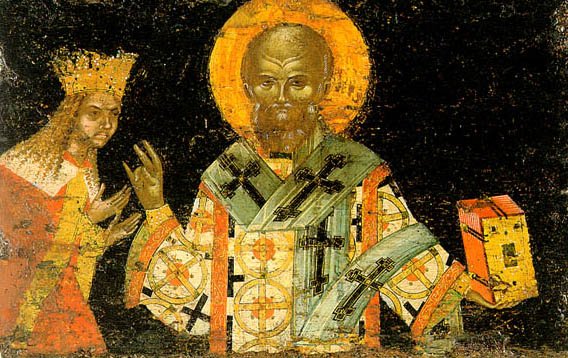
Saint Niphon, Patriarch of Constantinople (1508)

Saint Niphon, Patriarch of Constantinople (1508)

Saint Niphon (Nḗphon) II, the Patriarch of Constantinople, was from the Peloponnesos. His parents were named Manuel and Maria, and he was named Nicholas in Holy Baptism. Later, he was tonsured as a monk at Epidauros, receiving the new name Niphon. After the death of his Elder Anthony, he went to Mount Athos, where he occupied himself by copying books. A Saint Niphon (Nḗphon) II, the Patriarch of Constantinople, was from the Peloponnesos. His parents were named Manuel and Maria, and he was named Nicholas in Holy Baptism. Later, he was tonsured as a monk at Epidauros, receiving the new name Niphon. After the death of his Elder Anthony, he went to Mount Athos, where he occupied himself by copying books. Afterward, he was chosen as Metropolitan of Thessaloniki. In 1486 he occupied the Patriarchal throne of Constantinople. Banished in 1488, the Saint went to the Holy Mountain, at first to Vatopedi Monastery, and then to the monastery of Saint John the Forerunner (Dionysiou). He concealed his rank and occupied the lowliest position. By God’s providence, his rank was revealed to the brethren of the monastery. Once, when the Saint was returning from the forest where he had gone for firewood, all the brethren went out to meet him, greeting him as Patriarch. But even after this, the Saint continued to share various tasks with the brethren. In all, he served three times as Patriarch of Constantinople: 1486-1488; 1497-1498; and 1502. Saint Niphon reposed on September 3, 1508 at the age of 90. Immediately after his death, he was honored as a Saint in many places. On August 16, 1517, in the newly-established monastery of Curtea de Argeş, Patriarch Theoleptos of Constantinople, together with the Synod of the Romanian Lands, and the Igoumens of the Athonite monasteries, performed the solemn glorification of Saint Niphon, decreeing that his Feast Day be celebrated on August 11th. His relics are kept in a shrine at the Monastery of Dionysiou, where there is also a chapel dedicated to him. In gratitude, the Athonite monks gave the Saint's head and hand to Nyagoe Basarab, who placed them in the Monastery he built at Curtea de Argeş in what is now Romania. In the XVIII century, these relics were placed in a silver reliquary. At the behest of the Holy Synod of the Romanian Orthodox Church, they were brought to Craiova, to the church of Saint Dēmḗtrios, the Metropolitan cathedral of Oltenia on October 25, 1949. In 2009, the relics of Saint Niphon were moved to the Cathedral of the Ascension of the Lord at Târgovişte.

Troparion - Tone 3

Being exalted in the ways of humility, / you have illumined the entire Church; / for having been glorified on Athos with ascetic seeds, / you received the name “Adornment of Patriarchs.” / O glorious Nḗphon, fill with divine graces those who magnify you with faith and longing.

Repose of Fr Georges Florovsky (1979) (July 29 OC)

Scripture Readings

☩Epistle

1 Corinthians 10:12-22

12 Wherefore let him that thinketh he standeth take heed lest he fall.
13 There hath no temptation taken you but such as is common to man: but God is faithful, who will not suffer you to be tempted above that ye are able; but will with the temptation also make a way to escape, that ye may be able to bear it.
14 Wherefore, my dearly beloved, flee from idolatry.
15 I speak as to wise men; judge ye what I say.
16 The cup of blessing which we bless, is it not the communion of the blood of Christ? The bread which we break, is it not the communion of the body of Christ?
17 For we being many are one bread, and one body: for we are all partakers of that one bread.
18 Behold Israel after the flesh: are not they which eat of the sacrifices partakers of the altar?
19 What say I then? that the idol is any thing, or that which is offered in sacrifice to idols is any thing?
20 But I say, that the things which the Gentiles sacrifice, they sacrifice to devils, and not to God: and I would not that ye should have fellowship with devils.
21 Ye cannot drink the cup of the Lord, and the cup of devils: ye cannot be partakers of the Lord’s table, and of the table of devils.
22 Do we provoke the Lord to jealousy? are we stronger than he?

☩Gospel

Matthew 16:20-24

20 Then charged he his disciples that they should tell no man that he was Jesus the Christ.
21 From that time forth began Jesus to shew unto his disciples, how that he must go unto Jerusalem, and suffer many things of the elders and chief priests and scribes, and be killed, and be raised again the third day.
22 Then Peter took him, and began to rebuke him, saying, Be it far from thee, Lord: this shall not be unto thee.
23 But he turned, and said unto Peter, Get thee behind me, Satan: thou art an offence unto me: for thou savourest not the things that be of God, but those that be of men.
24 Then said Jesus unto his disciples, If any man will come after me, let him deny himself, and take up his cross, and follow me.

Liturgical data sourced from OCA.org and orthocal.info