Today

Fasting Rules

Meat not allowed Meat Abstain
Fish not allowed Fish Abstain
Dairy not allowed Dairy Abstain
Oil not allowed Oil Abstain
Wine not allowed Wine Abstain

☦ Saints & Commemorations

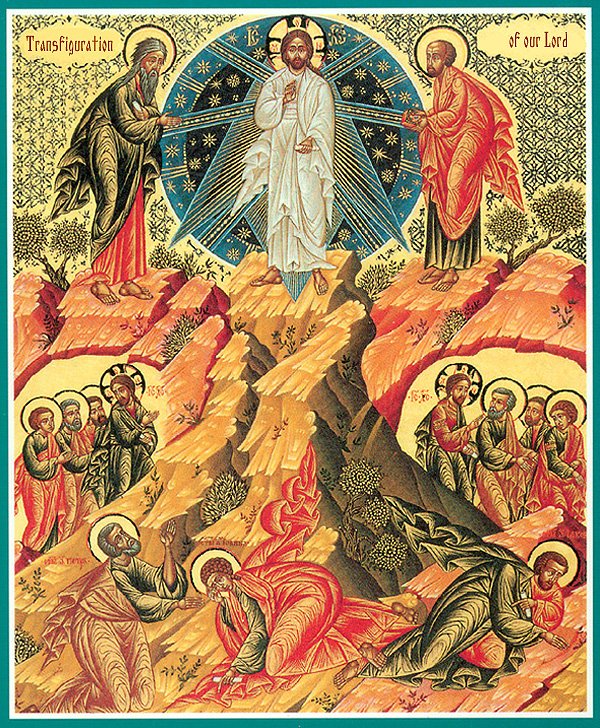
Afterfeast of the Transfiguration

Afterfeast of the Transfiguration

Today’s hymns speak of how Christ made those who ascended Mt Tabor with Him “partakers of (His) otherworldly glory.” The Apostles, “overcome with fear, fell headlong upon the earth.”

Troparion - Tone 7

You were Transfigured on the Mount, O Christ God, / revealing Your glory to Your disciples as far as they could bear it. / Let Your everlasting Light shine upon us sinners! / Through the prayers of the Theotokos, O Giver of Light, glory to You!

Kontakion - Tone 7

On the Mountain You were Transfigured, O Christ God, / and Your disciples beheld Your glory as far as they could see it; / so that when they would behold You crucified, / they would understand that Your suffering was voluntary, / and would proclaim to the world, / that You are truly the Radiance of the Father!
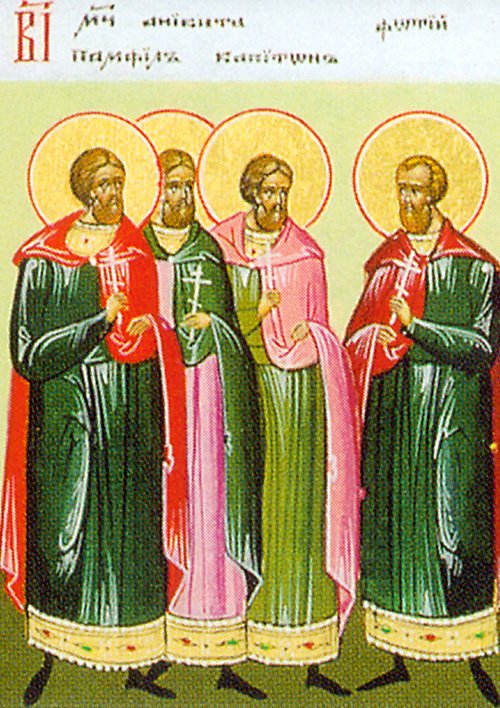
Martyrs Anicletus and Photius of Nicomedia

Martyrs Anicletus and Photius of Nicomedia

The Martyrs Anicetus and Photius (his nephew) were natives of Nicomedia. Anicetus, a military official, denounced the emperor Diocletian (284-305) for setting up in the city square an implement of execution for frightening Christians. The enraged emperor ordered Saint Anicetus to be tortured, and later condemned him to be devoured by wild beasts. The Martyrs Anicetus and Photius (his nephew) were natives of Nicomedia. Anicetus, a military official, denounced the emperor Diocletian (284-305) for setting up in the city square an implement of execution for frightening Christians. The enraged emperor ordered Saint Anicetus to be tortured, and later condemned him to be devoured by wild beasts. But the lions they set loose became gentle and fawned at his feet. Suddenly there was a strong earthquake, resulting in the collapse of the pagan temple of Hercules, and many pagans perished beneath the demolished city walls. The executioner took up a sword to cut off the saint’s head, but he fell down insensible. They tried to break Saint Anicetus on the wheel and burn him with fire, but the wheel stopped and the fire went out. They threw the martyr into a furnace with boiling tin, but the tin became cold. Thus the Lord preserved His servant for the edification of many. The martyr’s nephew, Saint Photius, saluted the sufferer and turned to the emperor, saying, “O idol-worshipper, your gods are nothing!” The sword, held over the new confessor, struck the executioner instead. Then the martyrs were thrown into prison. After three days Diocletian urged them, “Worship our gods, and I shall give you glory and riches.” The martyrs answered, “May you perish with your honor and riches!” Then they tied them by the legs to wild horses. Though the saints were dragged along the ground, they remained unharmed. They did not suffer in the heated bath house, which fell apart. Finally, Diocletian ordered a great furnace to be fired up, and many Christians, inspired by the deeds of Saints Anicetus and Photius, went in themselves saying, “We are Christians!” They all died with a prayer on their lips. The bodies of Saints Anicetus and Photius were not harmed by the fire, and even their hair remained whole. Seeing this, many of the pagans came to believe in Christ. This occurred in the year 305. Saints Anicetus and Photius are mentioned in the prayers for the Blessing of Oil and the Lesser Blessing of Water ( Book of Needs 1987, p. 230).

Troparion - Tone 4

Your holy martyrs Anicetus and Photius, O Lord, / through their sufferings have received incorruptible crowns from You, our God. / For having Your strength, they laid low their adversaries, / and shattered the powerless boldness of demons. / Through their intercessions, save our souls!
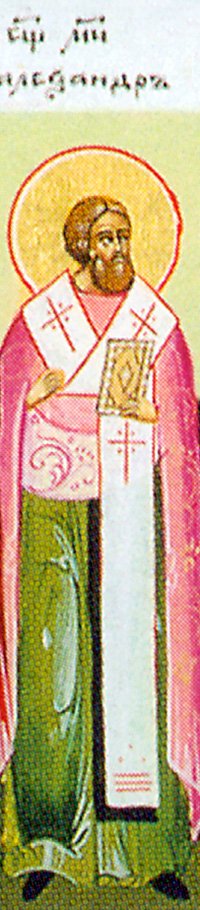
Hieromartyr Alexander, Bishop of Comana (3rd c.)

Hieromartyr Alexander, Bishop of Comana (3rd c.)

Saint Alexander, Bishop of Comana, lived in the III century not far from Neocaesarea. He studied the Holy Scriptures, and knew many sciences. Having taken upon himself the exploit (podvig) of foolishness, the Saint lived in poverty, selling coal in the city square. Many, seeing his face always black with charcoal dust, treated him with contempt. Saint Alexander, Bishop of Comana, lived in the III century not far from Neocaesarea. He studied the Holy Scriptures, and knew many sciences. Having taken upon himself the exploit (podvig) of foolishness, the Saint lived in poverty, selling coal in the city square. Many, seeing his face always black with charcoal dust, treated him with contempt. When the Bishop of Comana reposed, some proposed to elect a new primate from the nobility, others wanted a learned or eloquent man, and still others a wealthy one. Then Saint Gregory of Neocaesarea (November 17), who was invited for the consecration of the chosen one, pointed out that a Bishop should have not only external merits and distinctions, but first of all, a pure heart and a holy life. These words caused some to smile: "If you don't look at his appearance or nobility of origin, then Alexander the charcoal-burner could also be made a bishop." Saint Gregory realized that it was not without God's providence that this man had been mentioned, and asked that he be summoned. The Saint's appearance among those who had gathered caused laughter. Turning respectfully to Saint Gregory, Saint Alexander stood, absorbed in himself, paying no attention to the mockery; the Hierarch tested him, and the charcoal-burner was forced to reveal that he had previously been a philosopher, and had studied Holy Scripture, but for the Lord's sake he took upon himself voluntary poverty and humility. Then the Hierarch Gregory took the charcoal-burner to his house, where he was washed and then dressed in clean clothes. Returning to the Council, Saint Gregory began to put some questions to him about the Holy Scriptures before everyone, which Saint Alexander answered as a knowledgeable and wise pastor. Seeing this, those present were astonished by his humility, and unanimously elected Saint Alexander as their Bishop. Saint Gregory ordained him as a Presbyter, and then consecrated him as a Bishop. After his consecration the new Hierarch spoke a word to the people, filled with the power and grace of God. Everyone rejoiced that the Lord had sent them such a wise shepherd. Under Emperor Diocletian (284-305) the Hierarch courageously confessed Christ, refusing to worship idols. After torturing him they threw him into the fire, and there he surrendered his soul to God. According to some sources, Saint Alexander suffered during the reign of Emperor Decius (249-251).

Troparion - Tone 4

By sharing in the ways of the Apostles, / you became a successor to their throne. / Through the practice of virtue, you found the way to divine contemplation, O inspired one of God; / by teaching the word of truth without error, you defended the Faith, / even to the shedding of your blood. / Hieromartyr Alexander, entreat Christ God to save our souls.

Kontakion - Tone 4

As one who lived piously among Hierarchs and who underwent martyrdom, / O divinely-wise one, / you abolished the sacrifices of idolatry and showed yourself as the protector of your flock. / Therefore, we cry fervently to you: / “By your intercessions, deliver us from all misfortunes, O Alexander, our Father.”

Scripture Readings

☩Epistle

1 Corinthians 10:28-11:7

28 But if any man say unto you, This is offered in sacrifice unto idols, eat not for his sake that shewed it, and for conscience sake: for the earth is the Lord’s, and the fulness thereof:
29 Conscience, I say, not thine own, but of the other: for why is my liberty judged of another man’s conscience?
30 For if I by grace be a partaker, why am I evil spoken of for that for which I give thanks?
31 Whether therefore ye eat, or drink, or whatsoever ye do, do all to the glory of God.
32 Give none offence, neither to the Jews, nor to the Gentiles, nor to the church of God:
33 Even as I please all men in all things, not seeking mine own profit, but the profit of many, that they may be saved.
1 Be ye followers of me, even as I also am of Christ.
2 Now I praise you, brethren, that ye remember me in all things, and keep the ordinances, as I delivered them to you.
3 But I would have you know, that the head of every man is Christ; and the head of the woman is the man; and the head of Christ is God.
4 Every man praying or prophesying, having his head covered, dishonoureth his head.
5 But every woman that prayeth or prophesieth with her head uncovered dishonoureth her head: for that is even all one as if she were shaven.
6 For if the woman be not covered, let her also be shorn: but if it be a shame for a woman to be shorn or shaven, let her be covered.
7 For a man indeed ought not to cover his head, forasmuch as he is the image and glory of God: but the woman is the glory of the man.

☩Gospel

Matthew 16:24-28

24 Then said Jesus unto his disciples, If any man will come after me, let him deny himself, and take up his cross, and follow me.
25 For whosoever will save his life shall lose it: and whosoever will lose his life for my sake shall find it.
26 For what is a man profited, if he shall gain the whole world, and lose his own soul? or what shall a man give in exchange for his soul?
27 For the Son of man shall come in the glory of his Father with his angels; and then he shall reward every man according to his works.
28 Verily I say unto you, There be some standing here, which shall not taste of death, till they see the Son of man coming in his kingdom.

Liturgical data sourced from OCA.org and orthocal.info