
Fasting Rules
 Meat
Allowed
 Fish
Allowed
 Dairy
Allowed
 Oil
Allowed
 Wine
Allowed
Saints & Commemorations
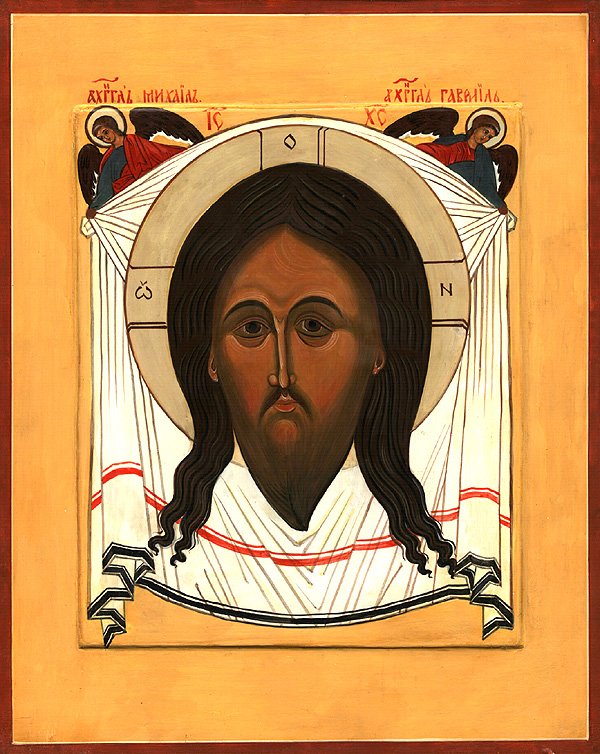
Image of Christ Not Made by Hands
The Transfer of the Icon of our Lord Jesus Christ Not-Made-by-Hands from Edessa to Constantinople occurred in the year 944. Eusebius, in his History of the Church (I:13), relates that when the Savior was preaching, Abgar was the ruler of Edessa. He was stricken with leprosy all over his body. Reports of the great miracles performed by the Lord spread throughout Syria (Mt.4:24) and even reached Abgar.
The Transfer of the Icon of our Lord Jesus Christ Not-Made-by-Hands from Edessa to Constantinople occurred in the year 944. Eusebius, in his History of the Church (I:13), relates that when the Savior was preaching, Abgar was the ruler of Edessa. He was stricken with leprosy all over his body. Reports of the great miracles performed by the Lord spread throughout Syria (Mt.4:24) and even reached Abgar. Without having seen the Savior, Abgar believed in Him as the Son of God. He wrote a letter requesting Him to come and heal him. He sent his own portrait painter Ananias to Palestine with this letter, and commissioned him to paint a likeness of the Divine Teacher.
Ananias arrived in Jerusalem and saw the Lord surrounded by many people. He was not able to get close to Him because of the large crowd which had gathered to hear the Savior. Then he stood on a high rock and tried to paint Christ's portrait from afar, but this attempt did not succeed. Then the Savior saw him, called him by name, and gave him a short letter for Abgar in which He praised the ruler's faith. He also promised to send His disciple to heal him of his leprosy and guide him to salvation.
Then the Lord asked for some water and a cloth to be brought to Him. After washing His Face, He dried it with the cloth, and His Divine countenence was imprinted upon it. Ananias brought the cloth and the Savior's letter to Edessa. Reverently, Abgar pressed the holy object to his face and received partial healing. Only a small trace of the terrible affliction remained until the arrival of the disciple promised by the Lord. This was Saint Thaddeus, an Apostle of the Seventy (August 21), who preached the Gospel and baptized Abgar and all the people of Edessa. Abgar attached the Holy Napkin to a board and placed it in a gold frame adorned with pearls. Then he placed it in a niche above the city gates. On the gateway over the Icon he inscribed the words, “O Christ God, let no one who hopes on Thee be put to shame.”
For many years the inhabitants had the pious custom of bowing down before the Icon whenever they went forth from the gates. Later, one of Abgar's great-grandsons, who ruled Edessa, fell into idolatry, and decided to remove the Icon from the city wall and to replace it with an idol. In a vision the Lord ordered the Bishop of Edessa to hide His Icon. The bishop came by night with his clergy, lit a lampada before the Icon, and placed a ceramic tile in front of the Icon to protect it, and then he sealed the niche with bricks.
As time passed, the people forgot about the Icon. But in the year 545, when the Persian emperor Chozroes I besieged Edessa and the city's position seemed hopeless, the Most Holy Theotokos appeared to Bishop Eulabios and ordered him to remove the Icon from the sealed niche, saying that it would save the city from the enemy. When he opened the niche, the bishop found the Holy Mandylion, and the lampada was still burning before the Icon, and an exact copy was produced upon the tile protecting the Icon.
The Persians lit a huge fire outside the city walls. Bishop Eulabios carried the Icon Not-Made-by-Hands around the city walls, and a violent wind turned the flames back on the Persians. The defeated Persian army retreated from the city.
In his Church History , the sixth century writer Evagrios Scholastikos refers to the Holy Mandylion (or Napkin) as The Icon made by God (Η θεοτεύκος εἰκών).
In the year 630 Arabs seized Edessa, but they did not hinder the veneration of the Holy Napkin, the fame of which had spread throughout the entire East. In the year 944, the emperor Constantine Porphyrogenitos (912-959) wanted to transfer the Icon to Constantinople, so he paid a ransom to the emir of the city for it. With great reverence the Icon of the Savior Not-Made-by-Hands and the letter which He had written to Abgar, were brought to Constantinople by clergy.
On August 16, the icon of the Savior was placed in the Pharos church of the Most Holy Theotokos. There are several traditions concerning what happened later to the Icon Not-Made-by-Hands. According to one, Crusaders stole it during occupation of Constantinople (1204-1261), but the ship on which the sacred object was taken, perished in the waters of the Sea of Marmora.
According to another tradition, the Icon Not-Made-by-Hands was transported to Genoa in 1362, where it is preserved in a monastery dedicated to the Apostle Bartholomew. It is known that the Icon Not-Made-by-Hands repeatedly produced exact copies of itself. One of these, named “On the tile,” was made when Ananias hid the Icon in the wall on his way to Edessa. Another, imprinted on a cloak, wound up in Georgia. Possibly, the various traditions about the original Icon Is explained by the existence of several exact copies.
During the time of the Iconoclast heresy, the defenders of the holy icons, who shed their blood for them, sang the Troparion to the Icon Not-Made-by-Hands. In proof of the validity of venerating icons, Pope Gregory II (715-731) sent a letter to the Byzantine Enperor, in which he mentioned Abgar's healing, and the sojourn of the Icon Not-Made-by-Hands at Edessa as a commonly known fact.
The Icon Not-Made-by-Hands was put on the standards of the Russian army, in order to protect them from the enemy. In the Russian Orthodox Church it is a pious custom for a believer to read the Troparion for the Icon of the Savior Not-Made-by-Hands when entering the temple, together with other prayers.
According to the Prologue, there are four known Icons of the Savior Not-Made-by-Hands: Abgar's original Icon at Edessa (August 16).
The one at Kamuliana (Καμουλιανά), which is mentioned by Saint Gregory of Nyssa (January 10).
According to Saint Νikόdēmos of the Holy Mountain (July 14), the Kamuliana Icon appeared in the year 392, but it resembled an icon of the Mother of God (August 9).
During the reign of Emperor Tiberius (578-582), Saint Mary Synklitike (August 11) was healed by the Icon on the tile (August 16).
The Feast of the Transfer of the Icon Not-Made-by-Hands is observed along with the Afterfeast of the Dormition. The commemoration of the third Icon Not-Made-by-Hands mentioned above is called the “The Savior on Linen Cloth.”
The particular reverence for this Feast in the Russian Orthodox Church is also expressed in iconography, and the Icon Not-Made-by-Hands was one of the most widely distributed.
Troparion - Tone 2
We venerate Your most pure image, O Good One, / and ask forgiveness of our transgressions, O Christ God. / Of Your own will You were pleased to ascend the Cross in the flesh / to deliver Your creatures from bondage to the Enemy. / Therefore with thanksgiving we cry aloud to You: / “You have filled all with joy, O our Savior, / by coming to save the world.”
Kontakion - Tone 2
Uncircumscribed Word of the Father / as we behold the victorious image of Your true incarnation, / not made by hands, but divinely wrought / in Your ineffable and divine dispensation towards us, / we honor it with veneration!
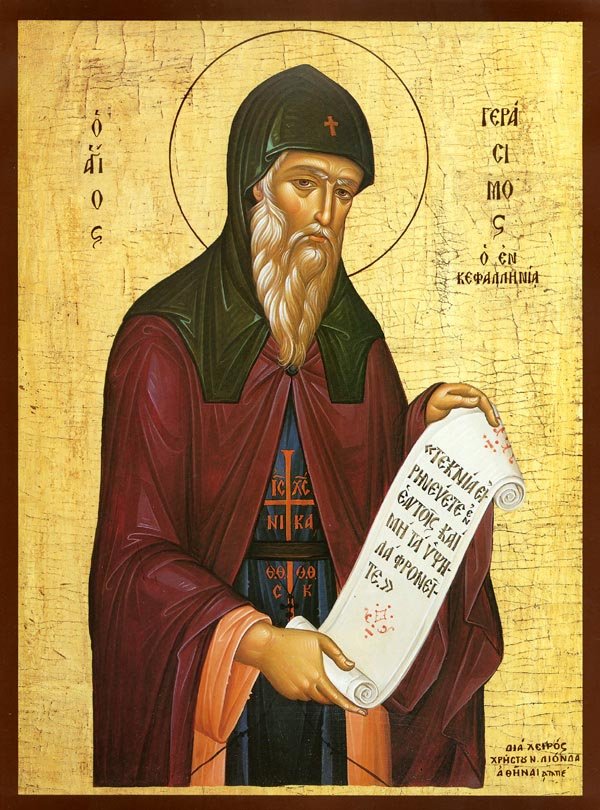
Gerasimus of Cephalonia
Saint Gerasimus the New Ascetic of Cephalonia was born in the village of Trikkala in the Peloponessos. As a young adult, he became a monk on the island of Zakynthos. On the Holy Mountain he became a schemamonk and studied with the ascetics of Mt Athos. Receiving a blessing from the Elders, the monk went to Jerusalem to worship at the Life-bearing Tomb of the Savior.
Saint Gerasimus the New Ascetic of Cephalonia was born in the village of Trikkala in the Peloponessos. As a young adult, he became a monk on the island of Zakynthos. On the Holy Mountain he became a schemamonk and studied with the ascetics of Mt Athos. Receiving a blessing from the Elders, the monk went to Jerusalem to worship at the Life-bearing Tomb of the Savior. After visiting many holy places in Jerusalem, Mount Sinai, Antioch, Damascus, Alexandria and Egypt, he returned to Jerusalem where he became a lamp-lighter at the Sepulchre of the Lord.
The monk was ordained a deacon and then a priest by the Patriarch of Jerusalem, Germanus (1534-1579). Saint Gerasimus maintained the discipline of an ascetic. For soltitude he withdrew to the Jordan, where he spent forty days without respite. Having received the Patriarch’s blessing for a life of silence, Saint Gerasimus withdrew to Zakynthos in solitude, eating only vegetation.
After five years he was inspired to go the the island of Cephalonia, where he lived in a cave. He restored a church at Omala, and he founded a women’s monastery where he lived in constant toil and vigil for thirty years. He prayed on bent knees stretched out on the ground. For his exalted life he was granted a miraculous gift: the ability to heal the sick and cast out unclean spirits.
At 71 years of age, the venerable Gerasimus knew that he would soon die. He gave his blessing to the nuns and peacefully fell asleep in the Lord on August 15, 1579. Two years later, his grave was opened and his holy relics were found fragrant and incorrupt with a healing power.
Since the Feast of the Dormition falls on August 15, Saint Gerasimus is commemorated on August 16th. Today’s Feast celebrates the uncovering of his holy relics in 1581.
Troparion - Tone 1
Let us the faithful praise the divine Gerasimos, / who is the protector of the Orthodox, and an angel in the body,
and a newly appeared God-bearing wonderworker; / for he has worthily received from God the unfailing grace of
healing; / he restores the sick, and heals those possessed by demons; / therefore, he pours forth healings upon those who honor him.
Kontakion - Tone 3
Today the island of Cephalonia / with sacred songs of thanksgiving, / calls upon all the Orthodox to extol the newly appeared boast and glory of Orthodoxy, / the divine Gerasimos, / who is truly her deliverer and champion.
Stamatios the Martyr
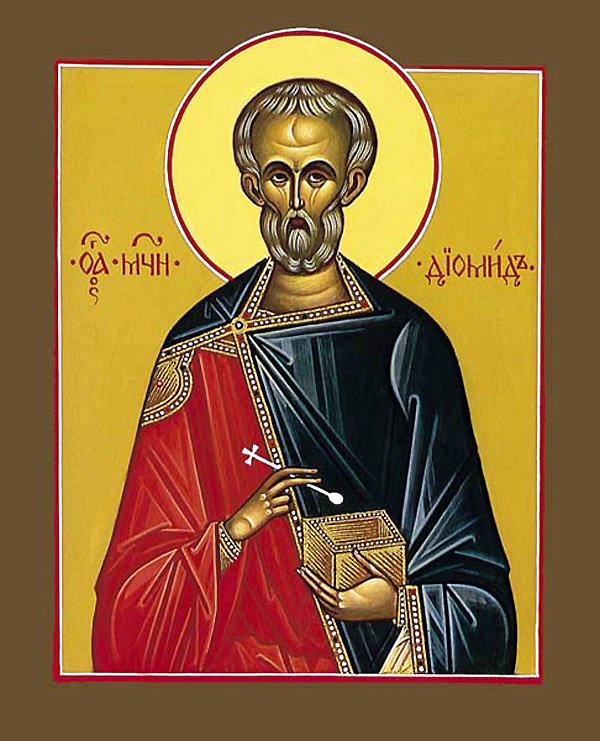
Martyr Diomedes the Physician of Tarsus in Cilicia (298)
The Martyr Diomedes (Diomḗdēs) was born in Tarsus in Cilicia, and studied the medical arts. His scientific knowledge did not make him proud, but he retained the piety in which his parents raised him. And since the Lord, the Physician of bodies and souls, "spoke to them about the Kingdom of God, and healed those who had need of healing" (Luke 9:11), so did Diomedes emulate his Lord and God, practicing his medical profession charitably and without charge. No
The Martyr Diomedes (Diomḗdēs) was born in Tarsus in Cilicia, and studied the medical arts. His scientific knowledge did not make him proud, but he retained the piety in which his parents raised him. And since the Lord, the Physician of bodies and souls, "spoke to them about the Kingdom of God, and healed those who had need of healing" (Luke 9:11), so did Diomedes emulate his Lord and God, practicing his medical profession charitably and without charge. Not only did he heal their bodies, he also treated their souls. He proclaimed the saving truth of the Gospel to the sick, and he brought many souls to Christ the Savior.
Divine zeal brought Diomedes as far as Nicaea in Bithynίa. There he healed the sick, and taught and nurtured their faith. When Diocletian began his persecution against the Christians, the activities of Diomedes were reported to the Emperor, who ordered his arrest. But before he could be arrested, God called him to Himself, and the soldiers found him dead. Even though he was dead, they beheaded him in order to prove that Diocletian's orders had been carried out. Then the soldiers were struck blind. The Emperor commanded them to take the head back and place it with the body. As soon as the soldiers did this, their sight was restored and they believed in Christ.
The Church venerates Saint Diomedes as an Unmercenary Physician and he is mentioned during the Mystery of Holy Unction.
Troparion - Tone 1
O Diomedes, as a healer of bodily sickness, / you also heal the soul by the word of truth. / You received this gift from God, / and you always help those who suffer from various diseases. / You were radiant with the grace of martyrdom; / therefore you preserve those who cry to you: / “Glory to Him Who glorified you. / Glory to Him Who crowned you. / Glory to Him Who, through you, works healings for all.”
Kontakion - Tone 6
The instruments of torture have made a way for you to Heaven, O soldier of Christ Diomḗdēs, / you defeated the devil’s intrigues and became distinguished in Heaven with Christ, / pray for those who honor your memory with faith.
Scripture Readings
☩Epistle
1 Corinthians 11:31-12:6
31
For if we would judge ourselves, we should not be judged.
32
But when we are judged, we are chastened of the Lord, that we should not be condemned with the world.
33
Wherefore, my brethren, when ye come together to eat, tarry one for another.
34
And if any man hunger, let him eat at home; that ye come not together unto condemnation. And the rest will I set in order when I come.
1
Now concerning spiritual gifts, brethren, I would not have you ignorant.
2
Ye know that ye were Gentiles, carried away unto these dumb idols, even as ye were led.
3
Wherefore I give you to understand, that no man speaking by the Spirit of God calleth Jesus accursed: and that no man can say that Jesus is the Lord, but by the Holy Ghost.
4
Now there are diversities of gifts, but the same Spirit.
5
And there are differences of administrations, but the same Lord.
6
And there are diversities of operations, but it is the same God which worketh all in all.
☩Gospel
Matthew 18:1-11
1
At the same time came the disciples unto Jesus, saying, Who is the greatest in the kingdom of heaven?
2
And Jesus called a little child unto him, and set him in the midst of them,
3
And said, Verily I say unto you, Except ye be converted, and become as little children, ye shall not enter into the kingdom of heaven.
4
Whosoever therefore shall humble himself as this little child, the same is greatest in the kingdom of heaven.
5
And whoso shall receive one such little child in my name receiveth me.
6
But whoso shall offend one of these little ones which believe in me, it were better for him that a millstone were hanged about his neck, and that he were drowned in the depth of the sea.
7
Woe unto the world because of offences! for it must needs be that offences come; but woe to that man by whom the offence cometh!
8
Wherefore if thy hand or thy foot offend thee, cut them off, and cast them from thee: it is better for thee to enter into life halt or maimed, rather than having two hands or two feet to be cast into everlasting fire.
9
And if thine eye offend thee, pluck it out, and cast it from thee: it is better for thee to enter into life with one eye, rather than having two eyes to be cast into hell fire.
10
Take heed that ye despise not one of these little ones; for I say unto you, That in heaven their angels do always behold the face of my Father which is in heaven.
11
For the Son of man is come to save that which was lost.
Liturgical data sourced from OCA.org and orthocal.info