
Fasting Rules
 Meat
Allowed
 Fish
Allowed
 Dairy
Allowed
 Oil
Allowed
 Wine
Allowed
Saints & Commemorations
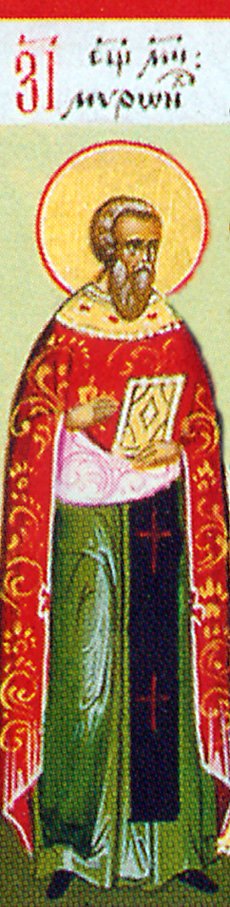
Martyr Myron, Presbyter of Cyzicus
The Holy Martyr Myron was a presbyter in Achaia (Greece), and lived during the third century. He suffered in the year 250 under the emperor Decius (249-251). The presbyter was gentle and kind to people, but he was also courageous in the defense of his spiritual children.
On the Feast of the Nativity of Christ, he was celebrating the Divine Liturgy.
The Holy Martyr Myron was a presbyter in Achaia (Greece), and lived during the third century. He suffered in the year 250 under the emperor Decius (249-251). The presbyter was gentle and kind to people, but he was also courageous in the defense of his spiritual children.
On the Feast of the Nativity of Christ, he was celebrating the Divine Liturgy. The local governor Antipater came into the church with soldiers so as to arrest those praying there and to subject them to torture. Saint Myron began to plead for his flock, accusing the governor of cruelty, and for this the saint was delivered over to be tortured.
They took Saint Myron and struck his body with iron rods. They then threw the presbyter into a red-hot oven, but the Lord preserved the martyr, but about 150 men standing nearby were scorched by the fire. The governor then began to insist that the martyr worship idols. Saint Myron firmly refused to do this, so Antipater ordered the leather thongs to be cut from his skin. Saint Myron took one of the leather thongs and threw it in the face of his tormentor.
Falling into a rage, Antipater gave orders to strike Saint Myron all over his stripped body, and then to give the martyr to wild beasts to be eaten. The beasts would not touch him, however. Seeing himself defeated, Antipater in his blind rage committed suicide. They then took Saint Myron to the city of Cyzicus, where he was beheaded by the sword.
Troparion - Tone 4
Your holy martyr, Myron, O Lord, / through his suffering has received an incorruptible crown from You, our God. / For having Your strength, he laid low his adversaries, / and shattered the powerless boldness of demons. / Through his intercessions, save our souls!
Kontakion - Tone 2
From childhood you longed for Christ, all-glorious one, / keeping His divine commandments and running to Him with all your being, all-honored Myron. / Now you zealously pray with the angels, / asking remission of sins / for those who celebrate your memory.
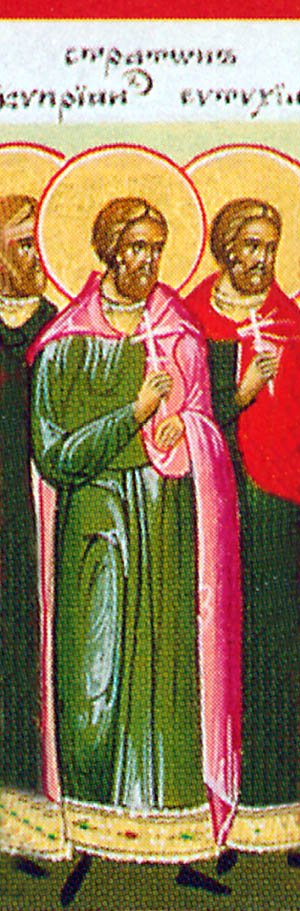
Straton, Philip, Eutychian, & Cyprian the Martyrs of Nicomedea
The Martyrs Straton, Philip, Eutychian and Cyprian suffered at Nicomedia. Visiting the circus, they taught people to abandon their idol-worship, and they converted many pagans to Christ. The governor, observing that the people were leaving the circus, summoned to himself the martyrs, who firmly confessed their faith in Christ.
The Martyrs Straton, Philip, Eutychian and Cyprian suffered at Nicomedia. Visiting the circus, they taught people to abandon their idol-worship, and they converted many pagans to Christ. The governor, observing that the people were leaving the circus, summoned to himself the martyrs, who firmly confessed their faith in Christ. For this they were given over to wild beasts to be eaten. The beasts did not touch them, and the martyrs were then tortured and thrown into a fire.
Troparion - Tone 4
Your holy martyrs O Lord, / through their sufferings have received incorruptible crowns from You, our God. / For having Your strength, they laid low their adversaries, / and shattered the powerless boldness of demons. / Through their intercessions, save our souls!
Holy Martyr Patroclus (late 3rd c.)
The Martyr Patroclus lived during the third century under the emperor Aurelian (270-275). He was a native of the city of Tricassinum (now the city of Troyes in France) and led a pious Christian life: he loved to pray, to read the Holy Scriptures, to fast and to be charitable to the poor. For this the Lord bestowed upon him the gift of wonderworking.
The Martyr Patroclus lived during the third century under the emperor Aurelian (270-275). He was a native of the city of Tricassinum (now the city of Troyes in France) and led a pious Christian life: he loved to pray, to read the Holy Scriptures, to fast and to be charitable to the poor. For this the Lord bestowed upon him the gift of wonderworking.
The emperor Aurelian summoned Saint Patroclus to himself and commanded him to worship idols, promising for this great honors and riches. The saint disdained idol worship saying that the emperor himself was a beggar.
“How can you call me, the emperor, a beggar?” asked Aurelian. The saint answered: “You possess many earthly treasures, but you do not have heavenly treasures. Since you do not believe in Christ and in the future life, you shall not receive the blessedness of Paradise. Therefore, you are poor.”
Aurelian sentenced him to beheading by the sword. Soldiers led him to the banks of the River Sequanum (now the Seine), but suddenly their eyes were clouded, and Saint Patroclus at this time went across the river on the water and began to pray on a hill on the other shore. Coming to themselves, some of the soldiers were astounded at the disappearance of the martyr and they glorified God, but others attributed the miracle to magic.
A pagan woman pointed out to the soldiers that Saint Patroclus was on the other bank of the river. Crossing over there, the soldiers killed the martyr. His body was buried by night by the priest Eusebius and deacon Liberius.
Troparion - Tone 3
Your holy martyr Patroclus, O Lord, / through his sufferings has received an incorruptible crown from You, our God. / For having Your strength, he laid low his adversaries, / and shattered the powerless boldness of demons. / Through his intercessions, save our souls!
Kontakion - Tone 2
You appeared as a bright star announcing Christ with your radiance, / which is repulsive to this world, O Martyr Patroclus; / extinguishing the allure of false gods, / you enlighten the faithful, / always interceding for us all.
Scripture Readings
☩Epistle
1 Corinthians 12:12-26
12
For as the body is one, and hath many members, and all the members of that one body, being many, are one body: so also is Christ.
13
For by one Spirit are we all baptized into one body, whether we be Jews or Gentiles, whether we be bond or free; and have been all made to drink into one Spirit.
14
For the body is not one member, but many.
15
If the foot shall say, Because I am not the hand, I am not of the body; is it therefore not of the body?
16
And if the ear shall say, Because I am not the eye, I am not of the body; is it therefore not of the body?
17
If the whole body were an eye, where were the hearing? If the whole were hearing, where were the smelling?
18
But now hath God set the members every one of them in the body, as it hath pleased him.
19
And if they were all one member, where were the body?
20
But now are they many members, yet but one body.
21
And the eye cannot say unto the hand, I have no need of thee: nor again the head to the feet, I have no need of you.
22
Nay, much more those members of the body, which seem to be more feeble, are necessary:
23
And those members of the body, which we think to be less honourable, upon these we bestow more abundant honour; and our uncomely parts have more abundant comeliness.
24
For our comely parts have no need: but God hath tempered the body together, having given more abundant honour to that part which lacked:
25
That there should be no schism in the body; but that the members should have the same care one for another.
26
And whether one member suffer, all the members suffer with it; or one member be honoured, all the members rejoice with it.
☩Gospel
Matthew 18:18-22, 19:1-2, 13-15
18
Verily I say unto you, Whatsoever ye shall bind on earth shall be bound in heaven: and whatsoever ye shall loose on earth shall be loosed in heaven.
19
Again I say unto you, That if two of you shall agree on earth as touching any thing that they shall ask, it shall be done for them of my Father which is in heaven.
20
For where two or three are gathered together in my name, there am I in the midst of them.
21
Then came Peter to him, and said, Lord, how oft shall my brother sin against me, and I forgive him? till seven times?
22
Jesus saith unto him, I say not unto thee, Until seven times: but, Until seventy times seven.
1
And it came to pass, that when Jesus had finished these sayings, he departed from Galilee, and came into the coasts of Judea beyond Jordan;
2
And great multitudes followed him; and he healed them there.
13
Then were there brought unto him little children, that he should put his hands on them, and pray: and the disciples rebuked them.
14
But Jesus said, Suffer little children, and forbid them not, to come unto me: for of such is the kingdom of heaven.
15
And he laid his hands on them, and departed thence.
Liturgical data sourced from OCA.org and orthocal.info