
Fasting Rules
 Meat
Abstain
 Fish
Abstain
 Dairy
Abstain
 Oil
Abstain
 Wine
Abstain
Saints & Commemorations
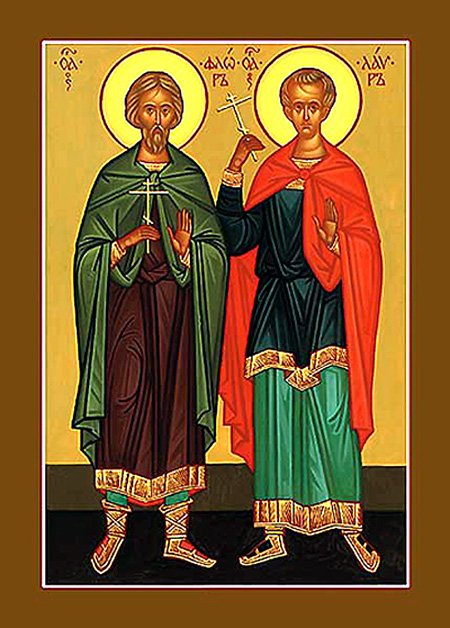
Martyrs Florus and Laurus of Illyria
The Martyrs Florus and Laurus were brothers by birth not only in flesh but in spirit. They lived in the second century at Byzantium, and afterwards they settled in Illyria. By occupation they were stone-masons (their teachers in this craft were the Christians Proclus and Maximus, from whom also the brothers learned about life pleasing to God).
The Martyrs Florus and Laurus were brothers by birth not only in flesh but in spirit. They lived in the second century at Byzantium, and afterwards they settled in Illyria. By occupation they were stone-masons (their teachers in this craft were the Christians Proclus and Maximus, from whom also the brothers learned about life pleasing to God).
The prefect of Illyria, Likaion, sent the brothers to a nearby district for work on the construction of a pagan temple. The saints toiled at the structure, distributing to the poor the money they earned, while they kept strict fast and prayed without ceasing.
Once, the son of the local pagan-priest Mamertin carelessly approached the structure, and a chip of stone hit him in the eye, severely injuring him. Saints Florus and Laurus assured the upset father, that his son would be healed.
They brought the youth to consciousness and told him to have faith in Christ. After this, as the youth confessed Jesus Christ as the true God, the brothers prayed for him, and the eye was healed. In view of such a miracle, even the father of the youth believed in Christ.
When the construction of the temple was completed, the brothers gathered the Christians together, and going through the temple, they smashed the idols. In the eastern part of the temple they set up the holy Cross. They spent all night in prayer, illumined with heavenly light. Having learned of this, the head of the district condemned to burning the former pagan priest Mamertin and his son and 300 Christians.
The martyrs Florus and Laurus, having been sent back to the prefect Likaion, were thrown down an empty well and covered over with earth. After many years, the relics of the holy martyrs were uncovered incorrupt, and transferred to Constantinople. In the year 1200 the Novgorod pilgrim Anthony saw them. Stephen of Novgorod saw the heads of the martyrs in the Pantokrator monastery around the year 1350.
Troparion - Tone 4
Let us praise as is meet, O you faithful, / the most comely, radiant and divinely wise martyrs: / Most blessed Florus and all venerable Laurus, / who proclaimed to all the uncreated Trinity. / Suffering unto bloodshed, / they were adorned with brilliant crowns. / Entreat Christ our God to save our souls.
Kontakion - Tone 8
Today all the world honors in glory the divinely wise Florus and Laurus, / as pious martyrs who suffered for Christ. / Through their prayers may we receive grace and mercy / and be delivered from calamity and temptation, / and from wrath and sorrow on the Day of Judgment.
Hermos the Martyr
John & George, Patriarchs of Constantinople
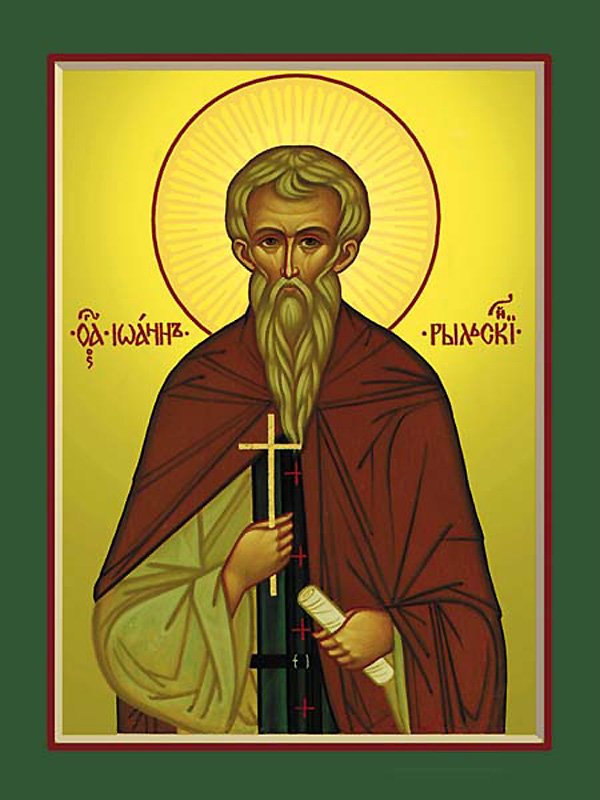
Our Holy Father John, Abbot of Rila (946)
Saint John of Rila, the great spiritual ascetic of the Bulgarian Orthodox Church and Heavenly Protector of the Bulgarian nation, was born in the year 876 in the village of Skrino in the Sredets district [now Sofia].
After he had been orphaned, the boy became a cowherd in order to avoid people. Once the rich man beat him for losing a cow with its calf.
Saint John of Rila, the great spiritual ascetic of the Bulgarian Orthodox Church and Heavenly Protector of the Bulgarian nation, was born in the year 876 in the village of Skrino in the Sredets district [now Sofia].
After he had been orphaned, the boy became a cowherd in order to avoid people. Once the rich man beat him for losing a cow with its calf. The boy cried long and he prayed, that God would help him. When he found the cow with the calf, the water at that time flowed high and strong in the River Struma. The young cowherd prayed, he placed his own tattered shirt on the water, made the Sign of the Cross over it, took up the calf in his arms and went with it, as though on dry land, to the other bank of the river where the cow was.
The rich man, hidden in the forest, was frightened upon seeing this miracle. He rewarded the youth generously, then sent him away from his home. Having given away his things, the boy left his village. Where and when the saint took monastic tonsure is unknown.
At the very beginning he lived an ascetical life on top of a high and barren hill, eating only wild plants. His
cell was made from brushwood. After a short time, robbers fell upon him by night, beat him, and drove him away. Later, he found a deep cave and settled in it. Soon, his nephew Saint Luke also came to live there.
Luke secretly left the home of his parents and went into the wilderness where the Saint was living. After much effort, he succeeded in finding him. At first the blessed one, seeing him from afar, thought this was a demonic temptation, and so he prayed. Like many solitaries, Saint John was bothered by demons, who assumed the shape of wild animals and tried to force him to leave. As Luke approached, he made prostration and asked for Saint John's blessing. That convinced the ascetic that it was truly his nephew, and not a delusion. He blessed Luke and asked why he had come. The young man told him of his desire to share his way of life, and was permitted to remain. Luke emulated Saint John the Forerunner, who had lived in the wilderness from childhood.
Satan could not endure Saint John's holy life of prayer and fasting. Moved by the devil, an acquaintance of Luke's father found him overwhelmed by grief and upset by his son's disappearance, so he said, "Your brother John came by night, took your son, and has him even now. Unless you rescue the boy, he will become food for the wild beasts. Come, and I will show you where he is, and then you can go and take your child."
When Luke's father heard this, he became furious and cursed his innocent brother. When they came near the place, the acquaintance showed him John's cave from afar and departed. The brother went on and found the Saint. He reproached him, calling him a deceiver and an evil man who had stolen his son.
He tried to kill the venerable one with a heavy stick and some stones, but Saint John just stood there saying nothing. The father seized the boy and took him from the wilderness, intending to bring him back to the world. The blessed man, knew that the child would fall into the snares of the devil, was overcome with sorrow and tears. He fell to his knees and prayed: "Lord Jesus Christ, behold the affliction of my heart, and grant me a sign of Thy mercy. Thou hast said, 'Let the children come to me, and do not hinder them; for of such is the Kingdom of Heaven' (Matthew 19:24).
After they had walked a short distance, a snake bit Luke, and at once he died a painless death. The father did not know what to do. He returned to Saint John and repented of his actions. With profound sorrow, he revealed what had happened. Saint John told him to bury the boy and return to his home. The Saint was comforted in his sorrow and he glorified God, because by means of a physical death, He had saved the child from the future death of his soul. Saint John often visited the grave of his righteous nephew, which became his favorite place of solitude.
Saint John spent twelve years in the desolate cave, and then he went into the Rila wilderness and settled in the hollow of a tree. He fasted and prayed a great deal, wept incessantly, and ate only grass. Seeing such endurance, God caused beans to grow, which he ate for a long time. The beans and his exploits made him known to people.
Once a flock of frightened sheep ran along the hilly steep paths, and did not stop until the place where the monk lived. The shepherds, following after the flock, with astonishment saw the hermit, who amicably greeted them: “You arrive here hungry. Pick some of my beans and eat.” All ate and were satisfied. One gathered many beans in reserve. Along the way home he offered them to his comrades, but there were no beans in the pilfered pods. The shepherds turned back penitent, and the Elder stood there, saying with a smile: “See, children, these fruits are appointed by God for subsistence in the wilderness.”
From that time they began to bring to the monk the sick and those troubled by unclean spirits, which he healed by prayer. Fleeing celebrity, the monk went from his beloved tree-hollow and settled on a high and rocky crag difficult of access, where he dwelt for seven years under the open sky. Reports about the great ascetic reached even the Bulgarian king Peter (927-969), who wanted to meet him. Saint John wrote a letter, refusing such a meeting out of humility.
Later on Saint John accepted under him the guidance of monks, who built a monastery with a church in the cave where Saint John formerly lived. He wisely tended his flock and died on August 18, 946 at 70 years of age.
Five years before his end he wrote in his own hand “A Testament to Disciples,” one of the finest creations of Old Bulgarian literature. The holy life of the ascetic and the remarkable mercies of God through his prayers were a fine preaching of the Christian Faith in the newly-baptized Bulgarian land. In the uneasy time of struggle of Bulgaria with Byzantium, under the west Bulgarian king Samuel (976-1014), Saint John appeared to his disciples, commanding them to transfer his relics to Sredets (Sofia), where the Bulgarian Patriarch Damian (927-972) was hiding. It is presumed that the transfer of relics took place in the year 980.
Somewhat later, the right hand of Saint John of Rila was transferred to Russia (presumably to the city of Rila, where a church was constructed in the name of Saint John of Rila, with a chapel dedicated to the martyrs Florus and Laurus, on the day of their commemoration (August 18) on which he died).
The name of Saint John was known and loved by the Russian people from antiquity. Data about the death of the saint is preserved, especially in Russian sources (the Menaion for August in the twelfth century, in the Mazurinsk Chronicle).
In the year 1183, the Hungarian king Bela II (1174-1196), during a campaign against the Greeks, seized the chest with the relics of Saint John, together with other booty, and took it to the city of Esztergom.
In the year 1187, after he embellished the reliquary, he sent back the holy relics with great honor. On October 19, 1238 the relics of Saint John were solemnly transferred to the new capital, Trnovo, and put in a church dedicated to the saint. On July 1, 1469 the holy relics of Saint John of Rila were returned to the Rila monastery, where they rest to the present day, granting grace-filled help to all the believers.
Troparion - Tone 1
Your life was a foundation of repentance / and a model of compunction, / an image of consolation and spiritual perfection, / equal to the angels, O venerable one. / You persevered in prayer, fasting and tears, O Father John; / intercede with Christ God for our souls.
Kontakion - Tone 8
Imitating the life of the angels and forsaking all earthly things, / you fled to Christ, O venerable one. / Protecting yourself with His commandments, / you were shown to be an unshakable pillar against the attacks of the enemy. / Therefore, we cry to you: “Rejoice, O Father John, most brilliant light!
Scripture Readings
☩Epistle
1 Corinthians 13:4-14:5
4
Charity suffereth long, and is kind; charity envieth not; charity vaunteth not itself, is not puffed up,
5
Doth not behave itself unseemly, seeketh not her own, is not easily provoked, thinketh no evil;
6
Rejoiceth not in iniquity, but rejoiceth in the truth;
7
Beareth all things, believeth all things, hopeth all things, endureth all things.
8
Charity never faileth: but whether there be prophecies, they shall fail; whether there be tongues, they shall cease; whether there be knowledge, it shall vanish away.
9
For we know in part, and we prophesy in part.
10
But when that which is perfect is come, then that which is in part shall be done away.
11
When I was a child, I spake as a child, I understood as a child, I thought as a child: but when I became a man, I put away childish things.
12
For now we see through a glass, darkly; but then face to face: now I know in part; but then shall I know even as also I am known.
13
And now abideth faith, hope, charity, these three; but the greatest of these is charity.
1
Follow after charity, and desire spiritual gifts, but rather that ye may prophesy.
2
For he that speaketh in an unknown tongue speaketh not unto men, but unto God: for no man understandeth him; howbeit in the spirit he speaketh mysteries.
3
But he that prophesieth speaketh unto men to edification, and exhortation, and comfort.
4
He that speaketh in an unknown tongue edifieth himself; but he that prophesieth edifieth the church.
5
I would that ye all spake with tongues, but rather that ye prophesied: for greater is he that prophesieth than he that speaketh with tongues, except he interpret, that the church may receive edifying.
☩Gospel
Matthew 20:1-16
1
For the kingdom of heaven is like unto a man that is an householder, which went out early in the morning to hire labourers into his vineyard.
2
And when he had agreed with the labourers for a penny a day, he sent them into his vineyard.
3
And he went out about the third hour, and saw others standing idle in the marketplace,
4
And said unto them; Go ye also into the vineyard, and whatsoever is right I will give you. And they went their way.
5
Again he went out about the sixth and ninth hour, and did likewise.
6
And about the eleventh hour he went out, and found others standing idle, and saith unto them, Why stand ye here all the day idle?
7
They say unto him, Because no man hath hired us. He saith unto them, Go ye also into the vineyard; and whatsoever is right, that shall ye receive.
8
So when even was come, the lord of the vineyard saith unto his steward, Call the labourers, and give them their hire, beginning from the last unto the first.
9
And when they came that were hired about the eleventh hour, they received every man a penny.
10
But when the first came, they supposed that they should have received more; and they likewise received every man a penny.
11
And when they had received it, they murmured against the goodman of the house,
12
Saying, These last have wrought but one hour, and thou hast made them equal unto us, which have borne the burden and heat of the day.
13
But he answered one of them, and said, Friend, I do thee no wrong: didst not thou agree with me for a penny?
14
Take that thine is, and go thy way: I will give unto this last, even as unto thee.
15
Is it not lawful for me to do what I will with mine own? Is thine eye evil, because I am good?
16
So the last shall be first, and the first last: for many be called, but few chosen.
Liturgical data sourced from OCA.org and orthocal.info