
Fasting Rules
 Meat
Abstain
 Fish
Abstain
 Dairy
Abstain
 Oil
Abstain
 Wine
Abstain
Saints & Commemorations
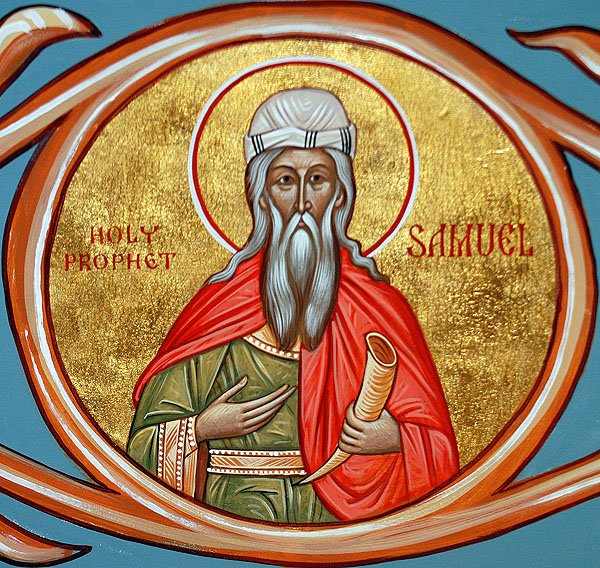
Prophet Samuel
The Prophet Samuel was the fifteenth and last of the Judges of Israel, living more than 1146 years before the Birth of Christ. He was descended from the Tribe of Levi, and was the son of Elkanah from Ramathaim-Zophim of Mount Ephraim. He was born, having been besought from the Lord through the prayers of his mother Hannah (therefore he received the name Samuel, which means “besought from God”). Eve
The Prophet Samuel was the fifteenth and last of the Judges of Israel, living more than 1146 years before the Birth of Christ. He was descended from the Tribe of Levi, and was the son of Elkanah from Ramathaim-Zophim of Mount Ephraim. He was born, having been besought from the Lord through the prayers of his mother Hannah (therefore he received the name Samuel, which means “besought from God”). Even before birth, he was dedicated to God. Her song, “My heart exults in the Lord,” is the third Old Testament ode of the Canon (1 Sam/1 Kings 2:1-10).
When the boy reached the age of three, his mother went with him to Shiloh and in accord with her vow dedicated him to the worship of God. She gave him into the care of the High Priest Eli, who at this time was a judge over Israel. The prophet grew in the fear of God, and at twelve years of age he had a revelation that God would punish the house of the High Priest Eli, because he did not restrain the impiety of his sons. Eli’s whole family was wiped out in a single day.
The prophecy was fulfilled when the Philistines, having slain in battle 30,000 Israelites (among them Hophni and Phinees, the sons of Eli the High Priest), gained victory and captured the Ark of the Covenant. Hearing this, the High Priest Eli fell backwards from his seat at the gate, and breaking his back, he died. The wife of Phinees, upon hearing what had happened in this very hour, gave birth to a son (Ichabod) and died with the words: “The glory has departed from Israel, for the Ark of God is taken away” (1 Sam/1 Kgs 4: 22).
Upon the death of Eli, Samuel became the judge of the nation of Israel. The Ark of God was returned by the Philistines on their own initiative. After returning to God, the Israelites returned to all the cities that the Philistines had taken. In his old age, the Prophet Samuel made his sons Joel and Abiah judges over Israel, but they did not follow the integrity and righteous judgment of their father, since they were motivated by greed.
Then the elders of Israel, wanting the nation of God to be “like other nations” (1 Sam/1 Kgs 8: 20), demanded of the Prophet Samuel that they have a king. The Prophet Samuel anointed Saul as king, but saw in this a downfall of the people, whom God Himself had governed until this time, announcing His will through “judges,” His chosen saints. Resigning the position of judge, the Prophet Samuel asked the people if they consented to his continued governance, but no one stepped forward for him.
After denouncing the first king, Saul, for his disobedience to God, the Prophet Samuel anointed David as king. He had offered David asylum, saving him from the pursuit of King Saul. The Prophet Samuel died in extreme old age. His life is recorded in the Bible (1 Sam/1 Kgs; Sirach 46:13-20).
In the year 406 A.D. the relics of the Prophet Samuel were transferred from Judea to Constantinople.
Troparion - Tone 2
You were given to a barren womb as a most precious gift, / and were sacrificed to your Lord as a whole burnt offering. / You served Him with holiness and righteousness; / therefore O Samuel, God's Prophet, we honor you as an intercessor for our souls.
Kontakion - Tone 8
You arrived by your mother's prayers, bearing the name “God has heard.” / You were called by the Lord from infancy, O revered Prophet Samuel, / you shepherded the rebellious people well and became the founder of the kingdom of Israel; / entreat the True God for us who honor you with faith / that He may save our souls.
Holy Martyr Luke of Bouleutos
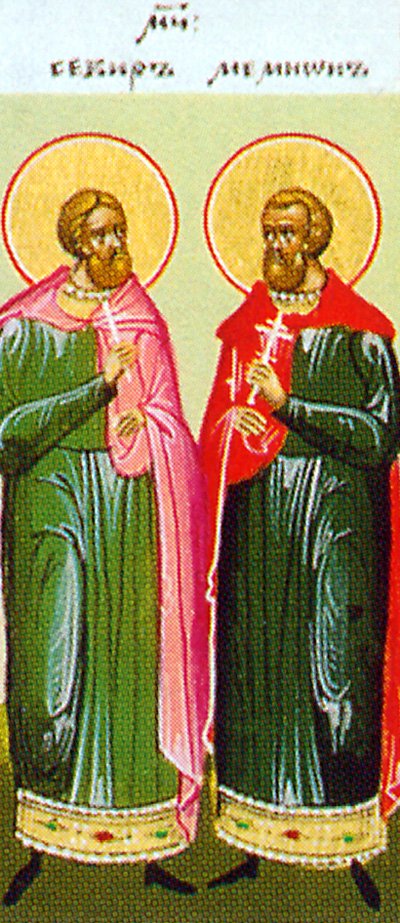
Hieromartyr Philip, Bishop of Heraklion, and those with him (2nd c.)
Saint Philip was Bishop of Heraclea, and suffered martyrdom with Saints Severus, Memnon, and thirty-seven others in Thrace during the third century. They all suffered in Philippopolis, Thrace under the emperor Diocletian (284-305).
When the governor learned that the Saint Severus had converted the centurion Memnon to Christ, he ordered that Memnon be tortured.
Saint Philip was Bishop of Heraclea, and suffered martyrdom with Saints Severus, Memnon, and thirty-seven others in Thrace during the third century. They all suffered in Philippopolis, Thrace under the emperor Diocletian (284-305).
When the governor learned that the Saint Severus had converted the centurion Memnon to Christ, he ordered that Memnon be tortured. They cut three strips of skin from Saint Memnon’s back.
Saint Severus was raked with iron hooks. Then they put red-hot rings on his fingers and girded him with a red-hot iron belt. After these tortures, he was blinded.
Bishop Philip and the others had their hands and feet cut off and were thrown into a fiery oven. Their names are Orion, Antilinus, Molias, Eudemon, Silvanus, Sabinus, Eustathius, Straton, Bosua of Byzantium, Timothy, Palmatus, Mestus, Nikon, Difilus, Dometian, Maximus, Neophytus, Victor, Rinus, Satorninus, Epaphroditus, Cercanus, Gaius, Zoticus, Cronion, Anthony, Horus, Zoilus, Tyrannus, Agathon, Panstenus [Parthenias], Achilles, Panthyrias, Chrysanthus, Athenodorus, Pantoleon, Theosebius, Genephlius of Philippopolis.
Troparion - Tone 4
Your holy martyrs O Lord, / through their sufferings have received incorruptible crowns from You, our God. / For having Your strength, they laid low their adversaries, / and shattered the powerless boldness of demons. / Through their intercessions, save our souls!
Scripture Readings
☩Epistle
1 Corinthians 14:26-40
26
How is it then, brethren? when ye come together, every one of you hath a psalm, hath a doctrine, hath a tongue, hath a revelation, hath an interpretation. Let all things be done unto edifying.
27
If any man speak in an unknown tongue, let it be by two, or at the most by three, and that by course; and let one interpret.
28
But if there be no interpreter, let him keep silence in the church; and let him speak to himself, and to God.
29
Let the prophets speak two or three, and let the other judge.
30
If any thing be revealed to another that sitteth by, let the first hold his peace.
31
For ye may all prophesy one by one, that all may learn, and all may be comforted.
32
And the spirits of the prophets are subject to the prophets.
33
For God is not the author of confusion, but of peace, as in all churches of the saints.
34
Let your women keep silence in the churches: for it is not permitted unto them to speak; but they are commanded to be under obedience, as also saith the law.
35
And if they will learn any thing, let them ask their husbands at home: for it is a shame for women to speak in the church.
36
What? came the word of God out from you? or came it unto you only?
37
If any man think himself to be a prophet, or spiritual, let him acknowledge that the things that I write unto you are the commandments of the Lord.
38
But if any man be ignorant, let him be ignorant.
39
Wherefore, brethren, covet to prophesy, and forbid not to speak with tongues.
40
Let all things be done decently and in order.
☩Gospel
Matthew 21:12-14, 17-20
12
And Jesus went into the temple of God, and cast out all them that sold and bought in the temple, and overthrew the tables of the moneychangers, and the seats of them that sold doves,
13
And said unto them, It is written, My house shall be called the house of prayer; but ye have made it a den of thieves.
14
And the blind and the lame came to him in the temple; and he healed them.
17
And he left them, and went out of the city into Bethany; and he lodged there.
18
Now in the morning as he returned into the city, he hungered.
19
And when he saw a fig tree in the way, he came to it, and found nothing thereon, but leaves only, and said unto it, Let no fruit grow on thee henceforward for ever. And presently the fig tree withered away.
20
And when the disciples saw it, they marvelled, saying, How soon is the fig tree withered away!
Liturgical data sourced from OCA.org and orthocal.info