
Fasting Rules
 Meat
Allowed
 Fish
Allowed
 Dairy
Allowed
 Oil
Allowed
 Wine
Allowed
Saints & Commemorations

Apostle Thaddeus of the Seventy
Saint Thaddeus, Apostle of the Seventy, was by descent a Hebrew, and he was born in the Syrian city of Edessa. The holy Apostle Thaddeus of the Seventy must be distinguished from Saint Jude, also called Thaddeus or Levi (June 19), who was one of the Twelve Apostles.
When he came to Jerusalem for a feastday, he heard the preaching of John the Forerunner.
Saint Thaddeus, Apostle of the Seventy, was by descent a Hebrew, and he was born in the Syrian city of Edessa. The holy Apostle Thaddeus of the Seventy must be distinguished from Saint Jude, also called Thaddeus or Levi (June 19), who was one of the Twelve Apostles.
When he came to Jerusalem for a feastday, he heard the preaching of John the Forerunner. After being baptized by him in the Jordan, he remained in Palestine. He saw the Savior, and became His follower. He was chosen by the Lord to be one of the Seventy Disciples, whom He sent by twos to preach in the cities and places where He intended to visit (Luke. 10: 1).
After the Ascension of the Savior to Heaven, Saint Thaddeus preached the good news in Syria and Mesopotamia. He came preaching the Gospel to Edessa and he converted King Abgar, the people and the pagan priests to Christ. He backed up his preaching with many miracles (about which Abgar wrote to the Assyrian emperor Nerses). He established priests there and built up the Edessa Church.
Prince Abgar wanted to reward Saint Thaddeus with rich gifts, but he refused and went preaching to other cities, converting many pagans to the Christian Faith. He went to the city of Beirut to preach, and he founded a church there. It was in this city that he peacefully died in the year 44. (The place of his death is indicated as Beirut in the Slavonic MENAION, but according to other sources he died in Edessa. According to an ancient Armenian tradition, Saint Thaddeus, after various tortures, was beheaded by the sword on December 21 in the Artaz region in the year 50).
Troparion - Tone 4
O holy Apostle Thaddeus, witness of God, / Who appeared in the flesh for our sake, / you brought the light of saving grace to those in darkness / and were revealed as an excellent physician to those in Edessa. / Wherefore shelter those who fervently seek you.
Kontakion - Tone 4
The Church has acquired you as a brilliant star, / and is ever enlightened by your miracles, O Apostle Thaddeus. / Save those who in faith honor your memory.
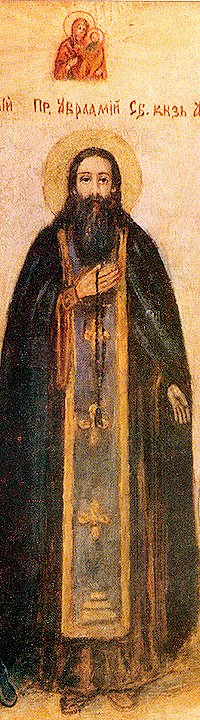
Avram, Archimandrite of Smolensk
Saint Abramius of Smolensk, a preacher of repentance and the Dread Last Judgment, was born in the mid-twelfth century at Smolensk of rich parents, who had twelve daughters before him, and they begged God for a son.
From childhood he grew up in the fear of God, he was often in church and had the opportunity to read books.
Saint Abramius of Smolensk, a preacher of repentance and the Dread Last Judgment, was born in the mid-twelfth century at Smolensk of rich parents, who had twelve daughters before him, and they begged God for a son.
From childhood he grew up in the fear of God, he was often in church and had the opportunity to read books. The parents hoped that their only son would enter into marriage and continue their illustrious lineage, but he sought a different life. After the death of his parents, having given away all his wealth to monasteries, to churches and to the destitute, the saint walked through the city in rags, asking God to show him the way to salvation.
He was tonsured in the monastery of the Most Holy Theotokos, five versts from Smolensk, at Selischa. Having passed through various obediences there, the monk fervently occupied himself with copying books, culling spiritual riches from them. The Smolensk prince Roman Rostislavich (+ 1170) started a school in the city, in which they taught not only in Slavonic, but also from Greek and Latin books. The Prince himself had a large collection of books, which Saint Abramius used. He had struggled for more than 30 years at the monastery, when in the year 1198 the igumen persuaded him to accept the dignity of presbyter. Every day he served the Divine Liturgy and fulfilled the obedience of clergy not only for the brethren, but also for the laity.
Soon the monk became widely known. This aroused the envy of the brethren, and then of the igumen also, and five years later, the monk was compelled to transfer to the Exaltation of the Cross monastery in Smolensk itself. With offerings from the devout, he embellished the cathedral church of the poor monastery with icons, and with curtains and candle-stands. He himself painted two icons on themes which most concerned him. On one he depicted the Dread Last judgment, and on the other the suffering of the trials of life. Lean and pale from extreme toil, in priestly garb the ascetic resembled Saint Basil the Great in appearance. The saint was strict both towards himself, and towards his spiritual children. He preached constantly in church and to those coming to him in his cell, conversing with rich and poor alike.
The city notables and the clergy demanded that Bishop Ignatius bring the monk to trial, accusing him of seducing women and tempting his spiritual children. But even more terrible were the accusations of heresy and the reading of forbidden books. For this they proposed to drown or burn the ascetic. At the trial by the Prince and the Bishop, the saint answered all the false accusations. Despite this, they forbade him to serve as a priest and returned him to his former monastery of the Most Holy Theotokos . A terrible drought occurred in consequence of God’s wrath over the unjust sentence, and only when Saint Ignatius pardoned Saint Abramius, permitting him to serve and preach, did the rain again fall on Smolensk.
The bishop Saint Ignatius built a new monastery, in honor of the Placing of the Robe of the Most Holy Theotokos, and he entrusted the guidance of it to Saint Abramius, and he himself settled into it, retiring from the diocese because of age. Many wished to enter under the guidance of Saint Abramius, but he examined them very intensely and only after great investigation, so at his monastery there were only seventeen brethren. Saint Abramius, after the death of Saint Ignatius, having become his spiritual friend, urged the brethren, more than before, to think about death and to pray day and night, that they be not condemned in the Judgment by God.
Saint Abramius died after the year 1224, having spent 50 years in monasticism. Already at the end of the thirteenth century a service had been compiled to him, together with his disciple Saint Ephraim. The terrible Mongol-Tatar invasion, seen as the wrath of God for the nation’s sins, not only did not stifle the memory of Saint Abramius of Smolensk, but rather was a reminder to people of his calling to repentance and recollection of the dread Last Judgment.
Troparion - Tone 8
By a flood of tears you made the desert fertile, / and your longing for God brought forth fruits in abundance. / By the radiance of miracles you illumined the whole universe! / O our holy father Abramius, pray to Christ our God to save our souls!
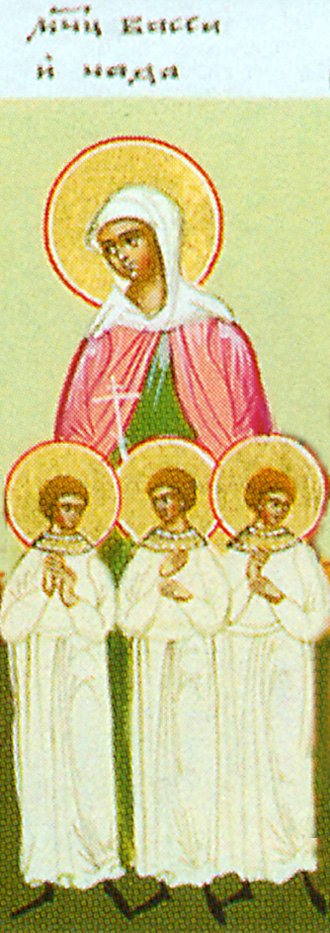
Holy Martyrs Bassa and her sons Theognis, Agapios, and Pistis (4th c.)
The Martyr Bassa with her sons Theognis, Agapius and Pistus, lived in the city of Macedonian Edessa and she was married to a pagan priest. From childhood she had been raised in the Christian Faith, which she passed on to her sons.
During the reign of the emperor Maximian Galerius (305-311), the husband denounced his wife and children to the governor.
The Martyr Bassa with her sons Theognis, Agapius and Pistus, lived in the city of Macedonian Edessa and she was married to a pagan priest. From childhood she had been raised in the Christian Faith, which she passed on to her sons.
During the reign of the emperor Maximian Galerius (305-311), the husband denounced his wife and children to the governor. In spite of threats, the boys refused to offer sacrifice to idols, so they were tortured and put to death. The eldest son, Theognis, was raked with iron claws, then he was beheaded. The skin of the young Agapius was flayed from head to chest, but the martyr did not utter a sound. The youngest son Pistus was tortured and beheaded, just as his brothers had been. One account says that the three brothers suffered at Edessa in Macedonia. Another account says they died at Larissa in Thessaly, their homeland.
Saint Bassa was thrown into prison and was weakened by hunger, but an angel strengthened her with heavenly food. Under successive tortures she remained unharmed by fire, water and beasts. When they brought her to a pagan temple, she shattered the statue of Zeus. Then they threw the martyr into a whirlpool in the sea. But to everyone’s surprise a ship sailed up, and three radiant men pulled her up (Saint Νikόdēmos of the Holy Mountain (July 14) suggests that these were her children, martyred earlier). After eight days Saint Bassa came by ship to the governor of the island of Alona, not far from Cyzicus, in the Propontis or Sea of Marmora. After beating her with rods, they beheaded her.
By the year 450 there was already a church in honor of the holy martyr Bassa at Chalcedon.
Troparion - Tone 4
Your holy martyr Bassa and her sons, O Lord, / through their sufferings have received incorruptible crowns from You, our God. / For having Your strength, they laid low their adversaries, / and shattered the powerless boldness of demons. / Through their intercessions, save our souls
Holy Forefathers Abraham, Isaac, and Jacob
They are also commemorated on the Sunday of the Holy Forefathers, before Nativity.
Scripture Readings
☩Epistle
Romans 14:6-9
6
He that regardeth the day, regardeth it unto the Lord; and he that regardeth not the day, to the Lord he doth not regard it. He that eateth, eateth to the Lord, for he giveth God thanks; and he that eateth not, to the Lord he eateth not, and giveth God thanks.
7
For none of us liveth to himself, and no man dieth to himself.
8
For whether we live, we live unto the Lord; and whether we die, we die unto the Lord: whether we live therefore, or die, we are the Lord’s.
9
For to this end Christ both died, and rose, and revived, that he might be Lord both of the dead and living.
☩Gospel
Matthew 15:32-39
32
Then Jesus called his disciples unto him, and said, I have compassion on the multitude, because they continue with me now three days, and have nothing to eat: and I will not send them away fasting, lest they faint in the way.
33
And his disciples say unto him, Whence should we have so much bread in the wilderness, as to fill so great a multitude?
34
And Jesus saith unto them, How many loaves have ye? And they said, Seven, and a few little fishes.
35
And he commanded the multitude to sit down on the ground.
36
And he took the seven loaves and the fishes, and gave thanks, and brake them, and gave to his disciples, and the disciples to the multitude.
37
And they did all eat, and were filled: and they took up of the broken meat that was left seven baskets full.
38
And they that did eat were four thousand men, beside women and children.
39
And he sent away the multitude, and took ship, and came into the coasts of Magdala.
Liturgical data sourced from OCA.org and orthocal.info