
Fasting Rules
 Meat
Allowed
 Fish
Allowed
 Dairy
Allowed
 Oil
Allowed
 Wine
Allowed
Saints & Commemorations
Ven. Anthony and Theodosius of Kiev Caves
Martyr Mamas of Caesarea in Cappadocia (275), and his parents, Martyrs Theodotus and Rufina
He began his life in the cruelest of circumstances: both of his parents were imprisoned for their faith in Christ. First his father, Theodotus, died in prison, then his mother, Rufina, died shortly after his birth, so the infant was left alone in prison beside the bodies of his parents. But an angel appeared to the widow Ammia, telling her to go to the prison and rescue the child.
He began his life in the cruelest of circumstances: both of his parents were imprisoned for their faith in Christ. First his father, Theodotus, died in prison, then his mother, Rufina, died shortly after his birth, so the infant was left alone in prison beside the bodies of his parents. But an angel appeared to the widow Ammia, telling her to go to the prison and rescue the child. Ammia obtained the city governor’s permission to bury the parents and bring the child home. He was called Mamas because he was mute until the age of five and his first word was `Mama’. Despite his late beginning, he showed unusual intelligence and, having been brought up in piety, soon openly proclaimed his Christian faith. When he was only fifteen years old he was arrested and brought before the Emperor Aurelian. The Emperor, perhaps seeking to spare the boy, told him to deny Christ only with his lips, and the State would not concern itself with his heart. Mamas replied `I shall not deny my God and King Jesus Christ either in my heart or with my lips.’ He was sent to be tortured, but miraculously escaped and lived in the mountains near Caesarea. There he lived in solitude and prayer and befriended many wild beasts. In time, he was discovered by the persecutors and stabbed to death with a trident by a pagan priest.
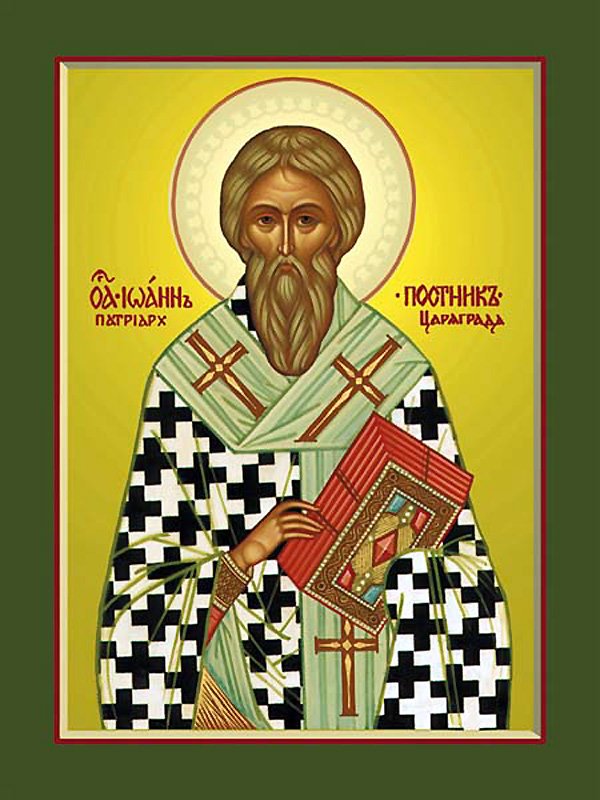
St John IV, Patriarch of Constantinople, known as John the Faster (595)
Our Holy Father John was born in Constantinople, the Queen of Cities. At first he worked as a goldsmith, and everyone expected him to continue in that occupation. From his youth, however, he was inclined toward the monastic life. He also possessed a rare gift for continence and a natural love for fasting, and thus he was known as “the Faster.” Because of his reputation for virtue, he was ordained as a deacon by Patriarch John III, and later he received the grace of the priesthood. Sai
Our Holy Father John was born in Constantinople, the Queen of Cities. At first he worked as a goldsmith, and everyone expected him to continue in that occupation. From his youth, however, he was inclined toward the monastic life. He also possessed a rare gift for continence and a natural love for fasting, and thus he was known as “the Faster.” Because of his reputation for virtue, he was ordained as a deacon by Patriarch John III, and later he received the grace of the priesthood. Saint John was found worthy to behold a vision which showed that he would become be a worthy recipient of God’s grace, for the spiritual enlightenment of his flock. He read the Holy Scriptures and other ecclesiastical books every day, thereby enriching his knowledge.
Once, when he was a young man, John was walking with Eusebius, an old monk from Palestine. Suddenly, a bodiless voice spoke to Eusebius: “Abba, do not walk to the right of the great John.” It was the voice of God, foretelling the great service to which John would shortly be called.
After the death of Patriarch Eutychius, Saint John was chosen to succeed him. He did not want to accept the office, but he was frightened by a heavenly vision, and so he consented. By the example of his own life he taught all believers to restrain their capricious desires and to control themselves. The hierarch was unable to abide his flock’s blatant disregard for the institutions of the Church. When the citizens of Constantinople decided to give in to their passions by attending a horse show in the Hippodrome on eve of the Feast of Pentecost, the hierarch fell on his knees before God and fervently prayed that the Lord would thwart their impious intention. As soon as the people began to make their way to the Hippodrome, a terrible storm arose with thunder, rain and hailstones so that everyone dispersed in fear and came to realize the inappropriateness of such entertainment.
St John was Patriarch of Constantinople from 582 - 595, and was the first to use the title “Ecumenical Patriarch.”
He was a great faster, intercessor and wonderworker right up to the time of his death. Distinguished for his abstinence and prayer, Saint John had such a love for the poor that he refused them nothing from his estate. After his death, his only personal possessions were found to be a wooden spoon, a linen shirt and an old garment. His writings on repentance and Confession are well known.
After a virtuous life of piety, during which he performed many miracles, Saint John reposed on September 2, 595. His grace-filled relics were entombed in the Church of the Holy Apostles.
Saint John is also commemorated on August 30.
Troparion - Tone 4
In truth you were revealed to your flock as a rule of faith, / an image of humility and a teacher of abstinence; / your humility exalted you; / your poverty enriched you. / Hierarch Father John, / entreat Christ our God / that our souls may be saved.
Kontakion - Tone 4
You became like your namesake, the Forerunner, O John, / for you were radiant with fasting and purity; / and Christ has revealed you / as a worthy shepherd of his flock: / Now pray for those who honor your holy memory!
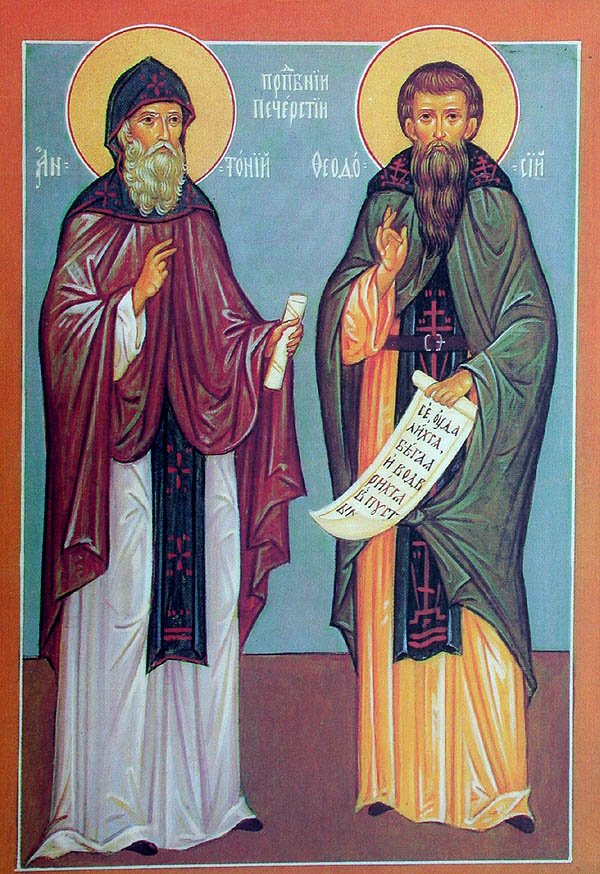
Ven. Anthony of the Kiev Caves
Saint Anthony of the Kiev Caves was born in the year 983 at Liubech, not far from Chernigov, and was named Antipas in Baptism. Possessing the fear of God from his youth, he desired to be clothed in the monastic schema. When he reached a mature age, he wandered until he arrived on Mt. Athos, burning with the desire to emulate the deeds of its holy inhabitants.
Saint Anthony of the Kiev Caves was born in the year 983 at Liubech, not far from Chernigov, and was named Antipas in Baptism. Possessing the fear of God from his youth, he desired to be clothed in the monastic schema. When he reached a mature age, he wandered until he arrived on Mt. Athos, burning with the desire to emulate the deeds of its holy inhabitants. Here he received monastic tonsure, and the young monk pleased God in every aspect of his spiritual struggles on the path of virtue. He particularly excelled in humility and obedience, so that all the monks rejoiced to see his holy life.
The igumen saw in Saint Anthony the great future ascetic, and inspired by God, he sent him back to his native land, saying, “Anthony, it is time for you to guide others in holiness. Return to your own Russian land, and be an example for others. May the blessing of the Holy Mountain be with you.”
Returning to the land of Rus, Anthony began to make the rounds of the monasteries about Kiev, but nowhere did he find that strict life which had drawn him to Mt. Athos.
Through the Providence of God, Anthony came to the hills of Kiev by the banks of the River Dnieper. The forested area near the village of Berestovo reminded him of his beloved Athos. There he found a cave which had been dug out by the Priest Hilarion, who later became Metropolitan of Kiev (October 21). Since he liked the spot, Anthony prayed with tears, “Lord, let the blessing of Mt. Athos be upon this spot, and strengthen me to remain here.” He began to struggle in prayer, fasting, vigil and physical labor. Every other day, or every third day, he would eat only dry bread and a little water. Sometimes he did not eat for a week. People began to come to the ascetic for his blessing and counsel, and some decided to remain with the saint.
Among Anthony’s first disciples was Saint Nikon (March 23), who tonsured Saint Theodosius of the Caves (May 3) at the monastery in the year 1032.
The virtuous life of Saint Anthony illumined the Russian land with the beauty of monasticism. Saint Anthony lovingly received those who yearned for the monastic life. After instructing them how to follow Christ, he asked Saint Nikon to tonsure them. When twelve disciples had gathered about Saint Anthony, the brethren dug a large cave and built a church and cells for the monks within it.
After he appointed Abbot Barlaam to guide the brethren, Saint Anthony withdrew from the monastery. He dug a new cave for himself, then hid himself within it. There too, monks began to settle around him. Afterwards, the saint built a small wooden church in honor of the Dormition of the Mother of God over the Far Caves.
At the insistence of Prince Izyaslav, the igumen Barlaam withdrew to the Dimitriev monastery. With the blessing of Saint Anthony and with the general agreement of the brethren, the meek and humble Theodosius was chosen as igumen. By this time, the number of brethren had already reached a hundred men. The Kiev Great Prince Izyaslav (+ 1078) gave the monks the hill on which the large church and cells were built, with a palisade all around. Thus, the renowned monastery over the caves was established. Describing this, the chronicler remarks that while many monasteries were built by emperors and nobles, they could not compare with those which are built with holy prayers and tears, and by fasting and vigil. Although Saint Anthony had no gold, he built a monastery which became the first spiritual center of Rus.
For his holiness of life, God glorified Saint Anthony with the gift of clairvoyance and wonderworking. One example of this occurred during the construction of the Great Caves church. The Most Holy Theotokos Herself stood before him and Saint Theodosius in the Blachernae church in Constantinople, where they had been miraculously transported without leaving their own monastery. Actually, two angels appeared in Constantinople in their forms (See May 3, the account of the Kiev Caves Icon of the Most Holy Theotokos). Having received gold from the Mother of God, the saints commissioned master architects, who came from Constantinople to the Russian land on the command of the Queen of Heaven to build the church at the Monastery of the Caves. During this appearance, the Mother of God foretold the impending death of Saint Anthony, which occurred on July 10, 1073.
Through Divine Providence, the relics of Saint Anthony remain hidden.
Troparion - Tone 8
By a flood of tears you made the desert fertile, / and your longing for God brought forth fruits in abundance. / By the radiance of miracles you illumined the whole universe! / O our holy father Anthony, pray to Christ our God to save our souls!
Righteous Eleazar, son of Aaron and second High Priest of Israel
He was the son of Aaron, the first High Priest of Israel, and he in turn became the second High Priest. He reposed in peace.
Repose of Hieromonk Seraphim (Rose) of Platina (1982). (August 20 OC)
This modern-day pioneer of Orthodoxy and monasticism in America has not been glorified as a Saint of the Church, though many individuals ask his prayers and icons of him have been painted.
Eugene Rose was born in 1934 in California, where he spent all his life. Following an intense spiritual search that took him through study of several Eastern Religions (he earned a graduate degree in Chinese Philosophy), he providentially encountered the Russian Orthodox community in San Francisco, and in 1962 was received into the Orthodox Church.
This modern-day pioneer of Orthodoxy and monasticism in America has not been glorified as a Saint of the Church, though many individuals ask his prayers and icons of him have been painted.
Eugene Rose was born in 1934 in California, where he spent all his life. Following an intense spiritual search that took him through study of several Eastern Religions (he earned a graduate degree in Chinese Philosophy), he providentially encountered the Russian Orthodox community in San Francisco, and in 1962 was received into the Orthodox Church. The sanctity of Archbishop (now Saint) John Maximovich was especially important to his development in the Faith.
After a few more years living in the world, he and his friend Gleb Podmosensky founded a small monastic brotherhood in the wilderness of far northern California; in time they were tonsured as monks and ordained as priests: Fr Seraphim and Fr Herman. At a time when Orthodoxy was almost invisible in North America, the monastery became a beacon of Orthodoxy for Americans seeking an authentic Christian faith.
Fr Seraphim reposed in 1982 at the age of forty-eight. Many of his writings are still in print. A biography, Father Seraphim Rose: His life and works, by Hieromonk Damascene, is highly recommended.
Scripture Readings
☩Epistle
2 Corinthians 4:1-6
1
Therefore seeing we have this ministry, as we have received mercy, we faint not;
2
But have renounced the hidden things of dishonesty, not walking in craftiness, nor handling the word of God deceitfully; but by manifestation of the truth commending ourselves to every man’s conscience in the sight of God.
3
But if our gospel be hid, it is hid to them that are lost:
4
In whom the god of this world hath blinded the minds of them which believe not, lest the light of the glorious gospel of Christ, who is the image of God, should shine unto them.
5
For we preach not ourselves, but Christ Jesus the Lord; and ourselves your servants for Jesus’ sake.
6
For God, who commanded the light to shine out of darkness, hath shined in our hearts, to give the light of the knowledge of the glory of God in the face of Jesus Christ.
☩Gospel
Matthew 24:13-28
13
But he that shall endure unto the end, the same shall be saved.
14
And this gospel of the kingdom shall be preached in all the world for a witness unto all nations; and then shall the end come.
15
When ye therefore shall see the abomination of desolation, spoken of by Daniel the prophet, stand in the holy place, (whoso readeth, let him understand:)
16
Then let them which be in Judea flee into the mountains:
17
Let him which is on the housetop not come down to take any thing out of his house:
18
Neither let him which is in the field return back to take his clothes.
19
And woe unto them that are with child, and to them that give suck in those days!
20
But pray ye that your flight be not in the winter, neither on the sabbath day:
21
For then shall be great tribulation, such as was not since the beginning of the world to this time, no, nor ever shall be.
22
And except those days should be shortened, there should no flesh be saved: but for the elect’s sake those days shall be shortened.
23
Then if any man shall say unto you, Lo, here is Christ, or there; believe it not.
24
For there shall arise false Christs, and false prophets, and shall shew great signs and wonders; insomuch that, if it were possible, they shall deceive the very elect.
25
Behold, I have told you before.
26
Wherefore if they shall say unto you, Behold, he is in the desert; go not forth: behold, he is in the secret chambers; believe it not.
27
For as the lightning cometh out of the east, and shineth even unto the west; so shall also the coming of the Son of man be.
28
For wheresoever the carcase is, there will the eagles be gathered together.
Liturgical data sourced from OCA.org and orthocal.info