
Fasting Rules
 Meat
Abstain
 Fish
Abstain
 Dairy
Abstain
 Oil
Abstain
 Wine
Abstain
Saints & Commemorations
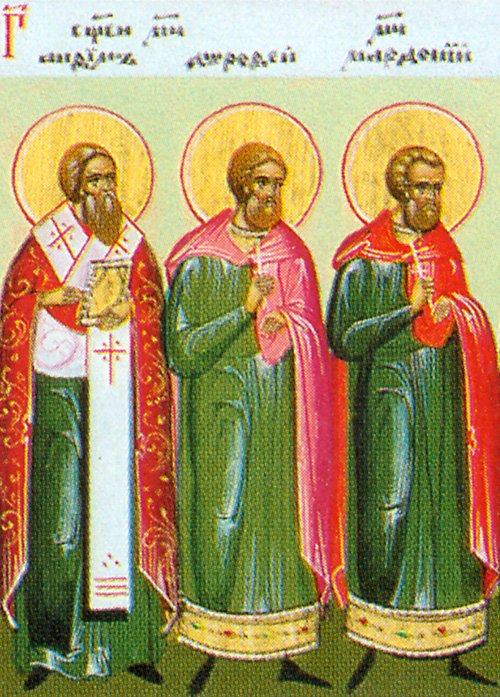
Hieromartyr Anthimus, Bishop of Nicomedia
The Hieromartyr Anthimus, Bishop of Nicomedia, and those with him suffered during the persecution against Christians under the emperors Diocletian (284-305) and Maximian (305-311). The persecution became particularly intense after a fire at the imperial court at Nicomedia. The pagans accused the Christians of setting the fire and reacted against them with terrible ferocity.
The Hieromartyr Anthimus, Bishop of Nicomedia, and those with him suffered during the persecution against Christians under the emperors Diocletian (284-305) and Maximian (305-311). The persecution became particularly intense after a fire at the imperial court at Nicomedia. The pagans accused the Christians of setting the fire and reacted against them with terrible ferocity.
In Nicomedia alone, on the day of the Nativity of Christ, as many as twenty thousand Christians were burned inside a church. However, this monstrous inhumanity did not frighten the Christians, who firmly confessed their faith and endured martyrdom for Christ.
Saints Dorotheus, Mardonius, Migdonius, Peter, Indes and Gorgonius died during this period. One of them was beheaded by the sword, others perished by burning, or being buried alive, or by drowning in the sea. The soldier Zeno boldly denounced the emperor Maximian, for which he was stoned, and then beheaded.
Then the holy Virgin Martyr Domna, a former pagan priestess, perished at the hands of the pagans, and also Saint Euthymius, because of their concern that the bodies of the holy martyrs should be buried. Bishop Anthimus, who headed the Church of Nicomedia, hid himself in a village not far from Nicomedia at the request of his flock. From there he sent letters to the Christians, urging them to cleave firmly to the holy Faith and not to fear tortures.
One of his letters, sent with Deacon Theophilus, was intercepted and given to the emperor Maximian. Theophilus was interrogated and died under torture, without revealing to his torturers the whereabouts of Bishop Anthimus. After a while Maximian managed to learn where Saint Anthimus was, and sent a detachment of soldiers after him.
The bishop met them along the way, but the soldiers did not recognize the saint. He invited them to join him and provided a meal, after which he revealed that he was the one they sought. The soldiers did not know what to do. They wanted to leave him and tell the emperor that they had not found him. Bishop Anthimus was not one to tolerate a lie, and so he would not consent to this.
The soldiers came to believe in Christ and received holy Baptism. The saint ordered them to carry out the emperor’s instructions. When Bishop Anthimus was brought before the emperor, the emperor ordered that the instruments of execution be brought out and placed before him. “Do you think, emperor, to frighten me with these tools of execution?” asked the saint. “No indeed, you cannot frighten one who wishes to die for Christ! Execution is frightening only for the cowardly, for whom the present life is most precious.” The emperor then directed that the saint be fiercely tortured and beheaded by the sword.
Bishop Anthimus joyfully glorified God with his last breath, and received the crown of martyrdom. (See December 28 for another account of the Nicomedian martyrs.)
Troparion - Tone 1
You protected your flock with your blood, / not fearing your adversaries. / Now you rejoice in heaven standing before the throne. / Glory to Christ who has strengthened you; / glory to your courage; / glory to your endurance, O holy Hieromartyr Anthimus!
Kontakion - Tone 4
Your holy martyrs O Lord, / through their sufferings have received incorruptible crowns from You, our God. / For having Your strength, they laid low their adversaries, / and shattered the powerless boldness of demons. / Through their intercessions, save our souls!
Holy Father Theoctistus and his fellow struggler Euthymius the Great
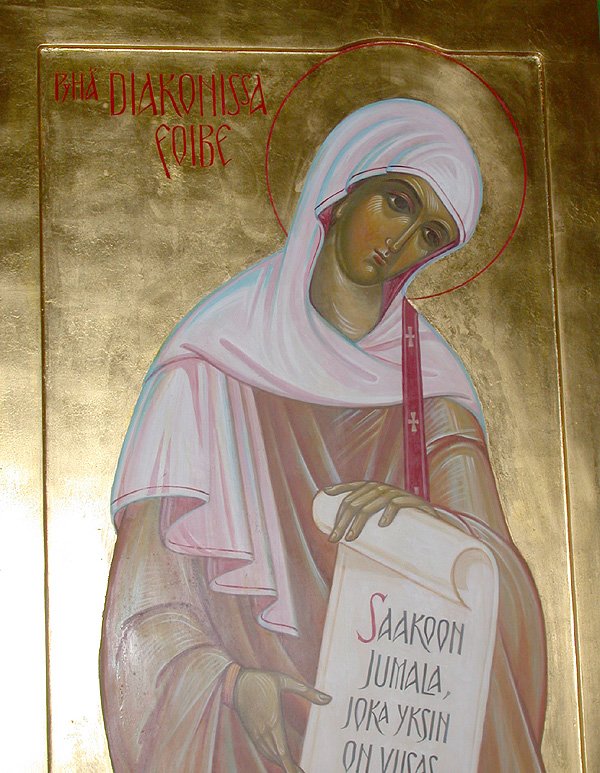
Phoebe the Deaconess
Saint Phoebe is mentioned by the Apostle Paul in his Epistle to the Romans 16:1-2. "I commend to you Phoebe, our sister, the deaconess 1 of the church of Cenchrea 2 that you may receive her in the Lord, as befits the saints, and may assist her in whatever business she has need of you, for she has been a helper of many, and of myself as well" (Romans 16:1-2).
Saint Phoebe is mentioned by the Apostle Paul in his Epistle to the Romans 16:1-2. "I commend to you Phoebe, our sister, the deaconess 1 of the church of Cenchrea 2 that you may receive her in the Lord, as befits the saints, and may assist her in whatever business she has need of you, for she has been a helper of many, and of myself as well" (Romans 16:1-2).
She may have been the one who delivered this Epistle, and then planned to continue her work in Rome.
1 Since Saint Paul called her diakonos, Origen concluded that this passage meant that women were appointed to the ministry of the Church (Commentary on Romans, Book 10, chapter 17). Saint John Chrysostom merely says: "Moreover, he has added to her rank by mentioning her as being a 'deaconess' (On Romans, Homily XXX). There are two possibilities: the word could mean 'servant' in a general sense (as in Matthew 20:26; 22:13; John 2:5:9; and in Romans 13:4. It may refer to her as one who had a special ministry to women, preparing them for Baptism, instruction, etc.
2 The village of Cenchrea (Κεγχρεαί) was a ship's wharf in Corinth.
Troparion - Tone 1
O Phoebe, converser with Saint Paul and divinely-inspired servant of God in the Church of Cenchrea, / as Christ's handmaiden, and filled with heavenly virtues, / therefore, we honor you with spiritual hymns. / Glory to Christ, Who glorified you. / Glory to Him Who crowned you. / Glory to Him Who, through you, grants us better things.
Kontakion - Tone 2
O godly-minded Phoebe, / companion of the Apostles and servant of Christ, / you were born on earth, yet cared for heavenly things; / entreat Him for those who with faith honor your memory.
Holy Martyr Basilissa (309)
The Martyr Basilissa of Nicomedia suffered for her faith in Christ under the emperor Diocletian. The Nicomedia governor Alexander gave orders to arrest the nine-year-old Basilissa and force her to renounce Christ. But the young maiden displayed unshakable firmness in fidelity to her Lord, and so she was subjected to protracted and intense torture.
The Martyr Basilissa of Nicomedia suffered for her faith in Christ under the emperor Diocletian. The Nicomedia governor Alexander gave orders to arrest the nine-year-old Basilissa and force her to renounce Christ. But the young maiden displayed unshakable firmness in fidelity to her Lord, and so she was subjected to protracted and intense torture.
Through the grace of God, the holy martyr remained alive and unharmed. This was evident to all those present as a manifestation of the power of God, and it so upset the governor Alexander, that he also came to believe in Christ and confessed himself a Christian.
Baptized later by Bishop Anthimus, he lived for a short while in deep repentance, and then departed peacefully to the Lord, as did Saint Basilissa some while after him. Her death was peaceful and accompanied by miraculous signs of God’s mercy.
Troparion - Tone 4
Your lamb Basilissa calls out to You, O Jesus, in a loud voice: / “I love You, my Bridegroom, and in seeking You I endure suffering. / In Baptism I was crucified so that I might reign in You, / and I died so that I might live with You. / Accept me as a pure sacrifice, / for I have offered myself in love.” / Through her prayers, save our souls, since You are merciful.
Our Holy Father Joannicius, Archbishop and first Patriarch of Serbia (1354)
Saint Joannicius, Patriarch of Serbia, was a native of the city of Prizren. At first, he was a secretary under King Karl (Charles) of Serbia, and later on from the year 1339, he guided the Church as Archbishop.
In the year 1346 a Council of all the Serbian archpastors, and including also the Patriarch of Bulgaria, at the wish of King Dushan, chose Archbishop Joannicius as Patriarch of the Serbian Orthodox Church.
Saint Joannicius, Patriarch of Serbia, was a native of the city of Prizren. At first, he was a secretary under King Karl (Charles) of Serbia, and later on from the year 1339, he guided the Church as Archbishop.
In the year 1346 a Council of all the Serbian archpastors, and including also the Patriarch of Bulgaria, at the wish of King Dushan, chose Archbishop Joannicius as Patriarch of the Serbian Orthodox Church. Saint Joannicius reposed on September 3, 1349 and was buried in the Pech monastery.
Troparion - Tone 4
In truth you were revealed to your flock as a rule of faith, / an image of humility and a teacher of abstinence; / your humility exalted you; / your poverty enriched you. / Hierarch Father Joannicius, / entreat Christ our God / that our souls may be saved.
Scripture Readings
☩Epistle
2 Corinthians 4:13-18
13
We having the same spirit of faith, according as it is written, I believed, and therefore have I spoken; we also believe, and therefore speak;
14
Knowing that he which raised up the Lord Jesus shall raise up us also by Jesus, and shall present us with you.
15
For all things are for your sakes, that the abundant grace might through the thanksgiving of many redound to the glory of God.
16
For which cause we faint not; but though our outward man perish, yet the inward man is renewed day by day.
17
For our light affliction, which is but for a moment, worketh for us a far more exceeding and eternal weight of glory;
18
While we look not at the things which are seen, but at the things which are not seen: for the things which are seen are temporal; but the things which are not seen are eternal.
☩Gospel
Matthew 24:27-33, 42-51
27
For as the lightning cometh out of the east, and shineth even unto the west; so shall also the coming of the Son of man be.
28
For wheresoever the carcase is, there will the eagles be gathered together.
29
Immediately after the tribulation of those days shall the sun be darkened, and the moon shall not give her light, and the stars shall fall from heaven, and the powers of the heavens shall be shaken:
30
And then shall appear the sign of the Son of man in heaven: and then shall all the tribes of the earth mourn, and they shall see the Son of man coming in the clouds of heaven with power and great glory.
31
And he shall send his angels with a great sound of a trumpet, and they shall gather together his elect from the four winds, from one end of heaven to the other.
32
Now learn a parable of the fig tree; When his branch is yet tender, and putteth forth leaves, ye know that summer is nigh:
33
So likewise ye, when ye shall see all these things, know that it is near, even at the doors.
42
Watch therefore: for ye know not what hour your Lord doth come.
43
But know this, that if the goodman of the house had known in what watch the thief would come, he would have watched, and would not have suffered his house to be broken up.
44
Therefore be ye also ready: for in such an hour as ye think not the Son of man cometh.
45
Who then is a faithful and wise servant, whom his lord hath made ruler over his household, to give them meat in due season?
46
Blessed is that servant, whom his lord when he cometh shall find so doing.
47
Verily I say unto you, That he shall make him ruler over all his goods.
48
But and if that evil servant shall say in his heart, My lord delayeth his coming;
49
And shall begin to smite his fellowservants, and to eat and drink with the drunken;
50
The lord of that servant shall come in a day when he looketh not for him, and in an hour that he is not aware of,
51
And shall cut him asunder, and appoint him his portion with the hypocrites: there shall be weeping and gnashing of teeth.
Liturgical data sourced from OCA.org and orthocal.info