
Fasting Rules
 Meat
Allowed
 Fish
Allowed
 Dairy
Allowed
 Oil
Allowed
 Wine
Allowed
Saints & Commemorations
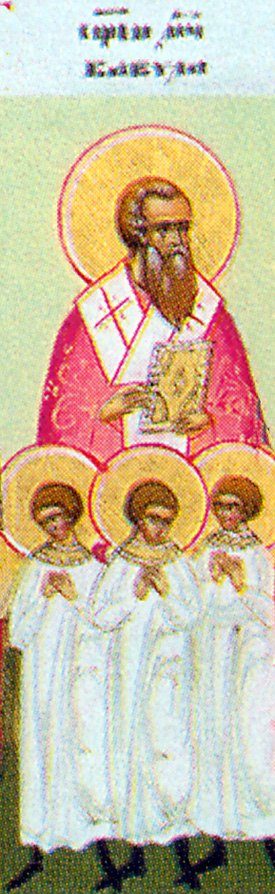
Hieromartyr Babylas, Bishop of Antioch
The Hieromartyr Babylas and with him the three youths Urban, Prilidian, Epolonius and their mother Christodoula died as martyrs under the emperor Decius (249-251). During his stay in their city of Antioch, the emperor arranged for a large festival in honor of the pagan gods.
At the same time, Babylas, the holy and God-fearing Bishop of Antioch, was serving the Divine Liturgy in church.
The Hieromartyr Babylas and with him the three youths Urban, Prilidian, Epolonius and their mother Christodoula died as martyrs under the emperor Decius (249-251). During his stay in their city of Antioch, the emperor arranged for a large festival in honor of the pagan gods.
At the same time, Babylas, the holy and God-fearing Bishop of Antioch, was serving the Divine Liturgy in church. He prayed for his flock and taught them to endure all tribulations for Christ with courage. The idolater Decius, curious to witness the Divine Mysteries, decided to enter the church.
News of this reached the bishop, so he went out to meet Decius and blocked the path to the church, for he was unwilling to permit impiety in the temple of God. When the emperor approached the church doors, Saint Babylas refused to let him enter, so the emperor had to abandon his intention. He wanted to take revenge on the saint right away, but when he saw the large throng of Christians, he feared they might riot.
The next day the angry emperor ordered that the church be set on fire, and for Bishop Babylas to be brought before him. When asked why he had insulted the imperial dignity by not allowing the emperor to enter the church, the holy bishop answered, “Anyone who would rise up against God and want to desecrate His sanctuary, is not worthy of respect, but has become the enemy of the Lord.”
Decius declared that the holy bishop must worship the idols in order to make up for his lack of respect for the emperor, or else face execution. After convincing himself that the martyr would remain steadfast in his faith, he commanded the military commander Victorinus to put him in heavy chains and lead him through the city in disgrace. The holy martyr replied, “Emperor, these chains are as venerable for me as your imperial crown is for you. For me, suffering for Christ is as desirable as the imperial power is for you. Death for the Immortal King is as precious to me as your life is to you.”
At the trial with Bishop Babylas were three young brothers, who did not forsake him even in this most difficult moment. Seeing them, the emperor asked, “Who are these children? “
“These are my spiritual children,” the saint replied, “and I have raised them in piety, I have given them an education, cultivated them with guidance, and here before you in a small body are these great young men and perfect Christians. Test them and see.”
The emperor tried in all sorts of ways to entice the youths and their mother Christodoula to renounce Christ, but in vain. Then, in a rage, he ordered each of them to be whipped with a number of blows corresponding to their age. The first received twelve blows, the second, ten, and the third, seven. Dismissing the mother and children, the torturer again summoned the bishop, telling him that the children had renounced Christ. He did not believe the lie, however.
Then he commanded all the martyrs be tied to a tree and burned with fire. Seeing the stoic bravery of the saints, the emperor finally condemned them to be beheaded with the sword.
Troparion - Tone 4
Your holy martyrs O Lord, / through their sufferings have received incorruptible crowns from You, our God. / For having Your strength, they laid low their adversaries, / and shattered the powerless boldness of demons. / Through their intercessions, save our souls!
Kontakion - Tone 4
You guarded the mighty works of faith in your heart, / therefore, you did not fear the tyrant; / preserve us as well, Hieromartyr Babylas, good servant of Christ.
Holy Prophet Moses, who beheld God.
What can we say of Moses? For his story read the Old Testament books of Exodus, Leviticus, Numbers and Deuteronomy. The Church holds him to be the author of the Pentateuch or Torah, the first five books of the Old Testament.
St John Mavropos, Metropolitan of Euchaita (1100)
He is best known for his part in the institution of the Synaxis of Sts Basil the Great, Gregory the Theologian and John Chrysostom (see January 30). The three holy hierarchs appeared to him and revealed that all three are united and equally honored in heaven, thus dispelling a spirit of factionalism that was disturbing Constantinople.
He is best known for his part in the institution of the Synaxis of Sts Basil the Great, Gregory the Theologian and John Chrysostom (see January 30). The three holy hierarchs appeared to him and revealed that all three are united and equally honored in heaven, thus dispelling a spirit of factionalism that was disturbing Constantinople. He is the composer of the Canon to the Most Sweet Jesus and the Canon to the Guardian Angel, both found in many prayer books. He reposed in peace. Mavropos is a nickname meaning ‘Black-foot’.
He is commemorated on June 14 on the Slavic Calendar.
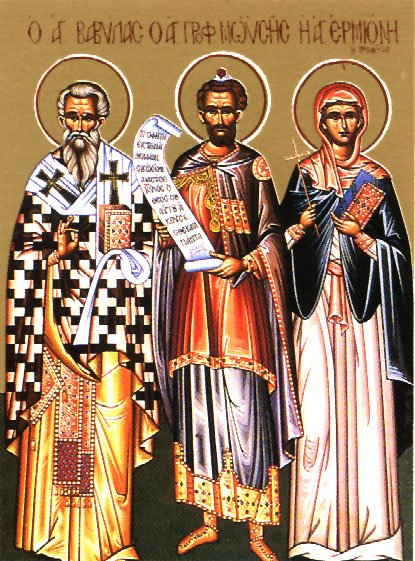
St Hermione, daughter of Apostle Philip (1st c.)
The Holy Virgin Martyr Hermione (Ἑρμιόνη) was one of the four daughters of Saint Philip the Deacon (October 11). She had the gift of prophecy (Acts 21:8), and devoted herself to apostolic labors.
Desiring to see the Holy Apostle John the Theologian, Hermione and her sister Eutykhida traveled to Ephesus in search of the Saint. While o
The Holy Virgin Martyr Hermione (Ἑρμιόνη) was one of the four daughters of Saint Philip the Deacon (October 11). She had the gift of prophecy (Acts 21:8), and devoted herself to apostolic labors.
Desiring to see the Holy Apostle John the Theologian, Hermione and her sister Eutykhida traveled to Ephesus in search of the Saint. While on their journey, they learned that he had reposed. Continuing on, the sisters met a disciple of Saint Paul, whose name was Petronius, and emulating him in all things, they became his disciples. Saint Hermione mastered the healing arts, rendering assistance to many Christians, and healing the sick by the power of Christ.
At that time, Emperor Trajan (98-117) was waging war against the Persians. When he heard of Saint Hermione's prophetic gift, he stopped at Ephesus in order to have her predict what his future would be. She told him that he would defeat the Persians, and that his son-in-law Hadrian would succeed him as the Emperor of Rome. Then Trajan discovered that Hermione was a Christian, and at first he tried to persuade her to renounce Christ with gentle admonitions. When this did not succeed, he commanded that she should be struck in the face for several hours, but she endured this suffering with patience. Moreover, she was comforted by a vision of the Lord, Who appeared in the form of Petronius, and sitting upon the Judgment Seat.
Convinced that Hermione would continue steadfast in her faith, Trajan released her. Later she built a hospice where she cared for the sick, treating their physical and spiritual infirmities.
Trajan’s successor, Hadrian, also demanded that the Saint be brought to trial for professing the Christian Faith. At first, the Emperor ordered that she be beaten mercilessly, then the soles of her feet were pierced with nails; and finally they threw her into a cauldron filled with boiling tar, lead, and sulphurous brimstone. The Saint bore all this without complaint, giving thanks to God.
The Lord was merciful and the fire was extinguished, the lead poured out, and Saint Hermione remained unharmed. Astonished, Hadrian went to the place of torture and touched the cauldron to ascertain whether it had cooled. When he touched the cauldron, he burned the skin of his hand, but even this did not dissuade the Emperor.
Then Hadrian ordered that she be thrown naked into a large red-hot copper vessel. Her Guardian Angel protected her and put out the fire, which burned those standing around her. The Saint stood in the vessel, as if on dewy grass, singing hymns of praise to the Lord.
When she was removed from the vessel, the Holy Martyr pretended that she was ready to sacrifice to the pagan "god" Hercules. The delighted Emperor had her taken to the temple, but when she prayed to the only true God, a loud thunderclap was heard, and all the idols in the pagan temple fell down and shattered.
In a rage, Trajan ordered that Saint Hermione be led out of the city and executed. Two servants, Theódoulos and Theótimos, were commanded to carry out his orders. Because they were in such a hurry to execute the Saint, they did not allow her time to pray, and their hands were withered. Then they believed in Jesus Christ, and falling at Saint Hermione's feet in repentance, they entreated her to pray that the Lord would heal them and call them to Himself before her martyrdom. By her prayers, that is what transpired. Afterward, she was beheaded and was buried at Ephesus.
Troparion - Tone 2
O pure one, you were an unsullied virgin, remaining chaste, and wedded to the Word, / Who was born of the Pure Virgin, according to the flesh; / thus you received divine grace for the labors of godliness, / to enlighten those in error; / therefore, O Hermione, Christ has glorified you.
Kontakion - Tone 1
As the fruitful offspring and unfading flower of Philip, / renowned among the holy Deacons, / you received divine grace, O most wondrous Hermione; / and you contended as a virgin, / offering your pure struggles to Christ our God Who glorified you.
Venerable Anthimos the Blind, New Ascetic (1782)
He was born on the island of Kephalonia in 1727, with the name Athanasios Kourouklis. At the age of seven he became blind as a result of smallpox. His devout mother prayed for his healing, and asked her priest to serve forty Ligurgies for her son’s healing. At the fortieth Liturgy, as the priest said ‘In the fear of God and with faith and love draw near,’ Athanasius cried out that he could see the priest’s vestments and chalice. He had
He was born on the island of Kephalonia in 1727, with the name Athanasios Kourouklis. At the age of seven he became blind as a result of smallpox. His devout mother prayed for his healing, and asked her priest to serve forty Ligurgies for her son’s healing. At the fortieth Liturgy, as the priest said ‘In the fear of God and with faith and love draw near,’ Athanasius cried out that he could see the priest’s vestments and chalice. He had recovered sight in his right eye. For a time he followed his father’s occupation as a seaman, but then took up the life of a monk, receiving the name Anthimos. At some point he went blind again, and soon thereafter had a vision: he was praying for the restoration of his sight before an icon of the Theotokos when two young men in radiant garments appeared and led him to the Mother of God herself, who told him ‘Depart, for your continual prayer that I restore your sight is not profitable to you.’ But the two young men pleaded for him, and the Theotokos said ‘Anthimos, because of your great piety and many prayers, I will restore your sight in part, but do not forget that, having gained temporal vision, you can lose that which is eternal.’ Thereafter, though Anthimos was almost completely blind, he could dimly discern the outlines of objects; but in compensation he was granted the gift of spiritual insight,and was able to predict the future and call by name those he had never met.
Saint Anthimos was about twenty when he entered monastic life, and lived on Mt Athos for awhile. Despite his blindness, he then took up a life of missionary work that took him throughout the Greek mainland and islands. Traveling from place to place he preached the Gospel, healed the sick, founded several monasteries. Once he restored a blind woman’s sight by his prayers, though he himself remained blind throughout his life. Throughout his amazing labors he maintained a life of the most severe asceticism, eating little, sleeping on a plank or on the floor.
In 1782, in the course of one of his many sea journeys, he told the sailors to change course for Kephalonia, saying ‘God’s will is not that I concern myself with [the mission he had undertaken], but that I go back and die in my monastery.’ On returning he fell ill and called his spiritual children to him. ‘My children, the hour has come for me to go where the Lord ordains. Death is the common lot of us all and is nothing to be afraid of. It is important rather to do your best to keep your promises and your monastic vows. The one thing necessary in this life is to please God and save your souls.’ Having said this, he fell asleep in peace, at the age of fifty-four. He was glorified as a Saint in 1976.
Note: It is sometimes said that celebrating Divine Liturgies for special intentions is ‘not Orthodox.’ The example of St Anthimos’ mother shows that the practice is a both traditional and efficacious.
Holy New Martyr Gorazd, Bishop of Slovakia and the Czech Lands (1942) (August 22 OC)
He was born in 1879 in Moravia and given the name Matthew Pavlik. He became a Roman Catholic priest, active in a movement for reform within the Roman Catholic Church. When Czechoslovakia became an independent state in 1919, about 800,000 Christians, including Fr Matthew, approached Bishop Dositheus of the Orthodox Patriarchate of Serbia, asking to be received into the Orthodox faith.
He was born in 1879 in Moravia and given the name Matthew Pavlik. He became a Roman Catholic priest, active in a movement for reform within the Roman Catholic Church. When Czechoslovakia became an independent state in 1919, about 800,000 Christians, including Fr Matthew, approached Bishop Dositheus of the Orthodox Patriarchate of Serbia, asking to be received into the Orthodox faith. Father Matthew was received into the Church in 1920; a year later was made Bishop of the Orthodox of Moravia and Silesia by Patriarch Demetrius of Serbia, and was named for St Gorazd, a disciple of St Methodius (July 27). Though many of the original ‘reform’ leaders turned back, finding the demands of Orthodoxy too difficult, Bishop Gorazd labored mightily for the restoration of Orthodoxy in Czechoslovakia: he established eleven parishes, translated the divine services into Czech, and published a Czech Prayer Book.
During the Second World War, two priests of the Orthodox Cathedral in Prague were arrested because some of the Czech resistance had taken refuge in the Cathedral. It was clear that the Nazis were planning retaliation against the entire Orthodox Church. Bishop Gorazd presented himself to the Nazis and, to save his priests, took full responsibility for the events in the Cathedral. He was arrested, tortured and finally shot on September 4 1942 (August 22 OC). Despite his selfless sacrifice, the Orthodox Church was severely persecuted by the Nazis: all the churches were closed and the priests sent to concentration camps in Germany.
Saint Gorazd was glorified by the Church of Serbia in 1961 and by the Patriarchate of Constantinople in 1987.
Scripture Readings
☩Epistle
1 Corinthians 1:3-9
3
Grace be unto you, and peace, from God our Father, and from the Lord Jesus Christ.
4
I thank my God always on your behalf, for the grace of God which is given you by Jesus Christ;
5
That in every thing ye are enriched by him, in all utterance, and in all knowledge;
6
Even as the testimony of Christ was confirmed in you:
7
So that ye come behind in no gift; waiting for the coming of our Lord Jesus Christ:
8
Who shall also confirm you unto the end, that ye may be blameless in the day of our Lord Jesus Christ.
9
God is faithful, by whom ye were called unto the fellowship of his Son Jesus Christ our Lord.
☩Gospel
Matthew 19:3-12
3
The Pharisees also came unto him, tempting him, and saying unto him, Is it lawful for a man to put away his wife for every cause?
4
And he answered and said unto them, Have ye not read, that he which made them at the beginning made them male and female,
5
And said, For this cause shall a man leave father and mother, and shall cleave to his wife: and they twain shall be one flesh?
6
Wherefore they are no more twain, but one flesh. What therefore God hath joined together, let not man put asunder.
7
They say unto him, Why did Moses then command to give a writing of divorcement, and to put her away?
8
He saith unto them, Moses because of the hardness of your hearts suffered you to put away your wives: but from the beginning it was not so.
9
And I say unto you, Whosoever shall put away his wife, except it be for fornication, and shall marry another, committeth adultery: and whoso marrieth her which is put away doth commit adultery.
10
His disciples say unto him, If the case of the man be so with his wife, it is not good to marry.
11
But he said unto them, All men cannot receive this saying, save they to whom it is given.
12
For there are some eunuchs, which were so born from their mother’s womb: and there are some eunuchs, which were made eunuchs of men: and there be eunuchs, which have made themselves eunuchs for the kingdom of heaven’s sake. He that is able to receive it, let him receive it.
Liturgical data sourced from OCA.org and orthocal.info