
Fasting Rules
 Meat
Allowed
 Fish
Allowed
 Dairy
Allowed
 Oil
Allowed
 Wine
Allowed
Saints & Commemorations
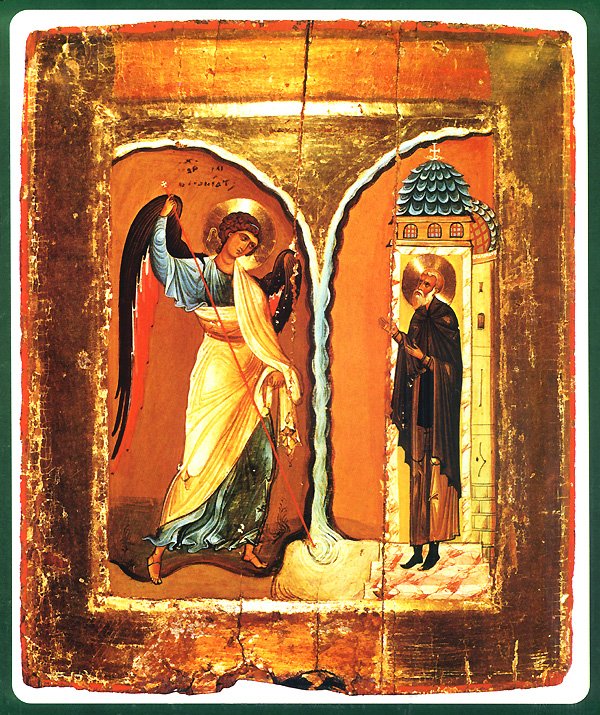
Miracle of Archangel Michael at Colossae
In Phrygia, not far from the city of Hieropolis, in a place called Cheretopos, there was a church named for the Archangel Michael, built over a miraculous spring.
This church was built by a certain inhabitant of the city of Laodicia in gratitude to God for healing his mute daughter. The holy Chief Commander Michael appeared to this man in a dream and revealed to him that his daughter would receive the gift of speech after drinking from the water of the spring.
In Phrygia, not far from the city of Hieropolis, in a place called Cheretopos, there was a church named for the Archangel Michael, built over a miraculous spring.
This church was built by a certain inhabitant of the city of Laodicia in gratitude to God for healing his mute daughter. The holy Chief Commander Michael appeared to this man in a dream and revealed to him that his daughter would receive the gift of speech after drinking from the water of the spring. The girl actually did receive healing and began to speak. After this miracle, the father and his daughter and all their family were baptized. In fervent gratitude, the father built the church in honor of the holy Chief Commander Michael. Not only did Christians begin to come to the spring for healing, but also pagans. In so doing, many of the pagans turned from their idols and were converted to the faith in Christ.
At this church of the holy Chief Commander Michael, a certain pious man by the name of Archippus served for sixty years as church custodian. By his preaching and by the example of his saintly life he brought many pagans to faith in Christ. With the general malice of that time towards Christians, and especially against Archippus, the pagans thought to destroy the church in order to prevent people from coming to that holy place of healing, and at the same time kill Archippus.
Toward this end they made a confluence of the Lykokaperos and Kufos Rivers and directed its combined flow against the church. Saint Archippus prayed fervently to the Chief Commander Michael to ward off the danger. Through his prayer the Archangel Michael appeared at the temple, and with a blow of his staff, opened a wide fissure in a rock and commanded the rushing torrents of water to flow into it. The temple remained unharmed. Seeing such an awesome miracle, the pagans fled in terror. Archippus and the Christians gathered in church glorified God and gave thanks to the holy Archangel Michael for the help. The place where the rivers plunged into the fissure received the name “Chonae”, which means “plunging.”
The Chudov (“of the Miracle”) monastery in Moscow is named for this Feast.
Troparion - Tone 4
Michael, commander of the heavenly hosts, / we who are unworthy beseech you, / by your prayers encompass us beneath the wings of your immaterial glory, / and faithfully preserve us who fall down and cry out to you: / “Deliver us from all harm, for you are the commander of the powers on high!”
Kontakion - Tone 2
O Chief Commander Michael, / you were seen overshadowing your church like a cloud raining waters of immortality. / You preserved it like another ark, / and turned aside the flow of the rivers with your staff, / for the glory of the Faith, and to the delight of our souls.
Holy Prophet Zacharias and Righteous Elizabeth (1st c.), parents of St John the Forerunner.
The story of the holy parents of the Forerunner is told in the first chapters of Luke’s Gospel. Several of the Fathers say that Zacharias is the one who, the Lord said, was slain between the temple and the altar (Matthew 23:35); because he continued to call the Mary the Mother of God a virgin even after she bore Christ; and because his son had escaped the slaughter of the innocents ordered by Herod. S
The story of the holy parents of the Forerunner is told in the first chapters of Luke’s Gospel. Several of the Fathers say that Zacharias is the one who, the Lord said, was slain between the temple and the altar (Matthew 23:35); because he continued to call the Mary the Mother of God a virgin even after she bore Christ; and because his son had escaped the slaughter of the innocents ordered by Herod. St Elizabeth had hidden him in a cave in the desert; he remained in the wilderness from that time until he began to preach by the Jordan.
St Maxim (Sandovich), martyr of Lemkos, Czechoslovakia (1914) (August 24 OC)
St Maxim was born in the Austro-Hungarian Empire in 1888. At this time all Orthodox Churches had been captured and subjected to the “Unia,” by which, though keeping the Orthodox liturgical rites, they were united to the Roman Catholic Church. Many of the Carpatho-Russian people were ignorant of the change and what it meant; others were unhappy with it but, in their subject condition, saw no alternative. Max
St Maxim was born in the Austro-Hungarian Empire in 1888. At this time all Orthodox Churches had been captured and subjected to the “Unia,” by which, though keeping the Orthodox liturgical rites, they were united to the Roman Catholic Church. Many of the Carpatho-Russian people were ignorant of the change and what it meant; others were unhappy with it but, in their subject condition, saw no alternative. Maxim’s farmer parents, at great personal sacrifice, obtained an education for him that enabled him to study for the priesthood at the Basilian seminary in Krakow. Here he discerned the un-Orthodox nature of the “Greek Catholic” training there and traveled to Russia, where he became a novice at the Great Lavra of Pochaev and met Archbishop Anthony (Khrapovitsky), who encouraged him in his quest for Orthodoxy. (Archbishop Anthony, after the Russian Revolution, became the first Metropolitan of the Russian Orthodox Church Abroad). He entered seminary in Russia in 1905 and was ordained to the Priesthood in 1911.Metropolitan Anthony, knowing the hardships and persecutions that awaited any Orthodox priest in Austro-Hungary, offered to find Maxim a parish in Russia. But Maxim was already aware of the hunger for Orthodoxy among many of the Carpatho-Russian people; several people from his village had travelled to America and while there had attended Orthodox Churches and confessed to Orthodox priests. They begged him to return to his country and establish an Orthodox parish there.
When he returned to his native village of Zhdynia, the polish authorities, seeing him in the riassa, beard and uncut hair of an Orthodox priest, mocked him, saying “Look, Saint Nicholas has come to the Carpathians!” But the people of nearby Hrab sent a delegation asking him to set up an Orthodox parish in their village. This he did, setting up a house-church in the residence that the people gave him. Almost immediately, he and his people began to be harassed and persecuted, first at the instigation of “Greek Catholic” priests, then of the government. His rectory/church was closed, and he and several of his parishioners were repeatedly jailed, sometimes on trumped-up charges of sedition. (The Carpatho-Russian people were always suspected of pro-Russian political sympathies by the Austrian and Polish authorities).
Despite these persecutions, through Fr Maxim’s labors a wave of desire for Orthodoxy spread through the region, with many Carpatho-Russians openly identifying themselves as Orthodox. The government issued orders to regional mayors to forbid those who had identified themselves as Orthodox to gather and, in 1913, appointed a special commissioner whose task was to force the people to return to Catholicism.
In 1914, war broke out between Russia and Austro-Hungary. Despite lack of any evidence that Fr Maxim had engaged in pro-Russian political activity — he once said “My only politics is the Gospel” — he was arrested and executed on September 6 by the Papal calendar, August 24 by the Church Calendar. He was denied any form of Church burial, and his father buried him with his own hands.
Following the First World War, Orthodoxy became legal in the new Polish Republic, and a monument was placed over Fr Maxim’s grave in his home town of Zhdynia. In 1994, the Orthodox Church of Poland officially glorified St Maxim.
Scripture Readings
☩Epistle
2 Corinthians 5:10-15
10
For we must all appear before the judgment seat of Christ; that every one may receive the things done in his body, according to that he hath done, whether it be good or bad.
11
Knowing therefore the terror of the Lord, we persuade men; but we are made manifest unto God; and I trust also are made manifest in your consciences.
12
For we commend not ourselves again unto you, but give you occasion to glory on our behalf, that ye may have somewhat to answer them which glory in appearance, and not in heart.
13
For whether we be beside ourselves, it is to God: or whether we be sober, it is for your cause.
14
For the love of Christ constraineth us; because we thus judge, that if one died for all, then were all dead:
15
And that he died for all, that they which live should not henceforth live unto themselves, but unto him which died for them, and rose again.
☩Gospel
Mark 1:9-15
9
And it came to pass in those days, that Jesus came from Nazareth of Galilee, and was baptized of John in Jordan.
10
And straightway coming up out of the water, he saw the heavens opened, and the Spirit like a dove descending upon him:
11
And there came a voice from heaven, saying, Thou art my beloved Son, in whom I am well pleased.
12
And immediately the Spirit driveth him into the wilderness.
13
And he was there in the wilderness forty days, tempted of Satan; and was with the wild beasts; and the angels ministered unto him.
14
Now after that John was put in prison, Jesus came into Galilee, preaching the gospel of the kingdom of God,
15
And saying, The time is fulfilled, and the kingdom of God is at hand: repent ye, and believe the gospel.
Liturgical data sourced from OCA.org and orthocal.info