
Fasting Rules
 Meat
Allowed
 Fish
Allowed
 Dairy
Allowed
 Oil
Allowed
 Wine
Allowed
Saints & Commemorations
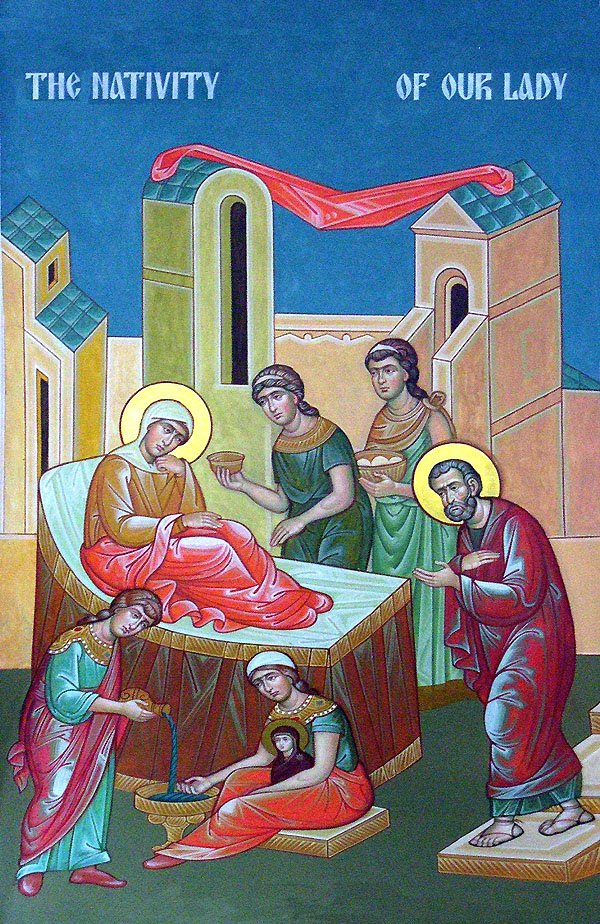
Forefeast of Nativity
The first lesson at Great Vespers (Genesis 28:10-17) describes Jacob’s dream of a ladder reaching from earth to heaven, and the angels ascending and descending upon it. The second lesson (Ezekiel 43:27-44:4) speaks of the gate of the sanctuary which faces east. God enters through this gate, which is shut so that no one else can enter by it. T
The first lesson at Great Vespers (Genesis 28:10-17) describes Jacob’s dream of a ladder reaching from earth to heaven, and the angels ascending and descending upon it. The second lesson (Ezekiel 43:27-44:4) speaks of the gate of the sanctuary which faces east. God enters through this gate, which is shut so that no one else can enter by it. The third reading (Proverbs 9:1-11) talks about the house that Wisdom has built.
These readings are interpreted as prefiguring the Mother of God.
Troparion - Tone 4
Podoben: “Joseph was amazed....”
From the root of Jesse, and from the loins of David, / the godly Mary is born to us today, / for which the universe rejoices and is renewed, / heaven and earth rejoice together. / Praise her, you Fathers of the nations, / Joachim rejoices and Anna celebrates shouting / “The barren woman has conceived the Theotokos, the nourisher of our lives.”
Kontakion - Tone 3
Today the Virgin Theotokos Mary / the bridal chamber of the Heavenly Bridegroom / by the will of God is born of a barren woman, / being prepared as the chariot of God the Word. / She was fore-ordained for this, since she is the divine gate and the true Mother of Life.
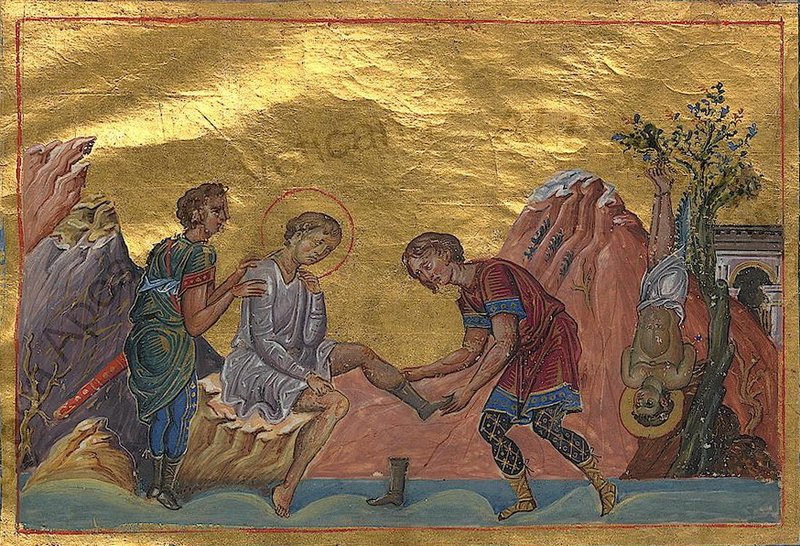
Martyr Sozon of Cilicia
Saint Sozon lived in the late III century. He was from Lykaonia in Cilicia, and originally his name was Tarasios. When he became a Christian, he was baptized and received the name Sozon. A shepherd by profession, he tried to imitate the meekness of the sheep, at which he marveled. “I am ashamed,” he said, “that I am inferior to sheep.”
He studied the Holy Scriptures attentively, and he also guided Christ‘s rational sheep to good pastures. One day,
Saint Sozon lived in the late III century. He was from Lykaonia in Cilicia, and originally his name was Tarasios. When he became a Christian, he was baptized and received the name Sozon. A shepherd by profession, he tried to imitate the meekness of the sheep, at which he marveled. “I am ashamed,” he said, “that I am inferior to sheep.”
He studied the Holy Scriptures attentively, and he also guided Christ‘s rational sheep to good pastures. One day, while watering his flock at a spring, Sozon fell asleep under an oak tree, where he had a vision which foretold his impending martyrdom for Christ. He was also informed that the spring would become a source of blessing and of healing for many, since it would be sanctified by God‘s grace. When he awakened, he entrusted his flock to another shepherd and journeyed to Pompeiopolis in Cilicia. Seeing what impiety there was in that city, his heart was profoundly grieved.
Entering one of the temples of the idolaters, he beheld a golden statue representing a pagan “god.” Then, with great courage, he broke off the statue‘s right hand with his shepherd‘s crook and smashed it into tiny pieces, which he distributed to the poor. This caused a great uproar in the city. Maximian, the governor of Cilicia, became very angry, and a search was made to find the culprit. Many innocent people were arrested and tortured in an attempt to force a confession from them.
When Saint Sozon heard about this, he could not permit others to suffer for something he had done. Therefore, he presented himself before the governor and responded to his threats in a calm manner, saying that the statue was not doing anyone much good inside the temple, and so he used the gold for the benefit of the poor.
Maximian asked the Saint how he dared to dishonor their “god” in such a way. Sozon replied, “I did this so that you might know that your ‘god’ is powerless. When I struck off his hand, he did not protest or make any attempt to stop me, nor did he cry out with pain. How could he? Your idol is deaf and dumb and without breath. It cannot see, hear, speak, or defend itself. If your ‘god’ was real, I would not have been permitted to break it.”
When Maximian heard these words, he ordered that Saint Sozon be tortured without mercy. He was suspended and his body was raked with iron claws. Then iron boots were nailed to the soles of his feet, and he was paraded through the city. Throughout his torments, he never ceased to glorify the Savior Christ. Once again he was suspended from a tree and beaten with iron rods, so that his body was mangled and his bones were broken. Amid such torture, the Saint surrendered his soul to God in the year 304.
Seeing that he was dead, the soldiers took him down from the tree and built a large fire to burn his body so that the Christians would not be able to claim it and venerate it. Suddenly, there was thunder and lightning, rain and hail, which put out the fire. The pagans fled in fear, and the holy relics were not damaged. The faithful came at midnight, when it was very dark. They were troubled because they could not find the relics, but a light from Heaven shone upon Christ‘s holy martyr to guide them. Gathering the Saint‘s relics, the Christians gave them an honorable burial.
Many miracles took place at the tomb, and also at the spring where the Saint had his vision under the oak tree. Later, a church was built by the spring, and was dedicated to Saint Sozon. In that holy place praise was offered to the one true God, the Father, and the Son, and the Holy Spirit, to Whom be glory throughout all the ages. Amen.
Troparion - Tone 4
O Martyr Sozon, you pledged your life to God, / Enduring the contest and becoming a sharer in Christ’s passion. / Save from temptation those who cry to you: / “Glory to him who strengthened you! / Glory to him who crowned you! / Glory to him who through you works healing for all!”
Kontakion - Tone 2
As we come together on this day, / let us, with loud voices, remember the true and God-bearing martyr,
and athlete of piety, Sozon, / the divine initiate of grace, / the most bountiful giver of healings, / for he intercedes with God for us all.
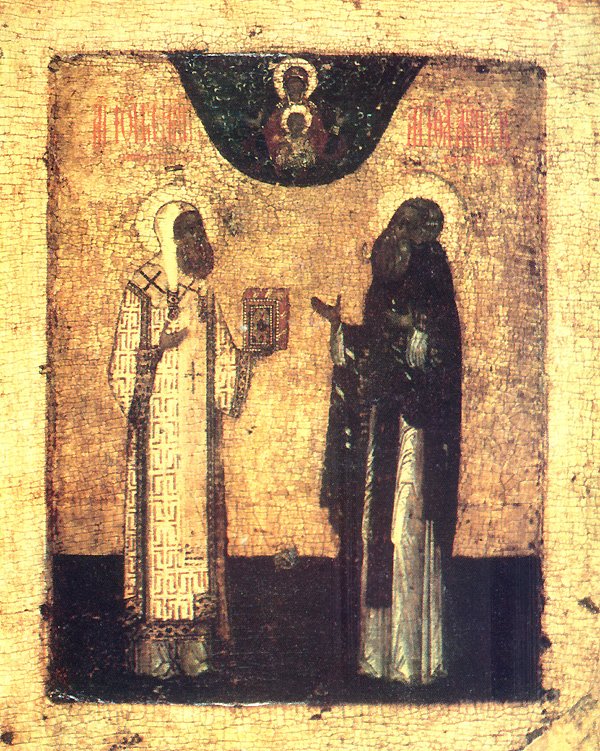
St John, Archbishop of Novgorod
Saint John, Archbishop of Novgorod, was born at Novgorod of the pious parents Nicholas and Christina. He passed his childhood in quiet and peaceful surroundings.
After the death of their parents, John and his brother Gabriel decided to establish a small monastery in honor of the Annunciation of the Most Holy Theotokos with their inheritance.
At first they built a wooden church, but a short time later they also built a stone church. Their good intentions were not without difficulties. Before they finished construction on the stone temple, the brothers totally exhausted their means. Only their steadfast and living faith inspired them to continue what they had started. They turned for help with it to the Queen of Heaven, on Whose account this God-pleasing matter was begun.
Because of their unflagging faith and zeal, She manifested Her mercy to them. She told them in a dream that everything necessary for the completion of the temple would be provided. On the following morning, the brothers saw a splendid horse loaded with two sacks of gold. No one came for it, and when the brothers removed the sacks, the horse vanished. Thus did the Mother of God provide for the monastery.
Upon completion of the monastery construction, under the protection of the Mother of God, the brothers were clothed in the monastic schema. Saint John took the name of Elias, and Saint Gabriel took the name Gregory.
The chronicles speak of Saint John being made bishop under the entries for the year 1162. His first archpastoral letter was addressed to the clergy of his diocese. It was filled with an endearing concern about his flock, written in a spirit of fatherly guidance: “It has pleased God and the Most Holy Theotokos, through your prayers, that I, a mere man, should not refuse this high office, of which I am unworthy. Since you yourselves have encouraged me to this service, now listen to me ...”
The saint spoke about the vocation of the pastor. He is concerned about his sheep, he not only chastizes, but also heals those who lead a sinful life. “At the beginning of my discourse I ask you not to be too much attached to this world, but rather be instructive to people. Look first of all, that they not give themselves over to drunkenness. You yourselves know, that through this vice most of all, not only do the simple people perish, but we also. When your spiritual children come to you in repentance, then question them with mildness. It is not seemly to impose harsh penances.Do not scorn the reading of books, since if we do not start doing this, then what will distinguish us from the simple unschooled people? ... Do not impose penances upon orphans.... Let everything be seemly, for the yoke of Christ ought to be light.”
In the year 1165 Saint John was elevated to archbishop (from that time the Novgorod cathedra became an archbishopric).
The winter of 1170 was a very difficult time for Novgorod. Suzdal forces with their allies laid siege to the city for two days, since the Novgorod people would not accept Prince Svyatoslav. They also took the tribute-tax of the Dvina district which was not subject to them.
In grief the people of Novgorod prayed to God and the Most Holy Theotokos for the salvation of the city. On the third night, while he was praying before an icon of the Savior, Saint John heard a voice ordering him to go to the church of the Savior on Il’ina street, to take the icon of the Most Holy Theotokos and carry it out to the walls of the city.
In the morning the saint told the people about the command and sent his deacon with clergy to the church of the Savior for the icon. Going into the church, the archdeacon bowed down before the icon and wanted to take it, but the icon would not budge. The archdeacon returned to the archbishop and told him what had happened.
Then the saint with all the assembly went to the Il’ina church and on their knees began to pray before the icon. They began to sing a Molieben, and after the Sixth Ode at the kontakion “Protectress of Christians,” the icon itself moved from the place. The people with tears cried out: “Lord, have mercy!”
Then Saint John took the icon and together with two deacons carried it to the city walls. The Novgorodian people saw their doom, for the Suzdal forces and their allies were ready for pillage. In the sixth hour the assault began, and the arrows fell like rain. Then the icon turned its visage towards the city, and tears trickled down from the eyes of the Most Holy Theotokos, which the saint gathered on his phelonion.
A darkness covered the Suzdal forces, they became unable to see and they fell back in terror. This occurred on February 25, 1170. Saint John established a solemn feastday for Novgorod, the Sign of the Most Holy Theotokos (November 27).
The Suzdal army inflicted great harm on the Novgorod region. Here also the archpastor did not remain on the sidelines. He showed fatherly concern for devastated households suffering hunger, and he distributed aid to orphans. Just like other Russian hierarchs, he calmed and soothed the internecine strife in much-suffering Rus by his prayers and his virtue. In 1172, the archpastor journeyed to Vladimir to reconcile Prince Andrew Bogoliubsky with the Novgorod people.
The saint not only shared in the adversity of his people, but most of all he concerned himself with their spiritual enlightenment. Saint John devoted much attention to spiritual conversations, which often occurred in the circle of the clergy and the laypeople. There are preserved about 30 of his instructions concerning Baptism, Confession, the Holy Eucharist.
His Guidance for Monks is filled with spiritual grandeur: “Once having followed after Christ, monks as actualisers of spiritual life by the Cross ought to live in solitary places, separate from worldly folk. Let them steal nothing for themselves, and let them be wholly dedicated to God. A monk ought always to be a monk, at every time and at every place, both in asleep and awake he should preserve the memory of death, and be fleshless in the flesh.”
“Not for everyone does the monastery serve as a therapy for sensual love, just as silence is for anger, and non-acquisitiveness is for money, and the tomb is for avarice. Monastic life and worldly life are incompatible, just as one would not harness a camel and horse together. The monk bends his neck beneath the yoke of the Creator and ought to pull the plow in the valley of humility, in order to multiply the fine wheat by the warmth of the Life-giving Spirit and to sow the seeds of the reason of God. The black-robed is not his own master; being like gods, take care not to rot in likeness to people, nor fall from the heights like Lucifer... for haughty pride comes from human glory.”
The saint’s spiritual powers of grace were unusual. For his simplicity of soul and purity of heart God gave him power against demons. Once, when the saint prayed by night, as was his custom, he heard something splashing the water in the washbasin. Seeing that there was no one beside him, the saint realized that this was a demon trying to scare him.
The saint made the Sign of the Cross over the washbasin and restrained the devil. Soon the evil spirit could no longer bear the prayer of the saint, which scorched it like fire, and it began to beg to be released from the washbasin. The saint was agreeable, but ordered the demon to carry him from Novgorod to Jerusalem to the Sepulchre of the Lord and back, all in one night. The demon fulfilled the saint’s command, but asked him to tell no one about his shame.
In one of his conversations, the saint told his flock that he knew a man who visited the Holy Land in one night. The revenge of the evil spirit was not slow in coming. It began to scatter women’s things in his cell. Once, when people had gathered in Saint John’s cell, the devil transformed himself into a woman who ran in front of them as if fleeing from the cell.
The saint heard the racket and gently asked, “What has happened, my children, what is the noise all about?” The unruly crowd, shouting various charges of perverse life against the saint, dragged him to the River Volkhov. They put the saint on a raft and released it down along the current of the river. But the raft, contrary to expectation, sailed against the current straight to the Saint George men’s monastery, three versts from Novgorod.
Seeing this, people were ashamed and with weeping and shouts they went along the riverbank after the raft, beseeching the saint to forgive them and to return to the city. The heart of the simple archpastor was filled with joy, not only for himself, but for his flock: “Lord, do not hold this sin against them!” he prayed, and granted pardon to all.
This happened not long before the death of the saint. Sensing its approach, he put off the hierarch’s omophor and took the schema with the name John, the same name he had in his youth. He appointed his brother, Saint Gregory (May 24) as his successor. The saint died on September 7, 1186 and was buried in the church of Holy Wisdom.
In 1439, repairs were being made at the cathedral of Holy Wisdom (Hagia Sophia) through the zeal of Saint Euthymius; in the portico chapel of Saint John the Forerunner, a stone suddenly came loose and cracked the lid of the tomb standing there. Saint Euthymius gave orders to lift off the boards broken by the stone, and the temple was filled with fragrance.
In the tomb they beheld the incorrupt relics of the saint, but no one was able to identify who this archpastor was. In his cell, Saint Euthymius fervently began to pray for God to reveal to him the name of this saint.
That night a man appeared before him, clothed in the vestments of a hierarch, and said that he was Archbishop John, who was found worthy to serve the miracle of the Most Holy Theotokos in honor of Her Sign.
“I proclaim to you the will of God,” continued the saint, “to celebrate the memory of the archbishops and princes lying here, on October 4, and I shall pray Christ for all Christians.” His memory is also celebrated at the Synaxis of Novgorod hierarchs on February 10. In 1630, a feastday was also established for December 1.
Troparion - Tone 8
Great Novgorod rejoices over your relics today, O holy Hierarch John, / for they shine as the sun and grant healing to all who honor them in faith. / Entreat Christ God to deliver his people from captivity, / O wise Wonderworker, heavenly man and earthly angel, / that together with them we may hymn and glorify the Triune God.
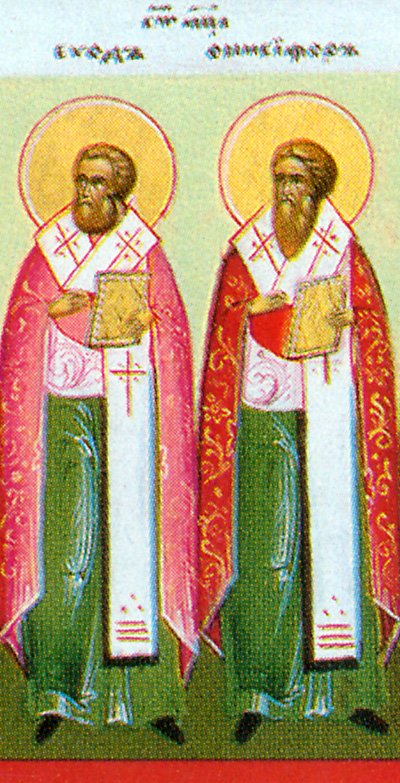
Holy Apostles Evodus and Onesiphorus of the Seventy
The Holy Apostle Onesiphorus of the Seventy Saint Paul writes of him: “God grant mercy to the house of Onesiphorus, for he often refreshed me, and was not ashamed of my bonds. When he was at Rome, he searched for me with great diligence, and found me. May the Lord grant him to find the mercy of the Lord on that day; and you know how much he served me at Ephesus.” (2 Tim 1:16-18).
Sa
The Holy Apostle Onesiphorus of the Seventy Saint Paul writes of him: “God grant mercy to the house of Onesiphorus, for he often refreshed me, and was not ashamed of my bonds. When he was at Rome, he searched for me with great diligence, and found me. May the Lord grant him to find the mercy of the Lord on that day; and you know how much he served me at Ephesus.” (2 Tim 1:16-18).
Saint Onesiphorus was bishop at Colophon (Asia Minor), and later at Corinth. He died a martyr in the city of Parium (not far from Ephesus) on the shores of the Hellespont, where he had gone to proclaim Christ among the local pagans.
Troparion - Tone 3
Holy Apostle Onesiphorus, / entreat the merciful God, / to grant our souls forgiveness of transgressions.
Holy Martyr Eupsychyius of Caesarea (2nd c.)
He was the son of a wealthy pagan senator in Caesarea of Cappadocia. When his father died, he gave his inheritance to the poor, proclaiming the Kingdom of God while he did so. For this he was arrested by Sapricius, Governor of Cappadocia, and put in prison. He persuaded his jailers to release him for awhile, and set about giving away the remainder of his worldly goods, first to his accusers and persecutors, then to the poor.
He was the son of a wealthy pagan senator in Caesarea of Cappadocia. When his father died, he gave his inheritance to the poor, proclaiming the Kingdom of God while he did so. For this he was arrested by Sapricius, Governor of Cappadocia, and put in prison. He persuaded his jailers to release him for awhile, and set about giving away the remainder of his worldly goods, first to his accusers and persecutors, then to the poor. When all his wealth was gone, he voluntarily returned to prison. He was viciously scourged several times, then beheaded. At his martyrdom, it is said that milk instead of blood flowed from his body.
St Kassia (Kassiani) the Hymnographer (9th c.)
She was born in Constantinople to a noble family, and grew to be unusually beautiful and learned — so much so that she was chosen to participate in a ‘bride show’, at which the Emperor Theophilos was to choose a wife. Struck by Kassia’s beauty, the Emperor approached her and said ‘Through a woman came forth the baser things,’ referring to Eve’s transgression. Kassia respon
She was born in Constantinople to a noble family, and grew to be unusually beautiful and learned — so much so that she was chosen to participate in a ‘bride show’, at which the Emperor Theophilos was to choose a wife. Struck by Kassia’s beauty, the Emperor approached her and said ‘Through a woman came forth the baser things,’ referring to Eve’s transgression. Kassia responded, ‘Through a woman came forth the better things’, referring to the Incarnation of Christ through His Most Pure Mother. Stung by her reply, the Emperor rejected her and chose Theodora as his wife. Kassia entered monastic life and founded a women’s monastery in Constantinople, closely allied with the Stoudion Monastery. Serving as abbess of the monastery, she wrote many liturgical hymns, at least twenty of which are included in the services of the Church. Best-known (or at least most closely associated with her) is the Hymn of Kassiani, sung at Matins on Holy Wednesday. She reposed in peace.
Scripture Readings
☩Epistle
2 Corinthians 5:15-21
15
And that he died for all, that they which live should not henceforth live unto themselves, but unto him which died for them, and rose again.
16
Wherefore henceforth know we no man after the flesh: yea, though we have known Christ after the flesh, yet now henceforth know we him no more.
17
Therefore if any man be in Christ, he is a new creature: old things are passed away; behold, all things are become new.
18
And all things are of God, who hath reconciled us to himself by Jesus Christ, and hath given to us the ministry of reconciliation;
19
To wit, that God was in Christ, reconciling the world unto himself, not imputing their trespasses unto them; and hath committed unto us the word of reconciliation.
20
Now then we are ambassadors for Christ, as though God did beseech you by us: we pray you in Christ’s stead, be ye reconciled to God.
21
For he hath made him to be sin for us, who knew no sin; that we might be made the righteousness of God in him.
☩Gospel
Mark 1:16-22
16
Now as he walked by the sea of Galilee, he saw Simon and Andrew his brother casting a net into the sea: for they were fishers.
17
And Jesus said unto them, Come ye after me, and I will make you to become fishers of men.
18
And straightway they forsook their nets, and followed him.
19
And when he had gone a little further thence, he saw James the son of Zebedee, and John his brother, who also were in the ship mending their nets.
20
And straightway he called them: and they left their father Zebedee in the ship with the hired servants, and went after him.
21
And they went into Capernaum; and straightway on the sabbath day he entered into the synagogue, and taught.
22
And they were astonished at his doctrine: for he taught them as one that had authority, and not as the scribes.
Liturgical data sourced from OCA.org and orthocal.info