
Fasting Rules
 Meat
Abstain
 Fish
Allowed
 Dairy
Abstain
 Oil
Allowed
 Wine
Allowed
Saints & Commemorations
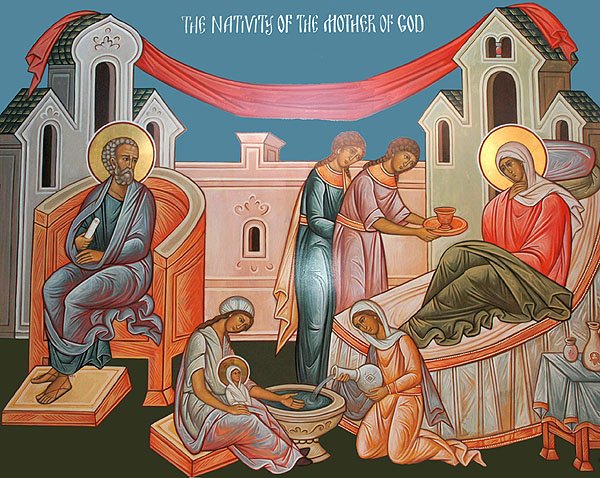
Nativity of the Most-Holy Theotokos
The Nativity of Our Most Holy Lady Theotokos and Ever Virgin Mary: The Most Holy Virgin Mary was born at a time when people had reached such a degree of moral decay that it seemed altogether impossible to restore them. People often said that God must come into the world to restore faith and not permit the ruin of mankind.
The Nativity of Our Most Holy Lady Theotokos and Ever Virgin Mary: The Most Holy Virgin Mary was born at a time when people had reached such a degree of moral decay that it seemed altogether impossible to restore them. People often said that God must come into the world to restore faith and not permit the ruin of mankind.
The Son of God chose to take on human nature for the salvation of mankind, and chose as His Mother the All-Pure Virgin Mary, who alone was worthy to give birth to the Source of purity and holiness.
The Nativity of Our Most Holy Lady Theotokos and Ever Virgin Mary is celebrated by the Church as a day of universal joy. Within the context of the Old and the New Testaments, the Most Blessed Virgin Mary was born on this radiant day, having been chosen before the ages by Divine Providence to bring about the Mystery of the Incarnation of the Word of God. She is revealed as the Mother of the Savior of the World, Our Lord Jesus Christ.
The Most Holy Virgin Mary was born in the small city of Galilee, Nazareth. Her parents were Righteous Joachim of the tribe of the Prophet-King David, and Anna from the tribe of the First Priest Aaron. The couple was without child, since Saint Anna was barren.
Having reached old age, Joachim and Anna did not lose hope in God’s mercy. They had strong faith that for God everything is possible, and that He would be able to overcome the barrenness of Anna even in her old age, as He had once overcame the barrenness of Sarah, spouse of the Patriarch Abraham. Saints Joachim and Anna vowed to dedicate the child which the Lord might give them, to the service of God in the Temple.
Childlessness was considered among the Hebrew nation as a Divine punishment for sin, and therefore the righteous Saints Joachim and Anna had to endure abuse from their own countrymen. On one of the feastdays at the Temple in Jerusalem the elderly Joachim brought his sacrifice to offer to God, but the High Priest would not accept it, considering him to be unworthy since he was childless.
Saint Joachim in deep grief went into the wilderness, and there he prayed with tears to the Lord for a child. Saint Anna wept bitterly when she learned what had happened at the Jerusalem Temple. Never once did she complain against the Lord, but rather she prayed to ask God’s mercy on her family.
The Lord fulfilled her petitions when the pious couple had attained to extreme old age and prepared themselves by virtuous life for a sublime calling: to be the parents of the Most Holy Virgin Mary, the future Mother of the Lord Jesus Christ.
The Archangel Gabriel brought Joachim and Anna the joyous message that their prayers were heard by God, and of them would be born a most blessed daughter Mary, through Whom would come the Salvation of all the World.
The Most Holy Virgin Mary surpassed in purity and virtue not only all mankind, but also the angels. She was manifest as the living Temple of God, so the Church sings in its festal hymns: “the East Gate... bringing Christ into the world for the salvation of our souls” (2nd Stikhera on “Lord, I Have Cried”, Tone 6).
The Nativity of the Theotokos marks the change of the times when the great and comforting promises of God for the salvation of the human race from slavery to the devil are about to be fulfilled. This event has brought to earth the grace of the Kingdom of God, a Kingdom of Truth, piety, virtue and everlasting life. The Theotokos is revealed to all of us by grace as a merciful Intercessor and Mother, to Whom we have recourse with filial devotion.
Troparion - Tone 4
Your Nativity, O Virgin, / has proclaimed joy to the whole universe! / The Sun of Righteousness,1 Christ our God, / has shone from you, O Theotokos! / By annulling the curse, / He bestowed a blessing. / By destroying death, He has granted us eternal Life.1 Malachai 4:2
Kontakion - Tone 4
Your Nativity, O Virgin, / has proclaimed joy to the whole universe! / The Sun of Righteousness,1 Christ our God, / has shone from you, O Theotokos! / By annulling the curse, / He bestowed a blessing. / By destroying death, He has granted us eternal Life.
New Martyr Athanasius of Thessalonika (1774)
He was born to a distinguished and pious Christian family in Thessalonika. After acquiring an unusually good education he spent a few years in Constantinople, then returned to his native city. He spoke both Turkish and Arabic well, and often conversed with Muslims. Once, while speaking with an emir, Athanasius pronounced the Muslim confession of faith to illustrate a point.
He was born to a distinguished and pious Christian family in Thessalonika. After acquiring an unusually good education he spent a few years in Constantinople, then returned to his native city. He spoke both Turkish and Arabic well, and often conversed with Muslims. Once, while speaking with an emir, Athanasius pronounced the Muslim confession of faith to illustrate a point. The emir, seeing an opportunity, immediately reported Athanasius to the Islamic judge, claiming that he had converted to Islam. The judge found no merit in the case and would have dismissed Athanasius; but the emir and other officials were insistent, and the judge pressured Athanasius to convert. When Athanasius answered that he knew no truth but that of Christ, he was thrown in prison. When he appeared before the judge several days later, he was still firm in his confession, and was sentenced to death. He was hanged outside the city in 1774, at the age of twenty-five.
Our Venerable Father Serapion of Pskov (1481)
He wss born in (what is now) Lithuania, but entered monastic life in the Pskov district. His spiritual father was St Euphrosynus (May 15), under whose care he lived for more than fifty-five years. He became known for his exceptional humility and asceticism. He tried never to be idle, giving any free moment to prayer and reading of Scripture.
He wss born in (what is now) Lithuania, but entered monastic life in the Pskov district. His spiritual father was St Euphrosynus (May 15), under whose care he lived for more than fifty-five years. He became known for his exceptional humility and asceticism. He tried never to be idle, giving any free moment to prayer and reading of Scripture. He emphasized the importance of the common prayer of the Church, saying that reciting the entire Twelve Psalm rule in one’s cell was not worth one Kyrie Eleison chanted by the brethren assembled together in church. His knowledge of Lithuanian and Finnish allowed him to strengthen the faith among the peoples of those lands. When he died, at the age of ninety, his clothing was so threadbare that no one wanted it. Soon after his repose, a blind man recovered his sight at St Serapion’s tomb, which has been the site of many miracles ever since.
Scripture Readings
☩Epistle
2 Corinthians 6:11-16
11
O ye Corinthians, our mouth is open unto you, our heart is enlarged.
12
Ye are not straitened in us, but ye are straitened in your own bowels.
13
Now for a recompence in the same, (I speak as unto my children,) be ye also enlarged.
14
Be ye not unequally yoked together with unbelievers: for what fellowship hath righteousness with unrighteousness? and what communion hath light with darkness?
15
And what concord hath Christ with Belial? or what part hath he that believeth with an infidel?
16
And what agreement hath the temple of God with idols? for ye are the temple of the living God; as God hath said, I will dwell in them, and walk in them; and I will be their God, and they shall be my people.
☩Gospel
Mark 1:23-28
23
And there was in their synagogue a man with an unclean spirit; and he cried out,
24
Saying, Let us alone; what have we to do with thee, thou Jesus of Nazareth? art thou come to destroy us? I know thee who thou art, the Holy One of God.
25
And Jesus rebuked him, saying, Hold thy peace, and come out of him.
26
And when the unclean spirit had torn him, and cried with a loud voice, he came out of him.
27
And they were all amazed, insomuch that they questioned among themselves, saying, What thing is this? what new doctrine is this? for with authority commandeth he even the unclean spirits, and they do obey him.
28
And immediately his fame spread abroad throughout all the region round about Galilee.
Liturgical data sourced from OCA.org and orthocal.info