
Fasting Rules
 Meat
Allowed
 Fish
Allowed
 Dairy
Allowed
 Oil
Allowed
 Wine
Allowed
Saints & Commemorations
Saturday before Elevation
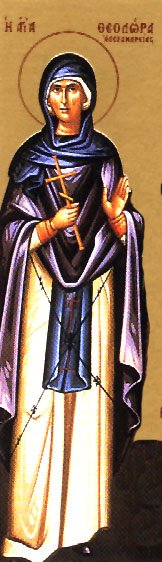
Ven. Theodora of Alexandria
Saint Theodora of Alexandria and her husband lived in Alexandria. Love and harmony ruled in their family, and this was hateful to the Enemy of salvation. Goaded on by the devil, a certain rich man was captivated by the youthful beauty of Theodora and began with all his abilities to lead her into adultery, but for a long time he was unsuccessful.
Saint Theodora of Alexandria and her husband lived in Alexandria. Love and harmony ruled in their family, and this was hateful to the Enemy of salvation. Goaded on by the devil, a certain rich man was captivated by the youthful beauty of Theodora and began with all his abilities to lead her into adultery, but for a long time he was unsuccessful. Then he bribed a woman of loose morals, who led the unassuming Theodora astray by saying that a secret sin, which the sun does not see, is also unknown to God.
Theodora betrayed her husband, but soon came to her senses and realizing the seriousness of her fall, she became furious with herself, slapping herself on the face and tearing at her hair. Her conscience gave her no peace, and Theodora went to a renowned abbess and told her about her transgression. The abbess, seeing the repentance of the young woman, spoke to her of God’s forgiveness and reminded her of the sinful woman in the Gospel, who washed the feet of Christ with her tears and received from Him forgiveness of her sins. In hope of the mercy of God, Theodora said: “I believe my God, and from now on, I shall not commit such a sin, and I will strive to atone for my deed.”
At that moment Saint Theodora resolved to go off to a monastery to purify herself by labor and by prayer. She left her home secretly, and dressing herself in men’s clothes, she went to a men’s monastery, since she feared that her husband would find her in a women’s monastery.
The igumen of the monastery, in order to test the resolve of the newcomer, would not even bless her to enter the courtyard. Saint Theodora spent the night at the gates. In the morning, she fell down at the knees of the igumen, and said her name was Theodore from Alexandria, and entreated him to let her remain at the monastery for repentance and monastic labors. Seeing the sincere intent of the newcomer, the igumen consented.
Even the experienced monks were amazed at Theodora’s all-night prayers on bended knee, her humility, endurance and self-denial. The saint labored at the monastery for eight years. Her body, once defiled by adultery, now became a vessel of the grace of God and a receptacle of the Holy Spirit.
Once, the saint was sent to Alexandria to buy provisions. After blessing her for the journey, the igumen indicated that in case of a delay, she should stay over at the Enata monastery, which was on the way. Also staying at the guest house of the Enata monastery was the daughter of its igumen. She had come to visit with her father. Attracted by the comeliness of the young monk, she tried to seduce the monk Theodore into the sin of fornication, not knowing that it was a woman standing before her. Meeting with refusal, she committed sin with another guest and became pregnant. Meanwhile, the saint bought the food and returned to her own monastery.
After a certain while the father of the shameless girl, realizing that a transgression had occurred, began to question his daughter about the father of the child. The girl indicated that it was the monk Theodore. The father at once reported it to the Superior of the monastery where Saint Theodora labored in asceticism. The igumen summoned the saint and repeated the accusation. The saint firmly replied: “As God is my witness, I did not do this.” The igumen, knowing of Theodore’s purity and holiness of life, did not believe the accusation.
When the girl gave birth, the Enata monks brought the infant to the monastery where the ascetic lived, and began to reproach its monks for an unchaste life. But this time even the igumen believed the slanderous accusation and became angry at the innocent Theodore. They entrusted the infant into the care of the saint and threw her out of the monastery in disgrace.
The saint humbly submitted to this new trial, seeing in it the expiation of her former sin. She settled with the child not far from the monastery in a hut. Shepherds, out of pity, gave her milk for the infant, and the saint herself ate only wild vegetables.
Bearing her misfortune, the holy ascetic spent seven years in banishment. Finally, at the request of the monks, the igumen allowed her to return to the monastery with the child, and in seclusion she spent two years instructing the child.
The igumen of the monastery received a revelation from God that the sin of the monk Theodore was forgiven. The grace of God dwelt upon the monk Theodore, and soon all the monks began to witness to the signs worked through the prayers of the saint.
Once, during a drought, all the wells dried up. The igumen said to the brethren that only Theodore would be able to reverse the misfortune. Having summoned the saint, the igumen bade her to bring forth water, and the water in the well did not dry up afterwards. The humble Theodore said that the miracle was worked through the prayer and faith of the igumen.
Before her death, Saint Theodora shut herself in her cell with the child and instructed him to love God above all things. She told him to obey the igumen and the brethren, to preserve tranquility, to be meek and without malice, to avoid obscenity and silliness, to love non-covetousness, and not to neglect their communal prayer. After this, she prayed and, for the last time, she asked the Lord to forgive her sins. The child also prayed together with her. Soon the words of prayer faded from the lips of the ascetic, and she peacefully departed to a better world.
The Lord revealed to the igumen the spiritual accomplishments of the saint, and also her secret. The igumen, in order to remove any dishonor from the deceased, in the presence of the igumen and brethren of the Enata monastery, told of his vision and uncovered the bosom of the saint as proof.
The Enata igumen and brethren shrank back in terror at their great transgression. Falling down before the body of the saint, with tears they asked forgiveness of Saint Theodora. News of Saint Theodora reached her former husband. He received monastic tonsure at this same monastery where his wife had been. And the child, raised by the nun, also followed in the footsteps of his foster-mother. Afterwards, he became igumen of this very monastery.
Troparion - Tone 4
You offered your life as a holy gift, O righteous Theodora, / for resplendent with the light of repentance, you illumined mankind. / Now pray to Christ who has magnified you to grant us his great mercy!
Kontakion - Tone 2
The image of God was truly preserved in you, O Mother, / for you took up the Cross and followed Christ. / By so doing you taught us to disregard the flesh for it passes away / but to care instead for the soul, since it is immortal. / Therefore your spirit, venerable Theodora, rejoices with the angels.
Trans. Rel. Ven. Sergius and Herman
Demetrios & Evanthea the Martyrs & their son Demetrianos
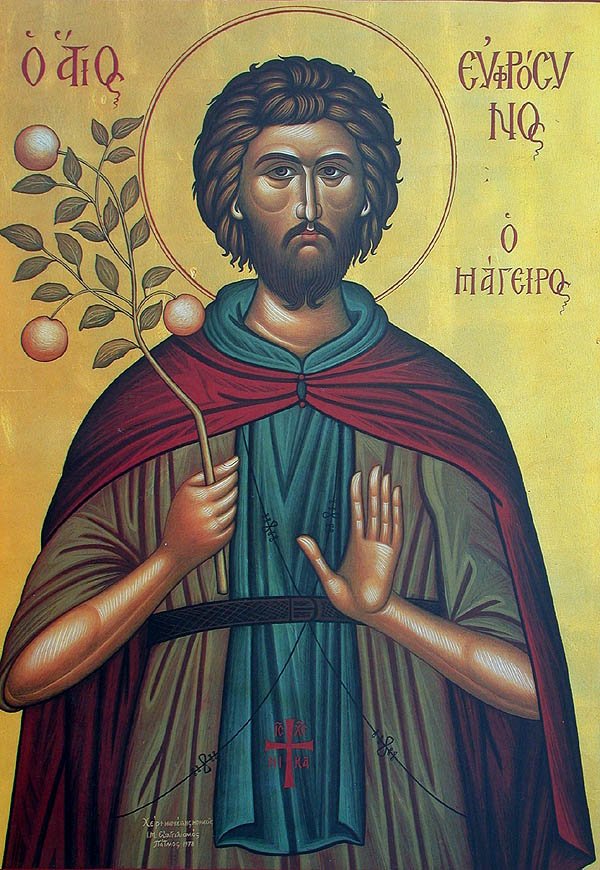
St Euphrosynos the Cook of Alexandria (9th c.)
Our Holy Father Euphrosynos (Euphrósynos) 1 the Cook was born into a peasant family, and had no schooling, but he was truly devout and faithful.
As an adult, he became a cook, and was able to save money out of his expenses by depriving himself, but only for the sake of almsgiving. His position as a cook permitted him to eat the best food first, but he never took advantage of this privilege.
Our Holy Father Euphrosynos (Euphrósynos) 1 the Cook was born into a peasant family, and had no schooling, but he was truly devout and faithful.
As an adult, he became a cook, and was able to save money out of his expenses by depriving himself, but only for the sake of almsgiving. His position as a cook permitted him to eat the best food first, but he never took advantage of this privilege. He ate his greens and olives gratefully, while the most appetizing meats and most tantalizing fish were cooking before him.
Later Euphrosynos went to a monastery, where his obedience was to work in the kitchen as a cook. In contrast to the meals that he used to prepare in secular hotels, he made very plain food in the monastery. To those who complained and mocked him, Euphrosynos meekly replied: "Good cooking is not useful for attaining the Kingdom of Heaven. The more the body craves pleasure, the more the soul will lose that which it truly needs. It is not my intention to punish you."
Some of the monks scorned him because of his coarse rustic background, but he endured their contempt in silence and was not disturbed by it. Saint Euphrosynos strove to please the Lord by his virtuous life, which he concealed from others, but the Lord Himself revealed to the monastic brethren just what spiritual heights their cook had attained.
In the same monastery there was a devout priest who prayed that he might know what good things are prepared for those who love God. One night, as he was sleeping, he found himself in a beautiful garden, where, to his astonishment, he beheld the most wondrous things. Then he saw Father Euphrosynos, the monastery cook standing in the garden and partaking of the good things of that place. As he approached the cook, he asked to whom the garden belonged, and how he came to be there.
Saint Euphrosynos replied, "This garden is reserved for God's elect, and by His great goodness, I also dwell here."
Then the priest asked him what he did in the garden. The Saint told him, "I have authority over all the things you see here. I rejoice and am filled with gladness and the spiritual enjoyment of them."
The priest questioned him again, "Can you give me something of these good things?"
"Certainly," he replied, "by God's grace, take whatever you wish."
Pointing to some apples, he inquired if he might have some of them. Taking a few of the apples, Saint Euphrosynos placed them in the priest's outer garment saying, "Receive that which you requested, and may you delight in them."
At that moment the semantron was heard, summoning the Fathers to the Midnight Service. When the priest awakened, he thought that his vision was just a dream. But when he reached for his outer garment, he found the apples which the cook had given him, and he could still smell their wonderful fragrance.
He got out of bed and then hurried to church. There he saw Euphrosynos and asked him where he had been that night. The Saint said, "Forgive me, Father, I have not been anywhere tonight. I have just come to church or the Service."
The priest urged him to tell the truth, so that God's glory might be made manifest. The humble Euphrosynos told him, "I was in the place where the good things are, which those who love God shall inherit, and which for many years you wished to behold. There you saw me enjoying the blessings of that garden; for God had deigned to reveal to you the blessings of the Just. He has performed this miracle through me, the lowly one."
"Father Euphrosynos, what did you give me from that garden?"
He replied, "The delightful and most fragrant apples which you just put on your bed. Forgive me, Father, for I am a worm and not a man."
When the service of Matins was over, the priest told the brethren about his vision and showed them the apples. They noticed the ineffable fragrance with spiritual joy, marveling at what the priest had told them. Rushing into the kitchen, they found that Saint Euphrosynos had already left the monastery, fleeing from the glory of men, and he could not be found.
The brethren shared the apples among themselves and, as a blessing, gave pieces to those who visited the monastery, especially for those in need of healing, for those who ate the apples were cured of their ailments. Many received benefit from the gift of Saint Euphrosynos. An account of this vision was written, not only on paper, but also in their hearts.
Finally, Saint Euphrosynos reposed in a remote Hēsykhastḗrion. The Church, knowing that a king or a philosopher is not more worthy to enter the Kingdom of Heaven than a cook, has numbered Euphrosynos the Cook among her Saints, for he knew God's will and lived according to it..
A fragment of the Saint's relics is located in the Monastery of Loukous in the Holy Metropolis of Mantineia and Kynouria in Greece.
1 The name Euphrosynos means gladness or delight.
Troparion - Tone 4
You lived righteously in great humility, / in labors of asceticism and in guilessness of soul, / O righteous Euphrósynos. / In a mystical vision, you demonstrated most wondrously the heavenly joy which you had found. / Make us worthy to be partakers of it as well, by your intercessions.
Kontakion - Tone 4
With a humble heart O Father Euphrósynos, / you offered your service as a cook, / and you were truly filled with the Holy Spirit, / therefore the glory of God became known to us through a venerable priest; / make us partakers of it as well, O God-bearer, by your intercessions.
St Paphnutius the Confessor (4th c.)
“A bishop of the Egyptian Thebaid, he suffered greatly for the Orthodox faith: heretics put out one of his eyes and broke his left leg. He took part in the First Ecumenical Council, refuting the Arian heresy with great power. The Emperor Constantine valued him greatly and often kissed him on the missing eye, lost for the truth of Orthodoxy. A
“A bishop of the Egyptian Thebaid, he suffered greatly for the Orthodox faith: heretics put out one of his eyes and broke his left leg. He took part in the First Ecumenical Council, refuting the Arian heresy with great power. The Emperor Constantine valued him greatly and often kissed him on the missing eye, lost for the truth of Orthodoxy. At the council, he stood in opposition to the western representatives, who proposed that secular priests be completely forbidden to marry. He was chaste throughout the whole of his life.” (Prologue)
Canonization of St Xenia of St Petersburg (1978)
She is commemorated on January 24.
Scripture Readings
☩Epistle
1 Corinthians 1:26-29
26
For ye see your calling, brethren, how that not many wise men after the flesh, not many mighty, not many noble, are called:
27
But God hath chosen the foolish things of the world to confound the wise; and God hath chosen the weak things of the world to confound the things which are mighty;
28
And base things of the world, and things which are despised, hath God chosen, yea, and things which are not, to bring to nought things that are:
29
That no flesh should glory in his presence.
☩Gospel
Matthew 20:29-34
29
And as they departed from Jericho, a great multitude followed him.
30
And, behold, two blind men sitting by the way side, when they heard that Jesus passed by, cried out, saying, Have mercy on us, O Lord, thou Son of David.
31
And the multitude rebuked them, because they should hold their peace: but they cried the more, saying, Have mercy on us, O Lord, thou Son of David.
32
And Jesus stood still, and called them, and said, What will ye that I shall do unto you?
33
They say unto him, Lord, that our eyes may be opened.
34
So Jesus had compassion on them, and touched their eyes: and immediately their eyes received sight, and they followed him.
Liturgical data sourced from OCA.org and orthocal.info