
Today

Fasting Rules

Meat allowed Meat Allowed
Fish allowed Fish Allowed
Dairy allowed Dairy Allowed
Oil allowed Oil Allowed
Wine allowed Wine Allowed

☦ Saints & Commemorations

Sunday before Elevation
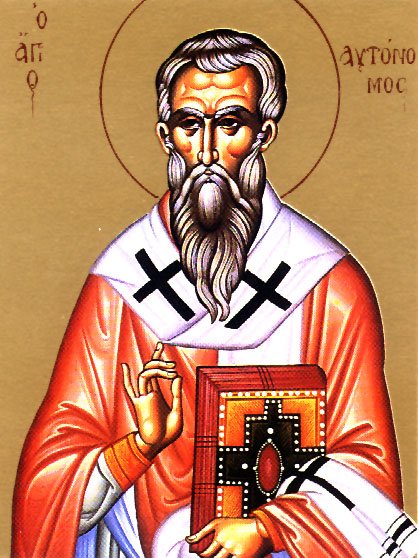
Hieromartyr Autonomus, Bishop in Italy

Hieromartyr Autonomus, Bishop in Italy

The Hieromartyr Autonomus was a bishop in Italy. During the time of the persecution against Christians under the emperor Diocletian (284-305), Saint Autonomus left his own country and resettled in Bithynia, in the locality of Soreus with a man named Cornelius. Saint Autonomus did his apostolic duty with zeal and converted to Christ so many pagans, that a large Church was formed, for which he consecrated a temple in the name of the Archangel Michael. The Hieromartyr Autonomus was a bishop in Italy. During the time of the persecution against Christians under the emperor Diocletian (284-305), Saint Autonomus left his own country and resettled in Bithynia, in the locality of Soreus with a man named Cornelius. Saint Autonomus did his apostolic duty with zeal and converted to Christ so many pagans, that a large Church was formed, for which he consecrated a temple in the name of the Archangel Michael. For this church, the saint at first ordained Cornelius as deacon, and then presbyter. Preaching about Christ, Saint Autonomus visited also Lykaonia and Isauria. The emperor Diocletian gave orders to arrest Saint Autonomus, but the saint withdrew to Claudiopolis on the Black Sea. In returning to Soreus, he had the priest Cornelius ordained bishop. Saint Autonomus then went to Asia, and when he had returned from there, he began to preach in the vicinity of Limna, near Soreus. Once, the newly-converted destroyed a pagan temple. The pagans decided to take revenge on the Christians. Seizing their chance, the pagans rushed upon the church of the Archangel Michael when Saint Autonomus was serving Divine Liturgy there. After torturing Saint Autonomus they killed him, reddening the altar of the church with his martyr’s blood. The deaconess Maria removed the body of the holy martyr from beneath a pile of stones and buried it. During the reign of Saint Constantine the Great, a church was built over the tomb of the saint. In the year 430, a certain priest had the old church pulled down. Not realizing that the martyr’s body had been buried beneath the church, he rebuilt the church in a new spot. But after another 60 years the relics of the saint were found incorrupt, and a church was then built in the name of the Hieromartyr Autonomus.

Troparion - Tone 4

By sharing in the ways of the Apostles, / you became a successor to their throne. / Through the practice of virtue, / you found the way to divine contemplation, O inspired one of God; / by teaching the word of truth without error, / you defended the Faith, even to the shedding of your blood. / Hieromartyr Autonomus, entreat Christ God to save our souls.

Kontakion - Tone 2

With reverence you served the divine mysteries, O wise one, / and became an acceptable sacrifice while partaking of the cup of Christ. / Now, as you stand before Him, holy martyr Autonomus, / unceasingly intercede for us all.

Julian the Martyr

The Holy Martyr Julian lived during the fourth century not far from the ancient city of Ancyra. A report was made to the governor of the district of Galatia that the Presbyter Julian was hiding in a certain cave with forty others of the same persuasion, and that he was celebrating divine services there. The Holy Martyr Julian lived during the fourth century not far from the ancient city of Ancyra. A report was made to the governor of the district of Galatia that the Presbyter Julian was hiding in a certain cave with forty others of the same persuasion, and that he was celebrating divine services there. They arrested Saint Julian and demanded that he reveal where the remaining Christians were hidden, but he refused. The pagans ordered the holy priest to offer sacrifice to their gods, but he would not consent to this, either. Then they stripped him and placed him on a red-hot iron grate. The martyr signed himself with the Sign of the Cross, and an angel of the Lord cooled the flame. Saint Julian remained unharmed. When the governor asked who he was and how he had quenched the fire, the martyr said: “I am a servant of God.” The torturers brought forth an old woman, the mother of the saint, and they threatened her that if she did not persuade her son to offer sacrifice to idols, then they would torture her. The brave woman answered that if they defiled her body against her will, this would not make her guilty of sin before God. On the contrary, it would constitute an act of martyrdom. The humiliated torturers sent the old woman away, but they condemned Saint Julian to death. In his prayer the saint gave fervent thanks to God and asked that he be given strength to endure the sufferings. Saint Julian also asked a special grace from God: that those who take earth from the place of his burial be granted forgiveness of sins and deliverance from passions, and that harmful insects and birds might not descend upon their fields. Commending himself to God with the words: “Lord, accept my spirit in peace!” the martyr bent his neck beneath the sword, and a Voice summoned the martyr to the Heavenly Kingdom. This Voice was heard also by the forty Christians who had hidden themselves in the cave. Emboldened, they come forth to the place of Saint Julian’s sufferings, but they found him already dead. They all confessed themselves to be Christians, and they were arrested and brought to the governor, who ordered them beheaded.

Troparion - Tone 4

Your holy martyrs O Lord, / through their sufferings have received incorruptible crowns from You, our God. / For having Your strength, they laid low their adversaries, / and shattered the powerless boldness of demons. / Through their intercessions, save our souls!

Theodore the Hieromartyr of Alexandria

This Saint Theodore of Alexandria is not the same person as Saint Theodore the Bishop of Alexandria (December 3). Today’s saint was a simple Christian who was thrown into prison for confessing Christ. Later, he was tortured and thrown into the sea, but remained unharmed. Saint Theodore was beheaded and buried in Alexandria.

Troparion - Tone 3

Your holy martyr Theodore, O Lord, / through his sufferings has received an incorruptible crown from You, our God. / For having Your strength, he laid low his adversaries, / and shattered the powerless boldness of demons. / Through his intercessions, save our souls!

Kontakion - Tone 2

You appeared as a bright star announcing Christ with your radiance, / which is repulsive to this world, O Martyr Theodore; / extinguishing the allure of false gods, / you enlighten the faithful, / always interceding for us all.

Our Holy Father Athanasius the Elder of Vysotsk (early 15th c.), and his disciple Athanasius the Younger (1395)

He was reared in piety by his father, a priest in Novgorod. One day, hearing the words of the Gospel, If any man will come after me, let him deny himself and take up his cross and follow me, he renounced the world and entered the Monastery of St Sergius of Radonezh. He became St Sergius’ disciple and, after a few years, became known for his virtue and his knowledge of Scripture. I He was reared in piety by his father, a priest in Novgorod. One day, hearing the words of the Gospel, If any man will come after me, let him deny himself and take up his cross and follow me, he renounced the world and entered the Monastery of St Sergius of Radonezh. He became St Sergius’ disciple and, after a few years, became known for his virtue and his knowledge of Scripture. In 1374, with the blessing of his spiritual father, he founded the Monastery of Vysotsk, becoming its first abbot. After heading the monastery for fourteen years, he traveled to Kiev and then, in 1401, to the Monastery of the Stoudion in Constantinople. There he devoted himself to translating books from Greek to Slavonic, sending his translations back to his monastery in Russia. It was he who translated the Jerusalem Typikon and several collections of the writings of the Fathers of the Church, immeasurably enriching the life of the Church in Russia. He reposed in peace in Constantinople. His disciple Athanasius the Younger was made Abbot of Vysotsk on the elder’s departure for Constantinople, and served as Abbot for eight years, reposing in peace in 1395. He was called ‘perfect in fasting, strong in self-restraint, zealous in prayer, patient in privations and tribulations.’ The Synaxarion says that “He taught his monks to keep careful watch on every movement of the heart so as to drive away every thought displeasing to God.”

Scripture Readings

☩Epistle

1 Corinthians 15:1-11

1 Moreover, brethren, I declare unto you the gospel which I preached unto you, which also ye have received, and wherein ye stand;
2 By which also ye are saved, if ye keep in memory what I preached unto you, unless ye have believed in vain.
3 For I delivered unto you first of all that which I also received, how that Christ died for our sins according to the scriptures;
4 And that he was buried, and that he rose again the third day according to the scriptures:
5 And that he was seen of Cephas, then of the twelve:
6 After that, he was seen of above five hundred brethren at once; of whom the greater part remain unto this present, but some are fallen asleep.
7 After that, he was seen of James; then of all the apostles.
8 And last of all he was seen of me also, as of one born out of due time.
9 For I am the least of the apostles, that am not meet to be called an apostle, because I persecuted the church of God.
10 But by the grace of God I am what I am: and his grace which was bestowed upon me was not in vain; but I laboured more abundantly than they all: yet not I, but the grace of God which was with me.
11 Therefore whether it were I or they, so we preach, and so ye believed.

☩Gospel

Matthew 19:16-26

16 And, behold, one came and said unto him, Good Master, what good thing shall I do, that I may have eternal life?
17 And he said unto him, Why callest thou me good? there is none good but one, that is, God: but if thou wilt enter into life, keep the commandments.
18 He saith unto him, Which? Jesus said, Thou shalt do no murder, Thou shalt not commit adultery, Thou shalt not steal, Thou shalt not bear false witness,
19 Honour thy father and thy mother: and, Thou shalt love thy neighbour as thyself.
20 The young man saith unto him, All these things have I kept from my youth up: what lack I yet?
21 Jesus said unto him, If thou wilt be perfect, go and sell that thou hast, and give to the poor, and thou shalt have treasure in heaven: and come and follow me.
22 But when the young man heard that saying, he went away sorrowful: for he had great possessions.
23 Then said Jesus unto his disciples, Verily I say unto you, That a rich man shall hardly enter into the kingdom of heaven.
24 And again I say unto you, It is easier for a camel to go through the eye of a needle, than for a rich man to enter into the kingdom of God.
25 When his disciples heard it, they were exceedingly amazed, saying, Who then can be saved?
26 But Jesus beheld them, and said unto them, With men this is impossible; but with God all things are possible.

Notes

["Leavetaking Nativity Theotokos"]

Liturgical data sourced from OCA.org and orthocal.info