
Fasting Rules
 Meat
Allowed
 Fish
Allowed
 Dairy
Allowed
 Oil
Allowed
 Wine
Allowed
Saints & Commemorations
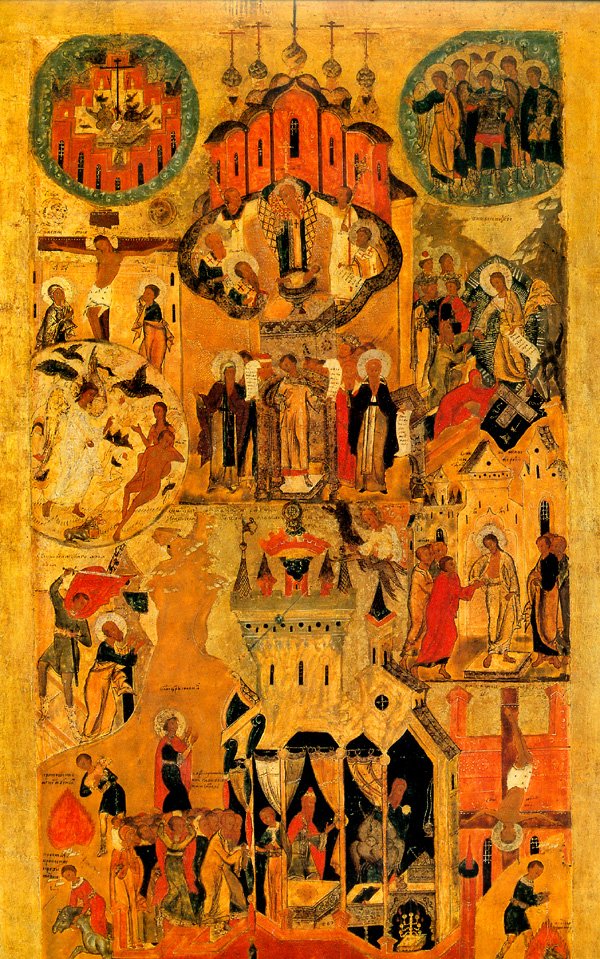
Founding of Church of the Holy Sepulchre
The Dedication of the Temple of the Resurrection of Christ at Jerusalem celebrates the dedication of the Church of the Resurrection, built by Saint Constantine the Great and his mother, the empress Helen.
After the voluntary Passion and Death on the Cross of our Lord and Savior Jesus Christ, the holy place of His suffering was long trampled on by pagans.
The Dedication of the Temple of the Resurrection of Christ at Jerusalem celebrates the dedication of the Church of the Resurrection, built by Saint Constantine the Great and his mother, the empress Helen.
After the voluntary Passion and Death on the Cross of our Lord and Savior Jesus Christ, the holy place of His suffering was long trampled on by pagans. When the Roman emperor Titus conquered Jerusalem in the year 70, he razed the city and destroyed the Temple of Solomon on Mount Moriah, leaving there not a stone upon a stone, as even the Savior foretold (Mt.13:1-2).
Later on the zealous pagan emperor Hadrian (117-138) built on the site of the Jerusalem destroyed by Titus a new city named Aelia Capitolina for him (Hadrian Aelius). It was forbidden to call the city by its former name.
He gave orders to cover the Holy Tomb of the Lord with earth and stones, and on that spot to set up an idol. On Golgotha, where the Savior was crucified, he constructed a pagan temple dedicated to the goddess Venus in 119. Before the statues they offered sacrifice to demons and performed pagan rites, accompanied by wanton acts.
In Bethlehem, at the place the Savior was born of the All-Pure Virgin, the impious emperor set up an idol of Adonis. He did all this intentionally, so that people would forget completely about Christ the Savior and that they would no loner remember the places where He lived, taught, suffered and arose in glory.
At the beinning of the reign of Saint Constantine the Great (306-337), the first of the Roman emperors to recognize the Christian religion, he and his pious mother the empress Helen decided to rebuild the city of Jerusalem. They also planned to build a church on the site of the Lord’s suffering and Resurrection, in order to reconsecrate and purify the places connected with memory of the Savior from the taint of foul pagan cults.
The empress Helen journeyed to Jerusalem with a large quantity of gold, and Saint Constantine the Great wrote a letter to Patriarch Macarius I (313-323), requesting him to assist her in every possible way with her task of the renewing the Christian holy places.
After her arrival in Jerusalem, the holy empress Helen destroyed all the pagan temples and reconsecrated the places desecrated by the pagans. She was zealous to find the Cross of our Lord Jesus Christ, and she ordered the excavation of the place where the temple of Venus stood. There they discovered the Sepulchre of the Lord and Golgotha, and they also found three crosses and some nails.
In order to determine upon which of the three crosses the Savior was crucified, Patriarch Macarius gave orders to place a dead person, who was being carried to a place of burial, upon each cross in turn. When the dead person was placed on the Cross of Christ, he immediately came alive. With the greatest of joy the empress Helen and Patriarch Macarius raised up the Life-Creating Cross and displayed it to all the people standing about.
The holy empress quickly began the construction of a large church which enclosed within its walls Golgotha, the place of the Crucifixion of the Savior, and the Sepulchre of the Lord, located near each other. The holy Apostle and Evangelist John wrote about this: "Now in the place where He was crucified, there was a garden, and in the garden a new tomb, in which no one had yet been laid. Therefore they laid Jesus there because of the Jewish preparation day, for the tomb was nearby" (John 19:41-42). The Church of the Resurrection was ten years in building, and the holy empress Helen did not survive to see its completion. She returned to Constantinople, and reposed in the year 327. After her arrival in Jerusalem, the holy empress built churches in Bethlehem, on the Mount of Olives, at Gethsemane and in many other places connected with the life of the Savior and events in the New Testament.
The construction of the church of the Resurrection, called "Martyrion" in memory of the sufferings of the Savior, was completed in the same year as the Council of Tyre, and in the thirtieth year of the reign of Saint Constantine the Great. Therefore, at the assembly of September 13, 335, the consecration of the temple was particularly solemn. Hierarchs of Christian Churches in many lands: Bythnia, Thrace, Cilicia, Cappadocia, Syria, Mesopotamia, Phoenicia, Arabia, Palestine, and Egypt, participated in the consecration of the church. The bishops who participated in the Council of Tyre, and many others, went to the consecration in Jerusalem. On this day all the city of Jerusalem was consecrated. The Fathers of the Church established September 13 as the commemoration of this remarkable event.
Troparion - Tone 4
You have revealed the beauty of the holy dwelling place of Your glory on earth / to be like the splendor of the heavenly firmament, O Lord. / Through the prayers of the Theotokos, / strengthen it for ever and ever / and accept our supplication / which we ceaselessly offer to You therein, / the life and resurrection of all.
Kontakion - Tone 4
The Church has been revealed to be a heaven filled with light / which enlightens all the faithful. / Standing within it we cry: “Establish this house, O Lord.”
Hierotheos the Righteous of Iveron Monastery, Mount Athos
According to Saint Νikόdēmos of the Holy Mountain, Saint Hierotheos was born in the year 1686 at Kalamata in the Peloponnḗsos, to wealthy and devout parents Dḗmo and Asēmina. Desiring to understand Divine wisdom as it is in the sciences and also as it is in monastic life, the pious young man showed great ability and diligence, studying the Latin and Greek languages as well as philosophy.
After
According to Saint Νikόdēmos of the Holy Mountain, Saint Hierotheos was born in the year 1686 at Kalamata in the Peloponnḗsos, to wealthy and devout parents Dḗmo and Asēmina. Desiring to understand Divine wisdom as it is in the sciences and also as it is in monastic life, the pious young man showed great ability and diligence, studying the Latin and Greek languages as well as philosophy.
After the death of his parents, and wishing to continue his education, Saint Hierotheos first visited Mount Athos, which was renowned for its many instructors in the spiritual life. At first he was the disciple of a certain hermit near the cell of Saint Artemios (October 20), and then he joined the brethren of Ivḗron Monastery, where he received the monastic tonsure.
Saint Hierotheos soon journeyed to Constantinople on monastery business, and from there to Valakhia, where the Lord directed him to continue his interrupted education. After he had been taught by a certain Cypriot monk, Saint Hierotheos won the favor of Metropolitan Auxentios of Sofia because of his virtuous life, and was ordained as a deacon.
When he completed his education in Venice, Saint Hierotheos returned to the Holy Mountain. He settled near Ivḗron Monastery in the Khaga wilderness. According to the testimony of his contemporaries, he led a very strict solitary life. Through the Jesus Prayer the Saint discovered a deep love for neighbor and joyful sorrow (χαρμολύπη). 1 At the request of the Igoumen of the Ivḗron Monastery, Saint Hierotheos was ordained to the priesthood by Metropolitan James of Neocaesarea, who was living there in retirement.
Giving in to the entreaties of the inhabitants of Skopelo, who had no priest, the self-denying ascetic forsook his solitude. He performed the Divine Services and preached for eight years, along with his Athonite disciples Hieromonk Meletios and the monks Joasaph and Simeon.
Foreseeing his own impending end, Saint Hierotheos and three disciples withdrew to the island of Yura, where those who were banished for life were sent. Weakened by his strict fasting, prayerful vigils and bodily illnesses, he could hardly walk in a small field. He departed to the Lord in the year 1745, and his disciples buried him on the island. After three years, his venerable head was transferred to the Ivḗron monastery. Many sick persons and those afflicted with bodily suffering were healed by praying to the Saint.
1 See The Ladder of Divine Ascent , Step 7.
Troparion - Tone 8
By a flood of tears you made the desert fertile, / and your longing for God brought forth fruits in abundance. / By the radiance of miracles you illumined the whole universe! / O our holy father Hierotheus, pray to Christ our God to save our souls!
Kontakion - Tone 8
With hymns, as is meet, let us honor the God-bearing Hierotheos among the Ascetics, / the new
herald of grace among the Saints; / he is the boast of Messēnia, and the divine adornment of Ivḗron
Monastery, / therefore we cry: “Rejoice, O God-bearing Father.”
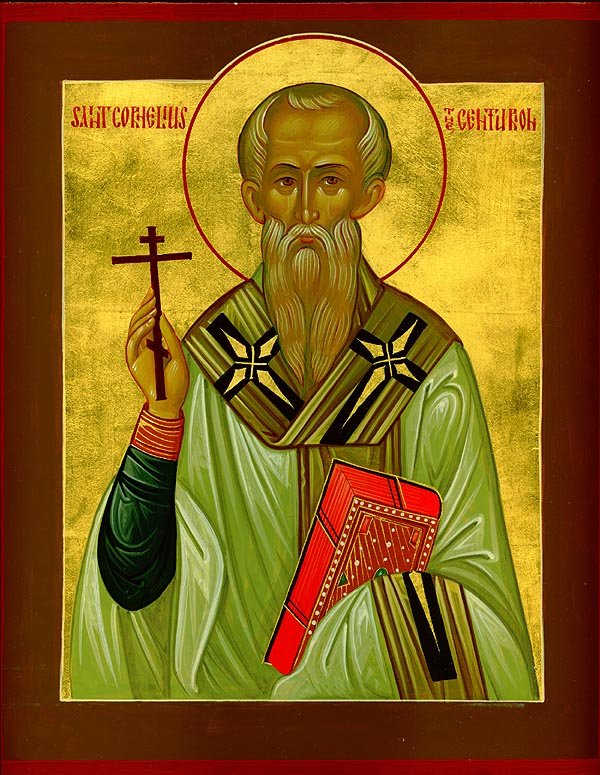
Holy Hieromartyr Cornelius the Centurion (1st c. )
Soon after the sufferings of the Lord Jesus Christ on the Cross and His Ascension into Heaven, a centurion by the name of Cornelius settled at Caesarea in Palestine. He had lived previously in Thracian Italy. Although he was a pagan, he distinguished himself by deep piety and good deeds, as the holy Evangelist Luke says (Acts 10:1).
Soon after the sufferings of the Lord Jesus Christ on the Cross and His Ascension into Heaven, a centurion by the name of Cornelius settled at Caesarea in Palestine. He had lived previously in Thracian Italy. Although he was a pagan, he distinguished himself by deep piety and good deeds, as the holy Evangelist Luke says (Acts 10:1). The Lord did not disdain his virtuous life, and so led him to the knowledge of truth and to faith in Christ.
Once, Cornelius was praying in his home. An angel of God appeared to him and said that his prayer had been heard and accepted by God. The angel commanded him to send people to Joppa to find Simon, also called Peter. Cornelius immediately fulfilled the command.
While those people were on their way to Joppa, the Apostle Peter was at prayer, and he had a vision: three times a great sheet was lowered down to him, filled with all kinds of beasts and fowl. He heard a voice from Heaven commanding him to eat everything. When the apostle refused to eat food which Jewish Law regarded as unclean, the voice said: “What God hath cleansed, you must not call common” (Acts 10:15).
Through this vision the Lord commanded the Apostle Peter to preach the Word of God to the pagans. When the Apostle Peter arrived at the house of Cornelius in the company of those sent to meet him, he was received with great joy and respect by the host together with his kinsmen and comrades.
Cornelius fell down at the feet of the apostle and requested to be taught the way of salvation. Saint Peter talked about the earthly life of Jesus Christ, and spoke of the miracles and signs worked by the Savior, and of His teachings about the Kingdom of Heaven. Then Saint Peter told him of the Lord’s death on the Cross, His Resurrection and Ascension into Heaven. By the grace of the Holy Spirit, Cornelius believed in Christ and was baptized with all his family. He was the first pagan to receive Baptism.
He retired from the world and went preaching the Gospel together with the Apostle Peter, who made him a bishop. When the Apostle Peter, together with his helpers Saints Timothy and Cornelius, was in the city of Ephesus, he learned of a particularly vigorous idol-worship in the city of Skepsis. Lots were drawn to see who would go there, and Saint Cornelius was chosen.
In the city lived a prince by the name of Demetrius, learned in the ancient Greek philosophy, hating Christianity and venerating the pagan gods, in particular Apollo and Zeus. Learning about the arrival of Saint Cornelius in the city, he immediately summoned him and asked him the reason for his coming. Saint Cornelius answered that he came to free him from the darkness of ignorance and lead him to knowledge of the True Light.
The prince, not comprehending the meaning of what was said, became angry and demanded that he answer each of his questions. When Saint Cornelius explained that he served the Lord and that the reason for his coming was to announce the Truth, the prince became enraged and demanded that Cornelius offer sacrifice to the idols.
The saint asked to be shown the gods. When he entered the pagan temple, Cornelius turned towards the east and uttered a prayer to the Lord. There was an earthquake, and the temple of Zeus and the idols situated in it were destroyed. All the populace, seeing what had happened, were terrified.
The prince was even more vexed and began to take counsel together with those approaching him, about how to destroy Cornelius. They bound the saint and took him to prison for the night. At this point, one of his servants informed the prince that his wife and child had perished beneath the rubble of the destroyed temple.
After a certain while, one of the pagan priests, by the name of Barbates, reported that he heard the voice of the wife and son somewhere in the ruins and that they were praising the God of the Christians. The pagan priest asked that the imprisoned one be released, in gratitude for the miracle worked by Saint Cornelius, and the wife and son of the prince remained alive.
The joyful prince hastened to the prison in the company of those about him, declaring that he believed in Christ and asking him to bring his wife and son out of the ruins of the temple. Saint Cornelius went to the destroyed temple, and through prayer the suffering were freed.
After this the prince Demetrius, and all his relatives and comrades accepted holy Baptism. Saint Cornelius lived for a long time in this city, converted all the pagan inhabitants to Christ, and made Eunomios a presbyter in service to the Lord. Saint Cornelius died in old age and was buried not far from the pagan temple he destroyed.
Troparion - Tone 4
O Blessed Cornelius, / you were distinguished in works of righteousness. / You received the enlightenment of godliness, / and were a fellow-laborer with the Apostles, / for you shared in their work, / preaching Christ’s incarnation to all. / With them pray that all who honor your memory may be saved!
Kontakion - Tone 4
O Divinely minded Cornelius, / the Church, receiving you as a blessed first-fruit of the Gentiles, / is enlightened by your holy life, / for you are a perfect seer of the Mysteries!
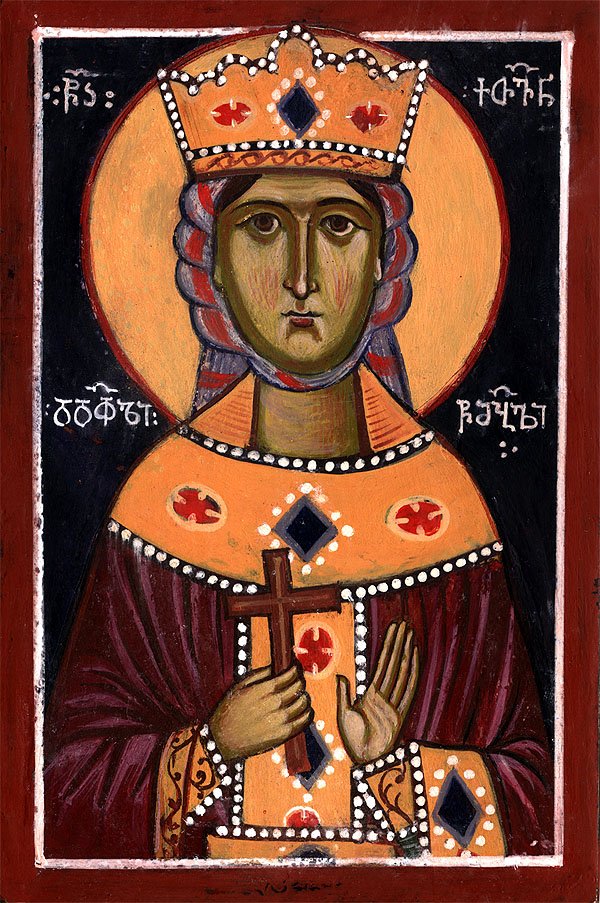
Holy Great Martyr Ketevan, Queen of Georgia (1624)
The holy Queen Ketevan was the daughter of Ashotan Mukhran-Batoni, a prominent ruler from the Bagrationi royal family. The clever and pious Ketevan was married to Prince David, heir to the throne of Kakheti. David’s father, King Alexander II (1574-1605), had two other sons, George and Constantine, but according to the law the throne belonged to David. C
The holy Queen Ketevan was the daughter of Ashotan Mukhran-Batoni, a prominent ruler from the Bagrationi royal family. The clever and pious Ketevan was married to Prince David, heir to the throne of Kakheti. David’s father, King Alexander II (1574-1605), had two other sons, George and Constantine, but according to the law the throne belonged to David. Constantine was converted to Islam and raised in the court of the Persian shah Abbas I.
Several years after David and Ketevan were married, King Alexander stepped down from the throne and was tonsured a monk at Alaverdi. But after four months, in the year 1602, the young king David died suddenly. He was survived by his wife, Ketevan, and two children—a son, Teimuraz, and a daughter, Elene—and his father ascended the throne once more.
Upon hearing of David’s death and Alexander’s return to the royal throne, Shah Abbas commanded Alexander’s youngest son, Constantine-Mirza, to travel to Kakheti, murder his father and the middle brother, George, and seize the throne of Kakheti. As instructed, Constantine-Mirza beheaded his father and brother, then sent their heads, like a precious gift, to Shah Abbas.
Their headless bodies he sent to Alaverdi. (Since the beginning of the 11th century, Alaverdi had been the resting place of the Kakhetian kings.) The widowed Queen Ketevan was left to bury her father-in-law and brother-in-law.
But Constantine-Mirza was still unsatisfied, and he proposed to take Queen Ketevan as his wife.
Outraged at his proposition, the nobles of Kakheti rose up and killed the young man who had committed patricide and profaned his Faith and the throne. Having buried the wicked Constantine-Mirza with the honor befitting his royal ancestry, Ketevan sent generous gifts to Shah Abbas and requested that he proclaim her son, Teimuraz, the rightful heir to the throne.
While she was awaiting his reply, Ketevan assumed personal responsibility for the rule of Kakheti. Concerned that, if he denied this request, Kakheti would forcibly separate from him and unite with Kartli, Shah Abbas hastily sent Prince Teimuraz to Georgia, laden with great wealth.
In 1614 Shah Abbas informed King Teimuraz that his son would be taken hostage, and Teimuraz was forced to send his young son Alexander and his mother Ketevan to Persia. As a final attempt to divide the royal family of Kakheti, Shah Abbas demanded that the eldest prince, Levan, be brought before him, and he finally summoned King Teimuraz himself.
The shah’s intentions were clear: to hold all of the royal family in Persia and send his own viceroys to rule in Kakheti. He sought to eliminate King Luarsab II of Kartli as well, but Teimuraz and Luarsab agreed to attack the Persian army with joint forces and drive the enemy out of Georgia.
Shah Abbas sent his hostages, Queen Ketevan and her grandsons, deep into Persia, while he himself launched an attack on Kakheti.
With fire and the sword the godless ruler plundered all of Georgia. The royal palace was razed, churches and monasteries were destroyed, and entire villages were abandoned. By order of the shah, more than three hundred thousand Georgians were exiled to Persia, and their homes were occupied by Turkic tribes from Central Asia. Hunger and violence reigned over Georgia.
The defeated Georgian kings Teimuraz and Luarsab sought refuge with King George III of Imereti.
After they had spent five years exiled in Shiraz (Persia), the princes Alexander and Levan were separated from Ketevan and castrated in Isfahan. Alexander could not endure the suffering and died, while Levan went mad.
Saint Ketevan, meanwhile, remained a prisoner of the ruler of southeastern Persia, the ethnic Georgian imam Quli-Khan Undiladze, who regarded the widowed Queen of Kakheti with great respect. According to his command, Ketevan was not to discover the fate of her grandsons.
Queen Ketevan spent ten years in prison, praying for her motherland and loved ones with all her might and adhering to a strict ascetic regime. Constant fasting, prayer and a stone bed exhausted her previously pampered body, but in spirit she was courageous and full of vitality. She looked after those assigned to her care and instructed them in the spiritual life.
After some time Abbas resolved to convert Ketevan to Islam, and he announced his intention to marry her. He asked that his proposal be conveyed to her the same day she was informed of the fate of her grandsons. As a condition of their marriage, Abbas insisted that Ketevan renounce the Christian Faith and convert to Islam. In the case of her acquiescence, Imam Quli-Khan was to respect and honor her as a queen, and in the case of her refusal, to subject her to public torture.
The alarmed imam begged the queen to submit to the shah’s will and save herself, but the queen firmly refused and began to prepare for her martyrdom. (According to one foreign observer, her steadfastness delayed the Islamization of the Georgians in Persia: “In the course of a conversation at the court of Shah Abbas, where a young and recently converted Georgian was present, the question arose as to why it was that, while all young Georgians were forced to embrace Islam, their mothers were not. The explanation given by one of those present was that since the Queen would not change her faith Georgian mothers likewise refused.” (Z. Avalishvili, “Teimuraz I and His Poem ‘The Martyrdom of Queen Ketevan,’” Georgica [vol I, no. 4/5, 1937] pp. 22.)
Queen Ketevan was robed in festive attire and led out to a crowded square. Her persecutors subjected her to indescribable torment: they placed a red-hot copper cauldron on her head, tore at her chest with heated tongs, pierced her body with glowing spears, tore off her fingernails, nailed a board to her spine, and finally split her forehead with a red-hot spade.
Saint Ketevan’s soul departed from her body, and the executioners cast her mutilated body to the beasts. But the Lord God sent a miracle: her holy relics were illumined with a radiant light.
A group of French Augustinian missionary fathers, who had witnessed the inhuman tortures, wrapped Queen Ketevan’s body in linens scented with myrrh and incense and buried it in a Catholic monastery.
Some time later the holy relics of Great-martyr Ketevan were delivered to her son, Teimuraz, King of Kakheti.
Teimuraz wept bitterly for his mother and sons and buried the relics with great honor in the Alaverdi Cathedral of Saint George.
Troparion - Tone 3
Your holy martyr Ketevan, O Lord, / through her sufferings has received an incorruptible crown from You, our God. / For having Your strength, she laid low her adversaries, / and shattered the powerless boldness of demons. / Through her intercessions, save our souls!
Kontakion - Tone 2
You appeared as a bright star announcing Christ with your radiance, / which is repulsive to this world, O Martyr Ketevan; / extinguishing the allure of false gods, / you enlighten the faithful, / always interceding for us all.
Scripture Readings
☩Epistle
2 Corinthians 8:7-15
7
Therefore, as ye abound in every thing, in faith, and utterance, and knowledge, and in all diligence, and in your love to us, see that ye abound in this grace also.
8
I speak not by commandment, but by occasion of the forwardness of others, and to prove the sincerity of your love.
9
For ye know the grace of our Lord Jesus Christ, that, though he was rich, yet for your sakes he became poor, that ye through his poverty might be rich.
10
And herein I give my advice: for this is expedient for you, who have begun before, not only to do, but also to be forward a year ago.
11
Now therefore perform the doing of it; that as there was a readiness to will, so there may be a performance also out of that which ye have.
12
For if there be first a willing mind, it is accepted according to that a man hath, and not according to that he hath not.
13
For I mean not that other men be eased, and ye burdened:
14
But by an equality, that now at this time your abundance may be a supply for their want, that their abundance also may be a supply for your want: that there may be equality:
15
As it is written, He that had gathered much had nothing over; and he that had gathered little had no lack.
☩Gospel
Mark 3:6-12
6
And the Pharisees went forth, and straightway took counsel with the Herodians against him, how they might destroy him.
7
But Jesus withdrew himself with his disciples to the sea: and a great multitude from Galilee followed him, and from Judea,
8
And from Jerusalem, and from Idumea, and from beyond Jordan; and they about Tyre and Sidon, a great multitude, when they had heard what great things he did, came unto him.
9
And he spake to his disciples, that a small ship should wait on him because of the multitude, lest they should throng him.
10
For he had healed many; insomuch that they pressed upon him for to touch him, as many as had plagues.
11
And unclean spirits, when they saw him, fell down before him, and cried, saying, Thou art the Son of God.
12
And he straitly charged them that they should not make him known.
Liturgical data sourced from OCA.org and orthocal.info