
Fasting Rules
 Meat
Abstain
 Fish
Abstain
 Dairy
Abstain
 Oil
Allowed
 Wine
Allowed
Saints & Commemorations
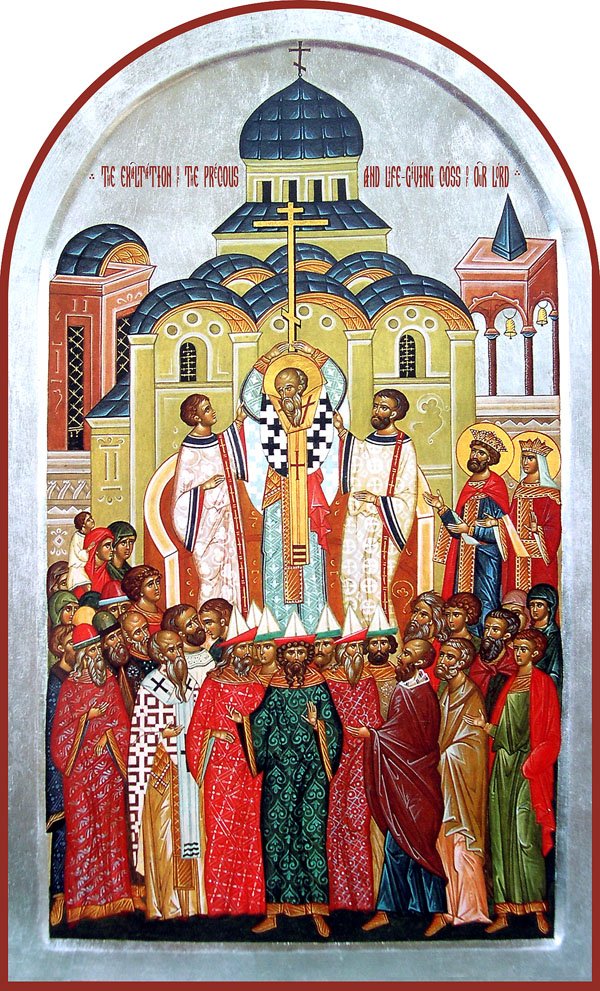
Exaltation (Elevation) of the Precious Cross
The pagan Roman Emperors tried to obliterate the holy places where our Lord Jesus Christ suffered and rose from the dead, so that they would be forgotten. Emperor Hadrian (117-138) ordered that Golgotha and the Lord's Sepulchre be buried, and that a temple in honor of the pagan "goddess" Venus and a statue of Jupiter be placed there.
The pagan Roman Emperors tried to obliterate the holy places where our Lord Jesus Christ suffered and rose from the dead, so that they would be forgotten. Emperor Hadrian (117-138) ordered that Golgotha and the Lord's Sepulchre be buried, and that a temple in honor of the pagan "goddess" Venus and a statue of Jupiter be placed there.
Pagans gathered at this place and offered sacrifice to idols. Eventually after 300 years, by Divine Providence, the Christian holy places, the Sepulchre of the Lord, and the Life-giving Cross, were discovered and opened for veneration. This took place under Emperor Constantine the Great (306-337) after his victory over Maxentius (in 312), who ruled the Western part of the Roman Empire, and over Licinius, the ruler of its Eastern part. In the year 323 Constantine became the sole ruler of the vast Roman Empire.
In 313 Saint Constantine issued the Edict of Milan, by which Christianity was legalized and persecutions against Christians in the Western half of the Empire were stopped. Although Licinius had signed the Edict of Milan in order to oblige Constantine, he continued his cruel persecutions against Christians. Only after his conclusive defeat did the Edict of Milan extend also to the Eastern part of the Empire. The Holy Equal of the Apostles Emperor Constantine, triumphing over his enemies in three wars, with God’s assistance, had seen the Sign of the Cross in the heavens. Written beneath were the words: “By this you shall conquer.”
Ardently desiring to find the Cross upon which our Lord Jesus Christ was crucified, Saint Constantine sent his mother, the pious Empress Helen (May 21), to Jerusalem, providing her with a letter to Saint Makarios, the Patriarch of Jerusalem. Saint Helen journeyed to the holy places connected with the earthly life of the Savior, building more than 80 churches, at Bethlehem the birthplace of Christ, and on the Mount of Olives where the Lord ascended to Heaven, and at Gethsemane where the Savior prayed before His sufferings, and where the Mother of God was buried after her Dormition.
Although the holy Empress Helen was no longer young, she set about completing the task with enthusiasm. In her search for the Life-giving Cross, she questioned both Christians and Jews, but for a long time her search remained unsuccessful. Finally, she was directed to a certain elderly Jew named Jude who stated that the Cross was buried beneath the temple of Venus. They demolished the pagan temple and, after praying, they began to excavate the ground. Soon the Lord's Tomb was uncovered. Not far from it were three crosses, and a board with the inscription ordered by Pilate, and four nails which had pierced the Lord’s Body (March 6).
In order to discover on which of the three crosses the Savior had been crucified, Patriarch Makarios alternately touched the crosses to a corpse. When the Cross of the Lord touched the dead man, he was restored to life. After witnessing the raising of the dead man, everyone was convinced that the Life-giving Cross had been found.
Christians came in a huge crowds to venerate the Holy Cross, beseeching Saint Makarios to lift the Cross, so that those far off could see it. Then the Patriarch and other spiritual leaders lifted the Holy Cross, and the people prostrated themselves before the Honorable Wood, saying “Lord have mercy." This solemn event occurred in the year 326.
During the discovery of the Life-giving Cross another miracle took place: a woman who was close to death was healed by the shadow of the Holy Cross. The elderly Jude (October 28) and other Jews believed in Christ and were baptized. Jude was given the name Kyriakos, and later he was consecrated as the Bishop of Jerusalem. He suffered a martyr’s death for Christ during the reign of Emperor Julian the Apostate (361-363).
Saint Helen took part of the Life-giving Wood and nails with her to Constantinople. Saint Constantine ordered a majestic and spacious church to built at Jerusalem in honor of the Resurrection of Christ, also including under its roof the Life-giving Tomb of the Lord and Golgotha. The church was built in ten years. Saint Helen did not survive until the dedication of the church, she reposed in the year 327. The church was consecrated on September 13, 335. On the following day, September 14, the festal celebration of the Exaltation of the Honorable and Life-giving Cross was established.
Another event connected to the Cross of the Lord is remembered also on this day: its return to Jerusalem from Persia after a fourteen year captivity. During the reign of the Byzantine Emperor Phokas (602-610) the Persian king Khozróēs II attacked Constantinople defeated the Greek army, plundered Jerusalem, capturing both the Life-giving Cross of the Lord and the Holy Patriarch Zachariah (609-633).
The Cross remained in Persia for fourteen years, and only under Emperor Herakleios (610-641), who defeated Khozróēs and concluded peace with his successor and son Syroes, was the Lord's Cross returned to the Christians.
With great solemnity the Life-giving Cross was transferred to Jerusalem. Emperor Herakleios, wearing a crown and his royal purple garments carried the Cross of Christ. The Emperor was accompanied by Patriarch Zachariah. At the gates by which they ascended Golgotha, the Emperor stopped suddenly and was unable to proceed. The holy Patriarch explained to the Emperor that an Angel of the Lord was blocking his way. Herakleios was told to remove his royal trappings and to walk barefoot, since He Who bore the Cross for the salvation of the world had made His way to Golgotha in all humility. Then Herakleios donned plain clothes, and without further hindrance, carried the Cross of Christ into the church.
In a sermon on the Exaltation of the Cross, Saint Andrew of Crete (July 4) says: “The Cross is exalted, and everything true is gathered together, the Cross is exalted, and the city makes solemn, and the people celebrate the feast."
Troparion - Tone 1
O Lord, save Your people, / and bless Your inheritance. / Grant victories to the Orthodox Christians / over their adversaries. / And by virtue of Your Cross, / preserve Your habitation.
Kontakion - Tone 4
As You were voluntarily raised upon the cross for our sake, / grant mercy to those who are called by Your Name, O Christ God; / make all Orthodox Christians glad by Your power, / granting them victories over their adversaries, / by bestowing on them the Invincible trophy, Your weapon of Peace.
St Placilla the Empress (385 or 386)
She was the wife of the Emperor Theodosius the Great, and the mother of two Emperors, Arcadius and Honorius. Despite her lofty station, she devoted herself to visiting the poor and to caring personally for the sick. She often worked in the kitchens of various hospices in Constantinople, taking on tasks unexpected of anyone of patrician rank, let alone the Empress herself.
She was the wife of the Emperor Theodosius the Great, and the mother of two Emperors, Arcadius and Honorius. Despite her lofty station, she devoted herself to visiting the poor and to caring personally for the sick. She often worked in the kitchens of various hospices in Constantinople, taking on tasks unexpected of anyone of patrician rank, let alone the Empress herself. To fulfil these missions, she often traveled unescorted through the poorest parts of the City. When others tried to caution or dissuade her, she answered that this was her way of giving thanks for all that God had given her. “Throughout her life, Saint Placilla served God in chastity, meekness, charity and prayer, and departed in peace to eternal life in 386 (or 385), having brought to those who encountered her a pledge of the Resurrection and of endless joy.” (Synaxarion)
Holy New Martyr Macarius of Thessalonica (1527)
“A disciple of Patriarch Niphon at the time that the latter was labouring in the asceticism of silence at Vatopedi, Macarius longed for martyrdom for the sake of Christ, and begged St Niphon’s blessing to seek it. The discerning Patriarch, perceiving that this was God’s will, blessed him for the way of martyrdom. Macar
“A disciple of Patriarch Niphon at the time that the latter was labouring in the asceticism of silence at Vatopedi, Macarius longed for martyrdom for the sake of Christ, and begged St Niphon’s blessing to seek it. The discerning Patriarch, perceiving that this was God’s will, blessed him for the way of martyrdom. Macarius went to Salonica and, in the midst of a crowd of Turks, began to speak of Christ as the one, true God. The Turks seized him and threw him into prison. When he was brought to trial, Macarius cried out to the Turks: ‘Oh, that you would come to know the truth and be baptised in the name of the Father, the Son and the Holy Spirit!’ The Turks beheaded him in 1527. At that moment, Niphon saw this in his spirit at Vatopedi, and told a monk of Macarius’s death by martyrdom, saying: ‘Know, my child, that your brother Macarius has today died a martyr, and is borne to heaven, triumphing and rejoicing in the Lord. May we be worthy of blessing by his prayers!’ (From the Athonite Patrology).” (Prologue)
Scripture Readings
☩Epistle
2 Corinthians 8:16-9:5
16
But thanks be to God, which put the same earnest care into the heart of Titus for you.
17
For indeed he accepted the exhortation; but being more forward, of his own accord he went unto you.
18
And we have sent with him the brother, whose praise is in the gospel throughout all the churches;
19
And not that only, but who was also chosen of the churches to travel with us with this grace, which is administered by us to the glory of the same Lord, and declaration of your ready mind:
20
Avoiding this, that no man should blame us in this abundance which is administered by us:
21
Providing for honest things, not only in the sight of the Lord, but also in the sight of men.
22
And we have sent with them our brother, whom we have oftentimes proved diligent in many things, but now much more diligent, upon the great confidence which I have in you.
23
Whether any do enquire of Titus, he is my partner and fellowhelper concerning you: or our brethren be enquired of, they are the messengers of the churches, and the glory of Christ.
24
Wherefore shew ye to them, and before the churches, the proof of your love, and of our boasting on your behalf.
1
For as touching the ministering to the saints, it is superfluous for me to write to you:
2
For I know the forwardness of your mind, for which I boast of you to them of Macedonia, that Achaia was ready a year ago; and your zeal hath provoked very many.
3
Yet have I sent the brethren, lest our boasting of you should be in vain in this behalf; that, as I said, ye may be ready:
4
Lest haply if they of Macedonia come with me, and find you unprepared, we (that we say not, ye) should be ashamed in this same confident boasting.
5
Therefore I thought it necessary to exhort the brethren, that they would go before unto you, and make up beforehand your bounty, whereof ye had notice before, that the same might be ready, as a matter of bounty, and not as of covetousness.
☩Gospel
Mark 3:13-19
13
And he goeth up into a mountain, and calleth unto him whom he would: and they came unto him.
14
And he ordained twelve, that they should be with him, and that he might send them forth to preach,
15
And to have power to heal sicknesses, and to cast out devils:
16
And Simon he surnamed Peter;
17
And James the son of Zebedee, and John the brother of James; and he surnamed them Boanerges, which is, The sons of thunder:
18
And Andrew, and Philip, and Bartholomew, and Matthew, and Thomas, and James the son of Alpheus, and Thaddeus, and Simon the Canaanite,
19
And Judas Iscariot, which also betrayed him: and they went into an house.
Liturgical data sourced from OCA.org and orthocal.info