
Fasting Rules
 Meat
Allowed
 Fish
Allowed
 Dairy
Allowed
 Oil
Allowed
 Wine
Allowed
Saints & Commemorations
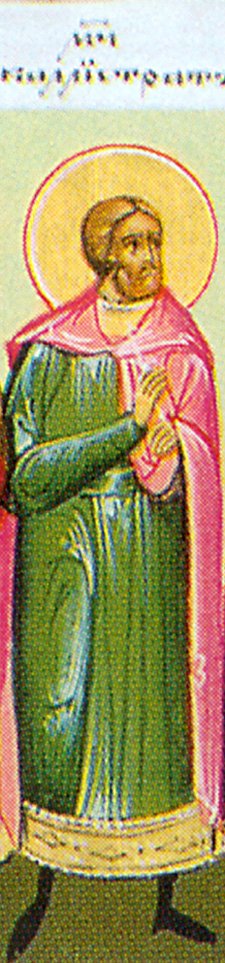
Martyr Callistratus and Companions
Saint Callistratus was a native of Carthage. An ancestor of Saint Callistratus, Neochorus, had served under the emperor Tiberius in Palestine, under the command of Pontius Pilate, the procurator of Judea, and was a witness to the suffering on the Cross of our Lord Jesus Christ, His voluntary death and glorious Resurrection.
Saint Callistratus was a native of Carthage. An ancestor of Saint Callistratus, Neochorus, had served under the emperor Tiberius in Palestine, under the command of Pontius Pilate, the procurator of Judea, and was a witness to the suffering on the Cross of our Lord Jesus Christ, His voluntary death and glorious Resurrection.
The saint’s father was a Christian, and he raised his son in faith and piety. Also like his father, Saint Callistratus became a soldier and excelled among his pagan military comrades by his good conduct and gentle disposition.
At night when everyone slept, he usually stayed up at prayer. Once, a soldier sleeping nearby heard Saint Callistratus invoking the Name of the Lord Jesus Christ, and he reported this to the military commander, who in turn summoned Callistratus, interrogated him and wanted to make him offer sacrifice to idols. The saint resolutely refused to do this, so the military commander ordered that the saint be beaten. Then, covered with wounds, the saint was dragged over sharp stones. The beating and the torments did not sway the firm will and brave endurance of the sufferer.
The saint was sewn up in a leather sack and drowned in the sea. By God’s mercy, however, the sack struck a sharp rock and was torn open. Saint Callistratus came to dry land unharmed, carried by dolphins. Viewing such a miracle, forty-nine soldiers came to believe in Christ. Then the military commander threw Saint Callistratus and the believing soldiers into prison. Before this, all of them were subjected to innumerable floggings.
In jail Saint Callistatus continued to preach the Word of God to the soldiers and he bolstered their spirits for martyrdom. Summoned again before the military commander, the sufferers firmly confessed their faith in Christ, after which they were bound hand and foot and thrown into the depths of a great lake behind a dam. But there their bonds broke, and with bright faces the holy martyrs stood in the water, rejoicing in their Baptism, which coincided with the act of martyrdom.
Beautiful bright crowns appeared over their heads, and all heard a voice: “Be brave, Callistratus, with your company, and come rest in the eternal habitations.” At the same time, the earth shuddered and an idol standing nearby fell down and smashed. Seeing this, another 135 soldiers also believed in the Lord Jesus Christ. The military commander, fearing a mutiny in the army, did not put them on trial, but again imprisoned Saint Callistratus with his 49 companions, where they fervently prayed and gave thanks to the Creator for giving them power to endure such sufferings.
At night the martyrs were cut to pieces with swords by order of the military commander. Their holy relics were buried by the 135 soldiers who remained alive. Later, a church was built on the spot of their sufferings, as Saint Callistatus had foretold.
Troparion - Tone 3
In contest you were strengthened by the Holy Spirit, Martyr Callistratus, / and were glorious in casting down the Enemy. / You offered a noble army of athletes / as sweet-smelling incense to Christ. / With them pray for us who praise you with hymns.
Kontakion - Tone 4
Like stars you have shone upon the world / shedding the light of your contests and miracles upon all who cry to you: / “Rejoice, Martyr Callistratus and fellow company of martyrs.”
Ven. Sabbatius of Solovetsk
He lived for many years as a monk at the Monastery of St Cyril of White Lake, where his ascetic struggles won him the respect of his brethren. To flee from the admiration of men he moved further north to Valaam Monastery. But he still attracted the good opinion of his community, so he secretly headed still further north, planning to reach the uninhabited Solovki Island in the White Sea (a large bay of the Arctic Ocean).
He lived for many years as a monk at the Monastery of St Cyril of White Lake, where his ascetic struggles won him the respect of his brethren. To flee from the admiration of men he moved further north to Valaam Monastery. But he still attracted the good opinion of his community, so he secretly headed still further north, planning to reach the uninhabited Solovki Island in the White Sea (a large bay of the Arctic Ocean). When he reached the coast, everyone who might take him tried to dissuade him from living in such a harsh place. He answered ‘My children, I have a Master who has the power to renew the strength of the old and to enfeeble the young if He so wills. He makes the poor rich, clothes the naked, provides for the destitute and satisfies the starving with a measure of food as he fed five thousand men in the desert.’
While waiting for seasonable sailing weather he met St Germanus (July 30) who lived nearby as a hermit. Together they found a fishing boat and, casting all their trust on the Lord, made the dangerous two-day voyage and set up a hermitage on the island. It became known as a holy place, and thenceforth those living in the world knew not to settle on Solovki, or even to set foot there without good reason. After six years, St Germanus departed, and Sabbatius was left alone.
When he was old, he began to fear that he would die without receiving the life-giving Mysteries, of which he had not partaken since he left Valaam. So he returned to the mainland where he met an abbot Nathanael just as he was taking Holy Communion to a sick man. Sabbatius persuaded the abbot to hear his confession and grant him the priceless gift of Holy Communion. He then settled in a nearby chapel and made ready for his departure from this life. A wealthy merchant from Novgorod visited him to ask for his blessing. The Saint said to him, ‘Spend the night here and you will see the grace of God.’ The next morning the merchant came to Sabbatius’ cell and found that he had reposed during the night; his cell was suffused with a beautiful scent.
The following year, St Germanus, along with St Zosimas (April 17), returned to Solovki island and founded a monastery there, which proved to be the nurturing ground of many Saints.
Holy Apostles Mark, Aristarchus and Zenas of the Seventy
St Mark was also called John; according to Acts 12:12, the apostles gathered for prayer in Jerusalem at his mother Mary’s house, and was later bishop in Byblos. St Aristarchus accompanied St Paul in his travels (Acts 16:29) and was later bishop in Syrian Apamea. St Zenas is mentioned as a lawyer in Titus 3:13, and was bishop in Lydda in Palestine.
Holy New Martyr Aquilina (1764)
Saint Aquilina (Akylina), the virgin martyr of Christ, was the daughter of pious parents who lived in the village of Zagliberi, Thessalonica in the diocese of Saint Ardamerios.
One day her father quarreled with a Turkish neighbor (for Turks and Christians lived together in that village), and struck the Turk, killing him.
Saint Aquilina (Akylina), the virgin martyr of Christ, was the daughter of pious parents who lived in the village of Zagliberi, Thessalonica in the diocese of Saint Ardamerios.
One day her father quarreled with a Turkish neighbor (for Turks and Christians lived together in that village), and struck the Turk, killing him. The authorities seized him and brought him to the pasha of Thessalonica to be executed for his crime. Fearing death, the unfortunate man converted to Islam in order to save his life. Saint Aquilina was still a babe at her mother’s breast when this happened. The saint’s mother remained a Christian, and she encouraged her daughter to adhere to the Christian Faith, and not to deny Christ.
After some time had passed, the Turks pressured Aquilina’s father to make her become a Moslem, too. He said, “Do not worry about my daughter, I’ll see to her. I will force her to convert to Islam in due course.”
When Saint Aquilina was eighteen, the Turks urged her father to make his daughter convert to their faith. He said to her, “The other Turks tell me that you must become a Moslem sooner or later. Do it one day sooner so that they will stop bothering me. “
She replied with great courage, “I will never deny the Lord Jesus Christ, Who died on the Cross for our sake. I am prepared to endure tortures, and even death, for love of my Christ.”
Seeing that she would not change her mind, her father went to the Turks and said, “I am not able to persuade my daughter to become a Moslem, so you may do as you wish with her.”
Hearing this, the Turks became angry, and sent servants to arrest the girl. When the saint’s mother saw them seize her daughter, she encouraged her to remain firm in confessing Christ, and to be brave in the face of the torments she was about to endure.
Aquilina replied, “That is my intention, Mother. May God help me. Pray for me.”
Then they said farewell with many tears and laments. Servants tied Aquilina with ropes and brought her to the judge. Her mother followed them, but the servants shut the door in her face and left her standing in the courtyard. Saint Aquilina was taken inside to appear before the judge, and her mother returned home to await the outcome.
The judge asked her, “Will you become a Moslem, you fool?”
She replied, “No, I will never deny my Faith or my Master Christ.”
Hearing these things, the judge became angry and ordered the saint to be stripped of her clothes, leaving her in her chemise. Then he ordered them to tie her to a pillar and to beat her with sticks, and it was done. Two servants beat her for a long time, but Saint Aquilina endured her sufferings with great courage.
Then once again the saint was brought before the judge and the other Turks. They began to flatter her, promising her many things. They even offered her gifts, if only she would deny her Christian Faith, but she regarded earthly riches as worthless. A prominent man among them, having more boldness than the others, said to her, “Become a Moslem, Aquilina, and I will marry you to my son.”
The martyr of Christ replied, “May the devil take you and your son.”
When the Turks heard this, they were enraged and tied the saint up as before, beating her for a long time. Then she was untied and questioned for a third time.
Since Aquilina had received so many lashes, her chemise was torn to shreds, and it no longer covered her. The judge said, “You fool! Aren’t you ashamed to appear naked before so many people? Become a Moslem, or I’ll break your bones one by one.”
The holy virgin replied, “What could I possibly want with your faith? Why should I deny Christ?”
The Turks were furious, and this time they beat the saint so mercilessly that they left her for dead. The earth was saturated with her blood, and pieces of her flesh fell to the ground. Finally, they untied her and gave her to a certain Christian who happened to be at that place, and he brought her to her mother’s house.
When her mother saw that her daughter was almost dead, she embraced her and asked, “What have you done, my child?”
The martyr opened her eyes with difficulty and said, “Behold, I have preserved the confession of my Faith, just as we agreed.”
While she was speaking to her mother, Saint Aquilina gave her pure soul into God’s hands and received the imperishable crown of martyrdom on September 27, 1764.
On the way to the cemetery, Saint Aquilina’s holy relics gave forth a wondrous fragrance which filled the entire road. That night a heavenly light shone upon her tomb like a brilliant star, and the Christians who witnessed this glorified God.
Troparion - Tone 5
Let us praise the devout Aquilina, / who was seen as a godly-minded girl and a champion of Christ, / who courageously maintained her faith out of love for Him / , and overcoming the Enemy by her holy struggles, she obtained divine glory. / Now she intercedes with Christ the Word to have mercy on our souls.
Scripture Readings
☩Epistle
Galatians 2:11-16
11
But when Peter was come to Antioch, I withstood him to the face, because he was to be blamed.
12
For before that certain came from James, he did eat with the Gentiles: but when they were come, he withdrew and separated himself, fearing them which were of the circumcision.
13
And the other Jews dissembled likewise with him; insomuch that Barnabas also was carried away with their dissimulation.
14
But when I saw that they walked not uprightly according to the truth of the gospel, I said unto Peter before them all, If thou, being a Jew, livest after the manner of Gentiles, and not as do the Jews, why compellest thou the Gentiles to live as do the Jews?
15
We who are Jews by nature, and not sinners of the Gentiles,
16
Knowing that a man is not justified by the works of the law, but by the faith of Jesus Christ, even we have believed in Jesus Christ, that we might be justified by the faith of Christ, and not by the works of the law: for by the works of the law shall no flesh be justified.
☩Gospel
Luke 4:37-44
37
And the fame of him went out into every place of the country round about.
38
And he arose out of the synagogue, and entered into Simon’s house. And Simon’s wife’s mother was taken with a great fever; and they besought him for her.
39
And he stood over her, and rebuked the fever; and it left her: and immediately she arose and ministered unto them.
40
Now when the sun was setting, all they that had any sick with divers diseases brought them unto him; and he laid his hands on every one of them, and healed them.
41
And devils also came out of many, crying out, and saying, Thou art Christ the Son of God. And he rebuking them suffered them not to speak: for they knew that he was Christ.
42
And when it was day, he departed and went into a desert place: and the people sought him, and came unto him, and stayed him, that he should not depart from them.
43
And he said unto them, I must preach the kingdom of God to other cities also: for therefore am I sent.
44
And he preached in the synagogues of Galilee.
Liturgical data sourced from OCA.org and orthocal.info