
Fasting Rules
 Meat
Allowed
 Fish
Allowed
 Dairy
Allowed
 Oil
Allowed
 Wine
Allowed
Saints & Commemorations
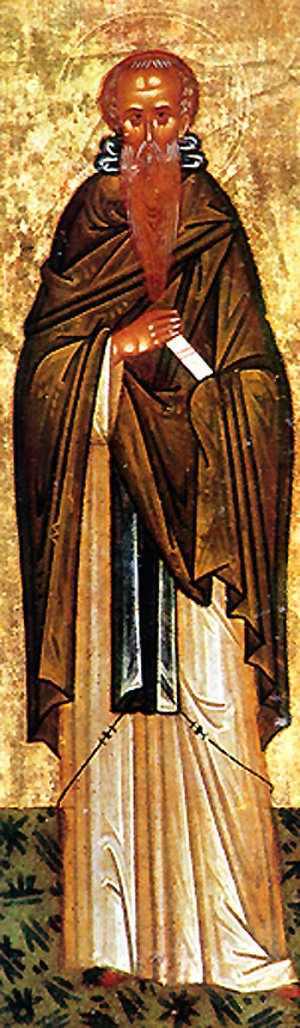
Ven. Chariton the Confessor
Saint Chariton the Confessor was born at Iconium in the province of Lycaonia, and suffered there during a persecution against Christians in the reign of Emperor Aurelian (270-275). The example of the holy Protomartyr Thekla ( September 24 ), who was also a native of his city, encouraged him to confess Christ, since he had a great devotion to her.
Saint Chariton the Confessor was born at Iconium in the province of Lycaonia, and suffered there during a persecution against Christians in the reign of Emperor Aurelian (270-275). The example of the holy Protomartyr Thekla ( September 24 ), who was also a native of his city, encouraged him to confess Christ, since he had a great devotion to her.
Saint Chariton bravely denounced the pagan gods and staunchly confessed faith in the one True God, Christ the Savior. The holy Confessor underwent fierce tortures but, by God's Providence, he survived. The persecution ended after Aurelian's death in 275. Saint Chariton was among the many Christians who were released from prison, and he resolved to dedicate his entire life to the service of the Lord. Although he escaped death, he grieved because he had not received the crown of martyrdom.
After arriving at Jerusalem on a pilgrimage to the holy places, he fell into the hands of thieves. They tied him up and threw him in a cave, intending to kill him later. After they left to find people to rob, the saint prayed fervently to God expecting to be put to death. He did not ask God to deliver him, but instead he entreated Him to do with him as He wished.
At this time a snake crawled into the cave and began to drink wine from a vessel setting there. Later it vomited forth its deadly venom, poisoning the wine. When they returned to the cave, the evil men drank the poisoned wine and they all perished. Thus, their wicked lives came to a fitting end. Saint Chariton gave thanks to God, and then he gave away the gold which the malefactors had stolen, distributing it to the poor, to churches, and to monasteries. He began his ascetic struggles in the place of his miraculous rescue, and there he built a church. In time a monastery was established: the renowned Pharan Lavra in Palestine. Saint Chariton's fame drew many disciples to him. He governed them with paternal affection, and he elevated them to the highest degrees of virtue.
Saint Chariton compiled a strict Rule for his monastery. Yearning for solitude, the monk withdrew farther into the desert in order to avoid the praise of men, but he never rejected anyone who sought his spiritual guidance. He founded two more monasteries: the Jericho (called the Monastery of Saint Chariton) and the Souka, which was called “the old Lavra.” He also brought many Jews and pagans to the Faith.
At the end of his life, Saint Chariton struggled in a cave atop a hill near the Souka monastery, but he did not cease to provide guidance for all three of the monasteries which he founded. He fell asleep in the Lord peacefully and at an advanced age on September 28, 350.
According to Tradition, Saint Chariton compiled the Office of the Monastic Tonsure. Saint Chariton was buried at the Pharan monastery, in accordance with his last wishes. His grace-filled relics were enshrined in the church that had been built on the site of the robbers' cave.
Troparion - Tone 8
By a flood of tears you made the desert fertile, / and your longing for God brought forth fruits in abundance. / By the radiance of miracles you illumined the whole universe! / Our Father Chariton, pray to Christ God to save our souls!
Kontakion - Tone 2
You delighted in the monastic life, divinely-wise one / and conquered the bodily passions; / you increased in faith, blossoming as the tree of life in the midst of Paradise, / most blessed and holy Chariton!
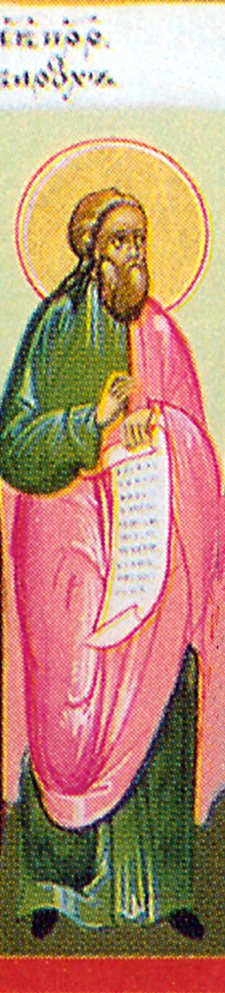
Holy Prophet Baruch (6th c. BC)
The Holy Prophet Baruch (his name means "blessed"), that courageous lover of truth, lived in the VII century B.C. He was the son of Nerias and the devoted follower and divinely-inspired secretary of the Prophet Jeremiah (May 1).
When Jeremiah was imprisoned, Baruch wrote down the prophecies which he dictated (Jeremiah 36:4), ordering him to read them to the people.
The Holy Prophet Baruch (his name means "blessed"), that courageous lover of truth, lived in the VII century B.C. He was the son of Nerias and the devoted follower and divinely-inspired secretary of the Prophet Jeremiah (May 1).
When Jeremiah was imprisoned, Baruch wrote down the prophecies which he dictated (Jeremiah 36:4), ordering him to read them to the people. When King Joachim was informed of this, instead of benefitting from the Prophet's admonitions, he threw the scroll into the fire. Baruch was also imprisoned because the Jews hated him for loving truth, and for his courageous language. When the Jews fled to Egypt in fear, because of their stand against the king of Babylon, Baruch accompanied Jeremiah. Rabbinic tradition suggests that Baruch returned to Babylon after he witnessed Jeremiah's death by stoning and buried his body.
In his prophetic book, Baruch clearly foresaw the Incarnation of the Lord Jesus Christ. The section from 3:9 to 4:4 is a beautiful description of the Divine Wisdom "Who showed Himself upon earth and conversed with men."
Here is what he said: "This is our God, and no other shall be compared to Him. He has found out all the way of knowledge, and has given it unto Jacob His servant, and unto Israel His beloved. Afterward He showed Himself upon earth, and conversed with men" (Baruch 3:36-38).
These words are read on the eve of the Nativity of Christ at the Third Hour, and are ascribed to the Prophet Jeremiah.
Saint John Chrysostom says, in the sixth of his Baptismal Instructions , "Here the Prophet is speaking about the Son. Of Whom does the Prophet speak? He does not say this about the Father, does He? Of course not." Saint John goes on to explain that Baruch was the first to say that God would become Man, yet remain as God. Christ is not only the Law-giver of the Old Testament, but also the Divine Wisdom, Word, and Power of God.
The Prophet Baruch is quoted or paraphrased several times in the Divine Services of the Church. On Palm Sunday we sing: "This is our God, and there is no other like Him.... He has shown Himself upon earth and lived among men. Blessed is He Who comes in the name of the Lord our Savior" (Canon at Matins Tone 4, Ode 9).
On the Great Feast of Theophany we hear: "The Godhead has appeared in the flesh to the dwellers upon earth" (Matins of the Forefeast, Aposticha Tone 2).
On the Feast of the Lord's Transfiguration we sing this hymn to the Most Holy Theotokos: "Your giving birth was undefiled; God came forth from your womb, and He appeared upon earth wearing flesh and made His dwelling among men; therefore, we all magnify you, O Theotokos" (Canon at Matins Tone 4, Ode 9).
Again, on the Transfiguration, we extol the All-Holy Virgin: "Every ear trembled with fear at hearing of the ineffable condescension of God: how the Most High of His own will came down even unto the flesh, and was made Man from a virginal womb. Therefore, we faithful magnify the undefiled Theotokos" (Second Canon at Matins Ode 8, Irmos).
The Prophet Baruch also prophesied the return of the Jews from the Babylonian Captivity, and Babylon's desolation. He is depicted in iconography as an old man with a rounded beard.
The Book traditionally ascribed to Baruch is regarded by Protestants as non-canonical, but is accepted by the Orthodox Church, and also by Roman Catholics.
Troparion - Tone 8
You were worthy of the light of prophecy / becoming a companion to Jeremiah. / You foretold the self-emptying of God the Word / which he wrought for the salvation of the world. / Now all heirs of his kingdom honor you, O holy Prophet Baruch!
Kontakion - Tone 4
Enlightened by the Spirit, your pure heart became the dwelling place of most splendid prophecy; / for you saw things far off as if they were near. / Therefore, we honor you, blessed and glorious Prophet Baruch.
Holy Martyr Vatslav (Wenceslas), King of the Czechs (929)
“The grandson of St Ludmilla, he lived as king in spiritual striving in the Faith like the great ascetics, and strengthened the Orthodox faith among his people. He took care when sitting in judgement that no innocent man should suffer. In his zeal for the Christian faith and his love for his neighbour, holy Vatslav bought pagan children who had been sold as slaves and immediately baptised them, bringing them up as Christians. H
“The grandson of St Ludmilla, he lived as king in spiritual striving in the Faith like the great ascetics, and strengthened the Orthodox faith among his people. He took care when sitting in judgement that no innocent man should suffer. In his zeal for the Christian faith and his love for his neighbour, holy Vatslav bought pagan children who had been sold as slaves and immediately baptised them, bringing them up as Christians. He translated St John’s Gospel into Czech and brought the relics of St Vitus and his grandmother, Ludmilla, to Prague. His brother Boleslav invited him to stay and killed him at his court. Immediately after this, Boleslav began to make German priests and to have the Liturgy celebrated in Latin. Holy Vatslav suffered in 929. His relics are preserved in Prague.” (Prologue) This is the “Good King Wenceslaus” of the popular Christmas carol.
Scripture Readings
☩Epistle
Galatians 2:21-3:7
21
I do not frustrate the grace of God: for if righteousness come by the law, then Christ is dead in vain.
1
O foolish Galatians, who hath bewitched you, that ye should not obey the truth, before whose eyes Jesus Christ hath been evidently set forth, crucified among you?
2
This only would I learn of you, Received ye the Spirit by the works of the law, or by the hearing of faith?
3
Are ye so foolish? having begun in the Spirit, are ye now made perfect by the flesh?
4
Have ye suffered so many things in vain? if it be yet in vain.
5
He therefore that ministereth to you the Spirit, and worketh miracles among you, doeth he it by the works of the law, or by the hearing of faith?
6
Even as Abraham believed God, and it was accounted to him for righteousness.
7
Know ye therefore that they which are of faith, the same are the children of Abraham.
☩Gospel
Luke 5:12-16
12
And it came to pass, when he was in a certain city, behold a man full of leprosy: who seeing Jesus fell on his face, and besought him, saying, Lord, if thou wilt, thou canst make me clean.
13
And he put forth his hand, and touched him, saying, I will: be thou clean. And immediately the leprosy departed from him.
14
And he charged him to tell no man: but go, and shew thyself to the priest, and offer for thy cleansing, according as Moses commanded, for a testimony unto them.
15
But so much the more went there a fame abroad of him: and great multitudes came together to hear, and to be healed by him of their infirmities.
16
And he withdrew himself into the wilderness, and prayed.
Liturgical data sourced from OCA.org and orthocal.info